18  NB-IoT vs LTE-M Comparison

In 60 Seconds

NB-IoT and LTE-M are two cellular IoT technologies optimized for different use cases: NB-IoT excels for stationary devices needing extreme battery life and deep indoor coverage (164 dB MCL), while LTE-M supports mobility with handover, higher throughput, and voice capability. The simple rule “Static = NB-IoT, Mobile = LTE-M” correctly guides 80% of technology selections.

Key Concepts
  • NB-IoT vs LTE-M Data Rate: NB-IoT peak ~250 kbps DL / 250 kbps UL; LTE-M peak 1 Mbps DL / 1 Mbps UL; both provide much lower practical throughput than theoretical peaks
  • NB-IoT vs LTE-M Mobility: NB-IoT is optimized for stationary devices (no handover); LTE-M supports mobility and seamless handover between cells (Class B and Class C mobility)
  • NB-IoT vs LTE-M Duplex: NB-IoT uses Half-Duplex FDD (device cannot transmit and receive simultaneously); LTE-M supports Full-Duplex FDD (simultaneous TX/RX)
  • NB-IoT vs LTE-M VoLTE: LTE-M supports VoLTE (voice calls) for applications like emergency buttons and wearables; NB-IoT does not support voice
  • NB-IoT vs LTE-M Coverage: Both achieve 164 dB MCL; NB-IoT achieves this with up to 2048 repetitions; LTE-M achieves 164 dB with CE Mode B using up to 32 repetitions
  • NB-IoT vs LTE-M Power: NB-IoT PSM sleep: ~1.5 µA; LTE-M PSM sleep: ~3 µA; both support eDRX; NB-IoT slightly better for ultra-low-power stationary sensors
  • NB-IoT vs LTE-M Deployment: NB-IoT can deploy In-Band (within LTE carrier), Guard-Band (in LTE guard bands), or Standalone (on dedicated spectrum); LTE-M deploys within LTE carriers only
  • Selecting NB-IoT vs LTE-M: NB-IoT for: stationary sensors, <1 KB/day data, ultra-low cost targets; LTE-M for: mobile assets, firmware updates, voice, >1 KB/day data
MVU: Minimum Viable Understanding

Core concept: NB-IoT and LTE-M are two cellular IoT technologies optimized for different use cases - NB-IoT for stationary devices needing extreme battery life and deep coverage; LTE-M for mobile devices requiring real-time response and voice support.

Why it matters: Choosing the wrong technology can result in failed deployments - NB-IoT devices cannot track moving vehicles (no handover), and LTE-M devices may not reach basement meters (8 dB less coverage than NB-IoT).

Key takeaway: Remember “Static = NB-IoT, Mobile = LTE-M” - this single decision criterion correctly guides 80% of technology selections.

18.1 Learning Objectives

By the end of this chapter, you should be able to:

  • Compare NB-IoT and LTE-M technical specifications across bandwidth, data rate, latency, mobility, and coverage
  • Justify the trade-offs between NB-IoT and LTE-M for a given deployment scenario
  • Select the appropriate cellular IoT technology for specific application requirements using a structured decision framework
  • Evaluate when dual-mode modules provide cost-effective flexibility over single-technology deployments
  • Differentiate Coverage Enhancement modes (NB-IoT CE0/CE1/CE2 vs LTE-M Mode A/B) and their impact on battery life

NB-IoT and LTE-M are two cellular IoT technologies with different strengths. NB-IoT excels at stationary devices that send tiny, infrequent messages (like water meters). LTE-M supports mobile devices that need higher data rates and voice (like pet trackers). This comparison helps you choose the right one for your project.

18.2 Prerequisites

Before diving into this chapter, you should be familiar with:

Sammy the Temperature Sensor and Lila the Light Sensor need to talk to the internet - but they have very different jobs!

18.2.1 The Two Magic Cell Phone Networks

Imagine there are two special cell phone networks just for tiny sensors like the Sensor Squad!

NB-IoT (Narrow-Band IoT) is like a super-patient postal service:

  • It’s GREAT for sensors that stay in one place (like a water meter in your basement)
  • It can send messages even from deep underground - like having a really loud voice!
  • It uses very little battery - Sammy could run for 10 YEARS on one tiny battery!
  • But it’s SLOW - like sending a postcard instead of a text message

LTE-M is like a speedy messenger on a bicycle:

  • It’s GREAT for things that move around (like a GPS tracker on your pet!)
  • It can make phone calls too - perfect for emergency buttons
  • It sends messages much faster - like sending a quick text
  • But it needs more battery power to keep up with all that moving

18.2.2 The Sensor Squad Story

Sammy the Temperature Sensor got a job watching the temperature in a basement. He chose NB-IoT because:

  • He never moves (basements don’t go anywhere!)
  • He only needs to report once an hour
  • The signal can reach him even through thick concrete
  • His battery lasts for years and years!

Meanwhile, Max the Motion Detector got a job tracking delivery trucks! He chose LTE-M because:

  • The trucks move FAST on highways
  • He needs to report location every few seconds
  • The drivers can press an emergency button that talks!

Remember: If it STAYS put, use NB-IoT. If it MOVES around, use LTE-M!

18.3 NB-IoT vs LTE-M: The Core Differences

Key Takeaway

In one sentence: NB-IoT optimizes for stationary devices needing extreme battery life and deep coverage; LTE-M enables mobile applications with real-time response and voice support.

Remember this: NB-IoT = static sensors (meters, parking); LTE-M = moving things (trackers, wearables).

⏱️ ~15 min | ⭐⭐ Intermediate | 📋 P09.C18.U02

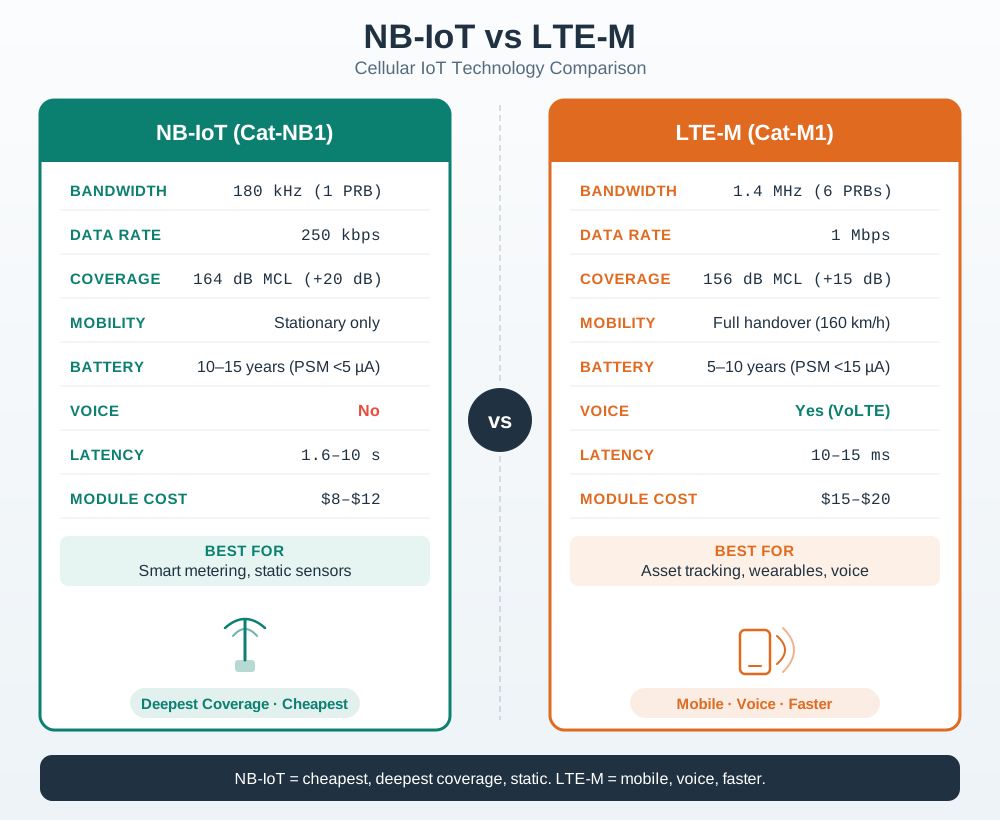
Flowchart comparing NB-IoT (orange) and LTE-M (teal) cellular IoT technologies. NB-IoT features: 180 kHz bandwidth using single LTE PRB, 250 kbps maximum data rate, no handover support (stationary devices only), 164 dB Maximum Coupling Loss for deep indoor coverage, and 10+ year battery life with PSM power saving mode. LTE-M features: 1.4 MHz bandwidth using 6 LTE PRBs, 1 Mbps maximum data rate, full mobility support with handover up to 160 km/h, 156 dB MCL, and VoLTE voice calling support. Decision node (navy) shows selection criteria: choose NB-IoT for static sensors needing deep coverage and ultra-low power; choose LTE-M for mobile tracking, voice applications, and real-time response requirements.

NB-IoT vs LTE-M Technology Comparison and Selection Guide
Figure 18.1

18.3.1 Detailed Technical Comparison

Feature NB-IoT (Cat-NB1) LTE-M (Cat-M1)
3GPP Release Release 13 (2016) Release 13 (2016)
Bandwidth 180 kHz (1 PRB) 1.4 MHz (6 PRBs)
Peak Data Rate DL 250 kbps 1 Mbps
Peak Data Rate UL 250 kbps 1 Mbps
Latency 1.6 - 10 seconds 10 - 15 ms
Mobility No (stationary) Yes (up to 160 km/h)
Handover Not supported Fully supported
Voice (VoLTE) No Yes
MCL (Coverage) 164 dB 156 dB
Power (Tx @ 23 dBm) 200 mA 350 mA
PSM Sleep Current 3-5 µA 5-10 µA
Battery Life 10+ years 5-10 years
Duplex Mode Half-duplex Half/Full-duplex
Module Cost (2024) $5-12 $8-18
Typical Data Plan $1-5/month $3-10/month
Critical Selection Criteria

Choose NB-IoT when:

  • Devices are stationary (meters, parking sensors, environmental monitors)
  • 10+ year battery life is required
  • Deep indoor coverage needed (basements, concrete structures)
  • Low data volume (<100 KB/month)
  • Cost-sensitivity is paramount ($5-12 module cost)

Choose LTE-M when:

  • Devices move (vehicles, wearables, pets)
  • Voice capability needed (emergency buttons, intercoms)
  • Real-time response required (<100 ms latency)
  • Higher data throughput needed (>250 kbps)
  • Full duplex communication required

The 8 dB coverage difference (164 dB vs 156 dB MCL) translates to real-world indoor penetration. Using the path loss equation:

\[\text{Path Loss} = 20\log_{10}(d) + 20\log_{10}(f) + 20\log_{10}\left(\frac{4\pi}{c}\right) + n \times W\]

where \(n\) walls at \(W = 15\) dB each. NB-IoT’s extra 8 dB allows penetration of \(\frac{8}{15} \approx 0.5\) additional concrete walls, making it suitable for basement meters where LTE-M would fail.

18.3.2 Technology Selection Decision Tree

Decision flowchart for selecting between NB-IoT and LTE-M based on application requirements including mobility, voice, latency, coverage depth, battery life, and cost considerations
Figure 18.2: Decision flowchart for selecting between NB-IoT (orange) and LTE-M (teal) based on application requirements. Starting from device requirements (navy), the tree branches on mobility: mobile devices lead to voice and latency considerations favoring LTE-M; stationary devices branch to coverage, battery life, and cost considerations favoring NB-IoT. Gray node indicates cases where both technologies could work.

18.4 Deployment Modes

Diagram showing NB-IoT deployment modes (orange) versus LTE-M deployment (teal). NB-IoT supports three modes from cell tower: In-Band using 1 existing LTE PRB out of 50, Guard Band using unused spectrum between LTE carriers, and Standalone using refarmed 2G GSM 200 kHz channel. LTE-M supports only In-Band deployment using 6 contiguous PRBs within LTE carrier. This flexibility allows NB-IoT deployment even without LTE infrastructure using standalone mode.

NB-IoT and LTE-M Deployment Mode Comparison
Figure 18.3

18.4.1 NB-IoT Deployment Flexibility

In-Band Mode:

  • Uses one 180 kHz Physical Resource Block (PRB) within existing LTE carrier
  • Shares spectrum with LTE, managed by scheduler
  • Most efficient use of existing infrastructure

Guard Band Mode:

  • Uses unused spectrum in LTE guard bands
  • Does not impact LTE capacity
  • Limited availability depending on LTE configuration

Standalone Mode:

  • Operates independently in refarmed 2G (GSM) spectrum
  • Uses 200 kHz channel (single GSM carrier)
  • Enables NB-IoT in areas without LTE coverage
  • Critical for rural deployments where 2G is available but LTE is not

18.5 Coverage Enhancement Comparison

Both technologies provide coverage enhancement (CE) modes for challenging RF environments:

Comparison of coverage enhancement capabilities between NB-IoT and LTE-M. NB-IoT provides three CE levels: CE0 (green) for normal coverage above -105 dBm with 1-4 repetitions, CE1 (orange) for extended coverage between -105 and -115 dBm with 8-16 repetitions, and CE2 (red) for extreme coverage below -115 dBm with 64-128 repetitions achieving 164 dB MCL (+20 dB versus standard LTE). LTE-M provides two modes: CE Mode A (green) for normal coverage with 1-4 repetitions, and CE Mode B (orange) for extended coverage with up to 32 repetitions achieving 156 dB MCL (+12 dB versus LTE). Shows NB-IoT advantage of 8 dB additional coverage for basement and underground deployments.

Coverage Enhancement Comparison: NB-IoT CE Levels vs LTE-M CE Modes
Figure 18.4

18.5.1 Coverage Enhancement Trade-offs

Mode Repetitions Latency Impact Power Impact Use Case
NB-IoT CE0 1-4 Minimal Low Normal indoor
NB-IoT CE1 8-16 2-5x Moderate Deep indoor
NB-IoT CE2 64-128 10-50x High Basements, underground
LTE-M Mode A 1-4 Minimal Low Normal coverage
LTE-M Mode B Up to 32 2-10x Moderate Extended indoor
Trade-off: Coverage vs Battery Life

NB-IoT CE2 (128 repetitions) impact:

  • Transmission time: 10-50x longer
  • Power consumption: 5-10x higher per transmission
  • Battery life reduction: 50-70% vs CE0

Real example: A water meter transmitting 4x/day: - CE0: 10-year battery life - CE2: 3-5 year battery life

Recommendation: Use CE2 only when absolutely necessary (underground vaults). Consider antenna upgrades or signal boosters as alternatives.

18.5.2 Quick Check: Coverage Enhancement

18.6 Use Case Mapping

Quadrant chart showing IoT use case positioning between NB-IoT and LTE-M based on mobility (x-axis) and data rate (y-axis). NB-IoT sweet spot (lower-left quadrant) includes smart meters, parking sensors, soil sensors, environmental monitors, and static asset tags requiring low mobility and low data rate. LTE-M sweet spot (lower-right quadrant) includes wearables, pet trackers, fleet GPS requiring high mobility with moderate data rate. Upper quadrants show cases where dual-mode or LTE Cat-1 may be preferred for high data rates. Emergency buttons positioned in middle requiring moderate response time.

NB-IoT and LTE-M Use Case Quadrant Analysis
Figure 18.5

18.6.1 Detailed Use Case Analysis

Application Technology Justification
Smart Water Meters NB-IoT Stationary, basement locations, 15-year life, 1 reading/hour
Smart Parking NB-IoT Ground-level, simple presence detection, cost-sensitive
Environmental Sensors NB-IoT Fixed location, low data, 10+ year battery
Agricultural Monitors NB-IoT Remote, solar/battery, infrequent updates
Fleet GPS Tracking LTE-M Highway speeds (120+ km/h), real-time location, handover critical
Wearables/Fitness LTE-M Body movement, health alerts, moderate data
Pet/Child Trackers LTE-M Mobility required, real-time alerts
Emergency Buttons LTE-M Low latency critical, VoLTE for confirmation
Industrial Monitoring Dual-Mode Coverage varies, some mobile equipment
Connected Cars LTE-M/5G High mobility, safety-critical latency
Figure 18.6

18.7 Dual-Mode Modules

For deployments spanning multiple use cases or uncertain requirements, dual-mode modules support both NB-IoT and LTE-M:

Flowchart showing dual-mode cellular IoT module (navy) that supports both NB-IoT and LTE-M. Application requirements check (gray) determines technology: switches to NB-IoT (orange) when deep coverage is needed, device is stationary, or ultra-low power mode required; switches to LTE-M (teal) when device is moving, voice is needed, or low latency required. Automatic fallback (purple) handles cases when primary technology is unavailable due to coverage gaps or carrier limitations, cycling back to requirements check when coverage restores.

Dual-Mode Module Operation with Automatic Technology Selection
Figure 18.7

18.7.1 Dual-Mode Module Examples

Module NB-IoT Bands LTE-M Bands Price (2024) Notes
Quectel BG96 B1, B3, B5, B8, B20, B28 B2, B4, B12, B13 $15-20 Most popular, GNSS included
u-blox SARA-R410M Multi-band Multi-band $18-25 Global variant available
Nordic nRF9160 Multi-band Multi-band $12-18 Integrated MCU + modem
Sequans Monarch 2 Multi-band Multi-band $10-15 Low-power optimized
When to Use Dual-Mode

Recommended for:

  • Global products shipped to multiple regions (carrier NB-IoT/LTE-M support varies)
  • Products with mixed static/mobile use cases
  • Future-proofing against carrier technology changes
  • Pilot deployments where requirements may evolve

Not recommended when:

  • Cost is primary driver (add $3-5 per module)
  • Single technology clearly matches all requirements
  • Simple, single-region deployment

18.8 Knowledge Check

Test your understanding of NB-IoT vs LTE-M technology selection with these scenario-based questions.

A utility company plans to deploy 10,000 smart water meters in basements throughout a city. The meters need to report consumption data once per hour and must operate for at least 10 years without battery replacement.

Which technology should they choose?

  1. LTE-M - for faster data transmission
  2. NB-IoT - for deep coverage and long battery life
  3. 5G - for future-proofing
  4. Dual-mode - for flexibility

Correct Answer: B) NB-IoT

Reasoning:

  • Stationary devices: Water meters never move, so NB-IoT’s lack of handover is not a limitation
  • Basement location: NB-IoT’s 164 dB MCL provides +8 dB coverage advantage over LTE-M’s 156 dB, crucial for concrete basements
  • 10+ year battery life: NB-IoT’s ultra-low power modes (PSM at 3-5 µA) enable decade-long operation
  • Low data volume: Hourly readings (~100 bytes) are well within NB-IoT’s capabilities
  • Cost savings: NB-IoT modules ($5-12) vs LTE-M ($8-18) saves $30,000-60,000 across 10,000 units

A logistics company tried using NB-IoT modules for fleet tracking but found the devices lost connectivity when trucks traveled on highways. Why can’t NB-IoT be used for vehicle tracking at highway speeds?

  1. Data rate is too low for GPS coordinates
  2. No handover support between cells
  3. Battery life is too short for vehicle use
  4. Voice communication is required for drivers

Correct Answer: B) No handover support between cells

Reasoning:

NB-IoT was explicitly designed for stationary devices and does not support handover (cell-to-cell transition).

  • At highway speeds (100+ km/h), a vehicle crosses cell boundaries every 2-3 minutes
  • Without handover, the connection drops at each cell boundary
  • Re-attachment requires a full connection procedure (10-60 seconds)
  • During re-attachment, location data is lost - defeating the tracking purpose

LTE-M solution: Supports seamless handover up to 160 km/h, maintaining continuous connectivity as vehicles move between cells.

A company is designing a pet tracker that alerts owners when their dog escapes the yard. The tracker must send immediate notifications and work while the pet is running.

Which criterion is MOST important for technology selection?

  1. Deep coverage (164 dB MCL) for when the pet hides
  2. Low latency for real-time escape alerts
  3. VoLTE support for owner communication
  4. 10-year battery life to avoid recharging

Correct Answer: B) Low latency for real-time escape alerts

Reasoning:

  • Time-critical alerts: When a pet escapes, every second counts. LTE-M’s 10-15 ms latency delivers near-instant alerts; NB-IoT’s 1.6-10 second latency means the pet could travel 50+ meters before the owner is notified
  • Mobility requirement: Pets run - NB-IoT cannot track moving targets due to lack of handover
  • Coverage: While deep coverage seems useful, escaped pets are outdoors where both technologies work; the real need is continuous tracking during movement
  • Battery life: Pet trackers are recharged weekly (like fitness trackers), so 10-year life is unnecessary

Technology choice: LTE-M is mandatory for this use case.

An oil refinery needs to monitor 500 pressure sensors across their facility. Some sensors are in deep metal tanks, others are on mobile inspection equipment. Data must arrive within 100 ms for safety systems.

What deployment strategy should they use?

  1. All NB-IoT for maximum battery life
  2. All LTE-M for consistent low latency
  3. Dual-mode modules for all sensors
  4. NB-IoT for tank sensors, LTE-M for mobile equipment

Correct Answer: D) NB-IoT for tank sensors, LTE-M for mobile equipment

Reasoning:

This is a mixed deployment scenario requiring both technologies:

Tank sensors (NB-IoT):

  • Stationary in metal enclosures needing deep coverage (164 dB MCL)
  • Can tolerate higher latency if data is buffered and transmitted in batches
  • Long battery life reduces maintenance in hard-to-access locations

Mobile inspection equipment (LTE-M):

  • Moves throughout the facility requiring handover support
  • Safety systems need <100 ms latency
  • Equipment is regularly charged anyway

Why not all dual-mode? Dual-mode adds $3-5 per module ($1,500-2,500 extra) for tank sensors that will never use LTE-M features. Mixed deployment optimizes both cost and performance.

A startup is launching a smart luggage tracker for international travelers. The product will be sold in Europe, North America, and Asia. Carrier NB-IoT and LTE-M support varies significantly by region.

What module strategy minimizes risk?

  1. NB-IoT only - lowest power consumption
  2. LTE-M only - best for moving luggage
  3. Dual-mode modules - carrier-agnostic flexibility
  4. Region-specific SKUs with different modules

Correct Answer: C) Dual-mode modules - carrier-agnostic flexibility

Reasoning:

Global coverage uncertainty:

  • US carriers favor LTE-M (Verizon, AT&T)
  • Some European carriers focus on NB-IoT
  • Asian markets are mixed
  • Carrier strategies change over time

Dual-mode benefits:

  • Single SKU simplifies manufacturing and inventory
  • Device automatically selects available technology
  • Future-proof against carrier technology changes
  • Premium $3-5 cost is acceptable for $100+ product price

Why not region-specific SKUs? Luggage travels internationally - a US-bought tracker with LTE-M only might not work when the traveler visits Asia.

A smart city deployment includes parking sensors installed in underground garages with -140 dBm signal strength. The sensors need to report availability every 5 minutes and were originally designed for 10-year battery life.

If NB-IoT CE2 mode (128 repetitions) is required for coverage, what is the likely impact on battery life?

  1. Battery life remains at 10 years - CE modes don’t affect power
  2. Battery life drops to 7-8 years (20-30% reduction)
  3. Battery life drops to 3-5 years (50-70% reduction)
  4. Battery life drops to 1 year (90% reduction)

Correct Answer: C) Battery life drops to 3-5 years (50-70% reduction)

Reasoning:

CE2 mode impact on power consumption:

  • Transmission time: CE2 uses 128 repetitions vs 1-4 in CE0, meaning 30-100x longer transmission time per message
  • Power during transmission: Active transmit power (200 mA) is consumed for the entire extended transmission
  • Per-message energy: Each 5-minute report consumes 5-10x more energy than in CE0 mode

Battery life calculation:

  • CE0 baseline: 10 years with ~3,000 mAh battery
  • CE2 with 128 repetitions: 50-70% additional energy per transmission
  • Result: 3-5 year battery life (documented trade-off in 3GPP specifications)

Why not 90% reduction?

  • While transmission power increases dramatically, the device spends most of its time in PSM sleep mode (3-5 µA)
  • Sleep current is unaffected by CE mode
  • For infrequent transmissions (every 5 minutes), active time is still a small percentage of total time

Mitigation strategies:

  • Use antenna improvements instead of relying on CE2
  • Consider wired power for extreme coverage locations
  • Deploy signal boosters in underground areas

18.9 Worked Example: Battery Life Comparison

Scenario: A smart city deploys 1,000 parking sensors. Each sensor detects vehicle presence (1 bit) and transmits a 20-byte status message every 10 minutes. Compare 5-year battery cost and total messages for NB-IoT vs LTE-M using a 3,600 mAh lithium battery (3.6 V).

Given:

  • Battery capacity: 3,600 mAh at 3.6 V = 12,960 mWh
  • Message frequency: 144 messages/day (every 10 minutes)
  • Payload: 20 bytes per message
  • Self-discharge: 1% per year (lithium thionyl chloride)

18.9.1 Step 1: Calculate Per-Message Energy

NB-IoT (PSM mode):

Phase Current Duration Energy (mWh)
Wake from PSM 10 mA 20 ms 0.0002
Attach + TAU 50 mA 500 ms 0.025
TX (23 dBm) 200 mA 160 ms 0.032
RX (DL window) 40 mA 100 ms 0.004
Return to PSM 10 mA 50 ms 0.0005
Total per message 830 ms 0.0617 mWh

LTE-M (PSM mode):

Phase Current Duration Energy (mWh)
Wake from PSM 15 mA 20 ms 0.0003
Attach + TAU 80 mA 300 ms 0.024
TX (23 dBm) 350 mA 30 ms 0.0105
RX (DL window) 60 mA 50 ms 0.003
Return to PSM 15 mA 50 ms 0.00075
Total per message 450 ms 0.0386 mWh

18.9.2 Step 2: Calculate Annual Energy Budget

NB-IoT annual energy:
  Active: 0.0617 mWh/msg × 144 msg/day × 365 days = 3,242 mWh
  Sleep:  0.005 mA × 3.6 V × 8,760 hours = 157.7 mWh
  Self-discharge: 12,960 × 0.01 = 129.6 mWh
  Total Year 1: 3,242 + 157.7 + 129.6 = 3,529 mWh

LTE-M annual energy:
  Active: 0.0386 mWh/msg × 144 msg/day × 365 days = 2,029 mWh
  Sleep:  0.010 mA × 3.6 V × 8,760 hours = 315.4 mWh
  Self-discharge: 12,960 × 0.01 = 129.6 mWh
  Total Year 1: 2,029 + 315.4 + 129.6 = 2,474 mWh

18.9.3 Step 3: Estimate Battery Life

NB-IoT: 12,960 mWh ÷ 3,529 mWh/year = 3.67 years
LTE-M:  12,960 mWh ÷ 2,474 mWh/year = 5.24 years

Surprising result: LTE-M lasts longer than NB-IoT in this scenario despite higher sleep current, because its per-message active time is much shorter (450 ms vs 830 ms). NB-IoT’s advantage only appears with deep coverage (CE1/CE2) where repetitions multiply TX time, or with very infrequent messages (hourly or less) where sleep current dominates.

18.9.4 Step 4: Calculate 5-Year Deployment Cost

Cost Factor NB-IoT LTE-M
Module cost (×1,000) $8 × 1,000 = $8,000 $14 × 1,000 = $14,000
Battery replacements 1 replacement at year 3.7 = $5 × 1,000 = $5,000 None (5.2 years > 5-year target)
Data plan (5 years) $2/mo × 1,000 × 60 = $120,000 $4/mo × 1,000 × 60 = $240,000
5-Year Total $133,000 $254,000

Key Insight: Even though LTE-M has better per-message energy efficiency for this workload, the data plan cost difference ($120K) dominates. NB-IoT’s cheaper data plans and modules make it the clear winner for stationary parking sensors – the one battery replacement is far cheaper than the subscription premium.


18.10 Working Code: AT Command Comparison

The following shows the actual AT command sequences for configuring NB-IoT and LTE-M modules. Both use the same base 3GPP AT command set with technology-specific parameters.

18.10.1 NB-IoT: Quectel BG96 Configuration

# nb_iot_config.py — Configure NB-IoT module via AT commands
# Hardware: Quectel BG96 connected via UART to Raspberry Pi
# Requires: pip install pyserial

import serial
import time

def send_at(ser, cmd, wait=2):
    """Send AT command and return response."""
    ser.write(f"{cmd}\r\n".encode())
    time.sleep(wait)
    return ser.read(ser.in_waiting).decode(errors="ignore")

# Connect to modem (typical: /dev/ttyUSB0 at 115200 baud)
ser = serial.Serial("/dev/ttyUSB0", 115200, timeout=5)

# Step 1: Verify modem responds
print(send_at(ser, "AT"))                      # Should return "OK"

# Step 2: Set NB-IoT mode (disable LTE-M, enable NB-IoT)
print(send_at(ser, 'AT+QCFG="nwscanmode",3')) # 3 = NB-IoT only
print(send_at(ser, 'AT+QCFG="iotopmode",1'))  # 1 = NB-IoT
print(send_at(ser, 'AT+QCFG="band",0,0,80'))  # Band 20 (EU868)

# Step 3: Configure Power Saving Mode (PSM)
# T3324 (active timer): "00000101" = 5 × 2s = 10s active after TX
# T3412 (TAU timer):    "00101000" = 8 × 1h = 8h between updates
print(send_at(ser, 'AT+CPSMS=1,,,"00101000","00000101"'))

# Step 4: Set APN and register
print(send_at(ser, 'AT+CGDCONT=1,"IP","iot.1nce.net"'))  # IoT SIM APN
print(send_at(ser, "AT+COPS=1,2,\"26201\"", wait=30))     # Manual attach

# Step 5: Send UDP data to cloud
print(send_at(ser, 'AT+QIOPEN=1,0,"UDP","cloud.example.com",5683'))
print(send_at(ser, 'AT+QISEND=0,20', wait=1))  # 20-byte payload
ser.write(b'\x01\x00\x01\x02' + b'\x00' * 16)  # CoAP-like payload
print(send_at(ser, "", wait=3))

# Step 6: Check signal quality
resp = send_at(ser, "AT+QENG=\"servingcell\"")
print(f"Cell info: {resp}")

ser.close()

# What to observe:
# - AT+COPS registration can take 10-60s (NB-IoT is slow to attach)
# - PSM sleep current drops to 3-5 µA between TAU intervals
# - Band 20 (800 MHz) provides best indoor coverage in Europe
# - RSRP below -130 dBm triggers CE1/CE2 repetitions

18.10.2 LTE-M: Same Module, Different Config

# lte_m_config.py — Configure LTE-M on the same Quectel BG96
# Key differences from NB-IoT highlighted with comments

import serial
import time

def send_at(ser, cmd, wait=2):
    ser.write(f"{cmd}\r\n".encode())
    time.sleep(wait)
    return ser.read(ser.in_waiting).decode(errors="ignore")

ser = serial.Serial("/dev/ttyUSB0", 115200, timeout=5)

# Step 1: Switch to LTE-M mode (key difference: mode 1 instead of 3)
print(send_at(ser, 'AT+QCFG="nwscanmode",1'))  # 1 = LTE-M only
print(send_at(ser, 'AT+QCFG="iotopmode",0'))    # 0 = LTE-M
print(send_at(ser, 'AT+QCFG="band",F,0,0'))     # Bands 1-4 (US)

# Step 2: PSM with shorter active timer (LTE-M supports eDRX too)
print(send_at(ser, 'AT+CPSMS=1,,,"00101000","00000010"'))  # 2s active

# Step 3: Enable eDRX for faster downlink (LTE-M exclusive feature)
# eDRX cycle: "0101" = 20.48s — device checks for downlink every ~20s
print(send_at(ser, 'AT+CEDRXS=1,4,"0101"'))  # 4 = LTE-M, 20.48s cycle

# Step 4: Register (LTE-M attaches much faster: 1-5s vs 10-60s)
print(send_at(ser, 'AT+CGDCONT=1,"IP","iot.att.net"'))
print(send_at(ser, "AT+COPS=0", wait=10))  # Auto-select (handover OK)

# Step 5: Send TCP data (LTE-M supports TCP efficiently)
print(send_at(ser, 'AT+QIOPEN=1,0,"TCP","cloud.example.com",8883'))
print(send_at(ser, 'AT+QISEND=0,20', wait=1))
ser.write(b'\x10\x0e\x00\x04MQTT' + b'\x00' * 10)  # MQTT CONNECT
print(send_at(ser, "", wait=3))

ser.close()

# Key differences from NB-IoT:
# 1. nwscanmode=1 (LTE-M) vs 3 (NB-IoT)
# 2. eDRX available (faster downlink response: 20s vs 8h TAU)
# 3. Attach time: 1-5s vs 10-60s
# 4. TCP supported efficiently (NB-IoT prefers UDP/CoAP)
# 5. Handover enabled: AT+COPS=0 (auto) works for mobile devices

18.11 Protocol Stack Comparison

Understanding the underlying protocol differences helps explain why NB-IoT and LTE-M have such different capabilities:

Protocol stack comparison showing NB-IoT with 180 kHz single PRB versus LTE-M with 1.4 MHz six PRBs, highlighting differences in physical layer signals, MAC layer bandwidth, and supported features like Non-IP data delivery and handover
Figure 18.8: Protocol stack comparison showing NB-IoT (orange, left) with narrower 180 kHz bandwidth using 1 PRB versus LTE-M (teal, right) with 1.4 MHz using 6 PRBs. Key differences highlighted: NB-IoT supports Non-IP data delivery and uses different physical layer signals (NPSS/NSSS/NPBCH), while LTE-M uses standard LTE physical layer (PSS/SSS/PBCH) and supports handover. The MAC layer bandwidth difference drives most capability differences between the two technologies.
Why Bandwidth Matters

NB-IoT’s 180 kHz (1 PRB) enables: - Extreme coverage through signal concentration - Lower power amplifier requirements - Simpler modem design (lower cost) - But limits data rate to 250 kbps

LTE-M’s 1.4 MHz (6 PRBs) enables: - Higher throughput (1 Mbps) - Full-duplex operation - VoLTE voice encoding - Faster handover procedures

18.12 Summary

Mindmap summarizing cellular IoT technology selection with three branches: NB-IoT for static deep-coverage low-data-rate devices, LTE-M for mobile voice-capable higher-bandwidth devices, and Dual-Mode for global deployments and mixed use cases
Figure 18.9: Mindmap summarizing cellular IoT technology selection. Central node shows three main branches: NB-IoT (best for static devices, deep coverage, 10+ year battery, low data rate, $5-12 module cost), LTE-M (best for mobile tracking, voice support, low latency, higher bandwidth, handover support), and Dual-Mode (recommended for global products, mixed use cases, future-proofing, with $3-5 cost premium).

18.12.1 Key Takeaways

  • NB-IoT specializes in stationary, low-data-rate applications with 250 kbps data rate, 164 dB MCL for deep coverage, and 10+ year battery life
  • LTE-M provides mobility support with handover (up to 160 km/h), higher data rates (1 Mbps), lower latency (10-15 ms), and VoLTE for voice applications
  • Coverage enhancement modes extend reach: NB-IoT CE2 provides 128x repetitions for extreme coverage; LTE-M Mode B provides 32x
  • Dual-mode modules offer flexibility for uncertain requirements or global deployments at modest cost premium ($3-5)
  • Use case alignment is critical: static sensors use NB-IoT; mobile tracking uses LTE-M

18.13 Knowledge Check

18.14 How It Works: NB-IoT vs LTE-M Coverage and Mobility Mechanisms

NB-IoT achieves 164 dB Maximum Coupling Loss through:

  1. Repetition coding: Transmits the same data up to 2048 times (Coverage Enhancement Mode 2), providing 20 dB gain over standard LTE through processing gain
  2. Narrowband concentration: 180 kHz channel (vs 1.4 MHz for LTE-M) concentrates energy into smaller bandwidth, improving receiver sensitivity
  3. Single-tone uplink: Option to transmit on just 3.75 kHz (vs 15 kHz minimum for LTE-M), further concentrating power for basement/underground penetration

LTE-M enables seamless handover at 160 km/h via:

  1. Measurement reports: Device continuously monitors neighboring cells, sending RSRP/RSRQ values to serving eNodeB
  2. Handover preparation: Network configures target cell and allocates resources before device arrives
  3. Execution phase: Device switches to target cell in <50 ms, maintaining active data sessions and VoLTE calls
  4. Buffering: Source cell buffers downlink data during handover, delivering after completion to prevent packet loss

Why NB-IoT cannot handover: NB-IoT simplified the LTE protocol stack to reduce device complexity and cost. The RRC (Radio Resource Control) state machine has only two states (Idle, Connected) versus LTE-M’s full state machine. Handover requires the device to maintain multiple cell synchronization, which was deemed unnecessary for stationary sensors and would increase module cost by $2-3.

18.15 Incremental Example: Selecting Technology for a Smart City Deployment

Let’s walk through a real decision process for a municipal smart city project deploying 10,000 IoT sensors across three use cases.

Use Case 1: Smart Water Meters (4,000 devices)

Starting point: Water meters in residential basements, reporting daily consumption (50 bytes/day), must last 15+ years on battery.

Decision factors: - Mobility: Meters are stationary → NB-IoT ✓ | LTE-M ✓ (both work) - Coverage: Basements need 164 dB MCL → NB-IoT ✓ | LTE-M ⚠️ (156 dB may be insufficient) - Data rate: 50 bytes/day requires only ~5 kbps → NB-IoT ✓ | LTE-M ⚠️ (overkill) - Battery life: 15 years requires PSM → NB-IoT ✓ (10 µA sleep) | LTE-M ⚠️ (15 µA sleep, 50% shorter life) - Cost: NB-IoT $8/module vs LTE-M $14/module → $24,000 savings for 4,000 devices

Verdict: NB-IoT - coverage and battery life requirements match perfectly, cost savings significant.

Use Case 2: Fleet Vehicle Trackers (200 devices)

Starting point: Delivery trucks reporting GPS every 30 seconds, traveling at 60-100 km/h on highways.

Decision factors: - Mobility: Trucks cross cell boundaries every 5 minutes → NB-IoT ❌ | LTE-M ✓ (handover required) - Latency: Real-time tracking needs <2s updates → NB-IoT ❌ (1.6-10s latency) | LTE-M ✓ (10-15 ms) - Data rate: GPS (10 bytes) + diagnostics (50 bytes) every 30s → LTE-M ✓ (1 Mbps handles bursts) - Battery life: Vehicle-powered, no battery constraint → LTE-M ✓

Verdict: LTE-M - NB-IoT physically cannot work for mobile devices due to lack of handover.

Use Case 3: Smart Parking Sensors (5,800 devices)

Starting point: Street-level parking occupancy sensors, event-driven (change detection), 10-year battery life.

Decision factors: - Mobility: Stationary → NB-IoT ✓ | LTE-M ✓ - Coverage: Street level has good signal → NB-IoT ✓ | LTE-M ✓ - Data rate: 12 bytes per event → NB-IoT ✓ | LTE-M ⚠️ (overkill) - Frequency: ~10 events/day (average turnover) → NB-IoT ✓ | LTE-M ✓ - Cost: NB-IoT $46,400 vs LTE-M $81,200 total → $34,800 savings

Verdict: NB-IoT - cost savings of $34,800 with no functional disadvantage for stationary sensors.

Final deployment architecture:

  • 4,000 water meters: NB-IoT ($32,000 modules + $96,000 data/5yr = $128,000)
  • 200 vehicle trackers: LTE-M ($2,800 modules + $48,000 data/5yr = $50,800)
  • 5,800 parking sensors: NB-IoT ($46,400 modules + $174,000 data/5yr = $220,400)
  • Total: $399,200 over 5 years

Alternative (all LTE-M): - 10,000 devices × $14 module = $140,000 - 10,000 devices × $4/month × 60 months = $2,400,000 - Total: $2,540,000 over 5 years

Savings from technology matching: $2,140,800 (84% reduction)

The key lesson: Matching technology to actual requirements (mobility, coverage, data rate) prevents massive overspending on features you don’t need.

18.16 Concept Check

## Concept Relationships

NB-IoT and LTE-M technology selection connects to:

  • LTE architecture fundamentals (Cellular IoT Overview) - both technologies reuse existing eNodeB base stations and EPC core network
  • Power saving modes (Cellular IoT Power Optimization) - PSM and eDRX configuration identical for both technologies, only sleep current differs (10 µA vs 15 µA)
  • 3GPP cellular evolution - NB-IoT and LTE-M introduced in Release 13 (2016) as IoT-specific optimizations to LTE, leading to 5G mMTC/URLLC modes
  • LPWAN alternatives (LoRaWAN) - NB-IoT/LTE-M use licensed spectrum and cellular infrastructure, LoRaWAN uses unlicensed ISM bands with private gateways
  • Application protocols - both support MQTT, CoAP, HTTP over IP; NB-IoT additionally supports Control Plane optimization for non-IP data delivery

Key architectural distinction: NB-IoT reduced LTE complexity by removing handover, reducing bandwidth to 180 kHz, and simplifying protocol stack → lower module cost ($8 vs $14) and deeper coverage (164 dB vs 156 dB). LTE-M retained full LTE mobility features → higher cost but supports moving devices and VoLTE.

18.17 See Also

Technology deep dives:

Power optimization:

Alternative technologies:

  • LoRaWAN - Unlicensed LPWAN comparison
  • Sigfox - Ultra-narrowband alternative
  • 5G NR - Next-generation cellular with mMTC mode

Common Pitfalls

LTE-M modules cost $8–20 vs NB-IoT modules at $4–10. For a 100,000-sensor smart city deployment, module cost difference alone is $400,000–1,000,000. LTE-M is worth the premium for: OTA firmware updates (>50 KB), mobile assets, or VoLTE. For stationary sensors sending <1 KB/day, NB-IoT provides the same coverage at lower cost. Perform per-application cost analysis rather than standardizing on LTE-M for the entire fleet.

NB-IoT’s 250 kbps peak throughput makes a 500 KB firmware update take 16–40 seconds of transmission time, but the overhead of multiple IP fragments, retransmissions in poor coverage (CE Mode B), and TCP session establishment can extend total update time to 10–60 minutes. For devices requiring frequent firmware updates (>monthly) or large updates (>100 KB), LTE-M or Cat-1 provides significantly better OTA update experience. Factor update frequency and size into technology selection.

NB-IoT coverage depth varies by operator configuration: operators using 23 dBm (sub-GHz band) achieve better indoor penetration than 20 dBm (1.8 GHz band) configurations. Some operators limit maximum repetitions to 128 (not 2048) for capacity reasons, reducing maximum coupling loss from 164 dB to 161 dB. Validate actual operator NB-IoT configuration (TX power, maximum repetitions, CE mode support) before assuming maximum coverage specifications apply.

NB-IoT and LTE-M share the same 3GPP stack but differ in supported transport protocols. NB-IoT Release 13 supports only UDP/IP with CoAP; TCP support was added in Release 14 and is not available on all modules. LTE-M supports both TCP and UDP from Release 13. Applications designed for LTE-M using TCP-based MQTT cannot directly migrate to NB-IoT without switching to CoAP/MQTT-SN. Verify protocol support on the target module before designing the application layer.

18.18 What’s Next

Topic Chapter Why It Helps
Power optimization Cellular IoT Power Optimization Configure PSM and eDRX timers and calculate battery life for both technologies
Hands-on LTE-M LTE-M Interactive Lab Simulate handover, VoLTE, and power modes on an ESP32 to reinforce comparison concepts
NB-IoT deep dive NB-IoT Fundamentals Explore NB-IoT channel structure, CE levels, and protocol stack in detail
Deployment planning Cellular IoT Deployment Planning Apply technology selection decisions to real coverage analysis and carrier strategies
Global connectivity eSIM and Global Deployment Manage dual-mode and multi-carrier deployments across regions with eSIM