19 5G Device Categories for IoT
More
Depth: Practitioner
Progress saves as you read. Mark sections complete as you go; your progress appears in the sidebar.
A pallet tag, factory camera, and wearable do not need the same 5G device modem. Throughput, latency, mobility, antenna count, energy, size, and network support pull the choice in different directions. Device categories help right-size the radio to the physical job instead of buying the largest capability label.
A payload is the sensor or application data carried by the 5G connection.
19.1 Read Category Choice From Workload to Device modem
This section: Read Category Choice From Workload to Device modem — Start at Figure 19.3.
Start at Figure 19.3. Follow application facts into the category filters and then the candidate device class. The labelled decisions ask what data rate, delay, mobility, coverage, power, and complexity the product needs. Read the rejection paths too: a category that misses one hard requirement is not rescued by unused strength elsewhere.
Figure 19.1 introduces the category landscape. Read from low-complexity, lower-rate devices toward richer broadband capability, noticing which use cases sit beside each region. Figure 19.2 compares capability dimensions rather than a single “faster” axis. Figure 19.4 completes the selection flow with deployment and network checks. Together the diagrams move from names, to trade-offs, to an evidence-based choice.
Take a wearable sending a 20 kB summary every minute. Its average application payload rate is , though short upload bursts require more. A factory camera producing 4 Mbps video differs by roughly three orders of magnitude. Choosing one device modem category for both products can burden the wearable with cost and energy it cannot use, or leave the camera without required throughput.
Peak rate is not the whole record. The wearable may require long battery life, compact antennas, indoor coverage, and mobility. The camera may have mains power but a strict uplink and thermal limit. An alarm controller can send few bytes yet need bounded delay and reliable local fallback. Write hard requirements separately from preferences so a convenient device modem does not quietly redefine the product.
Network availability is a release gate. Confirm that the intended category, bands, features, roaming, and power modes are supported by target operators. Check module certification, antenna design, firmware, and fallback behavior. A category in a standard does not promise that every network exposes it in every country.
Predict a device trial. Generate the wearable’s minute summaries and verify payload, attachment, energy, and delivery delay over a day. Feed the camera its worst approved stream and measure sustained uplink plus temperature. Remove service and confirm each product follows its local and queued-data rules. Approve the smallest category that passes those observed requirements with margin.
19.2 Begin With the Smallest Useful Radio
This section: Begin With the Smallest Useful Radio — Latency means the time from an event to the result that must act on it.
Latency means the time from an event to the result that must act on it. A payload is the useful data carried in a message. Picture a meter that sends a few bytes each hour. It sits in a hard place and must run for years. A large, fast modem may work, but that does not make it the right fit. Start with the job the device must do.
Write down message size, send rate, reply need, motion, coverage, power source, and service life. Add the latest safe arrival time. Then compare the smallest device class that can meet all of those needs. Test a poor signal. Test a failed send. Check how long the device stays awake and what the network plan will support over its life.
More speed can help large or urgent work, but it may raise cost and power use. Deep reach can help a fixed meter, but it does not promise fast service. A label on a modem does not prove an installed result. For a 5G device category, build and test a choice record; check capability, network, antenna, and life-cycle limits before accepting the result.
19.3 Overview: Right-Size the Modem
Cellular IoT device selection is a fit problem, not a race to the newest radio. The useful question is what the installed device must prove: payload size, movement, latency tolerance, coverage depth, power source, expected lifetime, operator support, and the maintenance path after deployment.
NB-IoT and LTE-M cover many low-power wide-area jobs. RedCap fills a mid-tier 5G NR role for devices that need more throughput than LTE-M but do not need a full smartphone-class modem. Full 5G NR belongs where broadband throughput, private-network engineering, or validated low-latency service is part of the requirement.
For example, a basement water meter that wakes twice per day to send a few counters should not inherit the cost, antenna burden, and power draw of a broadband modem. A trailer tracker that reports while moving may need LTE-M handover and more responsive downlink. A mains-powered inspection camera in a warehouse may justify a RedCap review if moderate video and 5G lifecycle support matter. A robot-control claim, however, is not solved by the label "5G"; it needs measured latency, reliability, coverage, and fallback evidence across the whole service path. The category choice should therefore be recorded as a requirement-to-evidence decision, not as a marketing generation.
A good first pass can be blunt: if the device cannot explain why it needs the next larger category, keep the smaller one in the candidate set and spend the saved complexity on antenna, pilot, and lifecycle evidence.
Start with the smallest category that satisfies the service contract. Over-specifying the modem usually adds power, certification, antenna, tariff, and lifecycle burden without improving the installed system.
Use Figure 19.1 to decide how far right a workload must move from compact, patient telemetry toward richer broadband capability without buying unused modem complexity.
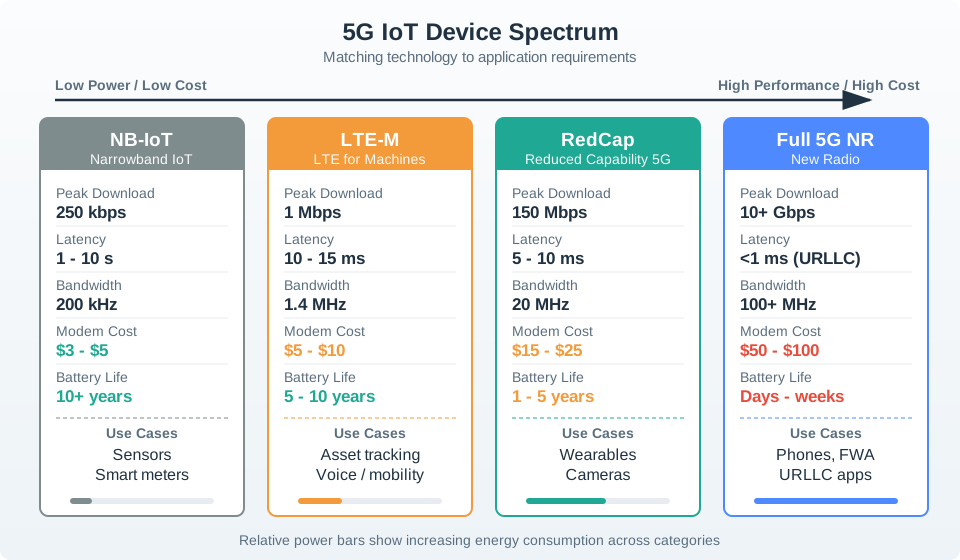
Read Figure 19.1 from NB-IoT and LTE-M on the left through RedCap to full 5G NR on the right. The progression raises rate and capability together with device and service complexity, while the workload cards keep each step tied to a practical need. The numeric comparison makes the gap concrete: a 20 kB summary each minute averages (20 × 8)/60 = 2.67 kbps, whereas a 4 Mbps camera produces 4,000 kbps, about 1,500 times as much application traffic. That separation, not the newest radio name, determines which category deserves field validation.
19.3.1 First-Pass Category Fit
NB-IoT
Best first candidate for fixed or mostly fixed devices that send compact telemetry, sleep for long periods, and can tolerate patient downlink behavior where the operator supports the service.
LTE-M
Best first candidate when a low-rate device needs practical mobility, handover, richer diagnostics, firmware updates, or more responsive interaction than an NB-IoT-only design can support.
RedCap
A reduced-capability 5G NR option for mid-tier devices such as wearables, cameras, industrial sensors, and gateways where 5G support is useful but full NR complexity is unnecessary.
Full 5G NR
Use for high-throughput devices or carefully engineered low-latency systems where the network, core, QoS, edge placement, and operational evidence are part of the design.
19.4 Practitioner: Make a Device-Category Record
A category decision should be written down as an evidence record. The record does not need to be long, but it must connect the application to measurable requirements and deployment constraints. If a pilot later fails, the team can see which assumption broke: coverage, mobility, firmware traffic, antenna performance, operator support, power budget, or latency.
A useful record is specific enough to reject attractive but wrong choices. Instead of writing "cellular sensor," write "fixed valve monitor, 120-byte alarm plus daily health packet, five-year battery target, indoor meter room, no voice, annual firmware update window, two-country operator footprint, and installation antenna limit." That sentence already points the review toward coverage, power, update, and roaming evidence before anyone orders modules.
Inspect the workload scale in Figure 19.2 before naming a 5G category. Typical power class for IoT workloads gives the vertical comparison, while NB-IoT anchors the low-power end against LTE-M, RedCap, and full 5G NR. The increasing capability also brings higher radio and system demands, so the device-category record must preserve the traffic, latency, mobility, and battery constraints that justified its position.
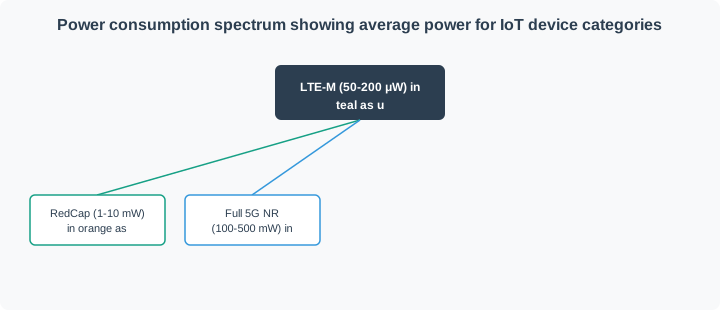
The comparison begins at Low, not at a vendor claim; Typical power class for IoT workloads introduces the alternative, and NB-IoT reveals the relevant constraint. the diagram in Figure 19.2 therefore demonstrates power and capability comparison across NB-IoT, LTE-M, RedCap, and full 5G NR. This turns practitioner: make a device-category record into a testable choice with an explicit rejected option.
19.4.1 Selection Workflow
For selection workflow, the useful question is not what the technology is called but what Figure 19.3 labels: decision tree for choosing full 5G NR, RedCap, LTE-M, or NB-IoT from latency, data rate, battery, mobility, and coverage needs. Inspect Safety-critical low latency? beside Full 5G NR before the next claim.
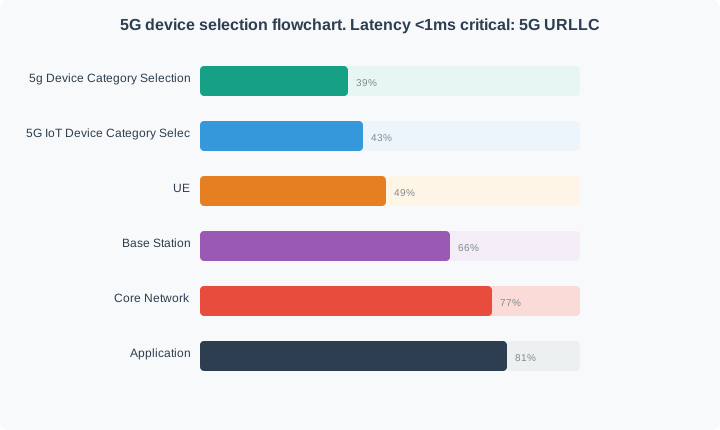
At the top of Figure 19.3, Start With Requirements collects the requirements. The branch Safety-critical low latency? tests one of them before allowing Full 5G NR as an outcome. The diagram therefore means decision tree for choosing full 5G NR, RedCap, LTE-M, or NB-IoT from latency, data rate, battery, mobility, and coverage needs, and selection workflow must retain both the test and its evidence.
19.5 Under the Hood: Capability Labels Are Not Guarantees
The radio category is only one layer of the service. RedCap reduces 5G NR device complexity by limiting parts of the full-NR feature set, but it still depends on deployed network support, module certification, firmware behavior, antenna design, and the traffic model. Full 5G NR can carry demanding workloads, but low-latency or high-reliability claims require an engineered path through the radio, transport, core, edge application, and operations process.
The same caution applies to network slicing and URLLC language. A slice label, a private-network label, or a 5G modem label does not prove deterministic behavior by itself. The evidence is measured end-to-end: latency distribution, packet loss, handover behavior, congestion response, fallback policy, power state transitions, and recovery after faults.
That means the category review must preserve the test conditions. A RedCap camera that works beside a lab cell may fail the real deployment if uplink congestion, indoor attenuation, SIM policy, firmware retry behavior, or cloud ingest limits are different. A full-NR gateway may meet throughput but still miss an alarm objective if the edge application queues events behind bulk video. The under-the-hood question is therefore not "which category is newest"; it is whether every boundary between modem, network, core, application, and operations has evidence for the promised service. A good test plan names those boundaries separately so a pass in one layer cannot hide a failure in another.
Do not write a requirement as "use 5G." Write it as a measurable service: payload size, maximum latency, availability target, coverage footprint, mobility behavior, power budget, update window, and support lifetime.
Use Figure 19.4 to test whether a workload belongs in RedCap’s mid-tier role and which deployment dependencies must be proved before making that field claim.
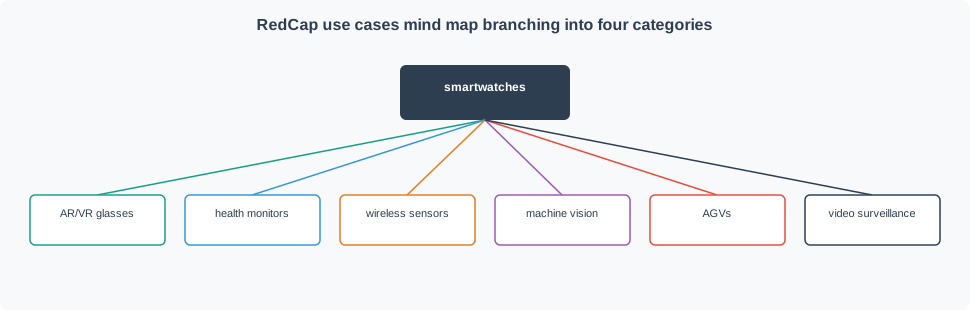
Compare the three device needs. Then choose the radio class. Read Figure 19.4 from the RedCap role to the named use-case families: wearables, video and vision, industrial sensors, and consumer or city devices. These examples occupy the middle because they need more throughput than LTE-M without requiring full-NR complexity. The final evidence panel changes the picture from taxonomy to release decision. Deployed network support, module certification, firmware behaviour, antenna design, and the actual traffic model must all support the proposed use. A workload resemblance alone is therefore insufficient; the device and operator path still need measured proof.
19.5.1 Boundary Checks
Coverage Boundary
Confirm the target operator supports the chosen category in the actual sites, bands, roaming profile, and deployment countries.
Module Boundary
Check certification, antenna constraints, firmware update path, host interface, SIM/eSIM handling, and diagnostics before committing hardware.
Service Boundary
Measure latency, throughput, sleep/wake behavior, handover, retransmission, and congestion response with realistic payloads.
Lifecycle Boundary
Plan operator sunsets, tariff changes, module substitutions, regulatory variants, and hardware refresh for long-lived fleets.

19.7 Start With the Story
This section: Start With the Story — 5G device categories are labels for very different device promises.
5G device categories are labels for very different device promises. A tiny sensor, mobile tracker, industrial controller, and video gateway should not be judged by the same throughput or latency story.
-
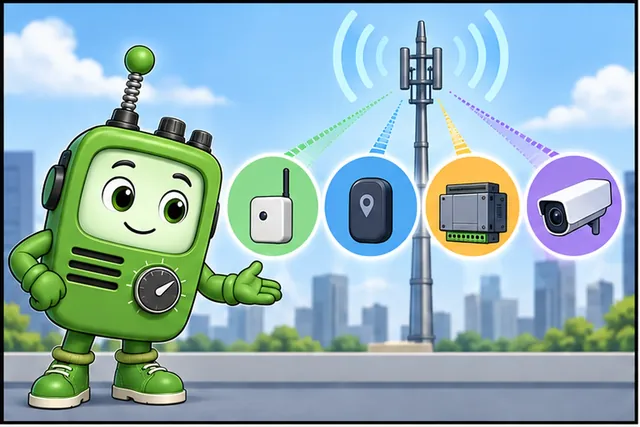
Four devices need different fifth-generation network promises.
-
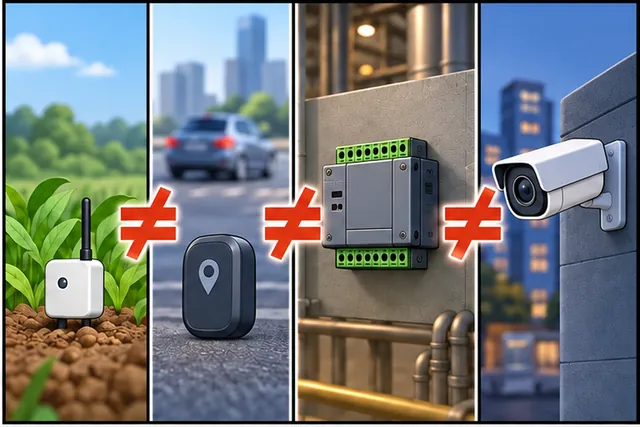
One speed or delay target cannot fit every device.
-
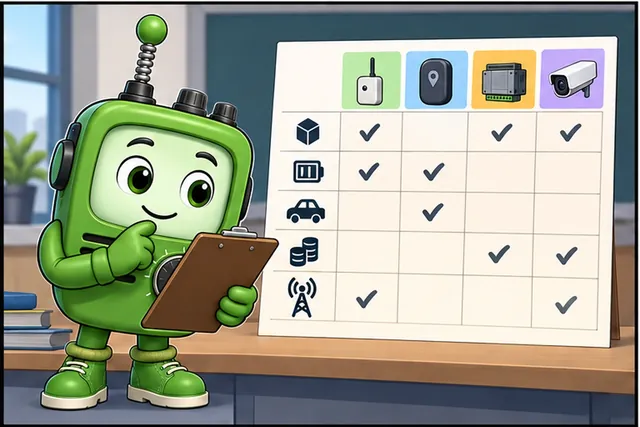
Compare data size, power, movement, cost, and reach.
-
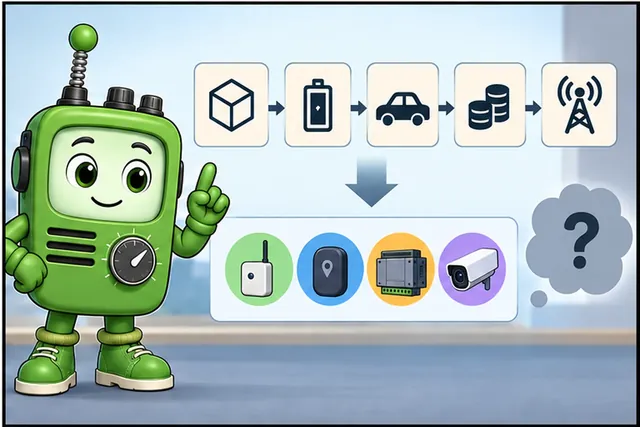
Choose the category that fits those needs.
Start simple: choose the category by payload, power, mobility, cost, and reachability before comparing feature lists.
19.8 Summary
This section: Summary — 5G-era cellular IoT is a spectrum of device categories.
5G-era cellular IoT is a spectrum of device categories. NB-IoT and LTE-M remain strong choices for low-power wide-area devices. RedCap adds a mid-tier 5G NR option for richer IoT devices. Full 5G NR is reserved for high-throughput or engineered low-latency systems where the whole service path is validated.
19.9 Key Takeaway
This section: Key Takeaway
Choose the lowest-complexity cellular category that satisfies the evidence record: workload, mobility, coverage, power, operator support, module readiness, lifecycle risk, and measured service behavior.
19.10 See Also
This section: See Also
Find help
3 reviewed answers.
Where should I start in a module?
Open the module page from the sidebar to see its chapters in order. Use the module map to return to a topic you need.
Modules and pathsReviewed
What can I try when a project does not work?
Check the symptom, then work through the diagnostic steps. Keep the error message and the smallest example that reproduces it.
When you are stuckReviewed
How do interactive examples work?
Use the interactive guide to check how examples and simulations work before changing your project.
Interactive examples guideReviewed