13 Cellular IoT Deployment Planning
More
Depth: Practitioner
Progress saves as you read. Mark sections complete as you go; your progress appears in the sidebar.
A street of water meters regains power at the same instant. Each device has a small payload waiting, yet the operator sees a burst of registration attempts. Deployment planning must cover the recovery event as well as an ordinary day.
13.1 Overview: Deployment Evidence Comes Before Procurement
This section: Overview: Deployment Evidence Comes Before Procurement — Picture a leak sensor that worked in the office.
Picture a leak sensor that worked in the office. Its final home is a steel box in a basement. Buying ten thousand units before that site test would turn one guess into a fleet risk.
Firmware is the software stored on the device. A payload is the useful data carried in a message. Start from a field fault and work back. Test the final antenna, case, battery, software, SIM, network plan, and data path. Record the site class and the owner. Make sure support can tell a coverage fault from a power, SIM, software, or server fault.
Use this release route:
- What job must the device do?
- Where will it be installed?
- Which hard site stands for that class?
- Does the final unit attach there?
- Does its data reach the right service?
- Can a reply return when needed?
- How much power does the full exchange use?
- What happens when service is lost?
- Who acts on a silent unit?
- Which proof allows a larger rollout?
One good site does not approve every site. The plan must name its limits and retest triggers. Practitioner builds the rollout and support record. Under the Hood covers radio load, control traffic, power states, and operator change. Those details can narrow the approved class. They do not make a coverage map proof of an installed device.
Cellular IoT deployment planning turns a working prototype into a fleet that can be installed, monitored, repaired, and changed over its lifetime. The decision is not just whether a module attaches to a network. It is whether the final device, antenna, enclosure, SIM profile, firmware, operator service, data path, and support workflow hold up in the places where devices will actually live.
Plan from the field incident backward. If a device goes silent, the release record should tell support whether to check coverage, battery state, SIM status, APN routing, firmware version, payload acknowledgement, or the installation category first. Procurement can then buy the modem, plan, and service contract that match the proven response model instead of buying the cheapest monthly line and discovering the operating cost later. Include the pilot date, approved site classes, exception owner, and next review trigger so the plan remains usable after the initial purchase.
To decide overview: deployment evidence comes before procurement, inspect Figure 13.1 now: it makes cellular IoT deployment evidence matrix linking site survey, radio behavior, connectivity lifecycle, data budget, operations, and rollout gate evidence visible before the prose turns that evidence into a release choice.
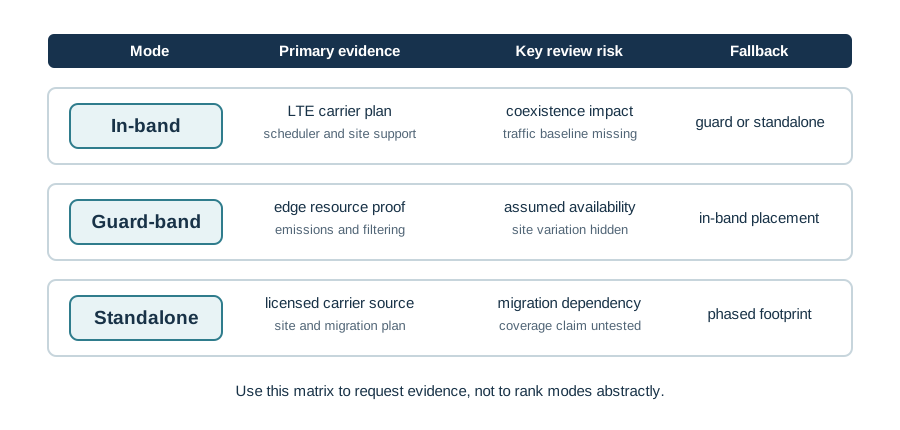
The labelled sequence in Figure 13.1 moves from Mode through Key review risk to In-band. Each step changes who owns the next proof, which is how the visual conveys cellular IoT deployment evidence matrix linking site survey, radio behavior, connectivity lifecycle, data budget, operations, and rollout gate evidence. For overview: deployment evidence comes before procurement, the missing record at any one step blocks the release claim.
Coverage Is Installed
Coverage maps and lab tests are planning inputs. Acceptance comes from representative devices measured in final installation categories, including the intended antenna, enclosure, SIM profile, and firmware behavior.
Radio Choice Is Conditional
NB-IoT, LTE-M, broadband cellular, and private cellular solve different service problems. Match the option to mobility, payload size, downlink urgency, coverage difficulty, operator support, and certification path.
Connectivity Has a Lifecycle
The plan must cover SIM or eSIM profile ownership, APN and routing design, data pooling, suspension, replacement, profile changes, support escalation, and retirement.
Pilots Validate Operations
A production-like pilot should prove provisioning, installation, monitoring, alerting, field service, firmware update behavior, data use, and recovery procedures before bulk procurement.
13.2 Practitioner: Build the Deployment Release Record
This section: Practitioner: Build the Deployment Release Record — The practitioner task is to turn assumptions into a release record that field technicians, firmware engineers, network engineers, and support teams can all use.
The practitioner task is to turn assumptions into a release record that field technicians, firmware engineers, network engineers, and support teams can all use. The record should separate hard constraints, measured evidence, accepted risks, and the decision that releases a staged rollout.
A strong record is useful during rollout, not only during design review. It should let a technician confirm the approved antenna position, let firmware staff compare a current trace with the release trace, let network staff verify the expected APN and profile, and let support decide whether a failed device is inside the accepted exception path or needs engineering review.
Build the release record along Figure 13.2 rather than from a single successful attachment. After the footprint requirement, 2. Support establishes operator and lifecycle ownership; 3. Placement then tests the installed antenna and enclosure context. The later measurement, pilot, and operations gates preserve why a chosen connectivity path was accepted and what change would force a retest.
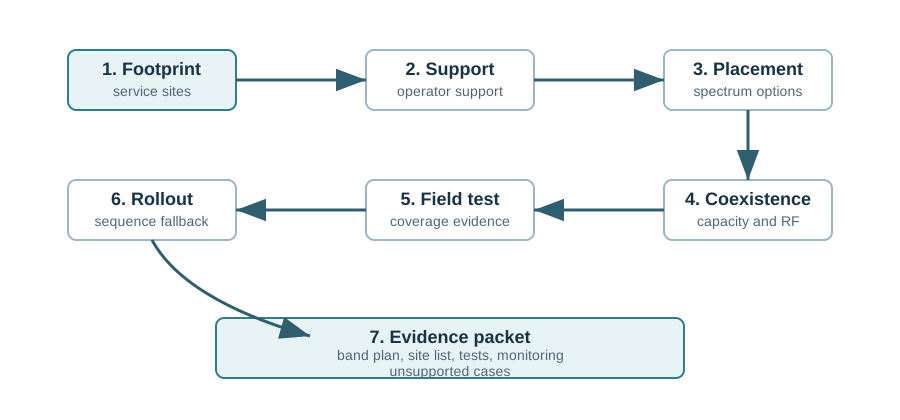
The decision starts with 1. Footprint in Figure 13.2; 2. Support asks the first separating question, and 3. Placement is one consequence of that answer. This makes cellular IoT deployment review workflow from requirements and site classes through measurements, connectivity selection, pilot, operations, and release decision actionable. The practitioner: build the deployment release record record should preserve the answered condition alongside the chosen category.
The next decision needs more than a category name. Figure 13.3 exposes cellular IoT deployment risk record showing dominant risk, evidence required, accepted mitigation, owner, and retest trigger, so examine it before committing to practitioner: build the deployment release record. Inspect Mode chosen from slide beside Operator mode support record before the next claim.
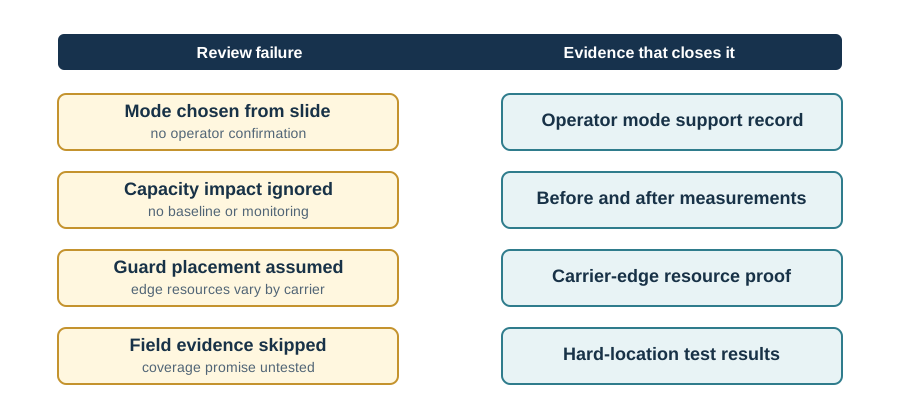
In the diagram in Figure 13.3, Review failure establishes the subject, Mode chosen from slide identifies the next evidence point, and Operator mode support record adds the limiting condition. The result is cellular IoT deployment risk record showing dominant risk, evidence required, accepted mitigation, owner, and retest trigger. This gives practitioner: build the deployment release record a specific review target rather than decorative context.
Survey by Category
Measure each installation category, not only the easiest site. Keep raw signal quality, attach behavior, retry counts, and current traces with the deployment record.
Budget Fleet Events
Separate normal telemetry from diagnostics, repeated TLS handshakes, certificate renewal, poor-coverage retries, and firmware updates. Small daily payloads can still create large fleet events.
Segment When Behavior Differs
Static low-data meters, mobile assets, exception-heavy devices, and critical service assets may need different operator, SIM, data, support, or update policies.
13.2.1 Capacity the Control Plane, Not Only the Payload
A cellular fleet can overload signalling resources even when every application payload is small. A device may attach, authenticate, establish radio and packet context, move between idle and connected states, page for downlink, release state, and retry after failure around a single short exchange. If many devices wake after the same timer, power restoration, coverage return, certificate event, or firmware fault, those control transactions align into a signalling storm. The bottleneck can be random access, state management, authentication, mobility, or core-network processing long before user-data capacity is exhausted.
Estimate the load in three linked dimensions: devices active in the busy interval, sessions per active device, and control transactions or other resources consumed by each session. Preserve distributions and worst credible fleet events rather than multiplying only annual averages. Then segment by radio state and cause: scheduled telemetry, paging, attach, mobility, failed authentication, retransmission, diagnostics, and update recovery can have very different costs.
For example, a meter fleet that sends one small reading per day may look negligible in a data-plan spreadsheet. If all meters reconnect at the same minute after a regional outage, each may repeat attachment and session setup while coverage is still unstable. Randomised scheduling, exponential backoff with jitter, bounded retries, staged recovery cohorts, retained local queues, and operator coordination spread that demand. The release test should rehearse a representative synchronized event and record attempts, state transitions, successful sessions, resource or rate-limit responses, battery impact, and time to drain the backlog.
13.3 Under the Hood: Why Cellular Plans Fail in the Field
This section: Under the Hood: Why Cellular Plans Fail in the Field — Most cellular IoT deployment failures are cross-layer failures.
Most cellular IoT deployment failures are cross-layer failures. A radio decision interacts with the enclosure, antenna, sleep mode, retry policy, SIM lifecycle, data path, operator support, and field-service process. The under-the-hood review asks how the plan behaves when those layers stop matching the optimistic case.
The failure review should name the layer that detects the problem and the layer that can fix it. A modem may report registration failures, but only installation policy can move an antenna. A cloud service may see missed payloads, but only firmware logs can distinguish a retry storm from a sleep-window mismatch. A carrier portal may show a suspended SIM, but only the asset system can prove whether the device was retired, replaced, or activated under the wrong account.
That separation keeps escalation practical. Each release gate should include the minimum log fields, timestamps, identifiers, and owner actions needed to connect radio evidence with application evidence when the fleet is under load.
Use the rollout loop in Figure 13.4 to find where a promising lab result can still fail. Set mobility / update limits. bounds the service first; only then should the team Shortlist operators / profiles. Survey, pilot, provisioning, and observability evidence follow before release, with explicit stop or rollback points. That ordering turns field failures into controlled gates instead of surprises after fleet installation.
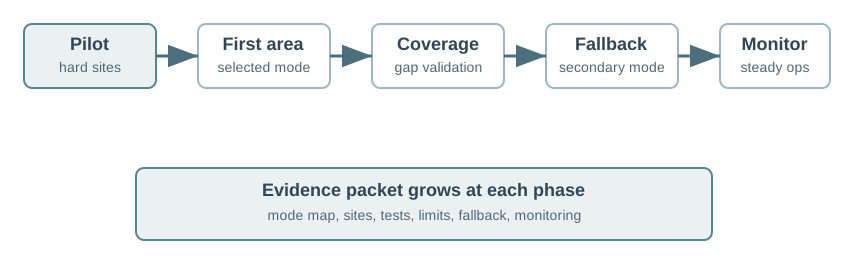
At NB-IoT rollout: evidence-led release and operations handoff, Figure 13.4 establishes the starting condition. The move to Requirements & shortlist creates the next obligation, and Set mobility / update limits. shows the downstream acceptance point. Thus the figure depicts evidence-led cellular IoT rollout loop from bounded requirements and survey through pilot, provisioning, observability, staged stop-or-rollback decisions, named operations handoff, and explicit change-triggered rechecks and gives under the hood: why cellular plans fail in the field its evidence order.
Enclosures Change Radio Behavior
Antenna position, cabinet material, mounting height, nearby equipment, and building structure can change attach stability and retry behavior even when outdoor maps look acceptable.
Sleep Modes Change Reachability
PSM, eDRX, connected idle, and always-on operation are service choices. A server command path that works in active mode may fail the product requirement when the device sleeps.
Retries Couple Power and Data
Poor coverage can turn a small payload into repeated attach attempts, retransmissions, diagnostics, and update retries. The battery and data budgets must include those field behaviors.
Provisioning Is Stateful
The device identity, SIM or eSIM profile, APN, cloud asset, certificate, firmware version, and support record need a controlled lifecycle from manufacturing through retirement.
13.4 Start With the Story
This section: Start With the Story — A pilot can pass at the bench and still fail in the field.
A pilot can pass at the bench and still fail in the field. Deployment planning is the discipline of proving coverage, operator fit, enclosure behavior, installation steps, and support ownership before the fleet grows.
Start simple: turn each site, route, SIM, antenna, and recovery action into evidence before approving rollout.

13.5 Reconnect the Estate without Repeating the Outage
This section: Reconnect the Estate without Repeating the Outage — Use an illustrative cohort of 600 meters.
Use an illustrative cohort of 600 meters. If all firmware timers fire within 10 s, the average initial attempt rate is 600 divided by 10 s = 60 attempts per second. Spread those first attempts over 300 s and the average falls to 2 attempts per second. This arithmetic describes the offered load; it does not claim that either rate is acceptable to a particular operator. Random timing also produces peaks around that average.
Suppose failed devices make four immediate attempts each. In the first case, the cohort could offer 2,400 attempts in a short interval. Buying an operator plan with a larger payload allowance does not solve this control-traffic problem. The firmware needs bounded retries and spacing that persists through the failure being tested. If every reboot resets the timer to the same value, a power fault can recreate the burst after each restart.
Read the deployment workflow at Figure 13.2 as a constraint on this test. Footprint identifies the affected site class; support establishes who can interpret network failures; placement fixes the antenna configuration. Measurement and pilot evidence then show whether the recovery schedule works for that class. A test with a different enclosure cannot silently approve the installed fleet.
Predict whether the 300 s schedule guarantees the last reading arrives within five minutes. It does not: registration, retries and application transfer take additional time. Record both the first-attempt distribution and successful delivery times. Next, remove the route to the application while keeping radio registration available. The firmware may report an attached modem while the application path still fails to deliver.
Support should be able to identify the cohort, firmware version, granted profile and oldest queued reading during this rehearsal. These fields connect a field symptom to an action. The plan may reduce the batch size or pause the next cohort while the backlog drains. In this module, a staged rollout is useful because it bounds a tested failure pattern before procurement multiplies it. The example rates are test inputs; operator limits must come from the service actually purchased.
13.6 Summary
This section: Summary — Cellular IoT deployment planning converts a working prototype into a supportable fleet.
Cellular IoT deployment planning converts a working prototype into a supportable fleet. The plan should start with service requirements, classify installation categories, measure representative locations with final hardware, select the radio and connectivity path from evidence, and run a production-like pilot before staged rollout. The most important work is cross-layer: installed coverage affects retries, retries affect power and data, sleep modes affect reachability, and SIM or eSIM lifecycle choices affect support.
13.7 Key Takeaway
This section: Key Takeaway
A cellular IoT rollout is ready when its deployment record proves the installed radio behavior, connectivity lifecycle, data and power assumptions, provisioning path, operations owner, and recheck trigger. A lab connection or coverage map is not enough.
13.8 See Also
This section: See Also
Cellular IoT Overview
Review the service families and deployment categories that frame the deployment decision.
NB-IoT vs LTE-M Comparison
Use the radio-fit comparison before locking the deployment technology.
Cellular IoT Power Optimization
Connect sleep modes, retry behavior, current traces, and battery evidence.
eSIM and Global Deployment
Plan profile lifecycle, roaming, and multi-market connectivity operations.
Find help
3 reviewed answers.
Where should I start in a module?
Open the module page from the sidebar to see its chapters in order. Use the module map to return to a topic you need.
Modules and pathsReviewed
What can I try when a project does not work?
Check the symptom, then work through the diagnostic steps. Keep the error message and the smallest example that reproduces it.
When you are stuckReviewed
How do interactive examples work?
Use the interactive guide to check how examples and simulations work before changing your project.
Interactive examples guideReviewed