4 NB-IoT Architecture

More
Depth: Practitioner
Progress saves as you read. Mark sections complete as you go; your progress appears in the sidebar.
A cellar meter reports successful network registration, but the billing service cannot find reading 42. The antenna may be working perfectly. This fault asks where the reading stopped after radio access, which is an architectural question.
4.1 Overview: NB-IoT Architecture Is a Service Chain
This section: Overview: NB-IoT Architecture Is a Service Chain — Firmware is the software stored on a device.
Firmware is the software stored on a device. A payload is the useful data inside a message. Telemetry is data sent from a remote device for watching or review. Picture one cellar meter sending a numbered reading to a service desk.
Trace that one reading first. Name the device and SIM, the radio site, the mobile core, the data route, the application, and the support owner. Keep the same number at each step so a missing reading can be found.
Then test sleep and failure. A device may join the network but use the wrong data route. A cloud service may reject a good radio message. Long sleep saves power, yet it delays a reply and can make support harder.
This cellar story cannot prove field cover, battery life, safe identity, or service quality. It also cannot show that every mobile operator grants the same settings. Those need an installed end-to-end test.
Use the Practitioner sections to build the service-chain and support record. Use Under the Hood for radio access, core paths, sleep, and exposure services. The deeper work adds exact roles without changing the one-reading trace.
Run one plain proof. Send reading 42. Note the send time. Note the device state. Note the site cell. Find reading 42 upstream. Find it in the app. Check its unit. Check its owner. Turn off the data route. Watch the failure. Restore the route. Send reading 43. Keep both support records.
NB-IoT architecture connects a constrained device to an application through an operator-managed cellular path. The device uses an NB-IoT radio carrier, the radio access network handles access and scheduling, the cellular core authenticates and routes the device, and the application platform turns compact telemetry into an operational record.
The important architectural question is not which acronym appears in the diagram. The useful question is whether the selected device, SIM or eSIM profile, operator service, deployment mode, data path, sleep policy, and application owner can prove the service contract in the installed environment.
Follow the evidence across the chain. The device must show the firmware build, antenna and enclosure state, power mode, and payload identifier. The radio and core path must show registration, granted timers, routing policy, and any exposure-service behavior the product depends on. The application must show receipt, acknowledgement, duplicate handling, and ownership of missed or late messages. If one layer cannot be observed, the architecture has a hidden support risk.
This matters because NB-IoT deployments often fail outside the radio diagram. A device can attach while the APN route is wrong, while the cloud rejects the payload, while the requested sleep timers are not granted, or while the asset database points to the wrong SIM. The architecture overview should make those boundaries visible before the pilot begins.
Use a single test payload to trace the architecture end to end. Give the payload an identifier, capture the modem event, confirm the network route, verify application receipt, and store the support record that would be used if the same payload disappeared in production. That trace turns the architecture from a diagram into an operations contract.
The running service decision reaches a visual proof point at Figure 4.1, which sets out NB-IoT service-chain architecture from installed UE through radio access, core policy, packet or exposure delivery, application receipt, and operations retest ownership for inspection. Inspect Installed UE beside SIM, antenna before the next claim.
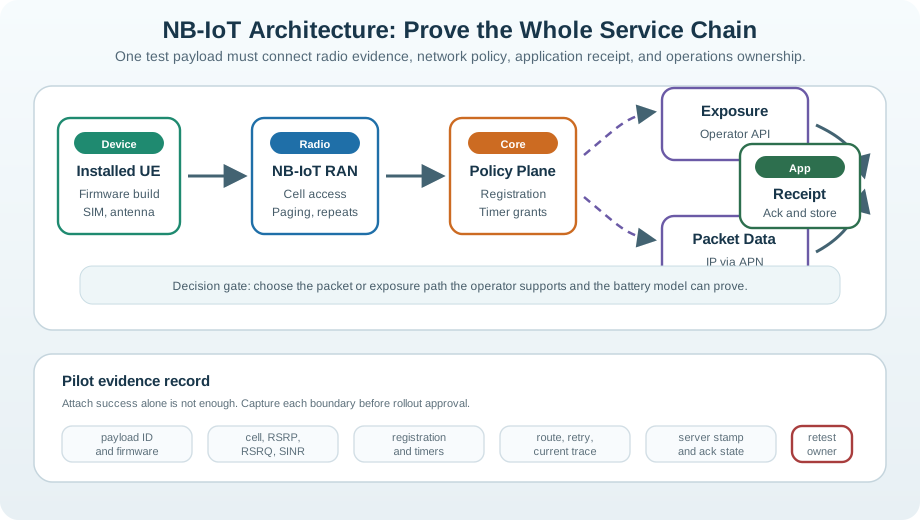
Use NB-IoT Architecture: Prove the Whole Service Chain, Installed UE, and SIM, antenna as three architecture checkpoints in Figure 4.1. Their interfaces embody NB-IoT service-chain architecture from installed UE through radio access, core policy, packet or exposure delivery, application receipt, and operations retest ownership. For overview: nb-iot architecture is a service chain, the evidence packet must join those checkpoints with one observed transaction.
Installed UE
The module, SIM profile, antenna, enclosure, host firmware, power supply, and payload schedule determine real field behavior.
NB-IoT carrier
The radio path provides synchronization, random access, scheduling, paging, and coverage-enhancement behavior on the deployed carrier.
Registration and policy
The cellular core authenticates the subscriber, tracks reachability, grants timers, and applies subscription and routing policy.
Packet or exposure path
Telemetry reaches the application through an IP packet path or an operator exposure function when that service is available and supported.
4.2 Practitioner: Build the Architecture Decision Record
This section: Practitioner: Build the Architecture Decision Record — A project architecture record should state the data path and the evidence required to approve it.
A project architecture record should state the data path and the evidence required to approve it. NB-IoT can use ordinary packet data connectivity, and some deployments can use operator exposure services for compact small-data delivery. The practical choice depends on what the operator supports, what the firmware can implement, how the application authenticates messages, and what the battery model can afford.
Standard application integration
Use a packet path when the product needs normal IP tools, private APN routing, existing application security, or maintenance traffic.
Compact operator-mediated messages
Use an exposure service only when the operator offers the needed API and the product can support its payload, security, and operations model.
Change the architecture
Frequent downlinks, large updates, mobility, or strict latency may point to LTE-M, private cellular, or a different network design.
4.3 Under the Hood: Control, User, and Operations Boundaries
This section: Under the Hood: Control, User, and Operations Boundaries — NB-IoT sits inside cellular architecture, so several boundaries matter at once.
NB-IoT sits inside cellular architecture, so several boundaries matter at once. The radio access network handles synchronization, random access, scheduling, paging, and coverage behavior. Core control functions handle subscriber authentication, registration state, tracking area updates, and timer grants. Packet gateways or exposure functions move application data toward the enterprise platform. The device firmware has to log enough evidence to make those boundaries supportable.
Inside an LTE carrier
The NB-IoT carrier is placed within LTE spectrum. Validate operator support and installed coverage rather than assuming LTE coverage is equivalent.
Between LTE carrier edges
The narrowband carrier uses guard-band spectrum. Device certification, RF planning, and operator availability remain practical constraints.
Dedicated narrow carrier
The radio carrier can be dedicated, for example in refarmed spectrum, but the service still depends on cellular core and operations support.
4.3.1 Named CIoT Nodes and Interfaces
Replace the generic phrase “the cellular core” with the actual path. The user equipment (UE) first reaches an NB-IoT-capable eNodeB in the CIoT radio access network. From there, control and user data can take different routes.
| Interface | Endpoints | Plane and responsibility |
|---|---|---|
| Uu | UE—eNodeB | Radio synchronization, random access, RRC, scheduling, paging, uplink and downlink transfer |
| S1-MME | eNodeB—MME | Control signalling for registration, authentication context, mobility, bearer control; also participates in control-plane CIoT optimisation |
| S1-U | eNodeB—Serving Gateway (SGW) | User-plane bearer packets when the normal user-plane path is active |
| S11 | MME—SGW | Bearer and session control between mobility control and the serving gateway |
| S5/S8 | SGW—Packet Data Network Gateway (PGW) | User-plane and bearer control toward the packet-data network; S8 is used across serving/home network boundaries |
| SGi | PGW—external packet-data service | IP delivery toward an enterprise endpoint, broker, or CIoT application service |
| T6a | MME—Service Capability Exposure Function (SCEF) | Control-plane non-IP data delivery and service exposure path |
| T8 | SCEF—application server | Exposed service API boundary, including authorization and delivery policy |
Follow a normal user-plane packet first: UE -> eNodeB -> S1-U -> SGW -> S5/S8 -> PGW -> SGi -> service. The MME establishes and controls the bearer through S1-MME and S11, but application payload does not normally pass through the MME on this route.
Now follow control-plane CIoT small data. The UE carries data with signalling toward the MME over the radio and S1-MME control path. The core can deliver it through the SCEF using T6a for non-IP data delivery, with the external service reached through the exposure interface. This can avoid maintaining a conventional user-plane bearer for a tiny transfer, but it moves payload handling, authorization, size limits, acknowledgements, and charging into a different operational boundary. Record which path the subscription and firmware actually use; “NB-IoT connected” does not identify it.
4.3.2 One-PRB Downlink and NPRACH Access
An NB-IoT downlink carrier occupies one LTE physical resource block: 12 subcarriers at 15 kHz spacing, for 180 kHz nominal occupied bandwidth. The named physical signals and channels share that narrow grid:
| Downlink element | Job |
|---|---|
| NPSS and NSSS | Cell timing and physical-cell identity acquisition |
| NPBCH | Broadcasts the narrowband master information needed to enter the cell |
| NRS | Provides reference symbols for channel estimation and coherent demodulation |
| NPDCCH | Carries downlink control information, including scheduling grants |
| NPDSCH | Carries scheduled system information and user data |
The UE cannot jump directly to application data. It searches for NPSS/NSSS, decodes NPBCH, reads required system information on NPDSCH, and then uses the random-access procedure to request uplink resources. Coverage repetitions can repeat these elements over time; the 180 kHz frequency footprint stays narrow while latency and energy grow.
NPRACH is the uplink random-access channel. A preamble is sent as groups of single-tone symbols, and the tone index hops between symbol groups according to the configured pattern. The hopping gives the eNodeB frequency-diverse observations and identifies the access preamble without requiring a wide simultaneous uplink. After detecting NPRACH, the network returns a random-access response with timing and uplink resource information; only then can the UE continue the scheduled access exchange.
Keep channel access and application delivery separate in logs. Record cell acquisition, NPRACH attempt and repetition level, random-access response, timing advance, scheduled uplink, core path, application message ID, and acknowledgement. A visible NPSS proves a cell can be detected. A successful NPRACH proves an access preamble was detected. Neither alone proves registration, bearer or SCEF delivery, SGi reachability, or application receipt.
4.4 Start With the Story
This section: Start With the Story — An NB-IoT device is part of a chain: radio module, base station, core network, application server, and operations team.
An NB-IoT device is part of a chain: radio module, base station, core network, application server, and operations team. A fault anywhere in that chain can look like a sensor problem unless the architecture is understood end to end.
Start simple: trace the path from device attach to cloud delivery before tuning protocol details.
4.5 Figure Review: Service Route Meets Radio Budget
This section: Figure Review: Service Route Meets Radio Budget — An NB-IoT architecture review should connect the chosen service path to the one-PRB radio resources that make attachment and delivery possible.
An NB-IoT architecture review should connect the chosen service path to the one-PRB radio resources that make attachment and delivery possible.

Figure 4.2 separates CONTROL: UE → RAN → MME → SCEF → service from USER: UE → RAN → SGW → PGW → service; below them, NPSS / NSSS, NPBCH, NPDCCH → NPDSCH, and UPLINK NPRACH expose the shared one-PRB constraint.
4.6 Locate Reading Forty-Two after Radio Access Succeeds
This section: Locate Reading Forty-Two after Radio Access Succeeds — Start with the narrow carrier.
Start with the narrow carrier. Twelve subcarriers at 15 kHz spacing occupy 12 × 15 kHz = 180 kHz. Repeating a transmission uses more time on that resource; it does not create a wider carrier. This helps explain why a visible cell and a completed access exchange do not establish a particular application response time.
Follow Figure 4.2 from the radio view to the two service routes. The control route passes through the MME and SCEF; the user route passes through the serving and packet gateways. The installed subscription and software determine which route is in use. Inspect that choice before searching a log belonging to the other path.
In an illustrative user-plane test, the device creates reading 42 at 10:00:00. The receiving service records it at 10:00:08. The end-to-end delay is 8 s, assuming the two clocks are aligned well enough for that comparison. A radio event at 10:00:02 only establishes an intermediate point. It does not show that the service accepted the payload at that time.
Now block the external packet-data route. The installed unit may still acquire the cell and register. Its uplink can still consume airtime while the application sees nothing. Check the gateway route and destination before changing antenna placement. On the control-plane exposure path, inspect the exposure service’s authorization and delivery result instead. The same symptom belongs to a different boundary.
Predict what an application acknowledgement adds to the test. It can establish that the named service accepted reading 42 under its stated rules. It cannot prove that the meter’s physical measurement is accurate. Next, replay the reading after a retry. The service should identify the repeated record and avoid billing the same usage twice, while preserving evidence that another delivery attempt occurred.
This distinction gives the module’s architecture practical value. Radio control, scheduled uplink and application receipt are separate observations that must be joined. Keeping a stable reading identifier across them makes a lost measurement traceable without confusing successful attachment with a completed customer service.
4.7 Summary
This section: Summary — NB-IoT architecture is the delivery path that connects a constrained field device, an NB-IoT radio carrier, cellular core control, a packet or exposure data path, and the application platform.
NB-IoT architecture is the delivery path that connects a constrained field device, an NB-IoT radio carrier, cellular core control, a packet or exposure data path, and the application platform. Good architecture work names the operator support assumptions, security boundaries, sleep and reachability policy, evidence logs, and retest triggers before rollout.
4.8 Key Takeaway
This section: Key Takeaway
NB-IoT is an architecture choice, not just a radio choice. Approve it only when the installed device, operator service, data path, application behavior, and operations evidence support the same service contract.
4.9 See Also
This section: See Also
Builds the fit model for narrowband cellular, coverage, payload cadence, and sleep-first operation.
Explains the radio access procedures that shape attach, scheduling, retries, and field evidence.
NB-IoT Power Saving (PSM/eDRX)
Connects timer grants and reachability windows to battery and command behavior.
Cellular IoT Deployment Planning
Turns architecture assumptions into pilot gates, operations handoff, and rollout decisions.
Find help
3 reviewed answers.
Where should I start in a module?
Open the module page from the sidebar to see its chapters in order. Use the module map to return to a topic you need.
Modules and pathsReviewed
What can I try when a project does not work?
Check the symptom, then work through the diagnostic steps. Keep the error message and the smallest example that reproduces it.
When you are stuckReviewed
How do interactive examples work?
Use the interactive guide to check how examples and simulations work before changing your project.
Interactive examples guideReviewed