4 Power Consumption Analysis
More
Depth: Practitioner
Progress saves as you read. Mark sections complete as you go; your progress appears in the sidebar.
A battery sensor appears idle most of the day, yet short radio bursts and long waiting states decide whether it lasts months or years. Power analysis follows current through time rather than trusting a single average from a data sheet. The state machine and measured trace must describe the same operating cycle.
4.1 Integrate One Complete Sensor Cycle
This section: Integrate One Complete Sensor Cycle — Read Figure 4.1 around one cycle.
Read Figure 4.1 around one cycle. Follow sleep into wake, sensing, processing, transmit, receive or wait, and return to sleep. The arrows expose transition time that a table of steady states can miss. A failed transmission may loop through radio states and change the cycle substantially.
Take a one-hour cycle. Sleep draws 0.02 mA for 3,590 s, sensing draws 5 mA for 2 s, processing draws 12 mA for 3 s, and radio work draws 120 mA for 5 s. Charge is current multiplied by time: sleep uses ; sensing uses 0.0028 mAh; processing uses 0.0100 mAh; radio uses 0.1667 mAh. Total cycle charge is about 0.1994 mAh.
The average current is . A nominal 2,400 mAh battery would suggest (2{,}400/0.1994=12{,}036) hours, or about 501 days. That is only a first model. Usable capacity, self-discharge, temperature, regulator loss, pulse capability, battery ageing, retries, and safety reserve reduce the field result.
The trace should cover startup and faults as well as a quiet successful hour. If one retry adds another 5 s at 120 mA, it costs 0.1667 mAh—almost the same as the original radio event. At one retry every cycle, average current nearly doubles. This is why a small packet-loss change can dominate battery life.
Measure voltage and current with enough bandwidth and range to see both sleep leakage and radio peaks. Mark state transitions using firmware signals or synchronized logs. Integrate the measured current over the same cycle used in the calculation, and state whether the instrument includes regulator input, device rail, or only one component.
Predict three traces. Expect the successful cycle to contain one radio burst and about 0.1994 mAh. Force a retry and expect approximately 0.1667 mAh extra under the simplified states. Extend sleep by one hour and expect only about 0.02 mAh added. Compare those predictions with captured area under the current curve before projecting lifetime.
Battery capacity and device current vary with cell, temperature, age, hardware, firmware, and network conditions. Validate the state budget over representative field cycles and keep margin instead of publishing the 501-day arithmetic as a guarantee.
Separate coulomb use from energy when voltage changes. Charge in mAh helps compare a battery cycle, while energy in mWh multiplies current by voltage and time. A converter can draw a different battery current while keeping the device rail stable. State the measurement point before comparing two designs.
Repeat enough cycles to include periodic work such as clock sync, key rotation, memory cleanup, or a daily health report. A one-hour fixture that omits the once-per-day radio exchange will overstate projected life. Weight every observed cycle by how often it occurs.
Report both the median cycle and a high-energy tail so retries and cold starts remain visible in the power budget.
4.2 Start With the Current Trace
This section: Start With the Current Trace — Instead of asking whether a device is low power, watch one full cycle.
Instead of asking whether a device is low power, watch one full cycle. Sleep current, sensor warm-up, compute time, storage writes, radio association, and transmit tails each leave a different shape on the current trace.
Power analysis is the habit of turning that trace into charge per cycle and average current. Once the state budget is visible, the real bottleneck is usually obvious.
4.3 Power Analysis Is a State Budget
This section: Power Analysis Is a State Budget — Power consumption analysis explains where a device spends energy during one complete useful cycle.
Power consumption analysis explains where a device spends energy during one complete useful cycle. Instead of asking only how much current the board draws at one moment, the review separates the device into states: sleep, wake, sensing, processing, storage, radio, shutdown, and return to sleep. Each state has a current level, a duration, and an evidence source.
The useful result is an average-current estimate that can be defended by measurements. A short radio session can dominate a cycle. A tiny sleep-current error can dominate a long-life device. A shutdown tail can erase an optimization that looked good in the active pulse. The state budget makes those tradeoffs visible.
Use Figure 4.1 to determine which state dominates charge after both its current and its duration are integrated over a complete cycle.
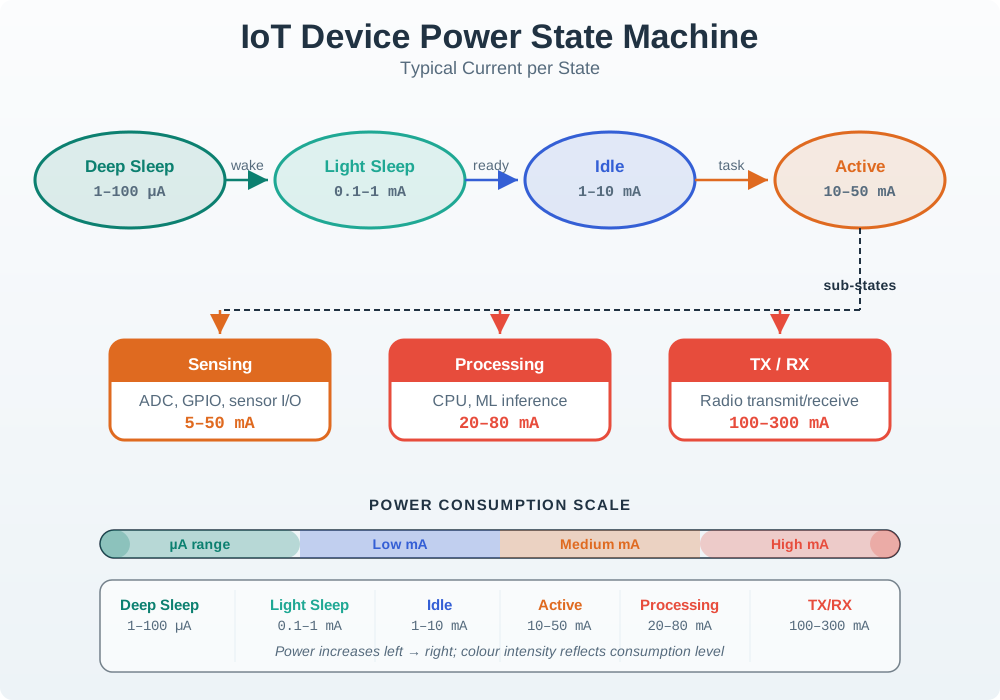
In Figure 4.1, follow one complete sensor cycle across sleep, sensing, processing, radio, and return to sleep. Then read the one-hour ledger: 3,590 seconds at 0.02 mA adds about 0.0199 mAh; the five-second, 120 mA radio interval adds about 0.1667 mAh. That one short radio step supplies most of the displayed 0.1994 mAh total. The ten-minute calculation below uses a different schedule, but the same current-times-duration method.
For example, a ten-minute reporting cycle with 599 s at 10 uA, 0.7 s of active work at 20 mA, and 0.3 s of radio at 120 mA uses 5.99 + 14 + 36 = 55.99 mA-s. Dividing by 600 s gives about 0.093 mA, or 93 uA average current. The radio lasts only 0.05% of the cycle but supplies most of the charge, while the sleep baseline still matters because it runs almost all the time.
The same ledger also separates product choices. Cutting 5 mA from a 0.7 s active window saves 3.5 mA-s per cycle, but cutting 3 uA from a 599 s sleep baseline saves 1.797 mA-s every cycle. Neither improvement is automatically better until the duration is included.
If you only need the intuition, use this rule: battery life depends on current multiplied by time across the whole cycle, not on the most impressive current number in the trace.
4.4 The Core State Budget
This section: The Core State Budget
Sleep Baseline
Retained wake sources, regulator quiescent current, pull-ups, standby sensors, debug paths, and leakage while the device waits.
Active Work
Wake, clock setup, sensor warm-up, sampling, local processing, storage writes, and state restoration.
Communication
Radio startup, association, receive windows, retries, acknowledgments, payload transfer, and shutdown.
Margin
Reserve for battery derating, temperature, aging, retries, measurement uncertainty, and rare but expensive events.
4.5 Beginner Examples
This section: Beginner Examples
- A device that sleeps almost all day can still fail its battery target if the sleep baseline is higher than expected.
- A radio payload may be short, but connection setup, receive windows, retries, and shutdown can carry most of the charge.
- A sensor may need warm-up before a valid reading; reading too soon can save energy while weakening evidence.
- A board LED, pull-up, debug adapter, or always-on regulator can be the largest drain in a low-duty-cycle product.
4.6 Overview Knowledge Check
This section: Overview Knowledge Check
4.7 Calculate Average Current from Measured States
This section: Calculate Average Current from Measured States — A practical power analysis begins with a trace or measurement record for one complete cycle.
A practical power analysis begins with a trace or measurement record for one complete cycle. The team marks each state, records its current and duration, calculates charge per state, and divides total charge by the cycle time. If a state has changing current, split it into smaller states or integrate the trace instead of using a convenient instant.
The basic relationship is simple: state charge equals current multiplied by duration. Average current equals the sum of state charge divided by total cycle duration. The hard part is making the state list honest enough to include startup, tails, retries, maintenance checks, faults, and hidden drains.
4.8 How to Build the Power Ledger
This section: How to Build the Power Ledger
- Define the cycle. State what counts as one useful report, wake interval, scan, control loop, or maintenance event.
- Mark every state. Include sleep, wake, sensing, processing, storage, radio, shutdown, and return-to-sleep evidence.
- Measure current and duration. Use a profiler, shunt setup, or defensible measurement method with firmware markers where possible.
- Calculate charge per state. Multiply current by duration for each state, then identify the largest contributors.
- Change one lever and remeasure. Optimize the dominant measured contributor, then rebuild the ledger instead of assuming the fix worked.
4.9 Power Analysis Ledger
This section: Power Analysis Ledger
4.10 Practitioner Knowledge Check
This section: Practitioner Knowledge Check
4.11 Measurement Boundaries Decide Trust
This section: Measurement Boundaries Decide Trust — Under the hood, power analysis is a measurement-quality problem.
Under the hood, power analysis is a measurement-quality problem. The numbers depend on where current is measured, which components are included, how traces are sampled, whether firmware markers align with real states, and whether the measurement setup changes device behavior. A state budget is only useful when its boundaries match the deployed device.
Power estimates also depend on how capacity is interpreted. A battery label is not a deployment guarantee. Usable capacity depends on load profile, cutoff voltage, temperature, age, chemistry, regulator behavior, reserve policy, and the consequences of brownout. The power ledger should therefore keep measurement assumptions visible instead of folding them into a single optimistic lifetime claim.
A boundary error can be larger than the optimization being reviewed. Suppose the isolated MCU rail measures 8 uA in sleep, but the product rail also includes a 25 uA regulator, a 12 uA standby sensor, and 6 uA of pull-up leakage. The deployed sleep baseline is 51 uA, not 8 uA. Over a 30-day bench interval, that missing 43 uA x 720 h = 30.96 mAh is already more than many design-review margins.
Capacity assumptions create the same kind of hidden swing. A ledger that predicts 220 uA average from a 2400 mAh cell with 80% usable capacity estimates 1920 mAh / 0.220 mA = 8727 h, or about 364 days. If cold temperature reduces usable capacity to 60% and retry margin adds 40 uA, the estimate becomes 1440 mAh / 0.260 mA = 5538 h, or about 231 days. Both numbers can be mathematically correct; only the assumption record tells reviewers which one applies.
Sampling resolution is another boundary. A meter that averages over one-second windows can hide a 120 mA, 200 ms transmit burst inside a calm-looking trace. For state budgets, reviewers need enough bandwidth to capture peaks and enough interval logging to prove the quiet states stay quiet.
4.12 Boundary Checks
This section: Boundary Checks
Scope Boundary
State whether the measurement includes sensors, radios, regulators, pull-ups, storage, debug hardware, indicators, and external peripherals.
Timing Boundary
Align traces with firmware states, wake sources, retries, rare events, maintenance tasks, and return-to-sleep behavior.
Capacity Boundary
Use usable capacity and reserve assumptions that match the load, environment, voltage limits, and service expectation.
Validation Boundary
Remeasure after firmware, hardware, radio policy, sensor schedule, power source, enclosure, or deployment condition changes.
4.13 Failure Patterns
This section: Failure Patterns
- Partial measurement: measuring the processor board while excluding the sensor, radio, regulator, or external pull-up that ships in the product.
- Hidden tail: stopping the trace at the end of active work before the device has returned to its intended sleep baseline.
- Nominal capacity trap: using a battery label without stating usable capacity, cutoff, temperature, reserve, or aging assumptions.
- Unverified optimization: changing firmware or hardware and updating the spreadsheet without measuring the full cycle again.
4.14 Under-the-Hood Knowledge Check
This section: Under-the-Hood Knowledge Check
4.15 A Ten-Year Battery Budget
This section: A Ten-Year Battery Budget — Processor throughput can improve quickly while stored energy improves slowly.
Processor throughput can improve quickly while stored energy improves slowly. That mismatch changes the design question. A faster processor may finish a burst sooner, but it does not grant the node a larger lifetime charge budget. For a long-lived product, start with the battery charge and the required service interval, then work backwards to the average current the entire device may consume.
If a battery provides a usable capacity in ampere-hours and the required life is hours, the ideal average-current ceiling is
Ten years without leap-day detail is
Apply the equation to two illustrative nameplate capacities before adding any derating:
| Battery example | Nameplate capacity | Ideal ten-year current | Derivation |
|---|---|---|---|
| Two AA cells represented as a 1,000 mAh pack | 1,000 mAh | 11.4 A | mA |
| CR2032 coin cell | 225 mAh | 2.57 A | mA |
The second row is the important hand-holding moment: 2.57 A is the whole-device average, not merely the processor’s sleep-current allowance. Regulators, pull-ups, sensor bias, storage leakage, watchdogs, periodic sampling, radio retries, and battery self-discharge must all fit beneath it.
A field budget therefore derates capacity before dividing:
where the factors represent temperature, discharge-rate behavior, aging or shelf loss, and the capacity deliberately left as a brownout reserve. If their product is 0.60, the 225 mAh example provides 135 mAh for planned work, reducing the ten-year ceiling to
This is why historical battery-capacity gains of only several percent per year cannot be treated like the much steeper growth once seen in processor benchmark throughput such as DMIPS. Those trends are technology-era observations, not a forecast for a chosen cell. The actionable result is timeless: freeze the service-life requirement, use the selected battery’s measured usable capacity, and force every state in the current ledger to compete for the resulting microampere budget.
4.16 Summary
This section: Summary — Power consumption analysis turns measured device behavior into a state budget.
Power consumption analysis turns measured device behavior into a state budget. Break one complete cycle into states, measure current and duration, calculate charge per state, and optimize the largest measured contributor first. Keep sleep baseline, communication sessions, shutdown tails, hidden drains, exceptions, and battery margin in the ledger so the estimate remains tied to evidence.
4.17 Key Takeaway
This section: Key Takeaway
Power analysis is current multiplied by time across the full device cycle. Trust the ledger only when the measurement scope, state timing, capacity assumptions, and remeasurement triggers are explicit.
4.18 See Also
This section: See Also
Energy-Aware Design Basics
Review duty-cycle thinking and average-current reasoning before building a state ledger.
Energy Measurement and Profiling
Collect traces, shunt measurements, and firmware markers for the state budget.
Energy Cost of Common Operations
Compare sensing, storage, computation, and communication work before choosing optimizations.
Low-Power Design Strategies
Turn the diagnosed bottleneck into sleep policy, gating, batching, and firmware changes.
Open printable teacher run sheet
Find help
3 reviewed answers.
Where should I start in a module?
Open the module page from the sidebar to see its chapters in order. Use the module map to return to a topic you need.
Modules and pathsReviewed
What can I try when a project does not work?
Check the symptom, then work through the diagnostic steps. Keep the error message and the smallest example that reproduces it.
When you are stuckReviewed
How do interactive examples work?
Use the interactive guide to check how examples and simulations work before changing your project.
Interactive examples guideReviewed