31 LoRaWAN Quiz: Battery Optimization
Quiz mastery targets are easiest to plan with threshold math:
\[ C_{\text{target}} = \left\lceil 0.8 \times N_{\text{questions}} \right\rceil \]
Worked example: For a 15-question quiz, target correct answers are \(\lceil 0.8 \times 15 \rceil = 12\). If a learner moves from 8/15 to 12/15, score rises from 53.3% to 80%, crossing mastery with four additional correct answers.
31.1 Learning Objectives
By the end of this quiz chapter, you will be able to:
- Calculate Battery Life: Compute device lifetime based on transmission patterns and power consumption
- Evaluate Duty Cycle Compliance: Verify EU868 1% duty cycle limits using per-device airtime calculations
- Differentiate Class Power Profiles: Contrast Class A, B, and C power consumption characteristics and trade-offs
- Configure for Longevity: Apply spreading factor and transmission interval optimizations to maximize battery life
Key Concepts
- Sleep Current: Device current draw in low-power sleep mode between transmissions; typically 1–10 µA for optimized microcontrollers; dominates battery life at low duty cycles.
- TX Current: Current drawn during LoRa transmission; typically 20–120 mA depending on TX power setting; brief but significant contribution to energy budget.
- RX Current: Current drawn during receive window listening; typically 5–15 mA; Class A minimizes RX time by opening only two brief windows after each uplink.
- Duty Cycle: Fraction of time a device spends transmitting; regulatory duty cycle (1% EU868) and application duty cycle are both constraints on message rate.
- Energy Per Message: Total energy consumed for one uplink cycle (sleep → wake → TX → RX1 → RX2 → sleep); optimized by minimizing TX power, SF, and payload size.
- Battery Capacity: Charge stored in battery (mAh); combined with average current draw determines battery lifetime in years.
- Optimization Strategies: Techniques to maximize battery life including ADR to minimize SF, payload compression, duty cycle reduction, and sleep state optimization.
Before attempting this quiz, you should be familiar with:
- LoRaWAN Overview - Protocol basics including spreading factors
- LoRaWAN Architecture - Device classes and their characteristics
- Fundamentals Quiz - Class selection concepts
This is Part 2 of 5 in the LoRaWAN Quiz Bank series.
| Quiz | Focus Area |
|---|---|
| 1. Fundamentals | Misconceptions, class selection |
| 2. Battery Optimization | Battery life calculations (You are here) |
| 3. Network Scalability | Collision analysis, ADR |
| 4. Activation & Security | OTAA vs ABP |
| 5. Regional Deployment | EU868, US915 configuration |
Return to the Quiz Bank Index for the complete overview.
31.2 Quiz Questions
## Visual Reference Gallery {#net-lora-quiz-batt-visual}
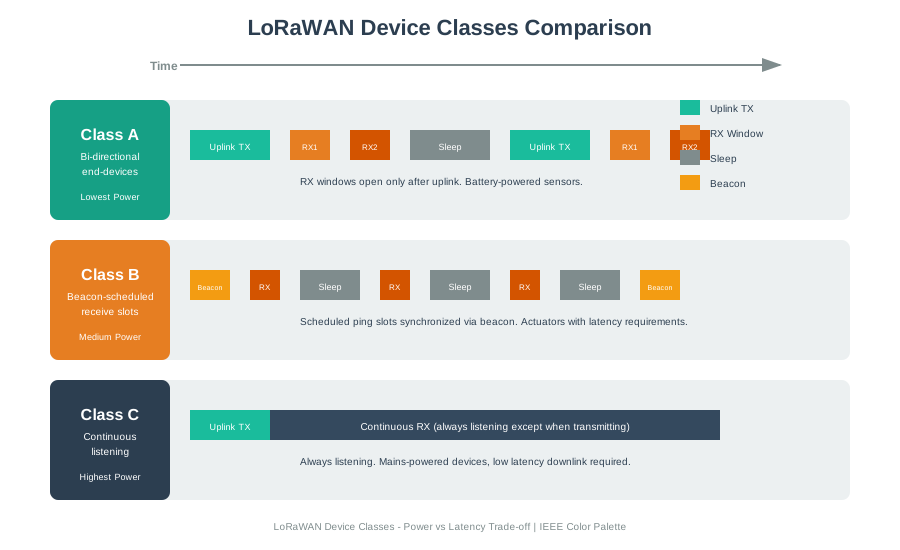
Many quiz questions test understanding of class selection trade-offs - this visualization shows the power vs latency continuum that drives device class decisions.
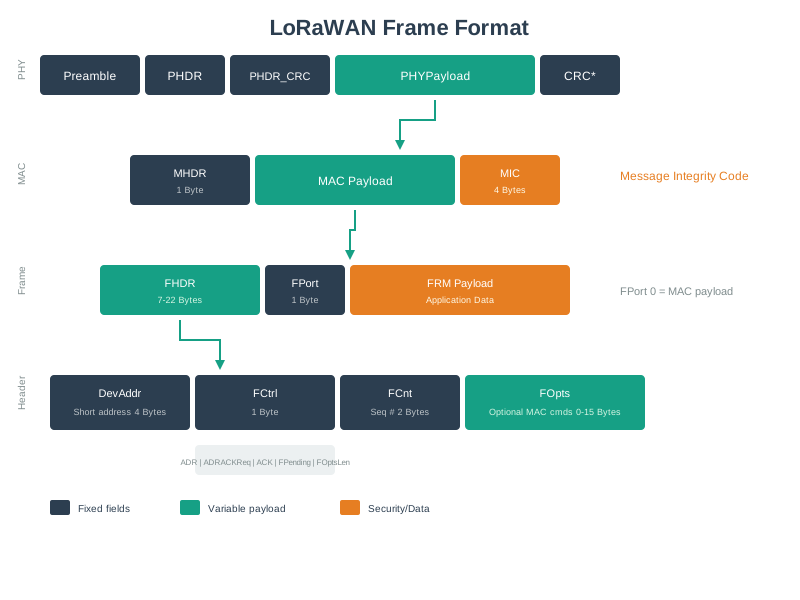
Frame format understanding is essential for airtime calculation questions and troubleshooting scenarios involving frame counter resets or MIC validation failures.
31.2.1 Mid-Chapter Check: Power Budget Fundamentals
Before working through the solar panel sizing example below, test your grasp of the core battery calculation concepts.
Scenario: A remote industrial valve requires Class C operation (< 1 second downlink latency) but has no mains power. Can solar + battery provide reliable power year-round?
Given:
- Class C LoRaWAN module: 12 mA continuous RX, 100 mA TX (10 messages/day, 206 ms each)
- Location: Seattle, WA (poor winter sun: 1.5 peak sun hours/day Dec-Jan)
- Battery: 18650 Li-ion cell (3,400 mAh, 3.7V = 12.6 Wh)
- Required autonomy: 7 days (winter clouds)
Power Budget Calculation:
Daily consumption (Class C):
- RX: 12 mA x 24 hours = 288 mAh/day
- TX: 100 mA x 206 ms x 10 = 206 mAs = 0.057 mAh/day
- Total: 288 mAh/day (RX dominates)

7-day reserve: 288 x 7 = 2,016 mAh
Battery capacity: 3,400 mAh
Usable capacity (80% DoD): 2,720 mAh
Margin: 2,720 - 2,016 = 704 mAh (26% safety buffer)
Solar Panel Sizing:
Daily charge needed: 288 mAh
Worst-case sun: 1.5 peak hours/day (Seattle Dec-Jan)
Solar efficiency: 70% (panel degradation, charging losses)
Required panel: 288 / (1.5 x 0.7) = 274 mA @ 5V

Panel selection: 2W panel (400 mA @ 5V) provides 1.46x safety margin
Cost: $15-25 per panel + $8 charge controller
Reality Check - Is This Viable?
Winter week (7 cloudy days):
- Battery drains: 288 mAh/day x 7 = 2,016 mAh
- Minimal solar input: ~50 mAh/day (0.5 peak hours) x 7 = 350 mAh
- Net drain: 1,666 mAh from 3,400 mAh battery = 49% capacity
- Status: Viable (does not exceed 80% DoD)

One sunny day recharge: 2W panel x 3.5 peak hours x 0.7 efficiency = 490 mAh
Days to full recharge: 1,666 / 490 = 3.4 days
Key Insight: Class C solar operation is possible in low-sun climates, but requires oversized battery (3,400 mAh vs 288 mAh daily use = 12x) and generous solar panel (2W for 288 mAh/day need). Compare this to Class A: same valve with 5-second heartbeat (30-day battery life) would need only 500 mAh battery + 0.5W panel, reducing total cost from $50 to $20 per node.
Production Decision: For battery-powered Class C, analyze worst-month sun data and size battery for 7-14 day autonomy. If budget allows, use mains power with battery backup instead - more reliable and often cheaper over 5-10 year lifetime.
31.3 Summary
This chapter covered battery optimization concepts for LoRaWAN deployments:
- Duty Cycle Compliance: Understanding EU868 1% limits and per-device calculations
- Class Power Profiles: Comparing Class A (lowest power) vs Class C (highest power)
- Downlink Latency Trade-offs: Balancing responsiveness against battery life
- Hybrid Approaches: Using context-aware transmission intervals for optimal battery usage
Common Pitfalls
Calculating expected battery life using datasheet typical values can be significantly wrong. Actual sleep current is heavily influenced by peripheral configuration, voltage regulator efficiency, and firmware implementation. Always measure actual current with a power analyzer before finalizing battery capacity.
TX power directly affects TX current. Transmitting at 14 dBm uses significantly more current than 2 dBm. ADR can lower TX power when near a gateway, dramatically extending battery life. Design applications to enable ADR rather than fixing maximum TX power.
Deep sleep modes saving the most power often don’t support RTC wake-up on some microcontrollers. Implementing the sleep cycle incorrectly results in devices that don’t transmit at all or wake too frequently, both causing battery life to miss targets.
Waking up to read sensors at high frequency (every second) and only transmitting occasionally still consumes significant power for sensor reads and ADC conversions. Sample sensors immediately before transmission rather than continuously accumulating readings.
31.4 What’s Next
Continue to the next quiz chapter or revisit other topics in the series:
| Next Chapter | Focus Area |
|---|---|
| Network Scalability Quiz | Collision analysis, ADR optimization, and gateway capacity planning |
| Fundamentals Quiz | Common misconceptions and device class selection scenarios |
| Activation & Security Quiz | OTAA vs ABP security trade-offs and frame counter management |
| Regional Deployment Quiz | EU868/US915 channel configuration and international roaming |
| Quiz Bank Index | Complete overview of all five quiz chapters |