A logistics company needs to track 2,000 refrigerated trailers across Europe for 5 years. Each trailer reports GPS location, temperature, and door status every 15 minutes.
Payload design:
| Latitude |
int24 × 0.0001° |
3 |
| Longitude |
int24 × 0.0001° |
3 |
| Temperature |
int8 × 0.5°C |
1 |
| Battery voltage |
uint8 × 0.02V |
1 |
| Status flags (door, motion, low battery) |
bitfield |
1 |
| Total |
|
9 bytes |
9 bytes < 12 bytes (Sigfox uplink limit) ✅
Message frequency:
24 hours / 15 minutes = 96 messages/day 96 < 140 (Sigfox daily limit) ✅
Sigfox 5-year TCO:
| Hardware (Sigfox module + GPS) |
2,000 × €18 |
36,000 |
| Sigfox subscription |
2,000 × €6/year × 5 years |
60,000 |
| Installation labor |
2,000 × €50 |
100,000 |
| Total 5-year cost |
|
€196,000 |
| Per-device |
|
€98 |
LoRaWAN 5-year TCO:
| Hardware (LoRa module + GPS) |
2,000 × €22 |
44,000 |
| Gateways (50 cities, 3 GW each) |
150 × €1,200 |
180,000 |
| Gateway installation |
150 × €800 |
120,000 |
| LTE backhaul |
150 × €25/month × 60 months |
225,000 |
| Network server (ChirpStack self-hosted) |
€15,000 setup + €8,000/year × 5 |
55,000 |
| Installation labor (devices) |
2,000 × €50 |
100,000 |
| Total 5-year cost |
|
€724,000 |
| Per-device |
|
€362 |
Cost comparison:
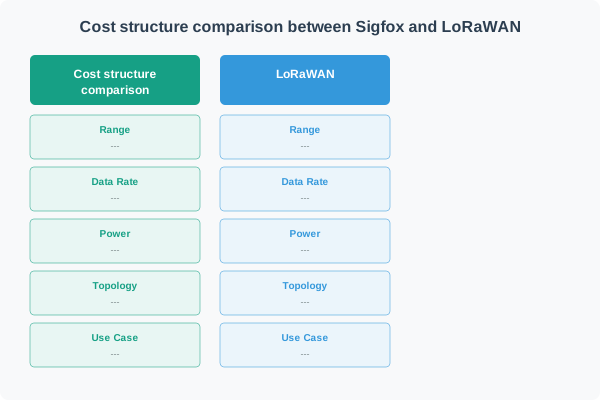
Sigfox: €196,000 (3.7× cheaper) LoRaWAN: €724,000
Winner: Sigfox for this scenario
Why Sigfox wins here:
- Geographically dispersed: Trailers spread across Europe → Sigfox’s operator-managed network provides coverage without deploying infrastructure
- Low message frequency: 96 messages/day well within Sigfox’s 140 limit
- Small payload: 9 bytes fits comfortably in 12-byte limit
- Rare downlinks: GPS configuration updates happen quarterly (4 downlinks/year < Sigfox’s 4/day limit)
- 5-year horizon: Sigfox subscription cost (€60k total) much lower than LoRaWAN infrastructure (€580k for gateways + backhaul + servers)
When LoRaWAN would win:
If payload was 40 bytes (vehicle diagnostics data): - Sigfox: Cannot support (12-byte limit) - LoRaWAN: Works perfectly (222-byte limit at SF7)
If message frequency was every 1 minute: - Sigfox: 1,440 messages/day exceeds 140 limit → Unusable - LoRaWAN: 1,440 messages/day easily supported
If deployment was confined to 10 company depots: - Sigfox: €196,000 (same) - LoRaWAN: €44,000 (devices) + €24,000 (20 gateways) + €55,000 (server) = €123,000 (cheaper than Sigfox!)
Lesson: Technology selection depends on deployment scale, geography, and message profile. Sigfox wins for dispersed, low-frequency applications. LoRaWAN wins for campus deployments or high-frequency/large-payload needs.
The TCO crossover analysis uses: \(C_{total} = N \times C_{device} + C_{gateway} + N \times C_{sub} \times Y\)
Setting LoRaWAN = Sigfox for \(N\) devices over 5 years: \[N \times 22 + 150 \times 1,200 + 225,000 = N \times 18 + N \times 6 \times 5\] \[22N + 405,000 = 48N\] \[N = 15,577 \text{ devices}\]
At 2,000 devices (our fleet scenario): - Sigfox: \(€196,000\) (wins by \(€528K\)) - LoRaWAN: \(€724,000\)
At 20,000 devices (10× scale): - Sigfox: \(€1,960,000\) - LoRaWAN: \(€1,069,000\) (wins by \(€891K\))
The crossover demonstrates how gateway CapEx amortizes: Sigfox’s per-device OpEx dominates at scale.