40 Sigfox Technology Deep Dive
40.1 Learning Objectives
- Explain Ultra Narrow Band (UNB) modulation with 100 Hz channels achieving -142 dBm sensitivity
- Compare Sigfox operator model with LoRaWAN user-deployable infrastructure across cost and control tradeoffs
- Calculate link budgets for Sigfox uplink/downlink with transmit power, path loss, and receiver sensitivity
- Apply Sigfox constraints (140 messages/day, 12-byte payload) to IoT application design
- Evaluate Sigfox Atlas RSSI-based geolocation for asset tracking without GPS hardware
Key Concepts
- BPSK Physical Layer: Sigfox uses Binary Phase Shift Keying (BPSK/DBPSK) for modulation; phase transitions encode 1-bit per symbol on 100 Hz bandwidth channel.
- Frequency Band: Sigfox operates in ISM bands; EU uses 868.0–868.6 MHz sub-band, US uses 902–928 MHz; regional variations managed by SNOs.
- Three Transmissions: Each Sigfox message is sent 3 times with random frequency within the 200 kHz band and random time offset; improves probability of base station reception.
- Base Station Sensitivity: Sigfox base station receivers achieve ~−130 dBm sensitivity enabling 30–50 km range in ideal conditions with modest TX power (14–22 dBm).
- Demodulation: Sigfox base stations use coherent BPSK demodulation; simple algorithm suitable for low-cost infrastructure; cloud aggregates multiple receptions.
- Spectrum Occupancy: Ultra-narrow 100 Hz transmission occupies minimal spectrum; many devices can coexist in 200 kHz band unlike wideband technologies.
- Technology Evolution: Sigfox published RC (Radio Configuration) variants for different regions; RC1 (EU), RC2 (US), RC3 (JP), RC4 (AU) with region-specific parameters.
This chapter explores the technical details of how Sigfox works: ultra-narrowband modulation, random frequency transmission, cooperative reception by multiple base stations, and cloud-based processing. Understanding these mechanisms explains why Sigfox achieves remarkable range and battery life with such simple hardware.
“Sigfox uses the narrowest radio channels in the IoT world!” Sammy the Sensor said. “Each channel is only 100 hertz wide – compare that to LoRaWAN’s 125,000 hertz or Wi-Fi’s 20 million hertz. This ultra-narrow bandwidth lets my signal be detected even when it is incredibly faint, giving me ranges of 30 to 50 kilometers in rural areas!”
“The transmission trick is clever,” Lila the LED explained. “When I send a message, I broadcast it three times on three random frequencies. Each time a different set of base stations might pick it up. The Sigfox cloud collects all the copies and combines them to reconstruct my message. It is like throwing three message bottles into the ocean from different spots!”
Max the Microcontroller added, “All the intelligence lives in the cloud, which makes my job incredibly simple. I do not need to handle network registration, frequency selection, or retransmissions. I just modulate my data onto a random frequency and transmit. The simpler I am, the cheaper I am to build and the less power I use.”
“The link budget is impressive,” Bella the Battery said. “Sigfox achieves -142 dBm receiver sensitivity, even better than LoRaWAN’s -137 dBm. Combined with the ultra-narrow bandwidth, this gives Sigfox the longest range of any LPWAN technology. For devices that only need to send tiny messages, Sigfox is hard to beat on range and simplicity!”
40.2 Sigfox Technology Overview
40.2.1 The Company and Vision
Sigfox is a French company founded in 2009 with a vision to connect billions of IoT devices using a dedicated low-power wide-area network. Rather than selling equipment for customers to build their own networks, Sigfox operates as a network service provider—similar to how cellular carriers operate.
Key philosophy:
- Software-based solution: Network and computing complexity managed in the cloud
- Simple devices: All intelligence in the network, not the endpoints
- Global coverage: Single subscription works across countries
- Ultra-low cost: Minimal device complexity reduces hardware costs
Table: Sigfox Technology Summary
| Property | Details |
|---|---|
| Name | Sigfox |
| Standard protocol is based on | Ultra Narrow Band (UNB) ISM radio band |
| Designed for | Uses Ultra Narrow Band (UNB) to transmit information between low power devices operating at 868 MHz frequency band, dividing the 192 kHz spectrum into ~1,920 channels of 100 Hz each |
| Connection range | 30-50 km for rural areas, and 3-10 km for urban areas |
| Data rate | 100bps, with a limit of 140 messages per day for each end device |
Traditional IoT vs Sigfox Approach:
| Aspect | Traditional IoT (Wi-Fi/Cellular) | Sigfox Approach |
|---|---|---|
| Device | Complex (full network stack) | Simple (UNB radio only) |
| Gateway | Local gateway with processing | Sigfox base station (forward only) |
| Processing | Split between edge and cloud | All processing in Sigfox Cloud |
| Complexity | High device cost, moderate latency | Ultra-low device cost, simple firmware |
40.2.2 Ultra-Narrow Band Modulation
Sigfox uses Ultra Narrow Band (UNB) modulation, which is fundamentally different from spread spectrum techniques used by LoRa or frequency hopping used by Bluetooth.
UNB Characteristics:
- Extremely narrow channel bandwidth: 100 Hz per channel
- Multiple channels across the ISM band
- Low data rate: 100 bps uplink, 600 bps downlink
- High receiver sensitivity: -126 to -142 dBm
- Robust against interference and jamming
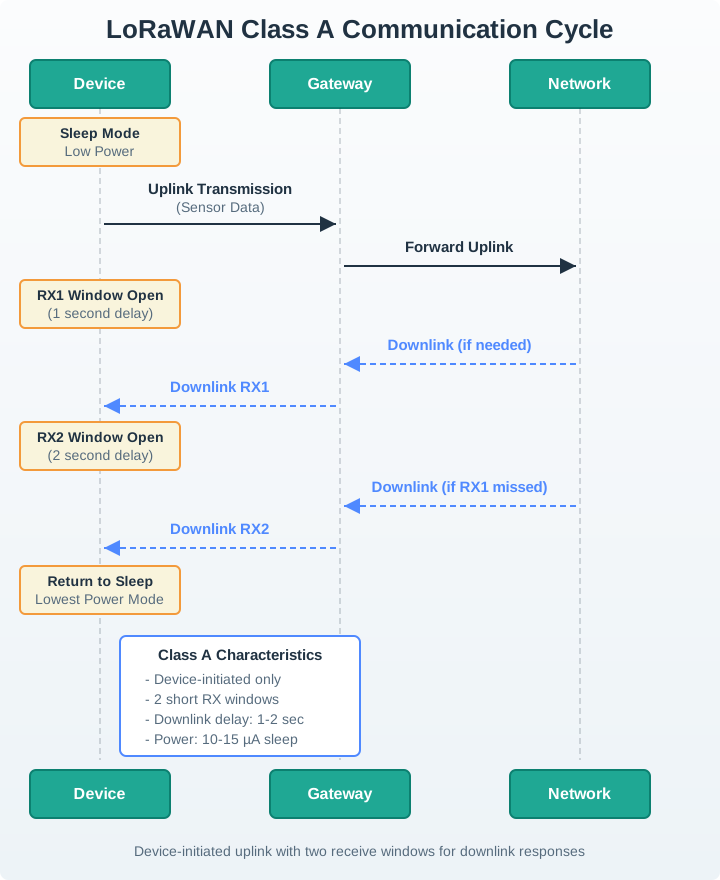
This Gantt chart shows Sigfox’s transmission pattern: each message is sent 3 times on different frequencies over ~6 seconds, providing redundancy through time and frequency diversity.
Comparison with other modulation schemes:
| Technology | Bandwidth | Data Rate | Sensitivity |
|---|---|---|---|
| Sigfox (UNB) | 100 Hz | 100 bps | -126 to -142 dBm |
| LoRa (CSS) | 125-500 kHz | 250-5,470 bps | -137 dBm (SF12/125kHz) |
| FSK (Cellular) | 200 kHz | 1-100 kbps | -110 dBm |
| Wi-Fi (OFDM) | 20-40 MHz | 1-600 Mbps | -90 dBm |
40.2.3 Sigfox Radio Parameters
The technical specifications of Sigfox’s radio system define its unique operational characteristics and constraints:
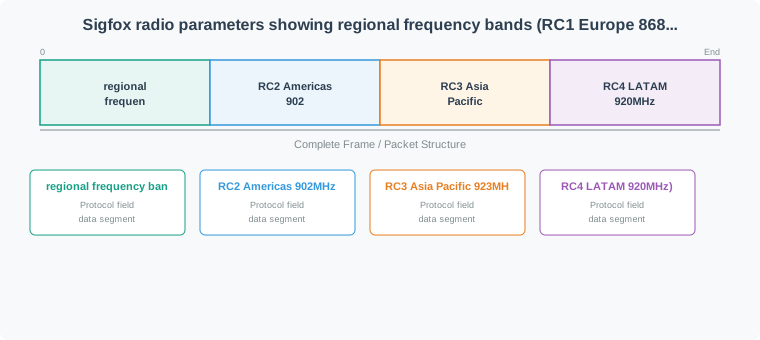
Key Constraints to Remember:
- Message Limits: 140 uplink + 4 downlink per day (non-negotiable)
- Payload Size: 12 bytes uplink, 8 bytes downlink (extremely small)
- Data Rate: 100 bps uplink means ~2 seconds per transmission
- Downlink Cost: Listening for downlink consumes significant battery (20-25 seconds RX)
- Regional Variations: Different frequency bands and regulations per region
40.2.4 Sigfox vs LoRaWAN: Architectural Comparison
Understanding the fundamental differences between Sigfox and LoRaWAN helps in making informed technology choices:
Decision Framework: When to Choose Each Technology
Choose Sigfox when:
- Coverage exists in your deployment region (verify first!)
- Small, infrequent messages (environmental monitoring, asset tracking)
- Deployment < 1,000 devices (subscription model economical)
- No infrastructure management capability
- Global roaming needed (single subscription works across countries)
Choose LoRaWAN when:
- Need larger payloads (> 12 bytes) or frequent updates (> 140/day)
- Large-scale deployment (> 1,000 devices - infrastructure becomes cheaper)
- Want network control and coverage customization
- Sigfox coverage unavailable in deployment area
- Private network required (security/compliance)
Crossover Point: Around 1,000-2,000 devices, LoRaWAN’s infrastructure cost becomes competitive with Sigfox’s cumulative subscription fees.
40.3 Decision Framework: Choosing the Right LPWAN Technology
Use Sigfox when:
- Simple sensors with infrequent data (temperature, water meters, parking sensors)
- Message size under 12 bytes and less than 140 messages/day
- Coverage exists in your deployment region (verify first!)
- Small to medium deployment (<1,000 devices)
- No infrastructure management capability or desire
- Global roaming needed (single subscription works across countries)
- Budget-constrained project (lowest upfront and operational cost)
Use LoRaWAN when:
- Need larger payloads (>12 bytes) or more frequent updates (>140/day)
- Large-scale deployment (>1,000 devices - infrastructure becomes economical)
- Want network control and coverage customization
- Sigfox coverage unavailable in your deployment area
- Private network required (security/compliance/independence)
- Bidirectional communication needed (sensors + actuators)
Use NB-IoT when:
- Need high data rates (>1 kbps) or larger payloads (>1 KB)
- Mobile assets requiring seamless handover (vehicles, shipping)
- Real-time applications with latency <5 seconds
- Existing cellular carrier relationships
- Indoor/underground deployments (better penetration than LPWAN)
- Willing to pay premium for carrier-grade reliability
40.3.1 LPWAN Technology Comparison with Real Numbers
| Criterion | Sigfox | LoRaWAN | NB-IoT |
|---|---|---|---|
| Range | 10-50 km rural, 3-10 km urban | 2-15 km rural, 1-5 km urban | 1-10 km (cellular coverage) |
| Payload | 12 bytes up, 8 bytes down | Up to 242 bytes | Up to 1600 bytes |
| Messages | 140 up/4 down per day | Unlimited (duty cycle limited) | Unlimited |
| Battery Life | 10-20 years | 5-15 years | 2-10 years |
| Device Cost | $5-15 | $10-25 | $15-30 |
| Connectivity | $1-2/device/year | $0 (own infrastructure) or $1-5/year (TTN) | $6-24/device/year |
| Infrastructure | $0 (operator-provided) | $200-1,500 per gateway | $0 (carrier-provided) |
| Coverage | 75+ countries, operator-dependent | Self-deployed or community (TTN) | 190+ countries (cellular) |
| Deployment | Easiest (plug-and-play) | Moderate (gateway setup) | Easy (SIM card) |
| Latency | 2-90 seconds | 1-5 seconds | 1-10 seconds |
40.3.2 Cost Crossover Analysis (5-Year Total Cost of Ownership)
100 DEVICES (5 years):
━━━━━━━━━━━━━━━━━━━━━━
Sigfox:    $1,500 devices + $500 subscription = $2,000 ✓ CHEAPEST
LoRaWAN:   $2,000 devices + $500 gateway + $0 subscription = $2,500
NB-IoT:    $2,000 devices + $12,000 subscription = $14,000

1,000 DEVICES (5 years):
━━━━━━━━━━━━━━━━━━━━━━━━
Sigfox:    $12,000 devices + $5,000 subscription = $17,000 ✓ WINNER
LoRaWAN:   $20,000 devices + $5,000 gateways + $0 subscription = $25,000
NB-IoT:    $25,000 devices + $120,000 subscription = $145,000

10,000 DEVICES (5 years):
━━━━━━━━━━━━━━━━━━━━━━━━━
Sigfox:    $120,000 devices + $50,000 subscription = $170,000
LoRaWAN:   $200,000 devices + $50,000 gateways + $0 subscription = $250,000 ✓ STARTS TO WIN
NB-IoT:    $250,000 devices + $1,200,000 subscription = $1,450,000

50,000+ DEVICES: LoRaWAN becomes most economical (infrastructure amortized)
Key Insight: Sigfox wins for small-to-medium deployments (<5,000 devices). LoRaWAN becomes cheaper at scale due to zero per-device fees. NB-IoT is premium option for specific use cases only.
40.4 Deep Dive: Advanced Sigfox Concepts
Ultra-Narrow Band (UNB) Modulation Explained:
Sigfox uses DBPSK (Differential Binary Phase Shift Keying) for uplink and GFSK (Gaussian Frequency Shift Keying) for downlink, both squeezed into extremely narrow 100 Hz channels.
Why 100 Hz Channels?
Bandwidth vs Range Trade-off:
━━━━━━━━━━━━━━━━━━━━━━━━━━
Wide channel (Wi-Fi 20 MHz):     High data rate, short range, high power
Medium channel (LoRa 125 kHz):  Moderate data, long range, low power
Narrow channel (Sigfox 100 Hz): Tiny data, extreme range, minimal power

Shannon-Hartley Theorem: C = B × log₂(1 + SNR)
- Sigfox reduces bandwidth (B) dramatically
- Compensates by improving SNR through long transmission time
- Result: Same information, much lower power density
Technical Specifications:
| Parameter | Uplink (DBPSK) | Downlink (GFSK) |
|---|---|---|
| Modulation | Differential BPSK | Gaussian FSK |
| Bandwidth | 100 Hz | 600 Hz |
| Data Rate | 100 bps | 600 bps |
| TX Power | 14-27 dBm (25-500 mW) | N/A (base station) |
| RX Sensitivity | -126 dBm typical, -142 dBm best | -142 dBm |
| Transmission Time | ~6 seconds per message | ~4 seconds |
| Frequency Hop | Random per message | Fixed during RX window |
Context: Sigfox link budget determines maximum communication range.
Free-space path loss formula: \[L_{\text{path}} = 32.45 + 20\log_{10}(f_{\text{MHz}}) + 20\log_{10}(d_{\text{km}})\]
For Sigfox at 868 MHz, 10 km distance: \[L_{\text{path}} = 32.45 + 20\log_{10}(868) + 20\log_{10}(10) = 32.45 + 59.0 + 20 = 111.4\,\text{dB}\]
Link budget calculation (10 km): \[P_{\text{RX}} = P_{\text{TX}} + G_{\text{TX}} - L_{\text{path}} + G_{\text{RX}}\] \[P_{\text{RX}} = 14 + (-2) - 111.4 + 10 = -89.4\,\text{dBm}\]
Link margin: \(M = P_{\text{RX}} - S_{\text{RX}} = -89.4 - (-126) = 36.6\,\text{dB}\) ✓ Excellent
Worked example at 30 km: \[L_{\text{path}} = 32.45 + 59.0 + 20\log_{10}(30) = 32.45 + 59.0 + 29.5 = 121.0\,\text{dB}\] \[P_{\text{RX}} = 14 - 2 - 121 + 10 = -99\,\text{dBm}\] \[M = -99 - (-126) = 27\,\text{dB}\] ✓ Still robust
Sigfox’s -126 dBm sensitivity (typical) to -142 dBm (best case) provides 16 dB additional margin in challenging environments.
Link Budget Calculation:
Sigfox Link Budget (Uplink):
━━━━━━━━━━━━━━━━━━━━━━━━━━━
TX Power:              +14 dBm (device)
Antenna Gain (device): -2 dBi (PCB antenna)
Path Loss (10 km):     -125 dB (free space + obstacles)
Antenna Gain (BS):     +10 dBi (base station tower)
━━━━━━━━━━━━━━━━━━━━━━━━━━━
Received Signal:       -103 dBm

RX Sensitivity:        -126 dBm (typical)
Link Margin:           23 dB ✓ (good margin)

With 30 km range:
Path Loss:             -135 dB
Received Signal:       -113 dBm
Link Margin:           13 dB ✓ (still works)
Why This Matters: The extreme sensitivity (-142 dBm) enables Sigfox to work in very challenging RF environments - underground pipes, inside metal containers, dense urban areas.
Three-Tier Architecture:
Spatial Diversity (Redundant Reception):
Sigfox base stations operate in “always listening” mode. When a device transmits, multiple base stations typically receive the same message, improving reliability:
Message Reception Example:
━━━━━━━━━━━━━━━━━━━━━━━━━━
Device sends 1 message

BS #1: RSSI -98 dBm, SNR 12 dB → ✓ Received
BS #2: RSSI -115 dBm, SNR 3 dB → ✓ Received
BS #3: RSSI -130 dBm, SNR -5 dB → ✗ Missed

Sigfox Cloud:
• Receives message from BS #1 and BS #2
• Deduplicates (keeps strongest signal)
• Uses triangulation for geolocation
• Result: 99%+ reliability even if one BS fails
Geolocation Without GPS:
Sigfox can estimate device location using signal strength from multiple base stations:
RSSI-Based Geolocation:
━━━━━━━━━━━━━━━━━━━━━━
BS #1 (-98 dBm): Device ~5 km away
BS #2 (-110 dBm): Device ~15 km away
BS #3 (-105 dBm): Device ~10 km away

Triangulation Algorithm:
→ Calculates most likely position
→ Accuracy: 1-10 km (rural) to 100-500 m (urban)
→ No GPS needed (saves device cost + power)
Use Cases: Asset tracking without GPS modules, emergency location for lone workers, wildlife monitoring.
Sigfox Atlas is a cloud-based service that provides device geolocation without requiring GPS hardware.
How It Works:
- RSSI Collection: Multiple base stations record signal strength (RSSI) when receiving device message
- Propagation Model: Sigfox applies radio propagation models accounting for terrain, buildings, weather
- Triangulation: Calculates most probable device location using RSSI from 2+ base stations
- Machine Learning: Improves accuracy over time by learning environmental factors
Accuracy Comparison:
| Environment | Atlas Accuracy | GPS Accuracy | Power/Cost Difference |
|---|---|---|---|
| Open rural | 1-5 km | 5-10 m | Atlas: 0 mW, $0 |
| Suburban | 500 m - 2 km | 5-10 m | GPS: +50 mW, +$5-15 |
| Dense urban | 100-500 m | 5-30 m | GPS battery: 2× drain |
| Indoor | Not available | Not available | Both fail indoors |
When to Use Atlas vs GPS:
- Use Atlas: Low-precision tracking (city-level), cost-sensitive, battery-critical
- Use GPS: High-precision needed (<100 m), mobile assets, outdoor-only deployment
40.5 Videos
40.7 Why Sigfox’s Business Model Changed in 2022
Sigfox filed for French court protection in January 2022 and was acquired by UnaBiz (a Singapore-based IoT company) in April 2022. Understanding why matters for technology selection decisions:
What went wrong:
Operator lock-in without operator-scale revenue: Sigfox built and operated its own base stations (like a cellular carrier) but charged only $1-2/device/year. Cellular carriers charge $5-60/device/year. The low ARPU (Average Revenue Per User) could not sustain network infrastructure costs across 72 countries.
LoRaWAN’s ecosystem grew faster: By 2021, there were 200+ LoRaWAN network operators and thousands of private deployments. Sigfox remained the sole operator of its network, limiting innovation and competition.
NB-IoT/LTE-M undercut the value proposition: Cellular carriers deployed NB-IoT on existing towers at marginal cost, offering similar coverage with better QoS guarantees and no separate network subscription.
What this means for new deployments (2024+):
| Factor | Pre-Acquisition (2020) | Post-Acquisition (2024+) |
|---|---|---|
| Network coverage | 72 countries | Consolidating to ~30 active countries |
| New device activations | Open | Available but monitor regional status |
| Long-term support | Uncertain | UnaBiz committed through 2030+ |
| Alternative path | None (proprietary) | UnaBiz supports LoRaWAN migration |
| Best use case | New greenfield deployments | Existing installations, dual-mode devices |
Recommendation for new projects: Evaluate Sigfox only if your target region has confirmed active coverage AND you need the ultra-simple device architecture. For new deployments, LoRaWAN or NB-IoT offer more predictable long-term support. For existing Sigfox deployments, UnaBiz provides continuity and a migration path to LoRaWAN when needed.
40.8 Concept Relationships
| Core Concept | Builds On | Leads To | Contrasts With | Prerequisites |
|---|---|---|---|---|
| UNB Modulation | Shannon-Hartley theorem, DBPSK/GFSK | 100 Hz channels, -142 dBm sensitivity | LoRa CSS (125-500 kHz), NB-IoT OFDMA | RF modulation, ISM bands |
| Three-Tier Architecture | Star topology, cellular model | Devices → Base stations → Cloud | LoRaWAN user-deployable gateways | Network architecture |
| Spatial Diversity | Redundant reception, RSSI triangulation | 99%+ reliability, Atlas geolocation | Single gateway reception (LoRaWAN) | Path loss, signal strength |
| Link Budget | Friis equation, path loss models | 30-50 km rural range, 3-10 km urban | LoRaWAN 15-30 km, NB-IoT 10 km | RF propagation, dBm calculations |
| Operator Dependency | Subscription model, shared infrastructure | Zero CapEx, coverage risk | LoRaWAN private networks (control) | Network economics |
40.9 See Also
- Sigfox Introduction - Business model, use cases, and common deployment mistakes
- LoRaWAN Architecture - Compare UNB with chirp spread spectrum modulation
- Link Budget Fundamentals - RF calculations for range estimation
- LPWAN Comparison - Sigfox vs LoRaWAN vs NB-IoT across 15+ dimensions
- Wireless Sensor Networks - WSN design patterns for LPWAN deployments
40.10 Try It Yourself
Challenge: Sigfox Link Budget Calculation
You’re designing a Sigfox-based agricultural monitoring system for a vineyard. Sensors will be placed 25 km from the nearest base station in rural terrain.
Given Parameters:
- Device TX power: 14 dBm (25 mW)
- Device antenna gain: -2 dBi (PCB antenna)
- Base station antenna gain: 10 dBi (tower-mounted directional)
- Base station RX sensitivity: -126 dBm (typical)
- Required link margin: 10 dB (for fading/obstacles)
Your Task:
- Calculate path loss at 25 km using free-space formula:
PL = 32.45 + 20log₁₀(f) + 20log₁₀(d)where f = 868 MHz, d = 25 km - Compute received signal strength: TX power + TX antenna gain - Path loss + RX antenna gain
- Determine link margin: Received signal - RX sensitivity
- Assess feasibility: Is the link margin ≥ 10 dB for reliable operation?
What to Observe:
- How much does the base station antenna gain contribute to overcoming 25 km path loss?
- If received signal is below sensitivity, what options exist (higher TX power, better antenna, external antenna)?
- At what distance would the link budget fail with 0 dB margin?
- How does moving from rural (line-of-sight) to urban (obstacles) change path loss?
Extension: Repeat the calculation for Sigfox’s best-case sensitivity (-142 dBm). How much additional range does this provide?
40.11 How It Works
Sigfox UNB Modulation: Why 100 Hz Channels Enable 50 km Range
Ultra-Narrow Band modulation achieves extreme range through physics, not magic. Here’s the step-by-step mechanism:
Step 1: Narrow Bandwidth Concentrates Power
- Standard FSK uses 25-50 kHz channels → power density = TX power / 50,000 Hz
- Sigfox UNB uses 100 Hz channels → power density = TX power / 100 Hz
- Result: Power spectral density is 500× higher for the same transmit power
- Analogy: Focusing a flashlight beam into a laser pointer - same energy, concentrated
Step 2: Narrow-Band Receiver Rejects Noise
- Thermal noise power is proportional to bandwidth: N = kTB (Boltzmann constant × Temperature × Bandwidth)
- Wide receiver (50 kHz): N = -174 dBm/Hz + 10log₁₀(50,000) = -127 dBm noise floor
- Narrow receiver (100 Hz): N = -174 dBm/Hz + 10log₁₀(100) = -154 dBm noise floor
- UNB receiver has 27 dB better noise floor, enabling -142 dBm sensitivity
Step 3: Long Integration Time Improves SNR
- At 100 bps, each bit lasts 10 milliseconds
- Receiver integrates signal over 10 ms window, averaging out random noise
- Signal (coherent) adds linearly; noise (random) adds as sqrt(N)
- Longer integration time = better SNR for the same signal strength
Step 4: Link Budget Calculation
Sigfox Uplink (30 km rural):
TX Power:          +14 dBm (25 mW)
TX Antenna Gain:   -2 dBi (PCB antenna)
Path Loss (30 km): -135 dB (868 MHz, rural)
RX Antenna Gain:   +10 dBi (base station)
─────────────────────────────
Received Signal:   -113 dBm

RX Sensitivity:    -142 dBm (UNB receiver)
Link Margin:       29 dB ✓ (excellent)
Step 5: Frequency Diversity Combats Fading
- Each message sent 3 times on random frequencies (e.g., 868.100 MHz, 868.250 MHz, 868.450 MHz)
- Urban multipath fading affects each frequency differently
- Probability all 3 frequencies fade simultaneously is low: P(fail) = 0.05³ = 0.0125%
Trade-off: The narrow 100 Hz bandwidth limits data rate to 100 bps by Shannon’s law: C = B × log₂(1 + SNR). Even with infinite SNR, 100 Hz bandwidth cannot support more than ~665 bps. This is why Sigfox is limited to tiny payloads and low data rates - the extreme range comes at the cost of throughput.
Key Insight: Sigfox’s 100 Hz channels are not an arbitrary choice - they are the optimal balance between range (narrow = better) and regulatory constraints (1% duty cycle in EU 868 MHz ISM band limits total airtime, which at 100 bps translates to 140 messages/day of 12 bytes each).
40.12 Summary
Key Takeaways:
- UNB Modulation: Ultra-narrow 100 Hz channels enable extreme sensitivity (-142 dBm) and long range (10-50 km)
- Three-Tier Architecture: Simple devices → Operator base stations → Sigfox cloud backend
- Spatial Diversity: Multiple base stations receive same message for 99%+ reliability
- Atlas Geolocation: RSSI-based positioning (1-10 km accuracy) without GPS hardware
- Network Philosophy: All intelligence in cloud, minimal device complexity
Technology Comparisons:
| Feature | Sigfox | LoRaWAN | NB-IoT |
|---|---|---|---|
| Modulation | UNB (DBPSK) | CSS (LoRa) | LTE (OFDMA) |
| Bandwidth | 100 Hz | 125-500 kHz | 180 kHz |
| Sensitivity | -126 to -142 dBm | -137 dBm (SF12) | -141 dBm (164 dB MCL) |
| Infrastructure | Operator-only | User-deployable | Carrier-only |
| Cost @1K devices | $17K (5yr) | $25K (5yr) | $145K (5yr) |
Common Pitfalls
NB-IoT uses 200 kHz channels, which is “narrowband” compared to cellular. Sigfox uses 100 Hz channels, which is “ultra-narrowband” — 2000x narrower than NB-IoT. This difference creates very different interference characteristics and sensitivity levels.
Sigfox doesn’t acknowledge receipt or retry like cellular. Three transmissions with random frequency and timing offsets improve probability that at least one copy is received by at least one base station in potentially noisy conditions. It’s diversity transmission, not automatic retry.
Both technologies operate in the same ISM bands. Sigfox’s 100 Hz channel sits within the broader frequency space shared by LoRaWAN transmissions. In areas with high LoRaWAN deployment density, LoRaWAN energy spreads into Sigfox’s narrow channels causing interference.
Sigfox uses different center frequencies by region (EU: 868 MHz, US: 902 MHz). Hardware designed for EU operation is technically incompatible with US operation. Always verify hardware regional compatibility matches the deployment country before procurement.
40.13 What’s Next
| Chapter | Description |
|---|---|
| Sigfox Worked Examples | Practical calculations for message budgets, TCO analysis, link budgets, and duty cycle compliance |
| Sigfox Use Cases | Suitability evaluation frameworks and real-world deployment analysis |
| Sigfox Assessment | Test your Sigfox knowledge with comprehensive quizzes |
| LoRaWAN Architecture | Compare Sigfox’s operator model with LoRaWAN’s user-deployable approach |
| LPWAN Fundamentals | Broader LPWAN technology landscape and protocol comparison |