32 LoRaWAN Quiz: Network Scalability
Quiz mastery targets are easiest to plan with threshold math:
\[ C_{\text{target}} = \left\lceil 0.8 \times N_{\text{questions}} \right\rceil \]
Worked example: For a 15-question quiz, target correct answers are \(\lceil 0.8 \times 15 \rceil = 12\). If a learner moves from 8/15 to 12/15, score rises from 53.3% to 80%, crossing mastery with four additional correct answers.
32.1 Learning Objectives
By the end of this quiz chapter, you will be able to:
- Calculate Collision Probability: Apply the ALOHA formula to compute packet loss rates based on network load, channel count, and SF distribution
- Assess ADR Benefits: Explain how Adaptive Data Rate improves network capacity by up to 21x through SF diversity and quantify its impact on airtime reduction
- Design Scalable Networks: Architect LoRaWAN deployments supporting thousands of devices with minimal packet loss by balancing SF distribution, channel utilization, and gateway placement
- Differentiate Scalability Bottlenecks: Distinguish configuration problems (SF misconfiguration, missing ADR) from true capacity limits (channel saturation, duty cycle constraints)
Key Concepts
- Network Capacity: Total number of devices and messages a LoRaWAN network can support; constrained by duty cycle, channel count, gateway density, and SF distribution.
- Collision Probability: Likelihood of two simultaneous transmissions using the same channel and SF; increases with device density and message frequency.
- Multi-Gateway Reception: LoRaWAN’s star-of-stars topology allows multiple gateways to receive the same uplink; network server deduplicates and selects best copy.
- Channel Plan: Set of frequencies and data rates available in a region; EU868 has 8 channels allowing parallel reception and reducing collision probability.
- Traffic Load: Total airtime consumed by all devices per unit time; must stay below duty cycle and channel capacity limits for reliable network operation.
- Scalability Techniques: Methods to increase network capacity including gateway densification, ADR to minimize airtime per device, and application-level message rate reduction.
- Simulation Models: Mathematical and software tools (e.g., LoRaSim) modeling collision probability, energy consumption, and PDR as functions of device density and network parameters.
Before attempting this quiz, you should be familiar with:
- LoRaWAN Overview - Spreading factors and their trade-offs
- LoRaWAN Architecture - Gateway and channel architecture
- Fundamentals Quiz - Troubleshooting decision frameworks
This is Part 3 of 5 in the LoRaWAN Quiz Bank series.
| Quiz | Focus Area |
|---|---|
| 1. Fundamentals | Misconceptions, class selection |
| 2. Battery Optimization | Battery life calculations |
| 3. Network Scalability | Collision analysis, ADR (You are here) |
| 4. Activation & Security | OTAA vs ABP |
| 5. Regional Deployment | EU868, US915 configuration |
Return to the Quiz Bank Index for the complete overview.
32.2 Quiz Questions
## Visual Reference Gallery {#net-lora-quiz-scale-visual}
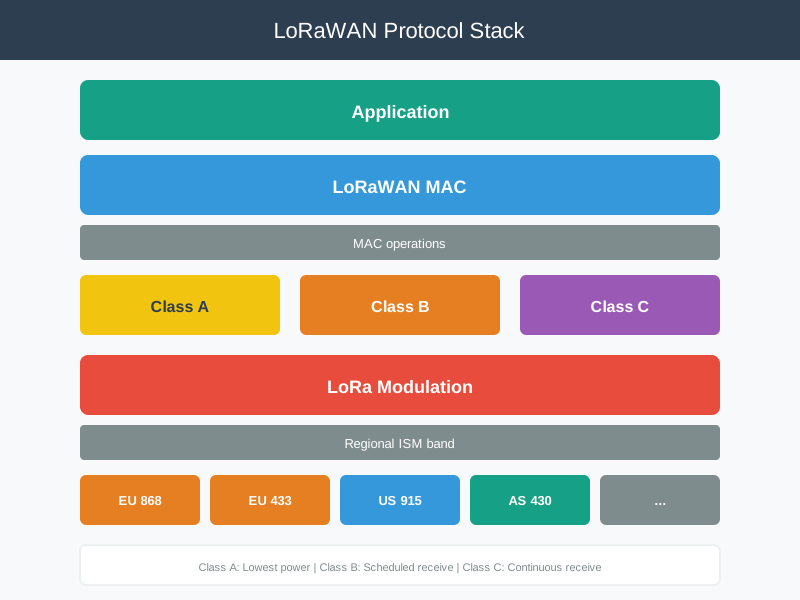
This overview connects the physical LoRa modulation with the LoRaWAN MAC protocol, showing how they work together to achieve the long range and low power characteristics tested in quiz scenarios.
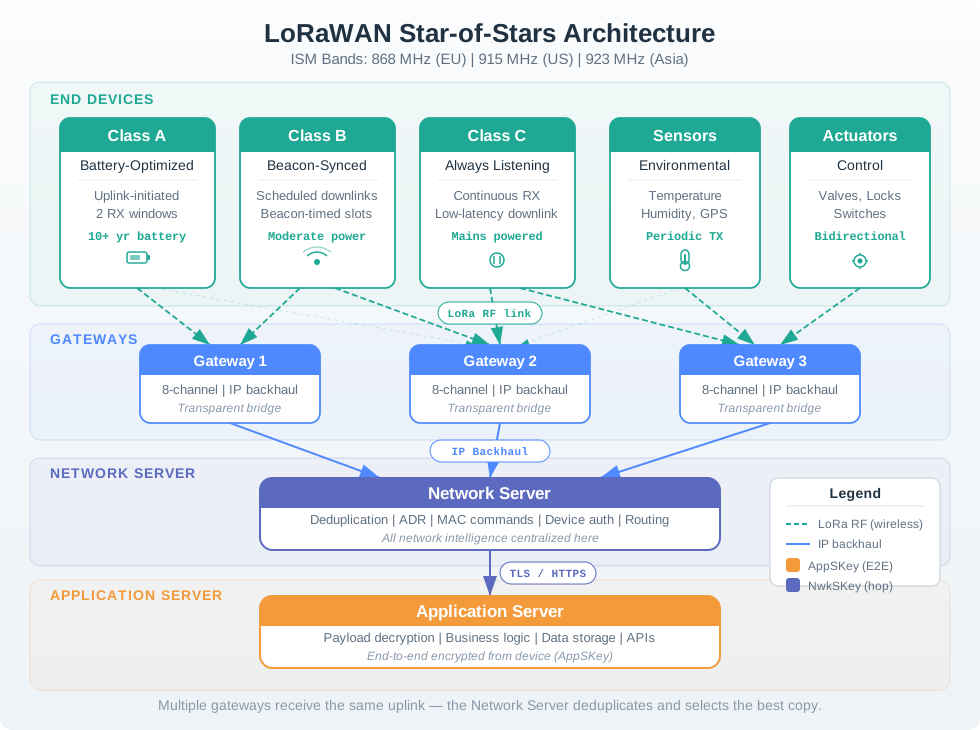
Complete LoRaWAN architecture showing how multiple gateways can receive the same transmission, providing diversity gain for improved reliability.
The Mistake: Developers calculate total network airtime (e.g., 500 devices x 2 msgs/hour x 61 ms = 61 seconds/hour) and conclude the network violates EU868 1% duty cycle (36 seconds/hour limit). They then reduce transmission frequency or add gateways to “share the duty cycle load.”
Why This Is Wrong:
Duty cycle is per-device, not per-gateway or per-network. Each device has its own independent 1% budget on each sub-band.
Correct Understanding:
EU868 Duty Cycle Regulation:
- Limit: 1% per device per sub-band
- Reset: Every hour (rolling window)
- Calculation: (Device airtime in seconds) / 3600 seconds < 0.01

Example - Single Device:
- SF7, 12-byte payload: 61 ms per message
- Messages per hour: 2 (every 30 minutes)
- Airtime: 61 ms x 2 = 122 ms = 0.122 seconds
- Duty cycle: 0.122 / 3600 = 0.0034% (well under 1%)

500 Devices on Same Gateway:
- Each device: 0.0034% duty cycle (compliant)
- Total gateway load: 500 x 122 ms = 61 seconds/hour
- This is NOT a duty cycle violation (different metric)
What Gateway Load Actually Affects:
The 61 seconds/hour total load affects collision probability, not duty cycle compliance:
Collision Analysis (not duty cycle):
- 8 channels, 6 SFs (SF7-SF12) = 48 virtual channels
- Load per virtual channel: 61s / (48 x 3600s) = 0.035% per channel
- Collision probability: Minimal (well under 1%)

If all devices used SF12 instead:
- Total load: 500 x 2 x 1318 ms = 1,318 seconds/hour
- Per virtual channel: 1318 / (48 x 3600) = 0.76%
- Collision probability: ~5-10% (now a problem!)
Why This Matters:
Incorrect thinking:
- “500 devices exceed duty cycle, must reduce to 250 devices or add gateway”
- Cost: $350 gateway + installation, or 50% less data
Correct thinking:
- “Each device compliant at 0.0034%, total load creates 0.035% channel utilization”
- “Enable ADR to spread across SFs, reducing collision risk”
- Cost: $0, improves both capacity and battery life
Red Flag Scenarios:
- Duty cycle violation warnings with low TX frequency: If devices transmit every 30 minutes and network reports violations, check gateway firmware - likely aggregating incorrectly
- Adding gateways to “meet duty cycle”: Duty cycle is per-device radio regulation, adding gateways doesn’t change it
- Reducing TX frequency below needs: If individual device already <1% duty cycle, reducing frequency doesn’t improve compliance
Real-World Case Study:
Netherlands farm (500 sensors, false duty cycle violations): - Reported: “Network exceeds duty cycle” - Actual: Gateway summed all 500 devices (61s/hour) and flagged as violation - Fix: Gateway firmware update to track per-device duty cycle - Result: All devices confirmed compliant (0.003% average)
Verification Checklist:
For each device:
[ ] Calculate individual airtime per hour
[ ] Divide by 3600 seconds
[ ] Result < 0.01 (1%)? Device is compliant
[ ] Gateway total load is separate metric (affects collisions, not duty cycle)32.3 Summary
This chapter covered network scalability concepts for LoRaWAN deployments:
- Collision Calculation: Applying the ALOHA formula with per-SF, per-channel utilization to compute expected packet loss rates
- ADR Capacity Gains: Quantifying how SF distribution increases network capacity by up to 21.6x while reducing battery consumption
- Duty Cycle Compliance: Distinguishing per-device regulatory duty cycle limits from aggregate gateway channel load metrics
- Optimization Strategy: Diagnosing whether packet loss stems from SF misconfiguration, true capacity saturation, or coverage gaps before committing to infrastructure investment
Common Pitfalls
Testing with one device shows connectivity but reveals nothing about capacity. Collision probability and duty cycle conflicts only become apparent with many devices transmitting simultaneously. Always test with realistic device density before assuming production capacity.
Network capacity calculations assuming all devices use the same SF are inaccurate. In practice, devices closer to gateways use lower SFs (shorter airtime) while distant devices use higher SFs. Model a realistic SF distribution for accurate capacity planning.
Designing network capacity exactly at the theoretical maximum leaves no margin for traffic bursts, device concentration in sub-areas, or future device additions. Target 50–70% maximum utilization to maintain reliability under load.
Gateway hardware has limits on concurrent reception and packet forwarding throughput. Industrial deployments with thousands of devices need gateways rated for high concurrent channel reception (8+ simultaneous channels). Consumer-grade gateways may drop packets under high load.
32.4 What’s Next
| Chapter | Focus Area |
|---|---|
| Activation & Security Quiz | OTAA vs ABP security trade-offs and frame counter management |
| Fundamentals Quiz | Common misconceptions and device class selection |
| Battery Optimization Quiz | Battery life calculations and power budgeting |
| Regional Deployment Quiz | EU868 and US915 regional parameter configuration |