18 LoRaWAN Physical Layer Review
18.1 Learning Objectives
By the end of this chapter, you will be able to:
- Explain Chirp Spread Spectrum: Describe how CSS modulation achieves sub-noise-floor reception and multipath immunity
- Analyze Spreading Factor Trade-offs: Calculate airtime, range, and battery impact for SF7-SF12 and justify SF selection for specific deployments
- Compare Bandwidth Options: Differentiate 125, 250, and 500 kHz bandwidth configurations and their impact on data rate and range
- Calculate Link Budgets: Determine required SF based on distance, path loss model, and environmental factors
- Distinguish LoRa from LoRaWAN: Classify physical layer modulation concepts separately from MAC layer protocol features
18.2 Prerequisites
Required Chapters:
- LoRaWAN Overview - Core concepts
- LoRaWAN Architecture - Network structure
Key Concepts
- Chirp Spread Spectrum (CSS): LoRa’s physical layer modulation using frequency-swept chirp symbols; spreading data across bandwidth provides interference immunity and below-noise-floor sensitivity.
- Symbol Duration: Time for one LoRa symbol; calculated as 2^SF / BW seconds; determines data rate and airtime for a given SF and bandwidth combination.
- Data Rate: Effective bit rate of LoRa transmission; increases with lower SF, wider bandwidth, and lower coding rate; ranges from ~250 bps (SF12/125kHz) to ~37.5 kbps (SF7/500kHz).
- Radio Frequency: LoRa operates on ISM bands; carrier frequency affects free-space path loss, atmospheric absorption, and regulatory requirements.
- Multi-Path Fading: RF signal degradation caused by reflected signal copies arriving with different phases; CSS modulation provides inherent robustness against multipath effects.
- Interference Resilience: LoRa’s CSS modulation can decode signals 20 dB below the noise floor, providing resistance to narrowband interference that would corrupt other modulations.
- Preamble: Fixed sequence of chirps at the start of a LoRa packet used for synchronization; gateway uses preamble detection to identify incoming transmissions.
Related Review Chapters:
| Chapter | Focus |
|---|---|
| Architecture & Classes Review | Network topology, device classes |
| Security & ADR Review | Encryption, adaptive data rate |
| Deployment Review | Regional parameters, TTN, troubleshooting |
Estimated Time: 15 minutes
What is LoRa? LoRa (Long Range) is a physical layer modulation technique using “chirps” - signals that sweep across frequencies. Think of it like a slide whistle that goes from low to high pitch.
Why Chirps?
- Chirp signals are very resistant to interference
- Can be received even when the signal is weaker than the noise floor
- Multiple chirp “speeds” (spreading factors) allow range/speed trade-offs
Simple Analogy: Imagine shouting across a canyon. You can whisper quickly (high data rate, short distance) or yell slowly (low data rate, long distance). LoRa lets you choose how to “shout” based on your needs.
“LoRa’s chirps are like nothing else in wireless!” Sammy the Sensor exclaimed. “My signal sweeps smoothly from one frequency to another, creating a chirp that can be detected even when it is buried under noise. Regular radios fail when the noise is louder than the signal, but LoRa keeps working!”
“Spreading factors are the key trade-off,” Lila the LED said. “SF7 gives me 5,500 bits per second and reaches a couple of kilometers. SF12 gives only 250 bits per second but reaches over fifteen kilometers. Each step up from SF7 to SF12 doubles the range but halves the data rate. It is a perfect example of the range-versus-speed trade-off!”
Max the Microcontroller added, “The coolest thing about LoRa is that different spreading factors are orthogonal. A device transmitting at SF7 and another at SF12 can use the exact same frequency at the exact same time without interfering. It is like two people singing different songs in the same room but at pitches so different that you can hear both clearly.”
“For this review, remember the key numbers,” Bella the Battery said. “LoRa operates at 868 or 915 MHz with 125 kHz bandwidth. Receiver sensitivity ranges from -123 dBm at SF7 to -137 dBm at SF12. And the link budget of 151 dB means you can communicate over incredible distances with just 14 dBm of transmit power!”
18.3 Quick Reference Card
18.3.1 Essential LoRaWAN Parameters
| Parameter | Typical Value | Notes |
|---|---|---|
| Frequency Bands | 868 MHz (EU), 915 MHz (US), 433 MHz (Asia) | Region-specific ISM bands |
| Range | 2-15 km (urban), 15-45 km (rural) | Line of sight dependent |
| Data Rate | 0.3 - 50 kbps | Spreading factor dependent |
| Battery Life | 5-10+ years | With duty cycling and Class A |
| Payload Size | 51-222 bytes | SF and region dependent |
| Max TX Power | 14-27 dBm | Region regulations apply |
| Gateway Capacity | 1000s of devices | Per gateway, SF orthogonality |
| Security | AES-128 | End-to-end encryption |
18.3.2 LoRa vs LoRaWAN
| Aspect | LoRa | LoRaWAN |
|---|---|---|
| Layer | Physical (PHY) | MAC/Network |
| Function | Modulation technique | Protocol stack |
| Defines | Radio parameters, chirp spread spectrum | Device classes, security, network topology |
| Proprietary | Yes (Semtech IP) | No (LoRa Alliance standard) |
| Use | Point-to-point or mesh | Star-of-stars network |
18.4 Spreading Factor Trade-offs
18.4.1 Spreading Factor Progression
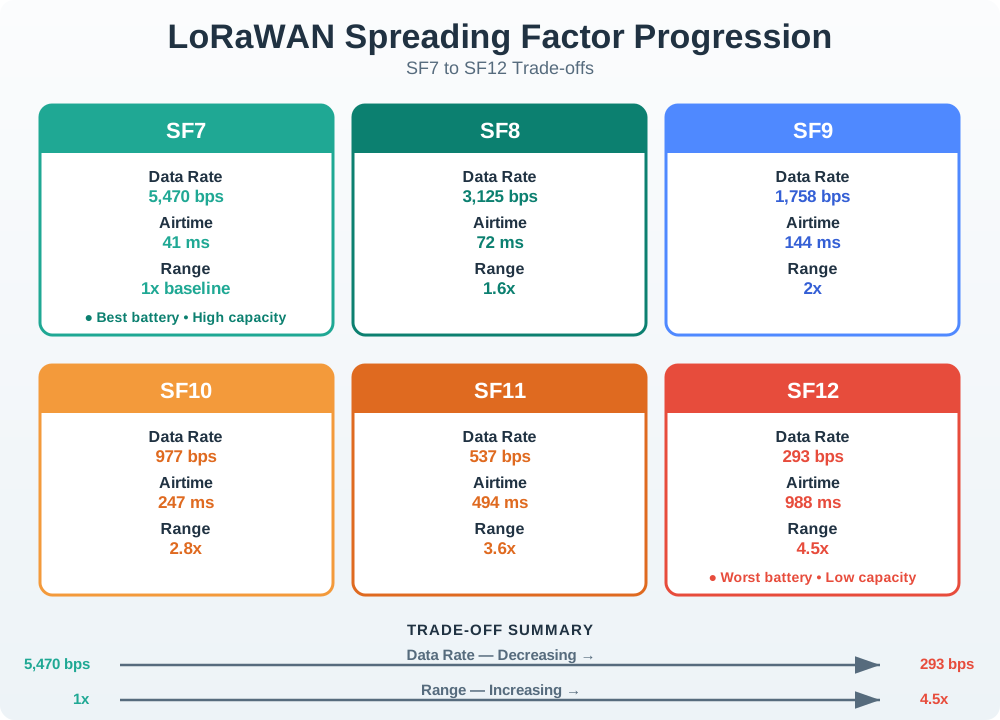
This chart shows energy consumption per byte: SF12 uses 24x more energy than SF7, making SF selection critical for battery-powered devices.
18.4.2 Detailed Spreading Factor Comparison
| SF | Data Rate (EU868) | Airtime (51B) | Range Factor | Battery Impact | Capacity Impact |
|---|---|---|---|---|---|
| SF7 | 5470 bps | 41 ms | 1x (baseline) | Best | High capacity |
| SF8 | 3125 bps | 72 ms | 1.6x | Good | Good |
| SF9 | 1757 bps | 144 ms | 2.5x | Fair | Fair |
| SF10 | 980 bps | 247 ms | 4x | Poor | Low |
| SF11 | 537 bps | 494 ms | 6x | Very Poor | Very Low |
| SF12 | 293 bps | 988 ms | 10x | Worst | Severely Limited |
Key Principle: Higher SF = more chips per symbol = better noise immunity = longer range BUT slower data rate and longer airtime.
Orthogonality: Different SFs can coexist on the same frequency channel without interfering, allowing gateway multiplexing.
Trade-off Example: A message taking 41ms at SF7 takes 988ms at SF12 (24x longer airtime), consuming 24x more battery per transmission.
18.4.3 Bandwidth Options
| Bandwidth | Common Use | Data Rate Impact | Range Impact |
|---|---|---|---|
| 125 kHz | Standard LoRaWAN | Baseline | Maximum range |
| 250 kHz | Higher throughput | 2x faster | Reduced ~10% |
| 500 kHz | Low latency | 4x faster | Reduced ~20% |
18.5 Chirp Spread Spectrum Explained
18.5.1 How CSS Works
18.5.2 Why CSS is Ideal for IoT
| Property | Benefit for IoT | Technical Explanation |
|---|---|---|
| Sub-noise Reception | Extreme range | Processing gain recovers signals 20+ dB below noise |
| Multipath Immunity | Urban deployment | Time-spread chirps avoid destructive interference |
| Low Power TX | Battery life | Lower transmit power needed for same range |
| Doppler Tolerance | Mobile devices | Frequency shift affects all chirp parts equally |
| Jamming Resistance | Security | Spread spectrum makes narrowband jamming ineffective |
18.6 Link Budget Calculations
18.6.1 Understanding Link Budget
18.6.2 Receiver Sensitivity by SF
| SF | Sensitivity (125 kHz) | Processing Gain | Max Path Loss (14 dBm TX) |
|---|---|---|---|
| SF7 | -123 dBm | Base | 137 dB |
| SF8 | -126 dBm | +3 dB | 140 dB |
| SF9 | -129 dBm | +6 dB | 143 dB |
| SF10 | -132 dBm | +9 dB | 146 dB |
| SF11 | -134.5 dBm | +11.5 dB | 148.5 dB |
| SF12 | -137 dBm | +14 dB | 151 dB |
Every 6 dB of additional path loss roughly halves the maximum range. Moving from SF7 to SF12 adds 14 dB of sensitivity, approximately tripling the range (but at 24x the airtime cost).
The relationship between link margin and range follows the inverse square law for free-space propagation. Path loss increases as: \(PL = 20\log_{10}(d) + 20\log_{10}(f) + 20\log_{10}\left(\frac{4\pi}{c}\right)\)
For 868 MHz at distance \(d\): \[PL(dBm) \approx 32.45 + 20\log_{10}(d_{km}) + 20\log_{10}(868)\]
Every doubling of distance adds \(20\log_{10}(2) = 6\) dB to path loss. Therefore, each additional 6 dB of sensitivity roughly doubles the range.
SF7→SF12 adds 14 dB sensitivity: \[\text{Range multiplier} = 10^{14/20} = 10^{0.7} \approx 5\times \text{ (free-space)}\]
However, real-world urban environments with higher path-loss exponents reduce this to roughly 3x practical range improvement.
18.7 Knowledge Check: Physical Layer
18.8 Worked Example: Choosing the Right Spreading Factor for a River Flood Sensor
A city water authority installs LoRaWAN water-level sensors along a river that runs through an urban area. The nearest gateway is on a building rooftop 4.2 km from the furthest sensor. The sensors are mounted on bridge pylons at water level (1.5 m height), with an urban environment between them and the gateway.
Step 1: Calculate Required Link Budget
Free-space path loss at 868 MHz, 4.2 km:
- FSPL = 20 log10(4200) + 20 log10(868 x 10^6) + 20 log10(4 x pi / 3 x 10^8) = 72.5 + 178.8 - 147.6 = 103.7 dB
Urban environment adds significant loss:
- Building shadowing and diffraction: +15 dB (moderate urban)
- Near-ground mounting penalty (1.5 m vs typical 3-5 m): +6 dB
- Wet weather fade margin: +8 dB (critical for flood monitoring – must work in rain)
- Total path loss: 132.7 dB
Step 2: Determine Minimum SF
Gateway: standard 3 dBi antenna, SX1301 concentrator. Sensor: 2 dBi antenna, SX1276 transceiver at 14 dBm.
Available link budget = Tx power + Tx antenna gain + Rx antenna gain - Required SNR offset
| SF | Receiver Sensitivity | Link Budget (14 + 2 + 3 - sensitivity) | Margin over 132.7 dB |
|---|---|---|---|
| SF7 | -123 dBm | 142 dB | +9.3 dB |
| SF8 | -126 dBm | 145 dB | +12.3 dB |
| SF9 | -129 dBm | 148 dB | +15.3 dB |
| SF10 | -132 dBm | 151 dB | +18.3 dB |
SF7 provides 9.3 dB margin – technically sufficient but leaves little room for additional obstructions (construction scaffolding, vegetation growth, antenna degradation).
Decision: Start at SF8 (12.3 dB margin) and let ADR optimize downward if conditions are better than expected. For flood monitoring, reliability matters more than battery life – a missed reading during a flood event has severe consequences.
Step 3: Battery Impact of This Decision
| Parameter | SF7 | SF8 (selected) | SF10 |
|---|---|---|---|
| Airtime per 20-byte packet | 56.6 ms | 102.7 ms | 370.7 ms |
| Energy per transmission (25 mA) | 1.4 mJ | 2.6 mJ | 9.3 mJ |
| Battery life (reporting every 15 min, 2x AA) | 11.2 years | 9.8 years | 5.1 years |
SF8 costs only 1.4 years of battery life compared to SF7, while providing substantially more reliable communication. This is a clear trade-off win for a safety-critical application.
18.9 Concept Relationships
| Concept | Relates To | Relationship Type | Significance |
|---|---|---|---|
| Chirp Spread Spectrum | Noise Immunity | Sub-noise floor detection | Can receive signals 20+ dB below noise |
| Spreading Factor | Data Rate | Inverse relationship | Each SF step up halves data rate |
| Spreading Factor | Airtime | Exponential relationship | SF12 has 24x longer airtime than SF7 |
| Bandwidth | Data Rate | Direct proportional | 500 kHz gives 4x faster rate than 125 kHz |
| Link Budget | Range | Logarithmic relationship | Each 6 dB loss halves maximum range |
| Receiver Sensitivity | Spreading Factor | Each SF step adds ~3 dB | SF12 is 14 dB more sensitive than SF7 |
| Orthogonality | Network Capacity | Different SFs coexist | Multiple simultaneous transmissions on same frequency |
18.10 See Also
Explore these related topics to deepen your understanding:
- Architecture & Classes Review - Network topology and device class selection
- Security & ADR Review - Encryption and adaptive optimization
- Deployment Review - Regional parameters and gateway planning
- LoRa Modulation and Spreading Factors - Detailed spreading factor analysis
- LoRaWAN Comprehensive Review - Complete technical review
18.11 Summary
This chapter reviewed LoRa physical layer fundamentals:
- LoRa vs LoRaWAN: LoRa is the physical layer modulation using chirp spread spectrum; LoRaWAN is the MAC layer protocol
- Spreading Factors: SF7-SF12 provide range-data rate trade-offs, with each SF doubling airtime and increasing range by ~1.6x
- CSS Benefits: Chirp spread spectrum enables sub-noise floor reception, multipath immunity, and Doppler tolerance
- Link Budget: Every 6 dB of additional loss halves range; SF12 provides 14 dB more sensitivity than SF7
- Bandwidth Options: 125/250/500 kHz trade speed for range, with 125 kHz standard for maximum coverage
Common Pitfalls
Receiver sensitivity (e.g., −137 dBm at SF12) is the theoretical minimum signal level. In practice, you need 10–15 dB link margin above sensitivity for reliable operation. Using sensitivity as the design target without margin leads to marginal links that fail in adverse conditions.
LoRa’s CSS modulation is resistant to narrowband interference but not to other LoRa signals on the same channel and SF. LoRa-to-LoRa interference (same SF, same channel, similar RSSI) causes packet loss. In dense deployments, ensure channel plans spread traffic across available channels.
Changing from 125 kHz to 250 kHz bandwidth doubles data rate, halves time on air, and improves duty cycle compliance — but also reduces receiver sensitivity by ~3 dB. This trade-off must be understood before selecting non-default bandwidth configurations.
Coding rate 4/8 (maximum FEC) adds 100% overhead to each transmission, doubling time on air compared to 4/5. Use higher coding rates only in high-interference environments where FEC benefits outweigh airtime costs. Default 4/5 coding rate is appropriate for most deployments.
18.12 What’s Next
Continue your LoRaWAN review:
| Direction | Chapter | Focus |
|---|---|---|
| Next | Architecture & Classes Review | Network topology and device class selection |
| Then | Security & ADR Review | Encryption and adaptive data rate optimization |
| Finally | Deployment Review | Regional parameters, TTN, and troubleshooting |
| Deep Dive | LoRa Modulation and Spreading Factors | Detailed spreading factor analysis |
Prerequisites:
- LoRaWAN Overview - Start here if new to LoRaWAN
- LoRaWAN Architecture - Network structure and device classes
- LPWAN Fundamentals - Core LPWAN concepts
Deep Dives:
- LoRaWAN Comprehensive Review - Full technical review
- LoRaWAN Quiz Bank - Practice questions