7 LoRaWAN Introduction
More
Depth: Practitioner
Progress saves as you read. Mark sections complete as you go; your progress appears in the sidebar.
7.1 Start Simple
This section: Start Simple
7.1.1 Follow One Field Reading End to End
A water tank stands beyond the farm buildings. Its battery device sends only a level and a time. The farm manager does not need a claim about impressive range. She needs a fresh reading that belongs to the right tank, reaches the service, and still makes sense after rain, a weak battery, or a brief break in coverage.
Follow that single reading. Name the device, the small data item, the nearby receiver, the service that checks it, and the application that turns it into a refill decision. Keep identity, time, unit, and quality with the value at every hand-off. A receiver hearing a signal does not by itself prove that the final record is usable.
Test at the field edge and behind the wet building wall. Send at busy times. Repeat an old reading. Restart the device and the receiving service. Check what is kept, what is rejected, how long delivery takes, and whether the manager can tell fresh evidence from a delayed copy. Record battery use during the same runs.
This opening does not promise continuous reach or instant control. It frames a long-range, low-power message path that must be measured at the real site. The deeper sections separate the radio method from the network system, then explain joining, forwarding, server roles, limits, and design trade-offs.
Start with a battery device that only needs to send a few bytes from far away. LoRa is the radio technique that can help that message travel. LoRaWAN is the network system that decides how the device joins, how gateways forward what they hear, how servers validate traffic, and how the application receives meaning. Keeping that split clear makes every later design choice easier to review.
Overview: LoRaWAN Is a Network Fit, Not Just a Radio Choice
LoRaWAN is a wide-area networking protocol for IoT devices that send small messages, sleep for long periods, and can tolerate delayed or class-limited downlinks. It is often used for sensors, meters, trackers, and simple status devices where coverage and battery life matter more than throughput.
The first beginner boundary is the difference between LoRa and LoRaWAN. LoRa is the physical radio modulation. LoRaWAN adds the network behavior around that radio: end-device rules, gateways, network-server decisions, activation, frame counters, security boundaries, device classes, ADR, and application routing.
Before deciding the “lorawan mac”–“mac operations” decision, inspect “LoRaWAN MAC” in Figure 7.1 and compare it with “MAC operations”. That contrast matters because LoRa provides the radio modulation; LoRaWAN adds MAC behavior, class timing, regional constraints, and application delivery responsibilities above that radio layer.
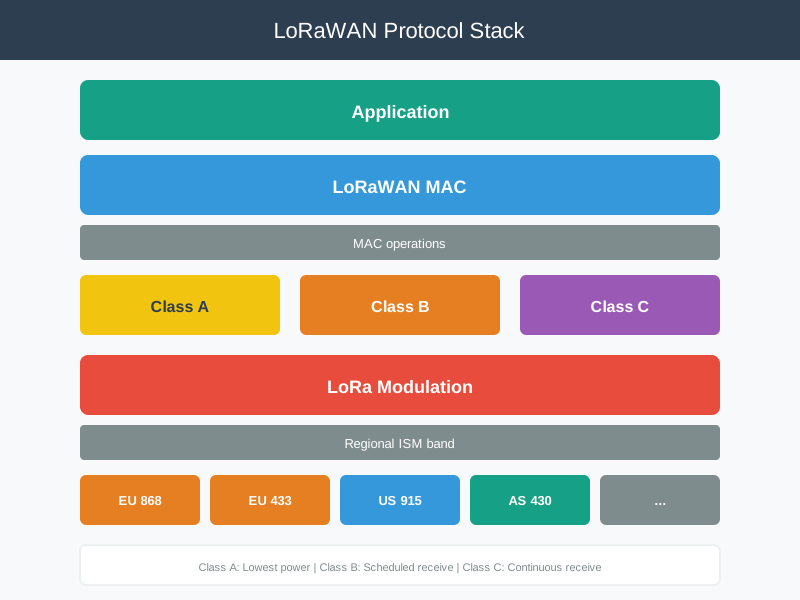
In Figure 7.1, notice how “LoRaWAN MAC” establishes the initial state; “MAC operations” supplies the next check. The move through “Class A” reaches “Class B”, making LoRa provides the radio modulation; LoRaWAN adds MAC behavior, class timing, regional constraints, and application delivery responsibilities above that radio layer observable. Return to the “lorawan mac”–“mac operations” decision with “Class B”, and keep “LoRaWAN MAC” in the release record.
Read the stack from the bottom up. The regional band constrains frequency plan and duty-cycle assumptions. LoRa modulation carries symbols over the air. The LoRaWAN MAC then adds frame structure, counters, device-class receive behavior, MAC commands, ADR decisions, and server-controlled scheduling. Application data sits above that stack, so a product claim usually needs both radio evidence and application acceptance evidence.
That separation prevents two common beginner mistakes. A gateway-heard uplink can support a narrow radio-path observation, but it does not prove the join path, replay handling, ADR policy, downlink timing, or business action. A dashboard event can prove the application saw something, but it does not prove the installed device will keep enough link margin after antenna, region, payload, or class changes.
If you only remember one rule, remember this: a LoRaWAN claim is not approved because the words "long range" or "low power" appear in the design. It is approved when the workload, region, device class, gateway path, server boundary, activation method, link evidence, application owner, and retest trigger are visible.
The One-Minute View
Fit the workload
Good first fits send compact telemetry or events, sleep most of the time, and can accept the downlink timing promised by their device class.
Separate the layers
LoRa explains the radio signal. LoRaWAN explains the network behavior, server control, joining, counters, class timing, and routing.
Review the path
End devices transmit; gateways forward packet records; the network server validates, deduplicates, routes, and schedules downlinks.
Keep limits explicit
A gateway log, coverage point, or dashboard screenshot is useful evidence, but it does not prove application acceptance or future field fit by itself.
Where LoRaWAN Fits
- Strong fit: small status readings, event reports, meter updates, and sparse telemetry where delayed delivery can be acceptable.
- Weak fit: streaming media, large file transfer, frequent downlink-heavy control, or immediate safety behavior without a local fallback.
- Evidence needed: payload size, message cadence, regional profile, gateway hearing, server ownership, activation records, class timing, link evidence, and operations owner.
- Retest trigger: new payload shape, deployment region, antenna placement, gateway path, device class, activation method, ADR policy, or application promise.
Beginner Example
A water meter that sends a compact reading a few times per day may be a LoRaWAN fit if the field evidence supports the selected region, antenna placement, payload size, gateway path, activation method, and class behavior. A camera, a bulk firmware channel, or a cloud-dependent emergency stop is not a beginner LoRaWAN fit unless another design layer changes the requirement.
Overview Knowledge Check
If you can separate LoRa from LoRaWAN and explain when the workload is a fit, you can stop here. Continue to Practitioner to build the first LoRaWAN evidence record.
Practitioner: Build the First LoRaWAN Evidence Record
The practitioner job is to turn a broad technology statement into a reviewable record. The record should show what the device sends, what the network is responsible for, what the application expects, and which evidence would make the claim stale.
Walkthrough: Review One LoRaWAN Flow
- State the application promise. Name the message, its meaning, cadence, payload size, downlink expectation, and what happens if the message is late, repeated, or missing.
- Separate radio from network. Record which claim belongs to LoRa radio behavior and which belongs to LoRaWAN MAC, server, activation, or routing behavior.
- Trace the path. Identify the end device, gateway set, network server, join boundary, application service, and observation points.
- Choose the device class by downlink promise. Class A is the usual sleeping-device baseline; Class B adds scheduled receive opportunities; Class C listens much more often and needs an energy and operations reason.
- Name security and activation evidence. Record the activation method, key custody, counter behavior, reset handling, and who owns negative tests.
- Set link and ADR evidence. State the placement, uplink history, link-margin evidence, ADR suitability, rollback rule, and retest trigger.
LoRaWAN Introduction Ledger
Worked Review: Soil-Moisture Sensor
Claim: a field sensor sends compact soil-moisture readings and can wait for ordinary maintenance commands.
Evidence to accept: payload size and cadence are compact; the deployment region is named; gateways hear installed-device uplinks; the network server records deduplication and routing; activation and counters are tested; Class A timing matches the downlink promise; ADR is allowed only after representative uplink history.
Limit: this record does not prove bulk updates, immediate control, or a different field location. Those changes require a new review.
Worked Review: Remote Valve Command
Claim: the cloud can close a valve immediately over LoRaWAN.
Evidence gap: a sleeping Class A device may not listen until after its next uplink, and a gateway forwarding record does not prove the valve changed state. The application promise is stronger than the introductory evidence.
Review action: separate the safety behavior from the telemetry path, require local safety behavior or a class and power design that supports the timing, and record device-side acknowledgement before accepting the command claim.
Practitioner Knowledge Check
If you can build the ledger and identify the evidence gap in a downlink-heavy design, you can stop here. Continue to Under the Hood for the mechanics behind LoRaWAN roles, classes, activation, and ADR.
Under the Hood: Roles, Classes, Activation, and ADR
The deeper layer explains why LoRaWAN evidence is split across several owners. A single uplink can involve a radio setting, more than one gateway, a network server, an activation boundary, application payload handling, device-class timing, and a future ADR decision. Each layer can be correct while another layer still needs review.
LoRa Versus LoRaWAN
LoRa describes how symbols are carried over the radio. LoRaWAN describes how end devices use that radio inside a network: uplinks, receive windows, frame counters, MAC commands, joins, server routing, and application payload delivery. A LoRa signal trace supports a radio claim; it does not by itself prove joining, security, routing, or application acceptance.
Gateway Forwarding and Server Control
LoRaWAN uses a star-of-stars pattern. End devices transmit, and any gateway that hears an uplink can forward a packet record and reception metadata over an IP backhaul. The network server performs the network control work: validation, deduplication when multiple gateways hear the same frame, routing to the application boundary, MAC behavior, ADR decisions, and downlink scheduling.
Device Classes Shape Downlinks
Class A devices open receive windows after uplinks, making them the usual starting point for sleeping sensors. Class B adds scheduled receive opportunities when the network and device support the timing discipline. Class C keeps the receiver open most of the time except while transmitting, so it is normally reserved for devices with an energy source and a real need for faster downlinks. The class is chosen from the application timing promise, not from a ranking of better or worse classes.
Activation, Counters, and Ownership
Activation determines how the device gets session state. OTAA uses a join procedure; ABP uses pre-provisioned session state and therefore needs extra care around counters, reset behavior, and operational exceptions. Frame counters help detect replay, but they must be reviewed with reset and recovery behavior. Key custody matters because network behavior and application payload meaning should remain separated.
ADR Is an Evidence Decision
Adaptive Data Rate can reduce airtime and power when the device is stationary enough and representative uplink evidence supports the change. It is not a magic setting for every device. A reviewer should ask which uplinks were observed after final placement, which ADR commands were issued, whether follow-up uplinks proved the new setting, and what rollback rule applies if the device moves or evidence weakens.
Mechanics and Evidence Limits
Under-the-Hood Knowledge Check
If you can keep radio evidence, gateway evidence, server evidence, activation evidence, class behavior, and ADR policy separate, you are ready for the focused LoRaWAN chapters.
The layered comparison in Figure 7.2 separates LoRa radio mechanics from the LoRaWAN network and device-class contract.

Read Figure 7.2 from LORAWAN · MAC + NETWORK down to LORA · RADIO PHY before comparing classes. CLASS A buys lowest energy by making downlink wait for an uplink; CLASS B adds scheduled reachability; CLASS C buys near-continuous receive at the highest listening cost.
7.2 Summary
This section: Summary — LoRaWAN is a network protocol for small, low-rate IoT messages from devices that often sleep.
LoRaWAN is a network protocol for small, low-rate IoT messages from devices that often sleep. LoRa is the radio modulation; LoRaWAN adds end-device behavior, gateways, network-server control, joining, counters, device classes, ADR, routing, and application boundaries.
The correct introduction is evidence-first. Before accepting a LoRaWAN design, record the workload, region, gateway path, server boundary, activation method, device class, link evidence, ADR policy, application owner, evidence limit, and retest trigger.
7.3 Key Takeaway
This section: Key Takeaway
LoRaWAN fit is proven by a bounded evidence record, not by a technology label. Keep radio, gateway, server, activation, class, ADR, and application claims separate.
7.4 See Also
This section: See Also
LoRa Modulation and Spreading Factors
Use this next when the question is radio behavior, spreading factor, airtime, payload fit, or ADR handoff.
LoRaWAN Network Architecture
Use this when the review depends on gateway forwarding, network-server control, join boundaries, or routing evidence.
LoRaWAN Device Classes Review
Use this when the application promise depends on receive windows, downlink timing, energy source, or class exceptions.
LoRaWAN Security and Joining Review
Use this when activation method, key custody, counters, reset behavior, or replay evidence drives the decision.
Open printable teacher run sheet
Find help
3 reviewed answers.
Where should I start in a module?
Open the module page from the sidebar to see its chapters in order. Use the module map to return to a topic you need.
Modules and pathsReviewed
What can I try when a project does not work?
Check the symptom, then work through the diagnostic steps. Keep the error message and the smallest example that reproduces it.
When you are stuckReviewed
How do interactive examples work?
Use the interactive guide to check how examples and simulations work before changing your project.
Interactive examples guideReviewed