36 Sigfox Introduction and Fundamentals
36.1 Introduction
Sigfox is both a proprietary LPWAN technology and the name of the French company that developed and operates it. Unlike other LPWAN technologies where you can deploy your own network, Sigfox operates as a network operator providing connectivity services globally. Sigfox pioneered the concept of ultra-narrow band (UNB) modulation for IoT, enabling billions of low-power devices to communicate with minimal infrastructure and energy consumption.
By the end of this chapter, you will be able to:
- Explain Sigfox’s ultra-narrow band (UNB) modulation and its trade-offs for range, power, and throughput
- Contrast the Sigfox operator-managed network model with self-deployed LPWAN architectures
- Analyze Sigfox power consumption relative to LoRaWAN, NB-IoT, and cellular alternatives
- Evaluate Sigfox suitability for specific IoT applications using payload, message rate, and coverage criteria
- Calculate message capacity, binary payload encoding, and daily transmission budgets for Sigfox deployments
Key Concepts
- Sigfox Origin: French IoT company founded 2010; pioneered commercial LPWAN networking before LoRaWAN and NB-IoT emerged as alternatives.
- Technology Positioning: Sigfox targets extremely simple, infrequent IoT data transmission; optimized for minimum device complexity and cost at the expense of flexibility.
- Network Model: Original network-as-a-service model where Sigfox SA and regional operators provide complete managed connectivity without customer infrastructure investment.
- Technical Pillars: UNB modulation, base station diversity reception, cloud-based device management, and simple API-based application integration.
- Market Focus: Asset tracking, utilities metering, environmental monitoring, and industrial monitoring where infrequent small data is sufficient.
- Competitive Context: Sigfox competed successfully before LoRaWAN became widely available; now faces challenges from LoRaWAN’s open ecosystem and NB-IoT’s carrier backing.
- Current Status: Unabiz acquired Sigfox network and technology assets in 2022; committed to network continuation but long-term trajectory uncertain for new deployments.
In one sentence: Sigfox is an ultra-low-power, operator-managed LPWAN that sends tiny messages (12 bytes) over extreme distances with no local infrastructure required.
Remember this rule: Choose Sigfox over LoRaWAN when you need global coverage without building infrastructure, only send small infrequent messages (<140/day), and can accept the operator’s coverage footprint; choose LoRaWAN when you need network control, larger payloads, or coverage in areas Sigfox doesn’t reach.
36.2 Prerequisites
Before diving into this chapter, you should be familiar with:
LPWAN Fundamentals: Understanding low-power wide-area network characteristics and trade-offs provides essential context for Sigfox’s design decisions and positioning
Networking Basics: Familiarity with wireless communication concepts, modulation schemes, and network topologies helps you understand Sigfox’s ultra-narrow band technology
LoRaWAN Fundamentals: Knowledge of alternative LPWAN technologies like LoRaWAN enables meaningful comparisons of deployment models, message limits, and coverage approaches
Wireless Sensor Networks: Understanding battery-powered sensor constraints and long-range communication needs explains why Sigfox targets specific IoT use cases
“Sigfox is like a postcard service for IoT!” Sammy the Sensor said. “I can send a tiny message – just 12 bytes – over distances of 30 to 50 kilometers. That is enough for a temperature reading, a GPS coordinate, or a simple ‘door open’ alert. I cannot send photos or stream data, but for simple status updates, it is perfect!”
“The beauty of Sigfox is simplicity,” Lila the LED explained. “You do not need to set up gateways or manage a network. Sigfox already built the infrastructure in over 70 countries. Just activate your device, and it starts sending messages through their base stations to their cloud. It is the easiest LPWAN to get started with!”
Max the Microcontroller added, “The 140-message-per-day limit sounds restrictive, but think about what IoT sensors actually do. A parking sensor only needs to report when a car arrives or leaves. A water leak detector only needs to say ‘leak detected!’ A temperature logger sending once every 11 minutes uses about 131 messages per day – within the limit!”
“My favorite thing about Sigfox,” Bella the Battery said, “is that the devices are incredibly simple and cheap. Because all the intelligence lives in the cloud, the device just needs a radio and a microcontroller. Less hardware means less power consumption, which means I can last for ten years or more on a single battery!”
36.3 Getting Started (For Beginners)
36.3.1 What is Sigfox? (Simple Explanation)
Analogy: Think of Sigfox like a telegram service for IoT - tiny messages sent over huge distances, ultra-reliable, and incredibly cheap.
REGULAR CELLULAR (4G/5G)         SIGFOX
━━━━━━━━━━━━━━━━━━━━━━           ━━━━━━
📱 → 📶 → 🌐                      📟 → 📶 → ☁️
• Send texts, calls, video        • Send tiny messages (12 bytes)
• High data, high cost            • Very low data, very low cost
• Monthly subscription            • $1-2/device/year
• Need SIM card                   • Simple radio chip

Like comparing:
📧 Email (any size, any time)     ✉️ Postcard (small, limited)
Key Terms Explained:
| Term | Simple Explanation |
|---|---|
| UNB (Ultra Narrow Band) | Radio signal squeezed into extremely thin channel - like using a laser pointer vs flashlight |
| Uplink | Message from device to cloud (140 messages/day allowed) |
| Downlink | Message from cloud to device (only 4 messages/day - very limited!) |
| Base Station | Sigfox tower that receives messages - you don’t build these, Sigfox does |
Why This Matters:
- Coverage in 75+ countries without you building a single tower
- Simplest LPWAN deployment - just buy devices and they work (if coverage exists)
- 10-20 year battery life means “install and forget”
36.3.2 What Makes Sigfox Different from LoRaWAN?
| Feature | Sigfox | LoRaWAN |
|---|---|---|
| Network ownership | Sigfox operates it (like AT&T) | You can build your own |
| Messages per day | Limited to 140 uplink | Unlimited (fair use) |
| Downlink messages | Only 4/day | Varies by device class |
| Coverage | 75+ countries (they build towers) | You choose coverage |
| Payload size | 12 bytes max | Up to 242 bytes |
| Cost model | Pay per device/year | Pay for infrastructure |
| Range | 10-50 km (rural), 3-10 km (urban) | 2-15 km (similar) |
| Power | 10-20 year battery life | 5-15 year battery life |
36.3.3 When to Use Sigfox
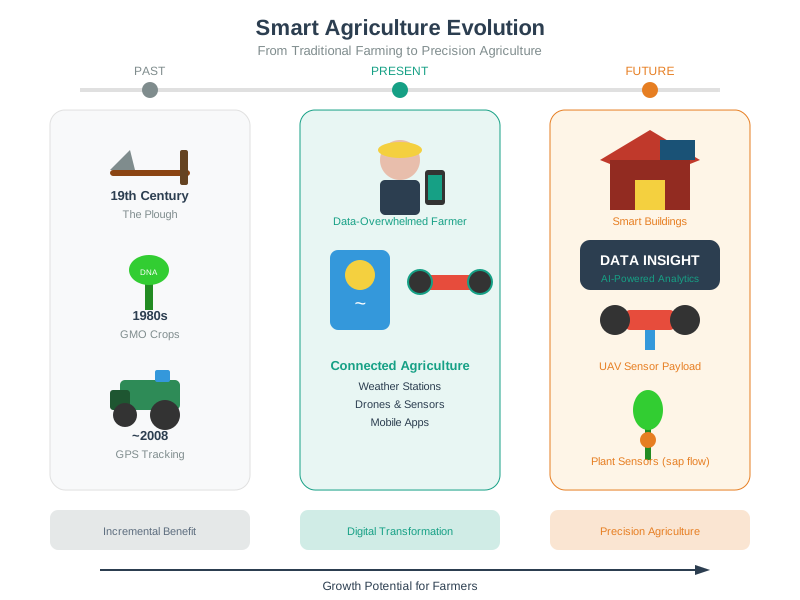
Source: Stanford University IoT Course - This diagram illustrates the evolution of precision agriculture and how LPWAN technologies like Sigfox enable the “Future” scenario where distributed sensors (weather stations, plant sensors, UAVs) communicate over long ranges to provide integrated data insights. Sigfox’s 10-50 km range and 10+ year battery life make it ideal for agricultural deployments where sensors are spread across large farms.
Perfect for:
- Asset tracking (where is my shipping container?)
- Simple sensors (parking spot occupied? yes/no)
- Utility meters (monthly water reading)
- Environmental monitoring (temperature once per hour)
- Global deployments (single subscription works across countries)
NOT suitable for:
- Real-time control (too slow, limited downlinks)
- Large data (12-byte limit)
- Frequent updates (140/day max)
- Private networks (you can’t run your own Sigfox)
- Areas without Sigfox coverage (operator dependency)
36.3.4 The 12-Byte Challenge
Sigfox messages are tiny—only 12 bytes! Here’s what you can fit:
12 BYTES = What Can You Send?
━━━━━━━━━━━━━━━━━━━━━━━━━━━━━
✅ Temperature + Humidity + Battery: 6 bytes
✅ GPS coordinates (lat/long):       8 bytes
✅ Door status + timestamp:          5 bytes
✅ Water meter reading:              4 bytes

❌ Photo:                          ~100,000 bytes (impossible!)
❌ Audio clip:                     ~50,000 bytes (impossible!)
❌ Detailed log:                   ~500 bytes (too big)
Design Tip: You need to get creative with data encoding. Use integers instead of floats, pack multiple values into single bytes, send only changes (deltas) instead of absolute values.
36.3.5 Self-Check: Understanding the Basics
Before continuing, make sure you can answer:
- What is Sigfox’s main advantage? → Very low cost ($1-2/device/year), global coverage without building your own network, simplest deployment
- Why only 12 bytes? → Ultra-narrow band modulation (100 Hz channels) trades data size for extreme range and low power
- When would you choose Sigfox over LoRaWAN? → When you want global coverage without infrastructure investment, only need tiny infrequent messages, and have operator coverage in your area
- What’s the downlink limitation? → Only 4 downlink messages per day per device - mostly one-way communication, use sparingly
36.4 In Plain English: Sigfox Explained
Imagine you’re traveling the world and want to update your family about your location:
Email (like Wi-Fi/Cellular):
- Send long messages with photos and videos
- Requires finding Wi-Fi or buying expensive data plans
- Battery drains quickly from constant connectivity
- Can send unlimited messages anytime
Postcard (like Sigfox):
- Write a tiny message: “Arrived Paris. Weather nice. -John”
- Works everywhere (global postal system)
- Extremely cheap ($1-2 per year unlimited)
- Limited space (12 bytes = ~12 characters)
- Can only send 140 postcards per day
- Takes time to deliver (not instant)
Key Insight: Sigfox trades message size and frequency for extreme affordability and simplicity. It’s designed for devices that say “I’m here” or “Temperature: 72°F” - not devices having conversations.
Real-World Translation:
Wi-Fi Smart Home:                Sigfox Smart Sensor:
─────────────────               ───────────────────
🏠 "Camera uploading 4K video"  📟 "Door opened"
💰 $50/month broadband          💰 $1/year total
🔋 Plugged into wall power     🔋 10-year battery
📱 Send gigabytes anytime       📱 Send 12 bytes max, 140×/day
The Genius: For most IoT sensors, you don’t NEED video quality - you just need to know “yes/no” or “current value.” Sigfox strips away everything except the essentials, making it dirt cheap and ultra-reliable.
36.5 Real-World Example: Concrete Numbers
The Challenge: Barcelona needed to monitor 20,000 trash bins across the city to optimize garbage truck routes and reduce fuel costs.
Traditional Approach (Cellular IoT):
Solution: NB-IoT with daily status reports
─────────────────────────────────────────
Cost per bin:
• Hardware: $30 (NB-IoT modem + sensor)
• Subscription: $5/month × 12 = $60/year
• Total 5-year cost: $30 + ($60 × 5) = $330 per bin
• City total: 20,000 bins × $330 = $6,600,000

Message capacity:
• Can send 500+ messages/day
• Each message up to 1600 bytes
• ...but bins only need 1 update/day!
Sigfox Approach (What Barcelona Actually Chose):
Solution: Sigfox with daily fill-level updates
──────────────────────────────────────────────
Cost per bin:
• Hardware: $12 (Sigfox module + ultrasonic sensor)
• Subscription: $1/year (Sigfox annual fee)
• Total 5-year cost: $12 + ($1 × 5) = $17 per bin
• City total: 20,000 bins × $17 = $340,000

Message breakdown:
• Daily message: Fill level (1 byte) + GPS (6 bytes)
                 + battery (1 byte) + bin ID (2 bytes)
                 + timestamp (2 bytes) = 12 bytes ✓
• Frequency: 1 message/day = 30 messages/month
• Within limit: 140 messages/day max ✓✓
• Downlink use: Emergency requests only (4/day available)
Results After 3 Years:
- Cost savings: $6.26M vs $340K = $5.92M saved (95% reduction)
- Fuel savings: 30% reduction in truck routes (optimized pickup)
- Efficiency: Bins emptied when 80%+ full (not on fixed schedule)
- Battery life: 8-10 years per sensor (no maintenance)
- Coverage: 99.7% message delivery rate in urban environment
Why Sigfox Was Perfect:
- Tiny payloads (12 bytes sufficient for “bin 45% full”)
- Infrequent updates (once per day, not real-time)
- Massive deployment (20,000 devices = subscription savings)
- Existing coverage (Sigfox already deployed in Barcelona)
- Long battery life (10+ years = minimal maintenance)
The Lesson: When your IoT application needs tiny messages sent infrequently across many devices, Sigfox can deliver 95% cost savings compared to cellular alternatives.
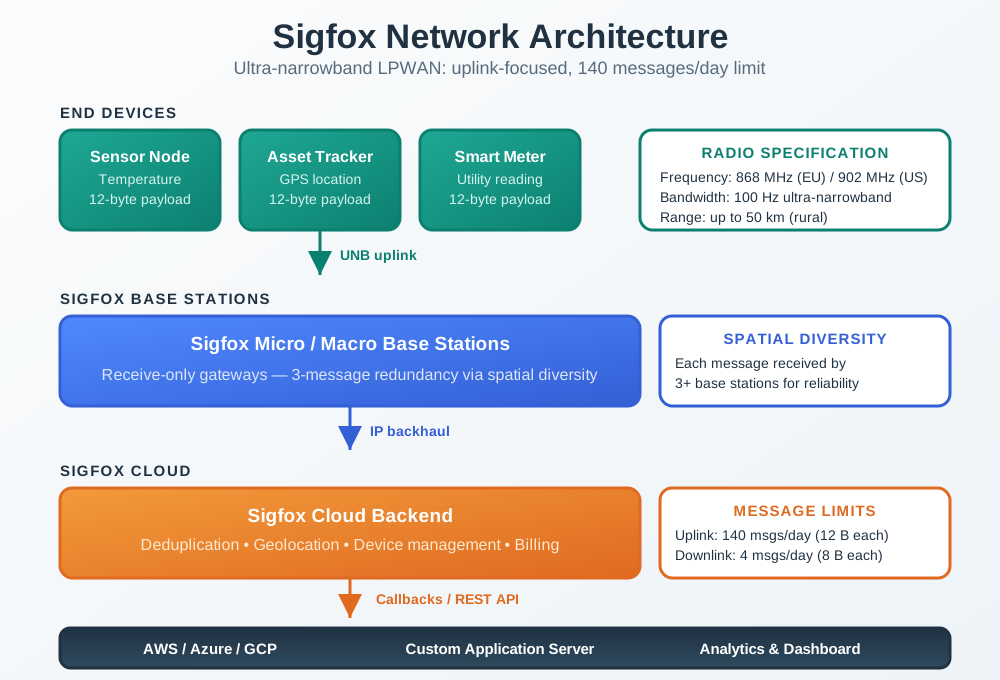
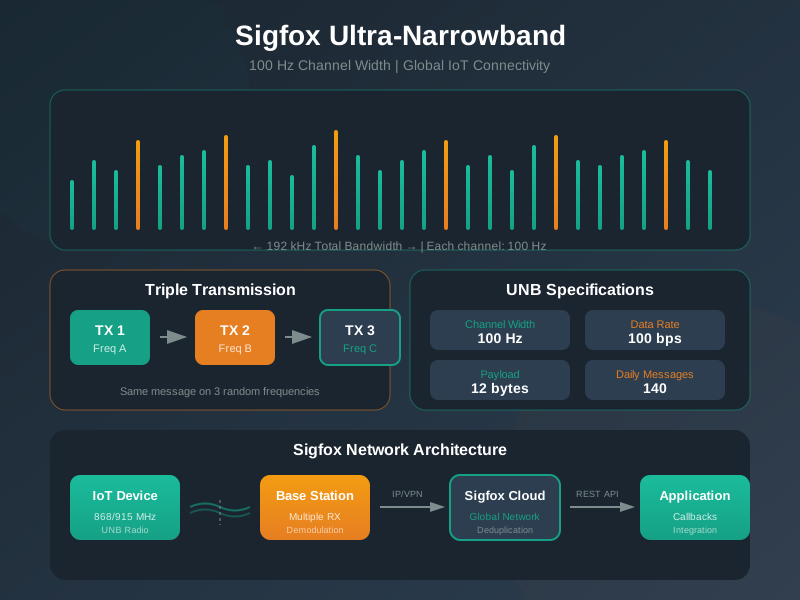
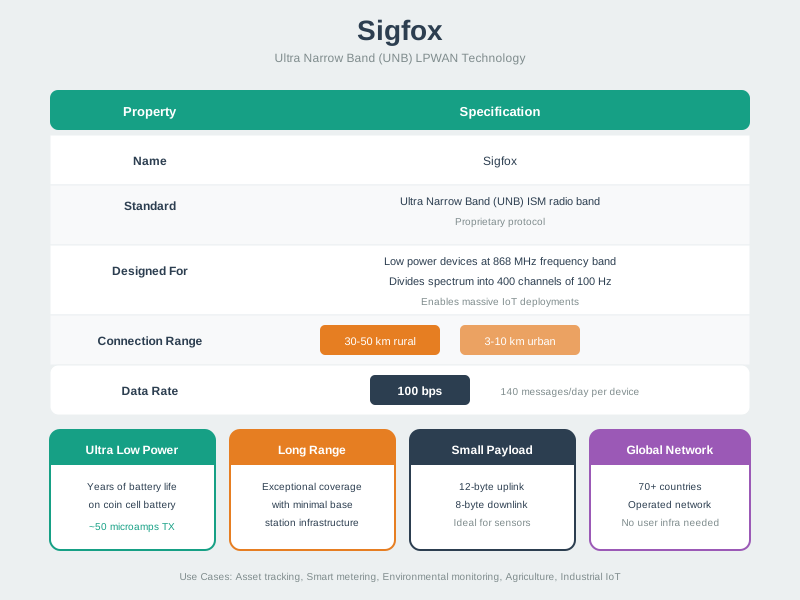
Context: Sigfox transmits each message three times on different random frequencies to achieve reliability without acknowledgments.
Frequency diversity probability: If single-transmission success rate is 90% (p = 0.1 failure), then probability all three transmissions fail is:
\[P(\text{all fail}) = p^3 = (0.1)^3 = 0.001 = 0.1\%\]
Therefore delivery reliability reaches 99.9% through triple transmission.
Energy budget analysis: Each transmission consumes 50 mW for 2 seconds = 100 mAs. Annual energy for 140 messages/day:
\[E_{\text{annual}} = 3 \times 140 \times 365 \times 100\,\text{mAs} = 15,330,000\,\text{mAs} = 4.26\,\text{Ah}\]
Worked example: With 2,400 mAh battery at maximum rate (140 msg/day): - Transmission energy: 4.26 Ah/year - Battery life: 2,400 mAh / 4,260 mAh = 0.56 years
But at typical rate (10 msg/day): 0.30 Ah/year → 8 years battery life
36.5.1 Why Sigfox Transmits Each Message Three Times on Different Frequencies
Sigfox’s ultra-narrow band (UNB) approach creates a unique reliability challenge: a 100 Hz wide channel is easily disrupted by even minor narrowband interference (a single harmonic from an industrial motor, for example, can obliterate the entire channel). To compensate, every Sigfox uplink message is transmitted three times on three different randomly selected frequencies within a 40-second window.
This design has specific engineering consequences:
Frequency diversity. The three transmissions use three different frequencies within the 192 kHz uplink band (868.034-868.226 MHz in Europe). If one frequency happens to coincide with an interference source, the other two probably will not. The probability of all three hitting interference simultaneously is roughly p3, where p is the probability of a single collision. With the 192 kHz band divided into approximately 1,920 potential 100 Hz channels, and typical urban interference occupying 5-10% of channels, the probability of all three replicas failing is (0.1)3 = 0.1%, yielding 99.9% message delivery.
Time diversity. The three replicas are spaced randomly within a 40-second window. This protects against bursty interference that might blank the band for a few seconds (e.g., a passing vehicle’s ignition noise). The 40-second window means the device’s radio is active for only 3 x 2 seconds = 6 seconds total, with 34 seconds of dead time between transmissions.
The cost of triple transmission. Each replica consumes approximately 50 mW for 2 seconds at 868 MHz (100 mW EIRP limit in EU). Three transmissions per message x 140 messages per day x 365 days = 153,300 transmissions per year. At 100 mAs per transmission (50 mA x 2 seconds), the annual energy budget for transmissions alone is 4.26 Ah. A 2,400 mAh lithium thionyl chloride battery (typical for Sigfox devices) would last 0.56 years if transmitting at maximum rate. In practice, most Sigfox devices send only 1-10 messages per day, extending battery life to 8-15 years. The 140 messages/day limit is partly a practical battery constraint, not just a network capacity rule.
36.7 Summary
Key Takeaways:
- Operator-Managed LPWAN: Sigfox is a proprietary network service (like cellular), not a platform you deploy yourself
- Ultra-Low Power: 10-20 year battery life from ultra-narrow band (UNB) modulation and simple protocols
- Severe Constraints: 12-byte payload, 140 messages/day uplink, only 4 downlinks/day
- Coverage Dependency: Works only where Sigfox operators provide coverage (75+ countries claimed, fragmented)
- Cost-Effective at Small Scale: $1-2/device/year beats LoRaWAN for <1,000 devices
- Design Philosophy: Compress data aggressively, test in real deployment environment, plan for uplink-only operation
When to Use Sigfox:
- Small infrequent messages (<12 bytes, <140/day)
- Existing operator coverage in deployment area
- No need for network control or infrastructure ownership
- Cost-sensitive deployments (<1,000 devices)
When to Avoid Sigfox:
- Need larger payloads (>12 bytes)
- Frequent updates (>140/day) or bidirectional control
- Coverage gaps in deployment area
- Critical infrastructure requiring network ownership
Common Pitfalls
Sigfox was a pioneer that proved LPWAN commercial viability before LoRaWAN became widely deployed. Understanding Sigfox’s contribution to LPWAN development provides important context for why LoRaWAN made certain design choices differently.
Unabiz acquired Sigfox network assets in 2022 and committed to continued operation. While new deployments should consider operator risk, existing Sigfox deployments continue operating and Unabiz has maintained network services.
Sigfox’s simplicity and low cost suit high-volume, low-margin applications like utility metering and industrial sensors where per-unit economics matter. These are commercially significant markets, not low-value applications.
Sigfox’s managed network model eliminated customer infrastructure investment, reducing the barrier to IoT connectivity adoption. Understanding this business model choice explains Sigfox’s go-to-market strategy and how it differed from LoRaWAN’s self-deployable approach.
36.8 What’s Next
Continue your Sigfox learning with these chapters:
| Chapter | Focus Area |
|---|---|
| Sigfox Best Practices | Common deployment mistakes, message limit strategies, and coverage gap workarounds |
| Sigfox Technology Deep Dive | UNB modulation details, network architecture, Atlas geolocation, and link budgets |
| Sigfox Worked Examples | Message budget planning, TCO calculations, and duty cycle compliance |
| LoRaWAN Architecture | Compare Sigfox with user-deployable LPWAN for informed technology selection |