51  Sigfox Examples & Assessment

In 60 Seconds

This chapter walks through practical Sigfox deployment calculations including message budget planning (fitting within 140/day), total cost of ownership comparisons between Sigfox and LoRaWAN at different scales, link budget estimation for long-range scenarios, and duty cycle compliant tracking schedules.

51.1 Introduction

⏱️ ~15 min | ⭐⭐ Intermediate | 📋 P09.C10.U04

This chapter provides detailed worked examples for Sigfox deployment calculations and comprehensive assessment questions to test your understanding of Sigfox fundamentals.

Learning Objectives

By the end of this chapter, you will be able to:

  • Calculate message budgets and verify compliance with Sigfox daily limits for asset tracking applications
  • Evaluate total cost of ownership (TCO) trade-offs between Sigfox and LoRaWAN at different deployment scales
  • Compute link budgets using the Friis path loss formula for long-range Sigfox deployments
  • Design duty cycle compliant tracking schedules that balance update frequency with battery longevity
  • Justify technology selection decisions using quantitative deployment analysis

Key Concepts

  • Worked Examples: Step-by-step calculations demonstrating Sigfox payload encoding, message budget planning, and coverage estimation for real-world scenarios.
  • Encoding Examples: Practical demonstration of encoding temperature (0.1°C resolution), GPS coordinates, and status flags into 12-byte Sigfox payloads.
  • Budget Calculation: Daily message allocation analysis determining message frequency for combined scheduled readings and event-driven alerts within 140/day limit.
  • Coverage Estimation: Link budget analysis for Sigfox: TX power + antenna gain − path loss vs. receiver sensitivity determines gateway reception probability.
  • Assessment Practice: Representative questions covering Sigfox modulation, payload limits, duty cycle, network model, and comparison with other LPWAN technologies.
  • Error Analysis: Common mistakes in Sigfox implementations including payload overflow, exceeding daily limits, improper byte ordering, and callback misconfiguration.
  • Case Studies: Real-world Sigfox deployments in asset tracking, utilities, and industrial monitoring illustrating best practices and lessons learned.

This chapter presents practical Sigfox examples and assessment questions. You will work through real scenarios – water meter monitoring, asset tracking, environmental sensing – and evaluate whether Sigfox is the right choice for each one. It bridges the gap between understanding Sigfox theory and applying it in practice.

“Let us work through some real deployment math!” said Max the Microcontroller, pulling out a calculator. “The first question is always: does my application fit within 140 messages per day?”

Sammy the Sensor started with the tracking scenario. “A shipping container needs GPS updates every hour for 30 days. That is 24 messages per day – well within the 140 limit. But each message is only 12 bytes, so I need to pack latitude, longitude, and status into that tiny space.” Max showed the encoding. “Use fixed-point representation: 4 bytes for latitude, 4 bytes for longitude, and 4 bytes for status. Exactly 12 bytes!”

“Cost comparison is where it gets interesting,” said Lila the LED. “At 1,000 devices, Sigfox costs about 1 dollar per device per year – total 1,000 dollars annually. LoRaWAN requires buying gateways at 500 to 1,000 dollars each plus network server costs, so the breakeven is around 200 to 500 devices depending on gateway coverage.”

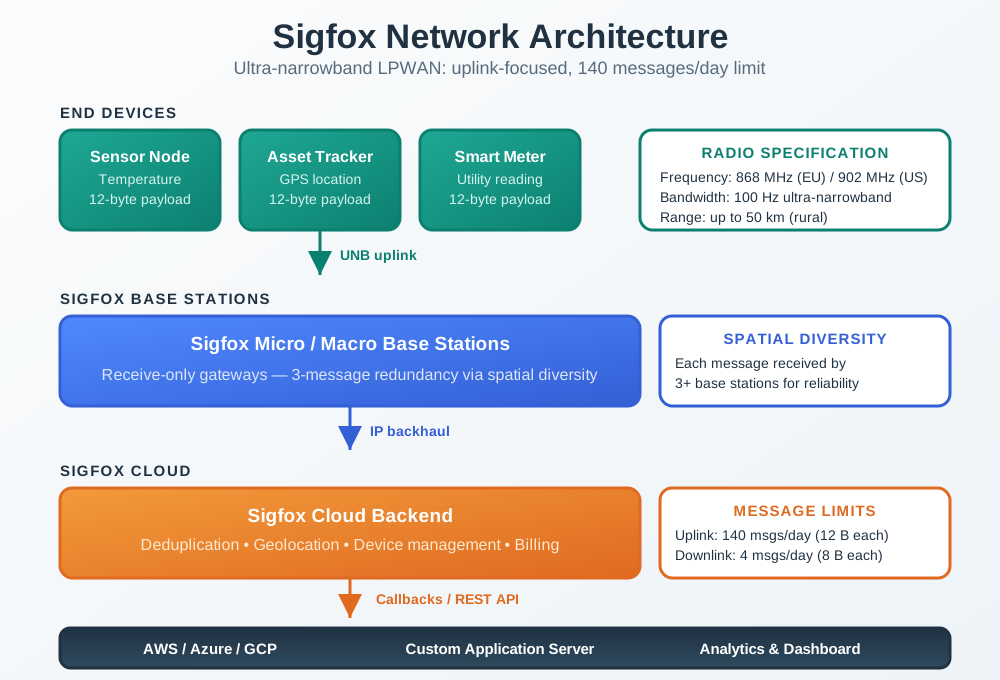
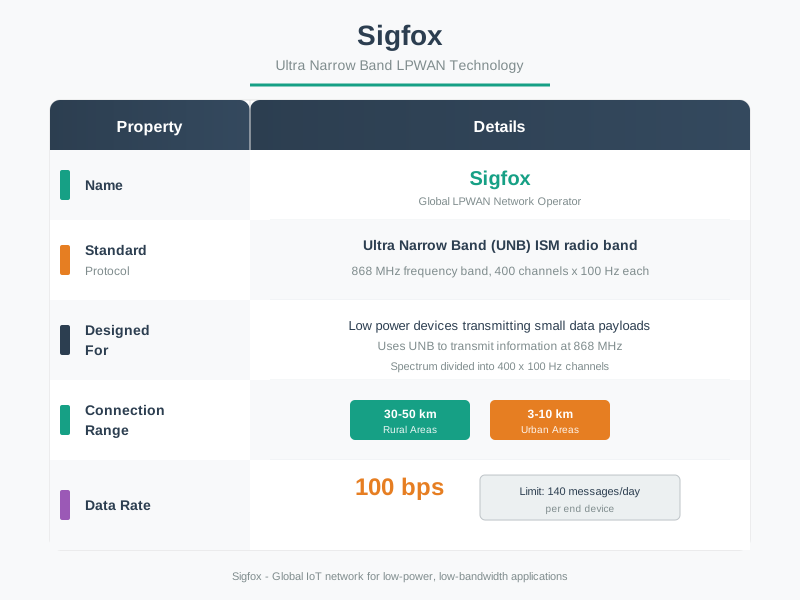
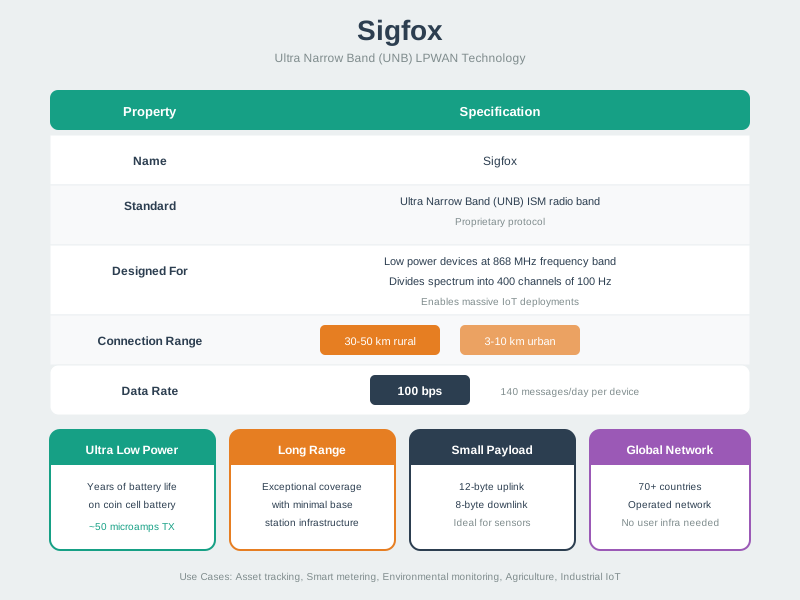
Bella the Battery highlighted the link budget calculation. “Sigfox’s UNB modulation gives it 164 dB of link budget – similar to NB-IoT. In free space, that reaches 50 kilometers. In an urban environment with 20 dB of building penetration loss, you still get 5 to 10 kilometers. Always add a 10 dB fade margin for reliable operation.”

51.2 Worked Examples

Worked Example: Sigfox Message Budget for Asset Tracking

Scenario: A logistics company wants to track 1,000 shipping containers using Sigfox. Each container needs to report its location and status during ocean transit (typically 30 days). Can Sigfox meet the tracking requirements within its message limits?

Given:

  • Number of containers: 1,000
  • Transit duration: 30 days average
  • Sigfox uplink limit: 140 messages per day per device
  • Sigfox downlink limit: 4 messages per day per device
  • Payload size: 12 bytes maximum
  • Required tracking data: GPS (8 bytes), temperature (1 byte), shock alert (1 byte), battery (1 byte), status (1 byte) = 12 bytes total

Step 1: Define tracking requirements

Location updates needed:
- Port departure: 1 message
- Ocean transit: Position every 4 hours = 6 per day × 30 days = 180 messages
- Port arrival: 1 message
- Total location: 182 messages over 30 days

Event alerts:
- Temperature excursion: Up to 5 events
- Shock/impact: Up to 10 events
- Door open/close: Up to 4 events
- Total events: ~19 messages

Grand total: 182 + 19 = 201 messages per transit

Step 2: Check against Sigfox daily limits

Sigfox limit: 140 messages per day
Required per day (transit): 6 location + ~0.6 events = 6.6 messages/day

6.6 messages/day << 140 messages/day limit

VERDICT: Well within daily limit (using only 4.7% of quota)

Step 3: Optimize message payload (12-byte constraint)

Standard GPS: Latitude (4 bytes) + Longitude (4 bytes) = 8 bytes
Temperature: Signed integer (-40 to +85C) = 1 byte
Shock level: 0-255 scale = 1 byte
Battery: 0-100% = 1 byte
Status flags: Door, motion, alarm = 1 byte

Total: 8 + 1 + 1 + 1 + 1 = 12 bytes (exactly fits!)

Example encoded message:
41.8902N, -87.6245W, 23C, no shock, 87%, door closed
Hex: 41 B9 45 C8 A7 B9 0A 17 00 57 00 00

Step 4: Calculate 5-year cost comparison

Sigfox Solution:
- Hardware (Sigfox module): 1,000 × $15 = $15,000
- Subscription: 1,000 × $2/year × 5 = $10,000
- Total 5-year: $25,000 ($25/container)

Cellular (NB-IoT) Solution:
- Hardware: 1,000 × $25 = $25,000
- SIM + data: 1,000 × $60/year × 5 = $300,000
- Total 5-year: $325,000 ($325/container)

Sigfox savings: $300,000 (92% cost reduction)

Result: Sigfox is ideal for this use case - the container tracking requirements use only 4.7% of the daily message quota, the 12-byte payload fits perfectly, and the 5-year cost is 92% lower than cellular alternatives.

Key insight: Sigfox excels when you can design your data to fit the 12-byte payload constraint. GPS coordinates can be encoded efficiently (8 bytes covers global positioning to ~1 meter accuracy). The 140 messages/day limit is rarely a constraint for asset tracking applications that update hourly or less frequently. Calculate your actual message needs - many applications use less than 10% of the Sigfox quota.

Worked Example: Sigfox vs LoRaWAN TCO for Smart Parking

Scenario: A city is deploying 5,000 parking sensors across downtown. Each sensor detects vehicle presence and sends status updates. The city needs to choose between Sigfox and LoRaWAN based on 5-year total cost of ownership.

Given:

  • Number of sensors: 5,000
  • Message frequency: Event-driven (car arrives/departs) + hourly heartbeat
  • Average messages per sensor per day: 20 (10 car events + 14 heartbeats, within 140 limit)
  • Payload: 5 bytes (sensor ID, status, battery, timestamp)
  • Deployment area: 15 km² downtown area
  • Sigfox coverage: Available from regional operator
  • LoRaWAN: Would require private gateway deployment

Step 1: Calculate Sigfox costs

Hardware:
- Sigfox sensor modules: 5,000 × $18 = $90,000
- Installation: 5,000 × $25 = $125,000

Subscription (5 years):
- Annual fee: 5,000 × $2/year = $10,000/year
- 5-year total: $10,000 × 5 = $50,000

Infrastructure: $0 (uses operator network)

Sigfox Total 5-Year: $90,000 + $125,000 + $50,000 = $265,000
Per sensor: $53

Step 2: Calculate LoRaWAN costs

Hardware:
- LoRaWAN sensor modules: 5,000 × $22 = $110,000
- Installation: 5,000 × $25 = $125,000

Gateway infrastructure:
- Gateways needed (15 km² / 2 km² coverage each): 8 gateways
- Gateway cost: 8 × $1,200 = $9,600
- Gateway installation (rooftop): 8 × $500 = $4,000
- Gateway internet backhaul: 8 × $50/month × 60 = $24,000

Network server:
- Cloud LoRaWAN service: $200/month × 60 = $12,000
  OR
- Self-hosted: $5,000 initial + $2,000/year maintenance = $15,000

Operations:
- Gateway maintenance: $1,000/year × 5 = $5,000

LoRaWAN Total 5-Year: $110,000 + $125,000 + $9,600 + $4,000 + $24,000 + $12,000 + $5,000 = $289,600
Per sensor: $57.92

Step 3: Compare and analyze

Cost Summary:
- Sigfox 5-year: $265,000
- LoRaWAN 5-year: $289,600
- Difference: $24,600 (LoRaWAN costs 9.3% more)

Operational Comparison:
                    Sigfox          LoRaWAN
Infrastructure      None            8 gateways to maintain
Deployment time     2 weeks         2 months (gateway install)
Coverage guarantee  Operator SLA    Self-managed
Scalability         Unlimited       May need more gateways
Network control     None            Full control

Step 4: Break-even analysis

At what scale does LoRaWAN become cheaper?

LoRaWAN fixed costs: $9,600 + $4,000 + $24,000 + $12,000 + $5,000 = $54,600
LoRaWAN per-sensor: $22 + $25 = $47 (no subscription)

Sigfox per-sensor: $18 + $25 + ($2 × 5) = $53

LoRaWAN becomes cheaper when:
N × $53 > $54,600 + N × $47
N × $6 > $54,600
N > 9,100 sensors

CROSSOVER: ~9,100 sensors

Result: For this 5,000-sensor deployment, Sigfox is $24,600 cheaper with zero infrastructure management. However, if the city expands to 10,000+ sensors, LoRaWAN would become more economical due to its zero per-device recurring fees.

Key insight: The Sigfox vs LoRaWAN decision depends heavily on scale. Below ~9,000 devices, Sigfox’s operator model eliminates infrastructure complexity and reduces TCO. Above that threshold, LoRaWAN’s gateway investment becomes amortized across enough devices to beat Sigfox’s subscription fees. Always calculate the crossover point for your specific deployment - it varies based on gateway costs, coverage area, and local Sigfox subscription rates.
Worked Example: Sigfox UNB Link Budget for Remote Agricultural Monitoring

Scenario: A vineyard deploys soil moisture sensors across 50 km of hilly terrain in rural France. The nearest Sigfox base station is 25 km away. Will the UNB (Ultra-Narrow Band) technology provide reliable connectivity at this extreme range?

Given:

  • Distance to base station: 25 km
  • Frequency: 868 MHz (RC1 Europe)
  • Sigfox TX power: 14 dBm (25 mW, EU limit)
  • Device antenna gain: 0 dBi (simple wire antenna)
  • Base station antenna gain: 6 dBi (omnidirectional tower)
  • Base station height: 30 meters
  • Terrain: Hilly rural with vineyard rows
  • Sigfox receiver sensitivity: -142 dBm (UNB advantage)
  • Required link margin: 15 dB (for weather, seasonal foliage)

Step 1: Calculate free-space path loss

The Friis free-space path loss formula calculates signal attenuation over distance. For Sigfox at 25 km and 868 MHz:

\[FSPL = 20 \log_{10}(d_{km}) + 20 \log_{10}(f_{MHz}) + 32.45\]

Worked example: Agricultural sensors 25 km from base station:

FSPL = 20 × log10(25) + 20 × log10(868) + 32.45
     = 28.0 dB (distance) + 58.8 dB (frequency) + 32.45 dB (constant)
     = 119.25 dB total path loss

With 18 dB additional losses (terrain + vegetation + weather):
Total loss = 119.25 + 18 = 137.25 dB

Link budget: +14 dBm TX - 137.25 dB loss + 6 dBi antenna = -117.25 dBm
Sigfox sensitivity: -142 dBm
Margin: -117.25 - (-142) = 24.75 dB (9.75 dB above 15 dB requirement!)

Each 6 dB of margin doubles reliable communication range. The 24.75 dB margin provides approximately 3× range safety factor in challenging rural environments.

Step 2: Add terrain and environmental losses

Hilly terrain (non-line-of-sight): +12 dB
Vegetation (vineyard canopy): +4 dB
Weather margin (rain fade at 868 MHz): +2 dB
Total additional losses: +18 dB

Total path loss = 119.25 + 18 = 137.25 dB

Step 3: Calculate link budget

Uplink Link Budget:
────────────────────────────────────
TX power (sensor):           +14 dBm
TX antenna gain:             +0 dBi
Path loss:                   -137.25 dB
RX antenna gain (base):      +6 dBi
────────────────────────────────────
Signal at receiver:          -117.25 dBm

Sigfox sensitivity:          -142 dBm
Link margin available:       24.75 dB
Required margin:             15 dB
Excess margin:               9.75 dB

Step 4: Compare with LoRaWAN at same distance

LoRaWAN SF12 sensitivity: -137 dBm (best case)
Signal at receiver: -117.25 dBm
LoRaWAN margin: 19.75 dB

Sigfox margin: 24.75 dB
Sigfox advantage: +5 dB (1.8x better range)

Step 5: Validate with Sigfox triple-redundancy

Sigfox transmits each message 3 times on different frequencies:
- If 1 transmission fails (interference), 2 others likely succeed
- Effective reliability at 24.75 dB margin: >99.9%

Per-transmission success probability at 24.75 dB margin: ~99%
3 independent transmissions: 1 - (0.01)³ = 99.9999%

Result: The vineyard sensors will work reliably at 25 km range with 24.75 dB link margin (9.75 dB excess). Sigfox’s -142 dBm sensitivity provides 5 dB advantage over LoRaWAN SF12, enabling this extreme-range rural deployment.

Key Insight: Sigfox’s ultra-narrow band (100 Hz) modulation concentrates transmission energy, achieving -142 dBm sensitivity versus LoRa’s -137 dBm at SF12. This 5 dB advantage translates to ~1.8x range extension, making Sigfox ideal for sparse rural deployments where base stations are far apart. The triple-redundancy transmission pattern further improves reliability in challenging RF environments.

Worked Example: Sigfox Duty Cycle and Message Timing Compliance

Scenario: A cold chain logistics company tracks 500 refrigerated containers. Each container has sensors for temperature, door status, and GPS location. The company wants to maximize tracking frequency while staying within Sigfox’s 140 messages/day limit and EU duty cycle regulations.

Given:

  • Sigfox payload: 12 bytes maximum
  • Sigfox uplink limit: 140 messages per day per device
  • EU868 duty cycle: 1% (36 seconds per hour TX time)
  • Sigfox message duration: ~2 seconds (100 bps × 12 bytes × 3 transmissions)
  • Required data: GPS (6 bytes), temperature (2 bytes), door status (1 byte), battery (1 byte), timestamp (2 bytes) = 12 bytes

Step 1: Calculate maximum message rate under duty cycle

EU868 duty cycle limit: 1% = 36 seconds/hour TX time
Sigfox message duration: ~6 seconds (including 3× redundancy)
Max messages/hour (duty cycle): 36 ÷ 6 = 6 messages/hour
Max messages/day (duty cycle): 6 × 24 = 144 messages/day

Step 2: Compare with Sigfox network limit

Sigfox network limit: 140 messages/day
EU duty cycle limit: 144 messages/day
Binding constraint: Sigfox network (140/day)

Step 3: Design optimal tracking schedule

Container states and tracking needs:
────────────────────────────────────
1. Stationary at warehouse: Low priority
   - 1 message every 4 hours = 6 messages/day

2. In transit (truck/ship): High priority
   - 1 message every 10 minutes during active hours
   - Active period: 12 hours/day
   - Messages: 72 messages/day

3. Temperature alarm: Critical
   - Immediate transmission on threshold breach
   - Reserve: 20 messages/day for alarms

4. Door open/close events: Important
   - Max 10 events/day typical
   - Reserve: 15 messages/day

Total allocation:
- Stationary: 6
- Transit tracking: 72
- Temperature alarms: 20
- Door events: 15
- Buffer: 27 (for retries, unexpected events)
────────────────────────────────────
Total: 140 messages/day (exactly at limit)

Step 4: Optimize payload encoding

Diagram showing PAYLOAD

GPS encoding example:

  • Latitude 48.8566N = 488566 = 0x07 0x74 0x26 (3 bytes)
  • Longitude 2.3522E = 23522 = 0x00 0x5B 0xE2 (3 bytes)
  • Resolution: 0.0001 degrees = approximately 11 meters (sufficient for container tracking)

Step 5: Calculate battery impact of message rate

Energy per Sigfox transmission:
- TX current: 50 mA
- TX duration: 6 seconds (3× redundancy)
- Energy: 50 mA × 6s = 300 mAs = 0.083 mAh

Daily consumption at 140 messages:
- TX energy: 140 × 0.083 = 11.62 mAh
- Sleep (3 µA × 24h): 0.072 mAh
- Total daily: 11.69 mAh

Battery life with 5000 mAh battery:
- Theoretical: 5000 ÷ 11.69 = 427 days = 1.2 years
- With 70% usable capacity: 299 days ≈ 10 months

For 5-year operation, reduce to:
- Messages/day: 140 ÷ 5 = 28 messages/day
- Update every 51 minutes (acceptable for stationary containers)

Result: The cold chain system can achieve 10-minute tracking intervals during transit (72 messages) plus temperature alarms and door events, staying within the 140 messages/day limit. However, this aggressive rate limits battery life to ~10 months. For 5-year battery life, reduce to 28 messages/day (every 51 minutes).

Key Insight: Sigfox’s 140 messages/day limit is the primary constraint for high-frequency tracking, not EU duty cycle (which allows 144/day). Design your tracking schedule around message budget, not just RF regulations. For cold chain, prioritize temperature alarms (immediate) over regular position updates (can be less frequent). The 12-byte payload constraint requires careful data encoding - GPS coordinates fit in 6 bytes using scaled integers with 11-meter resolution.

51.2.1 Interactive: Sigfox vs LoRaWAN TCO Calculator

51.3 Quiz 1: Sigfox Fundamentals

## Knowledge Check {#net-sigfox-examples-knowledge}

Test your understanding of fundamental concepts with these questions.

51.5 Summary

This chapter provided practical application of Sigfox concepts through worked examples:

  • Message budget calculations show Sigfox typically uses <10% of daily quota for asset tracking
  • TCO comparisons reveal crossover points around 9,000 devices where LoRaWAN becomes cheaper
  • Link budget analysis demonstrates Sigfox’s 5 dB sensitivity advantage over LoRaWAN for extreme range
  • Duty cycle design balances tracking frequency with battery life and message limits
  • Payload encoding requires efficient data representation to fit 12 bytes

Common Pitfalls

Using uint16 for temperature without offset encoding fails for sub-zero readings. Add offset to handle negative range: store (temperature + 40) × 10 as uint16 to cover −40°C to +125°C with 0.1°C resolution within 2 bytes.

Sigfox payloads are raw bytes; multi-byte values must use consistent byte ordering between device encoder and server decoder. Failing to match little-endian or big-endian convention between firmware and decoder produces wrong values that pass basic sanity checks.

Test payload decoders with minimum values, maximum values, and zero — not just typical sensor readings. Boundary values often reveal encoding bugs (overflow, sign handling, offset errors) that typical values don’t expose.

Budget calculations often assume uniform message distribution across the day. Real applications have bursts: startup after power restoration, alarm events, and scheduled synchronized transmissions from multiple devices. Model peak scenarios, not just average daily rate.

51.6 What’s Next

Now that you have worked through Sigfox deployment calculations, explore related LPWAN technologies and compare deployment options:

Next Topic Chapter Description
Sigfox Advanced Topics Sigfox Deep Dive Architecture, protocols, and implementation details
LoRaWAN Comparison LoRaWAN Fundamentals User-deployable alternative with higher data rates and no message limits
Cellular LPWAN NB-IoT & LTE-M Cellular LPWAN with global coverage and mobility support
LPWAN Overview LPWAN Introduction Compare all LPWAN technologies including Weightless and other alternatives