42  Sigfox

42.1 Learning Objectives

After completing this chapter series, you should be able to:

  • Explain Sigfox UNB modulation, message flow, and how triple-redundancy transmission achieves reliability without acknowledgement
  • Compare Sigfox deployment models with LoRaWAN gateway-based and NB-IoT cellular-based LPWAN alternatives
  • Design Sigfox message payloads that fit within the 12-byte constraint for real-world sensor telemetry
  • Evaluate Sigfox network coverage, cost structure, and operator dependency for large-scale IoT deployments
  • Implement hands-on Sigfox communication simulations and diagnose common configuration errors in message flow patterns

Key Concepts

  • Sigfox: Proprietary ultra-narrowband LPWAN technology; managed network service for IoT; uses 100 Hz channels, 12-byte payloads, 140 uplinks/day; acquired by Unabiz in 2022.
  • Ultra-Narrowband (UNB): Transmission using extremely narrow frequency channels (100 Hz); achieves high sensitivity enabling long range with low TX power.
  • Managed Network: Sigfox’s original deployment model where the technology provider builds and operates network infrastructure; removes gateway investment from customers.
  • Protocol Constraints: 12-byte maximum uplink payload, 8-byte maximum downlink payload, 140 uplinks/day, 4 downlinks/day; requires careful application design.
  • Network Coverage: Available in 70+ countries through licensed network operators; coverage quality varies significantly by region and operator investment.
  • Technology Trade-offs: Very long range and low device cost; but severe payload and duty cycle constraints, operator dependency, and limited downlink capability.
  • Ecosystem: Hardware certified by Sigfox SA; major module suppliers include Wisol, Murata, and ST; cloud integration via REST APIs and configurable callbacks.
In 60 Seconds

Sigfox is a proprietary LPWAN technology and global network operator using ultra-narrow band (UNB) modulation to transmit 12-byte messages up to 50 km on minimal power, with devices limited to 140 uplink messages per day. Its operator-managed subscription model provides the simplest path to IoT connectivity – no gateway deployment or network management needed – making it ideal for infrequent, low-data telemetry like asset tracking and environmental monitoring, but unsuitable for real-time or high-throughput applications.

MVU — Minimum Viable Understanding

Sigfox is a proprietary LPWAN technology and global network operator that uses ultra-narrow band (UNB) modulation to send tiny messages (12 bytes, up to 140 per day) over extreme distances (up to 50 km) with minimal power consumption. Its operator-managed model offers the simplest IoT connectivity but enforces strict message constraints that make it ideal only for infrequent, low-data telemetry such as asset tracking, environmental monitoring, and utility metering.

42.2 Introduction

⏱️ ~5 min | ⭐⭐ Intermediate | 📋 P09.C11.U01

Sigfox is both a proprietary LPWAN technology and the name of the French company that developed and operates it. Unlike other LPWAN technologies where you can deploy your own network, Sigfox operates as a network operator providing connectivity services globally. Sigfox pioneered the concept of ultra-narrow band (UNB) modulation for IoT, enabling billions of low-power devices to communicate with minimal infrastructure and energy consumption.

This chapter series provides comprehensive coverage of Sigfox technology, from fundamental concepts to hands-on implementation and assessment.

Characters: Sammy the Sensor, Lila the LED, Max the Microcontroller, Bella the Battery

Imagine Sammy the Sensor wants to send a postcard to the cloud every day. But Sammy doesn’t have a phone — he has a tiny walkie-talkie that can only whisper very short messages (like 12 words!) across a huge distance (an entire city!).

Bella the Battery loves this because whispering uses barely any energy. “I can keep Sammy talking for years without needing a recharge!” she says proudly.

Max the Microcontroller explains: “Sigfox is like a postal service for sensors. You pay a tiny subscription, drop your postcard in the mailbox (send a 12-byte message), and the Sigfox network delivers it to the cloud. But you can only send 140 postcards a day — so make each one count!”

Lila the LED adds: “And if the cloud wants to reply? It can only send back 4 tiny notes a day — so Sigfox is mostly about sensors reporting things, not having long conversations.”

Think of it this way: Sigfox is like a postcard service — cheap, simple, goes far, but you can’t send a novel!

If you’re new to LPWAN (Low-Power Wide-Area Network) technologies, here’s what you need to know about Sigfox:

  • What it does: Sigfox lets small, battery-powered devices (like sensors and trackers) send tiny amounts of data over very long distances (up to 50 km in rural areas) using very little power.
  • How it’s different: Unlike Wi-Fi or Bluetooth, Sigfox is designed for IoT devices that only need to send small, infrequent updates — think temperature readings, GPS coordinates, or alarm notifications.
  • The operator model: Sigfox runs its own global network (like a mobile phone carrier), so you don’t need to build or manage infrastructure. You buy a Sigfox-compatible module, pay a low annual subscription (around $1–$14 per device per year), and your device can communicate.
  • Key limitations: Messages are tiny (12 bytes up, 8 bytes down), and you’re limited to 140 uplink and 4 downlink messages per day. This makes Sigfox great for simple telemetry but unsuitable for streaming, firmware updates, or real-time control.

When to use Sigfox: Asset tracking, environmental monitoring, utility metering, smart agriculture — any scenario with simple, periodic data reporting and long battery life requirements.


42.3 Chapter Overview

The Sigfox content is organized into five focused chapters, each covering specific aspects of the technology:

42.3.1 1. Sigfox Overview

Technology foundations and ultra-narrow band modulation

  • Sigfox company history and business model
  • Ultra-Narrow Band (UNB) technology principles
  • Network architecture and star topology
  • Power consumption analysis and battery life calculations
  • Comparison with LoRaWAN and NB-IoT alternatives

42.3.2 2. Message Flow and Communication

Understanding uplink, downlink, and message constraints

  • Message flow sequence from device to cloud
  • Uplink characteristics: 12-byte payload, 140 messages/day
  • Downlink limitations: 8-byte payload, 4 messages/day
  • Energy impact of bi-directional communication
  • Common pitfalls: RX window timing, message budgeting

42.3.3 3. Deployment Considerations

Planning and implementing Sigfox solutions

  • Decision framework for Sigfox suitability
  • Total Cost of Ownership (TCO) analysis
  • Payload design and encoding best practices
  • Firmware update strategies
  • Deployment verification checklist

42.3.4 4. Hands-On Lab

Practical implementation with ESP32 simulation

  • Wokwi ESP32 Sigfox simulator lab
  • Complete device code with UNB modulation simulation
  • Python deployment analyzer tool
  • Payload encoding/decoding implementations
  • Lab exercises with solutions

42.3.5 5. Assessment and Review

Comprehensive quizzes and knowledge checks

  • Multiple choice questions with detailed explanations
  • Scenario-based analysis exercises
  • Technology comparison tables
  • Quick reference summary

42.4 Sigfox Network Architecture at a Glance

Before diving into the individual chapters, it is helpful to see how the core components of the Sigfox ecosystem fit together. The following diagram shows the end-to-end data flow from device to application.

Sigfox end-to-end network architecture showing device, base station, Sigfox Cloud, and customer application connected via UNB radio, IP backhaul, and REST API callbacks.

Sigfox end-to-end network architecture

Key architectural points:

  • Star topology – devices talk directly to base stations, with no mesh routing.
  • Redundant reception – each message is transmitted three times on random frequencies and can be received by multiple base stations, improving reliability without acknowledgement overhead.
  • Cloud-managed – deduplication, geolocation, and forwarding are handled centrally by the Sigfox Cloud, which pushes data to your application via HTTP callbacks.

42.5 LPWAN Technology Comparison

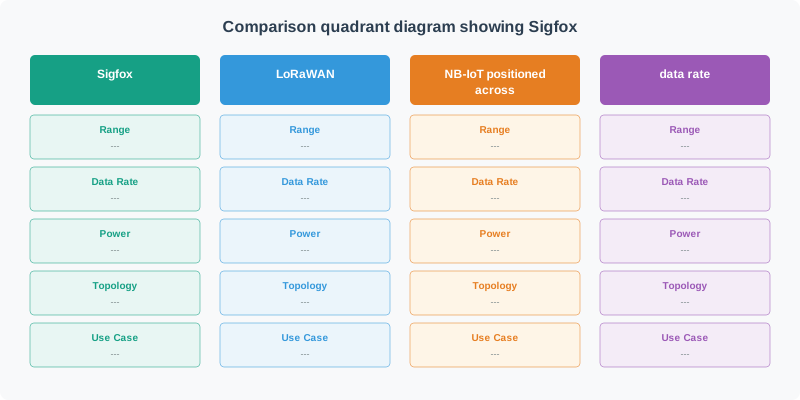
When selecting an LPWAN technology, Sigfox occupies a unique niche. The diagram below positions Sigfox relative to LoRaWAN and NB-IoT on the dimensions that matter most for IoT projects.

Comparison quadrant diagram showing Sigfox, LoRaWAN, and NB-IoT positioned across cost, data rate, range, and deployment complexity dimensions.

Feature Sigfox LoRaWAN NB-IoT
Modulation Ultra-Narrow Band (UNB) Chirp Spread Spectrum (CSS) OFDMA / SC-FDMA
Spectrum Unlicensed ISM Unlicensed ISM Licensed cellular
Max payload (uplink) 12 bytes 242 bytes ~1600 bytes
Daily message limit 140 uplink, 4 downlink Duty-cycle limited None (data-plan based)
Typical range 10-50 km 2-15 km 1-10 km
Battery life 10-15 years 5-10 years 5-10 years
Bidirectional Very limited Yes (Class A/B/C) Full
Deployment model Operator-managed Private or public Carrier-managed
Per-device cost Very low (~$1-14/yr) Medium (gateway CAPEX) Medium (SIM + data plan)


42.6 Learning Path

Recommended Sequence

For the best learning experience, work through the chapters in order:

  1. Overview → Understand the technology fundamentals
  2. Message Flow → Learn communication patterns and constraints
  3. Deployment → Apply knowledge to real-world planning
  4. Hands-On Lab → Build practical skills with simulation
  5. Assessment → Validate your understanding

42.7 Prerequisites

Before starting this chapter series, you should be familiar with:


42.8 Common Pitfalls

Common Pitfalls

1. Exceeding the daily message budget. Sigfox enforces a hard limit of 140 uplink messages per day. Developers who design for “send every minute” (1,440 messages/day) will exceed this by 10x. Always calculate your required daily message count before selecting Sigfox.

2. Expecting real-time downlink communication. With only 4 downlink messages per day, Sigfox cannot support real-time device control, frequent configuration updates, or over-the-air firmware updates. If your application requires regular cloud-to-device commands, choose LoRaWAN (Class C) or NB-IoT instead.

3. Ignoring payload encoding. A 12-byte payload is far too small for JSON or human-readable text. You must use binary encoding (bit-packing, fixed-point integers) to fit meaningful data. Sending {"temp":22.5} as ASCII uses 14 bytes – already over the limit. The same value encoded as a 16-bit integer uses only 2 bytes.

4. Assuming global coverage. Sigfox coverage varies significantly by country. Before committing to Sigfox, verify coverage in your specific deployment region using the Sigfox Coverage Map. Rural and indoor coverage gaps are common.

5. Overlooking the operator lock-in risk. Unlike LoRaWAN, where you can deploy your own gateway, Sigfox is entirely operator-dependent. If Sigfox ceases operations in your region (as has happened in some markets), you have no fallback without hardware replacement.

6. Not accounting for triple-transmission energy cost. Each Sigfox uplink transmits the message three times on different frequencies. Battery life calculations must include the energy for all three transmissions (total TX time of approximately 6-18 seconds depending on the module and region), not just a single frame. Underestimating this can lead to batteries depleting years earlier than expected.


42.9 Worked Example: Smart Water Tank Monitoring

Scenario

A water utility company wants to monitor 5,000 water tanks across a rural region. Each tank has a level sensor, a temperature sensor, and a leak-detection flag. The company needs hourly readings during the day (06:00-22:00) and readings every 4 hours overnight. Battery replacement is expensive due to the remote locations, so a minimum 10-year battery life is required.

42.9.1 Step 1: Calculate Daily Messages

Period Hours Interval Messages
Daytime (06:00-22:00) 16 h Every 1 hour 16 messages
Nighttime (22:00-06:00) 8 h Every 4 hours 2 messages
Total 24 h 18 messages/day

18 messages per day is well within the 140-message daily limit (only 12.9% utilization). This leaves headroom for alarm messages (e.g., leak detected, low battery).

42.9.2 Step 2: Design the Payload (12-byte budget)

Field Data Encoding Bytes
Water level 0-100% uint8 (0-200, /2 for 0.5% resolution) 1
Temperature -10 to 50 C int8 (offset by +10, x2 for 0.5C resolution) 1
Leak flag Yes/No 1 bit (packed)
Battery voltage 2.0-3.6 V uint8 (0-160, /100 + 2.0) 1
Timestamp delta 0-255 min uint8 1
Reserved 8
Total 4 bytes used / 12 available

Only 4 of 12 bytes are needed, leaving 8 bytes for future expansion (e.g., second tank, water quality sensor).

Context: Battery life calculation for Sigfox water tank monitoring (18 messages/day).

Energy per message (triple transmission): \[E_{\text{msg}} = 40\,\text{mA} \times (3 \times 2\,\text{s}) / 3600\,\text{s/h} = 0.067\,\text{mAh}\]

Daily transmission energy: \[E_{\text{daily,tx}} = 18 \times 0.067 = 1.2\,\text{mAh}\]

Sleep energy (assuming 1 µA): \[E_{\text{daily,sleep}} = 0.001\,\text{mA} \times 24\,\text{h} = 0.024\,\text{mAh}\]

Total daily consumption: \[E_{\text{total}} = 1.2 + 0.024 = 1.224\,\text{mAh/day}\]

Worked example with 6,000 mAh battery (2× AA lithium): \[\text{Battery life} = \frac{6000\,\text{mAh}}{1.224\,\text{mAh/day}} = 4,902\,\text{days} = 13.4\,\text{years}\]

To meet 10-year requirement with safety margin, use D-cell lithium (19,000 mAh) for 42-year theoretical life, or reduce to 10 messages/day for 16-year life with AA cells.
42.9.3 Step 3: Estimate Battery Life

Parameter Value
TX current 40 mA
TX duration per message 3 x 2 s (triple TX) = 6 s
Energy per message 40 mA x 6 s / 3600 = 0.067 mAh
Daily energy (18 msgs) 18 x 0.067 = 1.2 mAh
Sleep current 1 uA = 0.001 mA
Daily sleep energy 0.001 mA x 24 h = 0.024 mAh
Total daily energy 1.224 mAh
Battery capacity (2x AA lithium) 6,000 mAh
Estimated life 6,000 / 1.224 = 4,902 days = 13.4 years

The 13.4-year estimate exceeds the 10-year requirement with good margin. To add safety margin (accounting for battery self-discharge and temperature effects):

  • Conservative estimate (70% capacity): 4,200 mAh effective capacity yields 9.4 years – marginally below target.
  • Use D-cell lithium (19,000 mAh) for 42-year theoretical life and ample safety margin.
  • Reduce to 10 messages/day for 16-year life with AA cells even at 70% efficiency.

42.9.4 Interactive: Battery Life Estimator

42.9.5 Step 4: Cost Analysis (5,000 Devices, 10 Years)

Cost Item Per Device Fleet (5,000)
Sigfox module + MCU $15 $75,000
Annual subscription ($2/device) $20 (10 yr) $100,000
D-cell lithium battery $8 $40,000
Enclosure + installation $25 $125,000
Total (10-year TCO) $68 $340,000

Conclusion: Sigfox is an excellent fit for this use case. The message budget is comfortable, the payload fits easily, and the total cost of ownership is very low at $68 per device over 10 years ($0.57/device/month).


42.10 Knowledge Checks

Test your understanding of Sigfox fundamentals before diving into the detailed chapters.


Common Mistake: Designing for “Worst-Case” Message Frequency

The Mistake: Engineers design Sigfox applications assuming they must handle worst-case message rates every single day, leading them to incorrectly reject Sigfox for applications that would actually work fine.

Example Scenario: Smart agriculture soil moisture sensor design:

Flawed Calculation:

  • Worst case (heavy rain): sensor detects rapid moisture changes every 5 minutes
  • 5-minute intervals = 288 messages/day
  • 288/day > 140/day limit → “Sigfox won’t work” ❌

Correct Approach:

  • Normal operation (95% of days): 1 reading/hour = 24 messages/day
  • Rain events (5% of days): 12 readings/hour during 4-hour storm = 48 messages during event, 20 messages rest of day = 68 total/day
  • Average utilization: (0.95 × 24) + (0.05 × 68) = 26.2 messages/day average
  • Peak day utilization: 68/140 = 49% of limit ✓ Sigfox works!

The Insight: Sigfox’s 140 message/day limit is a daily budget, not a sustained rate requirement. Applications with burst patterns (most real-world IoT) can use Sigfox effectively by:

  1. Queuing messages during outages: Store up to 20 readings locally, send when connection resumes
  2. Adaptive reporting: Report every 15 minutes during critical events, hourly during normal operation
  3. Statistical thinking: Design for typical day (80th percentile), not absolute worst case

Real-World Example: Parking Sensor Fleet (10,000 sensors)

Scenario Messages/Sensor/Day Days/Year Total Messages/Year
Typical weekday 8-12 (office hours) 250 2.5M
Weekend 2-3 (low activity) 104 0.26M
Holiday 0-1 (closed) 11 0.01M
Annual average 7.5 messages/day 365 27.4M total

At 7.5 messages/day average, fleet operates at 5.4% of Sigfox capacity with room for 20x growth.

The Anti-Pattern That Wastes Money:

Choosing NB-IoT ($36/year/device for SIM and data plan) over Sigfox ($2/year/device subscription) because of a worst-case scenario that occurs 5% of the time costs an extra $34,000/year on 1,000 devices. The correct solution is: use Sigfox with firmware logic that reduces reporting frequency when approaching daily limit (e.g., if 120 messages sent by 6pm, switch from 15-min to 30-min intervals for remainder of day).

Best Practice: Calculate your median daily message count and 95th percentile, not worst case. If 95th percentile <100 messages/day, Sigfox is safe. If >120/day, evaluate alternatives.

42.11 Summary and Key Takeaways

Key Takeaways
  1. Sigfox is both a technology and an operator. Unlike LoRaWAN (which you can deploy privately), Sigfox provides end-to-end managed connectivity. You buy a module, pay a subscription, and Sigfox handles the network.

  2. Ultra-Narrow Band (UNB) enables extreme range and low power. By squeezing each transmission into a 100 Hz channel (compared to 125 kHz for LoRaWAN), Sigfox achieves superior link budget and can reach devices up to 50 km away in rural environments.

  3. Strict message constraints define the use case. The 140-uplink / 4-downlink daily limit and 12-byte payload are non-negotiable. Always calculate your exact daily message count and payload size before selecting Sigfox.

  4. Binary payload encoding is mandatory. With only 12 bytes per message, JSON or text encoding is impossible. Efficient bit-packing is essential for any Sigfox application.

  5. Triple-transmission provides reliability without ACKs. Each message is sent three times on random frequencies, eliminating the need for energy-expensive acknowledgement handshakes while maintaining high delivery rates.

  6. Lowest per-device cost in LPWAN. At $1-14 per device per year with no gateway infrastructure to purchase or maintain, Sigfox offers the most cost-effective connectivity for simple, high-volume IoT deployments.

  7. Operator dependency is a real risk. Sigfox’s centralized operator model means coverage depends on the company’s continued operation in your region. Always have a migration plan.


42.12 What’s Next?

Start your Sigfox learning journey with the Overview chapter, or jump directly to any chapter that matches your current learning needs.

Direction Chapter Description
Next Sigfox Overview Technology foundations and ultra-narrow band modulation
Next Sigfox Message Flow Uplink, downlink, and message constraints
Next Sigfox Deployment Planning and implementing Sigfox solutions
Related NB-IoT Fundamentals Cellular-based LPWAN for licensed spectrum deployments
Related LoRaWAN Comprehensive Review Deep comparison with Sigfox’s main competitor
Related MQTT Fundamentals Application layer protocols for IoT data transport