Sigfox achieves extreme range using Ultra-Narrow Band (UNB) modulation at 100 bps across 100 Hz channels, with all network intelligence in the cloud and simple endpoints. This chapter covers UNB radio parameters, link budget calculations, architectural comparison with LoRaWAN, and cost crossover analysis at different deployment scales.
39.1 Introduction
⏱️ ~12 min | ⭐⭐ Intermediate | 📋 P09.C10.U03
This chapter explores the technical foundations of Sigfox, including Ultra-Narrow Band (UNB) modulation, radio parameters, network architecture, and how Sigfox compares with other LPWAN technologies from a technical perspective.
Learning Objectives
By the end of this chapter, you will be able to:
Explain how Ultra-Narrow Band (UNB) modulation achieves extreme range through power spectral density concentration
Analyze Sigfox radio parameters and perform link budget calculations for deployment feasibility
Contrast Sigfox architecture with LoRaWAN across modulation, payload, infrastructure, and cost dimensions
Apply the LPWAN decision framework to select appropriate technologies for specific IoT use cases
Calculate cost crossover points between Sigfox and LoRaWAN at different deployment scales
Key Concepts
BPSK Modulation: Binary Phase Shift Keying used in Sigfox uplinks; combined with ultra-narrow 100 Hz bandwidth provides high sensitivity for long-range operation.
DBPSK: Differential BPSK variant used in Sigfox; encoding data as phase changes rather than absolute values reduces synchronization requirements.
Frequency Hopping: Sigfox device randomly selects carrier frequency from 200 kHz band for each of the 3 transmission repetitions; provides diversity against narrowband interference.
Diversity Reception: Sigfox base stations use 3-branch antenna diversity; multiple base stations may receive same message providing spatial diversity.
Sigfox Sensitivity: Receiver sensitivity of approximately −130 dBm enabling 50 km range in rural line-of-sight conditions.
Message Structure: Sigfox uplink includes device ID, sequence number, payload (0–12 bytes), and authentication MAC; total frame < 26 bytes over the air.
Downlink Mechanism: Sigfox downlink is only possible in the 20 seconds following an uplink; device must explicitly request downlink in the uplink frame.
For Beginners: Sigfox Technology
Sigfox uses ultra-narrowband radio to send tiny messages over long distances with extreme power efficiency. A Sigfox message is only 12 bytes – enough for a temperature reading or a door-open alert, but not a photo. This radical simplicity means devices can run on a coin cell battery for up to 10 years.
Sensor Squad: The Sigfox Deep Dive!
“Let us dig into how Sigfox really works!” Sammy the Sensor said. “The UNB modulation uses 100 Hz channels at 100 bits per second. That is incredibly slow compared to Wi-Fi, but it means my signal can travel 30 to 50 kilometers and penetrate deep inside buildings. For a sensor that only sends 12 bytes, slow speed is not a problem!”
“The software-defined approach is brilliant,” Lila the LED added. “In LoRaWAN, the gateway does some processing. In Sigfox, the base stations are as simple as possible – all the intelligence is in the cloud. This keeps infrastructure costs low and lets Sigfox update its network algorithms without touching any hardware.”
Max the Microcontroller said, “The architecture comparison with LoRaWAN is interesting. LoRaWAN gives you control – you own and operate your gateways. Sigfox gives you convenience – they own and operate everything. For a startup deploying 100 sensors, Sigfox’s zero-infrastructure approach can save months of setup time.”
“The cost crossover point matters,” Bella the Battery noted. “At small scale, Sigfox is cheaper because you avoid gateway costs. At large scale with thousands of devices in one area, LoRaWAN can be cheaper because you pay for gateways once instead of per-device subscriptions forever. Run the numbers for your specific deployment!”
39.2 Sigfox Technology Overview
39.2.1 The Company and Vision
Sigfox is a French company founded in 2009 with a vision to connect billions of IoT devices using a dedicated low-power wide-area network. Rather than selling equipment for customers to build their own networks, Sigfox operates as a network service provider—similar to how cellular carriers operate.
Key philosophy:
Software-based solution: Network and computing complexity managed in the cloud
Simple devices: All intelligence in the network, not the endpoints
Global coverage: Single subscription works across countries
Uses Ultra Narrow Band (UNB) to transmit information between low power devices operating at 868 MHz frequency band, that divides the spectrum into 400 of 100 Hz channels
Connection range
30-50 km for rural areas, and 3-10 km for urban areas
Data rate
100bps, with a limit of 140 messages per day for each end device
39.2.2 Ultra-Narrow Band Modulation
Sigfox uses Ultra Narrow Band (UNB) modulation, which is fundamentally different from spread spectrum techniques used by LoRa or frequency hopping used by Bluetooth.
UNB Characteristics:
Extremely narrow channel bandwidth: 100 Hz per channel
Multiple channels across the ISM band
Low data rate: 100 bps uplink, 600 bps downlink
High receiver sensitivity: -126 to -142 dBm
Robust against interference and jamming
Sigfox ultra-narrowband modulation architecture showing 868/902 MHz ISM band (192 kHz total) divided into ~1,920 channels of 100 Hz each. Frequency hopping selects random channel per message. Bandwidth comparison shows Sigfox at 100 Hz (ultra narrow), compared to NB-IoT 180 kHz (1,800× wider), LoRa 125 kHz (1,250× wider), and Wi-Fi 20-40 MHz (200,000-400,000× wider). Ultra-narrow design provides excellent interference resistance, long range through concentrated power density, and enables low-cost receivers.
Alternative View: Message Transmission Timeline
Sigfox message transmission timeline
This Gantt chart shows Sigfox’s transmission pattern: each message is sent 3 times on different frequencies over ~6 seconds, providing redundancy through time and frequency diversity.
Figure 39.1
Comparison with other modulation schemes:
Technology
Bandwidth
Data Rate
Sensitivity
Sigfox (UNB)
100 Hz
100 bps
-142 dBm
LoRa (CSS)
125-500 kHz
250-5,470 bps
-148 dBm
FSK (Cellular)
200 kHz
1-100 kbps
-110 dBm
Wi-Fi (OFDM)
20-40 MHz
1-600 Mbps
-90 dBm
39.2.3 Why Sigfox Chose 100 Hz Channels When Everyone Else Uses Kilohertz or Megahertz
Sigfox’s 100 Hz channel width is 1,250 times narrower than LoRa (125 kHz) and 200,000 times narrower than Wi-Fi (20 MHz). This extreme design choice has profound consequences that shape every aspect of the technology.
Narrower bandwidth concentrates power into a smaller frequency slice. Think of it like a garden hose: the same water pressure through a narrow nozzle produces a focused jet that reaches farther. A Sigfox device transmitting at +14 dBm (25 mW) into a 100 Hz channel has a power spectral density of -6 dBm/Hz. A LoRa device at the same +14 dBm spread across 125 kHz has a power spectral density of -37 dBm/Hz. That 31 dB difference in power concentration is why Sigfox base stations can decode signals at -142 dBm – far below the noise floor – using long integration times (2 seconds per message at 100 bps).
The trade-off is stark: range for data. Shannon’s theorem (C = B x log2(1 + SNR)) says channel capacity is proportional to bandwidth. At 100 Hz bandwidth with a practical SNR of 20 dB (typical for Sigfox’s operating conditions), the maximum theoretical data rate is about 665 bps (C = 100 x log2(1 + 100) = 665). Sigfox’s practical 100 bps uses just 15% of this theoretical maximum, leaving substantial margin for real-world impairments like fading and interference. This means a 12-byte payload takes 960 ms to transmit – nearly a full second for data that would take 0.05 ms on Wi-Fi.
Putting Numbers to It
Let’s calculate the power spectral density advantage and link budget that make Sigfox’s ultra-narrow band approach viable for IoT.
Power Spectral Density (PSD) Comparison:
For Sigfox transmitting at \(P_{TX} = +14\) dBm (25 mW) across \(BW = 100\) Hz:
This 29 dB margin accommodates: - Fading (10-15 dB) - Indoor penetration loss (10-20 dB) - Antenna misalignment (3-5 dB)
Result: 30 km range is achievable with sufficient margin for real-world conditions.
The 100 Hz width also explains the 140 message/day limit. In Europe (EU868), the duty cycle regulation is 1% – a device can transmit for at most 36 seconds per hour. Each Sigfox message (including 3 replicas) takes about 6 seconds of airtime. That gives 6 transmissions per hour x 24 hours = 144, rounded down to 140 for safety margin. This is not a Sigfox business decision to limit usage – it is a direct consequence of physics, regulation, and the triple-transmission redundancy scheme.
Frequency accuracy is the engineering challenge. A 100 Hz channel requires the transmitter’s frequency to be stable within +/-50 Hz. At 868 MHz, this is a relative accuracy of 0.06 ppm – far tighter than typical crystal oscillators (10-20 ppm). Sigfox solves this by having the base station, not the device, perform wideband scanning. The device transmits at an approximately correct frequency, and the base station’s SDR (software-defined radio) receiver scans the full 192 kHz band to find each 100 Hz signal. This pushes complexity (and cost) to the infrastructure side, keeping devices simple and cheap ($2-5 for the radio chip).
39.2.4 Sigfox Radio Parameters
The technical specifications of Sigfox’s radio system define its unique operational characteristics and constraints:
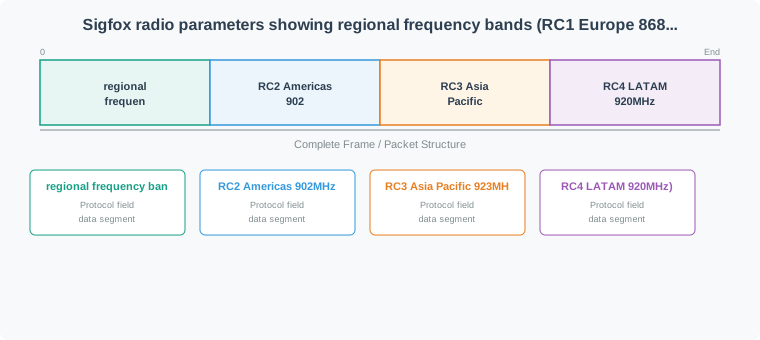
Sigfox radio parameters showing regional frequency bands (RC1 Europe 868MHz, RC2 Americas 902MHz, RC3 Asia Pacific 923MHz, RC4 LATAM 920MHz). Uplink specifications: 12-byte payload, 100 bps, DBPSK modulation, 14-27 dBm TX power, -126 dBm sensitivity, 140 messages/day limit. Downlink specifications: 8-byte payload, 600 bps, GFSK modulation, 20-25 second RX window, -142 dBm sensitivity, 4 messages/day limit. Performance: 10-40 km rural range, 3-10 km urban, limited indoor penetration (~20 dB loss), 10-20 year battery life.
Figure 39.2
Key Constraints to Remember:
Message Limits: 140 uplink + 4 downlink per day (non-negotiable)
Key Insight: Sigfox wins for small-to-medium deployments (<5,000 devices). LoRaWAN becomes cheaper at scale due to zero per-device fees. NB-IoT is premium option for specific use cases only.
39.4 Deep Dive: Advanced Sigfox Concepts
Technical Deep Dive: UNB Modulation Details
Ultra-Narrow Band (UNB) Modulation Explained:
Sigfox uses DBPSK (Differential Binary Phase Shift Keying) for uplink and GFSK (Gaussian Frequency Shift Keying) for downlink, both squeezed into extremely narrow 100 Hz channels.
Why 100 Hz Channels?
Bandwidth vs Range Trade-off:
━━━━━━━━━━━━━━━━━━━━━━━━━━
Wide channel (Wi-Fi 20 MHz):     High data rate, short range, high power
Medium channel (LoRa 125 kHz):  Moderate data, long range, low power
Narrow channel (Sigfox 100 Hz): Tiny data, extreme range, minimal power

Shannon-Hartley Theorem: C = B × log₂(1 + SNR)
- Sigfox reduces bandwidth (B) dramatically
- Compensates by improving SNR through long transmission time
- Result: Same information, much lower power density
Technical Specifications:
Parameter
Uplink (DBPSK)
Downlink (GFSK)
Modulation
Differential BPSK
Gaussian FSK
Bandwidth
100 Hz
600 Hz
Data Rate
100 bps
600 bps
TX Power
14-27 dBm (25-500 mW)
N/A (base station)
RX Sensitivity
-126 dBm typical, -142 dBm best
-142 dBm
Transmission Time
~6 seconds per message
~4 seconds
Frequency Hop
Random per message
Fixed during RX window
Link Budget Calculation:
Sigfox Link Budget (Uplink):
━━━━━━━━━━━━━━━━━━━━━━━━━━━
TX Power:              +14 dBm (device)
Antenna Gain (device): -2 dBi (PCB antenna)
Path Loss (10 km):     -125 dB (free space + obstacles)
Antenna Gain (BS):     +10 dBi (base station tower)
━━━━━━━━━━━━━━━━━━━━━━━━━━━
Received Signal:       -103 dBm

RX Sensitivity:        -126 dBm (typical)
Link Margin:           23 dB ✓ (good margin)

With 30 km range:
Path Loss:             -135 dB
Received Signal:       -113 dBm
Link Margin:           13 dB ✓ (still works)
Why This Matters: The extreme sensitivity (-142 dBm) enables Sigfox to work in very challenging RF environments - underground pipes, inside metal containers, dense urban areas.
Technical Deep Dive: Sigfox Network Architecture
Three-Tier Architecture:
Spatial Diversity (Redundant Reception):
Sigfox base stations operate in “always listening” mode. When a device transmits, multiple base stations typically receive the same message, improving reliability:
Message Reception Example:
━━━━━━━━━━━━━━━━━━━━━━━━━━
Device sends 1 message

BS #1: RSSI -98 dBm, SNR 12 dB → ✓ Received
BS #2: RSSI -115 dBm, SNR 3 dB → ✓ Received
BS #3: RSSI -130 dBm, SNR -5 dB → ✗ Missed

Sigfox Cloud:
• Receives message from BS #1 and BS #2
• Deduplicates (keeps strongest signal)
• Uses triangulation for geolocation
• Result: 99%+ reliability even if one BS fails
Geolocation Without GPS:
Sigfox can estimate device location using signal strength from multiple base stations:
RSSI-Based Geolocation:
━━━━━━━━━━━━━━━━━━━━━━
BS #1 (-98 dBm): Device ~5 km away
BS #2 (-110 dBm): Device ~15 km away
BS #3 (-105 dBm): Device ~10 km away

Triangulation Algorithm:
→ Calculates most likely position
→ Accuracy: 1-10 km (rural) to 100-500 m (urban)
→ No GPS needed (saves device cost + power)
Use Cases: Asset tracking without GPS modules, emergency location for lone workers, wildlife monitoring.
Technical Deep Dive: Sigfox Atlas Geolocation
Sigfox Atlas is a cloud-based service that provides device geolocation without requiring GPS hardware.
How It Works:
RSSI Collection: Multiple base stations record signal strength (RSSI) when receiving device message
Propagation Model: Sigfox applies radio propagation models accounting for terrain, buildings, weather
Triangulation: Calculates most probable device location using RSSI from 2+ base stations
Machine Learning: Improves accuracy over time by learning environmental factors
Accuracy Comparison:
Environment
Atlas Accuracy
GPS Accuracy
Power/Cost Difference
Open rural
1-5 km
5-10 m
Atlas: 0 mW, $0
Suburban
500 m - 2 km
5-10 m
GPS: +50 mW, +$5-15
Dense urban
100-500 m
5-30 m
GPS battery: 2× drain
Indoor
Not available
Not available
Both fail indoors
When to Use Atlas vs GPS:
Use Atlas: Low-precision tracking (city-level), cost-sensitive, battery-critical
Use GPS: High-precision needed (<100 m), mobile assets, outdoor-only deployment
39.5 Sigfox vs LoRaWAN Technology Selection (Variant View)
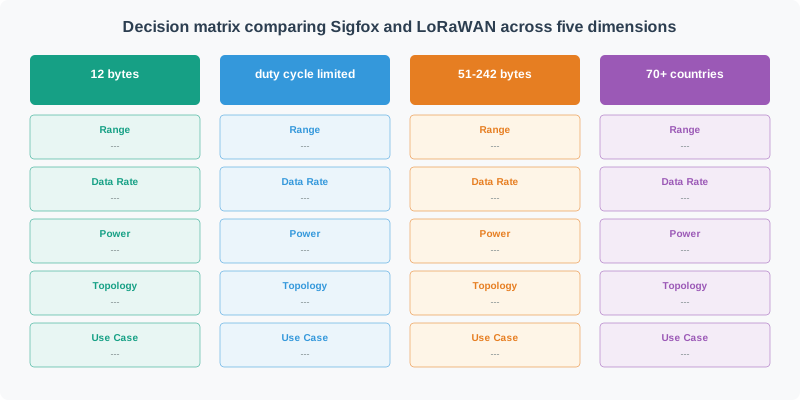
This decision matrix provides an alternative comparison framework to help select between Sigfox and LoRaWAN based on deployment requirements:
Figure 39.4: Sigfox (orange) vs LoRaWAN (teal) technology selection matrix comparing deployment model, message capacity, coverage control, cost structure, and optimal use cases. Sigfox excels for simple, infrequent sensors in covered areas with no infrastructure investment. LoRaWAN provides flexibility, higher throughput, and network control for demanding applications.
39.6 Videos
LPWAN Overview (Context for Sigfox)
LPWAN Overview (Context for Sigfox)
Lesson 4 — LPWAN positioning and trade-offs (provides context for Sigfox's operator model and UNB design).
Interactive: Sigfox Uplink vs Downlink Asymmetry
39.7 Incremental Learning Examples
Master Sigfox technical concepts through these progressive scenarios:
Example 1: Link Budget Calculation (Beginner) Calculate if a Sigfox device 15 km from a base station in suburban environment will connect:
Transmit Power: +14 dBm (25 mW, typical device)
Antenna Gain (device): -2 dBi (PCB trace antenna loss)
Path Loss (15 km suburban): -130 dB (from Hata model)
Antenna Gain (base station): +8 dBi (tower-mounted directional)
Received Signal: +14 - 2 - 130 + 8 = -110 dBm

Base Station Sensitivity: -126 dBm (typical)
Link Margin: -110 - (-126) = +16 dB ✓ Good!

Conclusion: Connection reliable with 16 dB margin (enough for fading)
Example 2: UNB Capacity Analysis (Intermediate) How many devices can transmit simultaneously in a single Sigfox base station coverage area?
Available spectrum: 192 kHz (Europe 863-870 MHz ISM band)
Channel width: 100 Hz per transmission
Guard bands: 20 Hz between channels
Effective channels: 192,000 ÷ 120 = 1,600 channels

Triple transmission (3× redundancy on different frequencies):
Concurrent devices: 1,600 ÷ 3 ≈ 533 devices simultaneously

Message duration: 6 seconds (3 replicas × 2 sec each)
Base station hourly capacity: 533 × (3,600 sec ÷ 6 sec) = 319,800 messages/hour
Daily capacity: 7.67 million messages across all devices

Lesson: Sigfox scales through massive channel parallelism, not high data rates
Example 3: Cost Crossover Calculation (Advanced) At what deployment scale does LoRaWAN become cheaper than Sigfox?
Assumptions:
- Sigfox: $12/device + $6/year subscription
- LoRaWAN: $15/device + $500/gateway (covers 100 devices)
- Timeframe: 5 years

TCO equations:
Sigfox(N) = 12N + 6N×5 = 42N
LoRaWAN(N) = 15N + 500×(N/100) = 15N + 5N = 20N

Crossover point:
42N = 20N
22N = infrastructure difference
At N = 1,000: Sigfox = $42K, LoRaWAN = $20K + $5K gateways = $25K
At N = 2,000: Sigfox = $84K, LoRaWAN = $40K + $10K = $50K

Conclusion: LoRaWAN wins at >1,500 devices in one geographic area
39.8 Concept Check
## Try It Yourself
Challenge: Design a Sigfox Payload for Multi-Sensor Deployment
You’re deploying 500 environmental sensors in a smart city. Each sensor must report: temperature (-40°C to +85°C), humidity (0-100%), air quality index (0-500), battery level (0-100%), and a status byte with 5 boolean flags (motion detected, tamper alert, low battery, calibration needed, sensor fault).
Your Task:
Design the 12-byte payload: Map each sensor reading to binary encoding. Show byte-by-byte breakdown.
Calculate message budget: Sensors report every 30 minutes. Is this within the 140/day limit?
Estimate battery life: Each transmission consumes 50 mA for 6 seconds. Device sleeps at 10 µA. Battery is 2,400 mAh. How many years?
Justify Sigfox choice: Compare 5-year TCO with LoRaWAN alternative (assume gateway costs $500, covers 200 sensors).
What to Observe:
How much payload space remains after encoding all required values?
At what reporting interval would you hit the 140 message/day ceiling?
How does the crossover point between Sigfox and LoRaWAN change with sensor count?
When would NB-IoT become more economical than either LPWAN option?
Extension: Modify the design to add GPS coordinates (latitude/longitude). What trade-offs must you make to fit within 12 bytes?
39.9 How It Works
Sigfox UNB Transmission: From Device to Cloud
When a Sigfox device sends a 12-byte message, the following sequence occurs over approximately 6 seconds:
Step 1: Frequency Selection (Device)
Device firmware selects a random 100 Hz channel from the 192 kHz ISM band (~1,920 available channels)
Random selection provides frequency diversity and collision avoidance
No coordination with network required - pure Aloha approach
Step 2: Triple Transmission (Device)
Same 12-byte payload transmitted 3 times on 3 different random frequencies
Each transmission ~2 seconds (12 bytes × 8 bits/byte ÷ 100 bps = 960 ms + preamble/overhead)
Multiple base stations (typically 2-4) within 30-50 km receive the message
Each base station logs: RSSI (signal strength), SNR (signal-to-noise ratio), timestamp, and frequency offset
Base stations forward all receptions to Sigfox cloud via IP backhaul
Step 4: Cloud Processing (Sigfox Backend)
Deduplication: Identify the 3 copies of the same message across different base stations
Best-copy selection: Choose strongest signal (highest SNR) for payload extraction
Geolocation: Triangulate device position using RSSI differences from multiple base stations (Sigfox Atlas)
Callback delivery: Forward payload to customer application via HTTPS webhook
Step 5: Application Integration
Customer server receives JSON payload with device ID, message data, RSSI, timestamp, and optional geolocation
Application processes data and updates dashboards, triggers alerts, or logs to database
Key Insight: The device has zero confirmation that the message was received. This fire-and-forget approach keeps device firmware ultra-simple (no ACK handling, no retransmission logic) but requires the network to provide reliability through redundancy (3 transmissions) and spatial diversity (multiple base stations).
Decision framework: Choose based on payload, frequency, coverage, and scale requirements
Common Pitfalls
1. Confusing Sigfox BPSK With LoRaWAN CSS
Sigfox uses BPSK/DBPSK modulation on 100 Hz channels while LoRaWAN uses Chirp Spread Spectrum. Both achieve long range but through different mechanisms: Sigfox through ultra-narrowband filtering, LoRa through spread spectrum processing gain. Understanding the modulation difference explains their different interference characteristics.
2. Assuming Three Transmissions Triple Energy Consumption
Sigfox sends each message 3 times but uses very low data rates and short transmission windows. The 3x redundancy has a modest energy impact compared to the dominant sleep current for typical IoT reporting rates. Calculate actual energy budget rather than assuming 3x penalty.
3. Expecting Sigfox to Be Resistant to LoRa Interference
Sigfox operates in the same ISM bands as LoRaWAN but uses different modulation and channel width. In regions with high LoRaWAN density, wideband LoRa transmissions overlap Sigfox’s 100 Hz channels and can cause interference despite different technologies.
4. Overlooking Base Station Count Requirements
Sigfox requires 3 base station receptions for reliable delivery (diversity combining). Single base station coverage is insufficient for production deployments. Verify that target locations have reception from at least 2–3 base stations before finalizing deployment plans.