6 Matching Transport to Message Purpose

More
Depth: Practitioner
Progress saves as you read. Mark sections complete as you go; your progress appears in the sidebar.
A cloud service sends a sampling-interval change to a gateway, which forwards it to a sleeping sensor. The first transport segment succeeds while the second is still waiting. Matching transport to message purpose requires the command’s final state to remain visible across both segments.
6.1 Start With the Receiver Evidence
This section: Start With the Receiver Evidence — A protocol is a set of rules that two ends use for an exchange.
A protocol is a set of rules that two ends use for an exchange.
Picture a sensor that sends an alarm while the link drops some data. The key question is what the far side saw and what the app did next.
First, name the flow, its time need, and the cost of a lost or late unit. Then record the reply, retry, order, and end state that matter.
More checks and retries can aid delivery, but they spend time, power, and link space. A light flow is cheap, yet the app may need to repair gaps itself.
That is the simple story, but a protocol name cannot prove the app result. The records later in the chapter tie wire events to user-visible proof.
Use the Practitioner section to write and test the flow record. Use Under the Hood to study order, loss, state, and app limits in more depth.
A protocol is a set of rules that two ends use for an exchange.
Plain check
- Name the flow. Name the time need. Name the loss cost. Name the end state.
- Test one lost unit. Test one late unit. Test one repeat. Save the app result.
- Use Practitioner to record. Use deeper state checks. Keep wire proof separate. State each limit.
A protocol name does not prove that the receiver understood the message. Start with the evidence the receiver can show: bytes received, message parsed, command accepted, duplicate rejected, or record stored. Then decide which transport behavior helps create that evidence and which responsibility still belongs to the application.
6.2 Overview: Transport Review Starts With the Flow
This section: Overview: Transport Review Starts With the Flow — Transport protocol review starts with a flow, not with a favorite protocol.
Transport protocol review starts with a flow, not with a favorite protocol. Name what is moving, who sends and receives it, what the receiver must do with it, and which layer owns acknowledgement, retry, duplicate handling, ordering, and protection.
TCP is reviewed as a connection-oriented byte stream. UDP is reviewed as discrete datagrams. DTLS is reviewed as protected records carried over UDP. A mixed gateway path is reviewed as separate segments because each segment can have a different owner and receiver action.
For example, a soil-moisture sample that updates a trend chart may tolerate a missing reading if the application records sequence number, timestamp, and freshness. A valve-close command on the same radio path needs a different record: sender intent, gateway handoff, receiver acceptance, duplicate behavior, final valve state, and the security boundary that proves the command came from the right owner. The network path alone cannot decide both cases.
The first review question is therefore not "TCP or UDP?" but "what failure would matter if this message were lost, late, duplicated, replayed, or applied twice?" A periodic reading, an alarm, a command, and a firmware chunk each turn transport behavior into different evidence requirements. Once the consequence is named, the protocol choice can be judged against receiver proof and retest triggers instead of against a generic preference.
If you only need the intuition, this layer is enough: choose transport behavior from message consequence, endpoint roles, receiver evidence, protection boundary, and the retest trigger that would make the decision stale.
The four message examples above need one review route that keeps purpose, ownership, and receiver proof together. Figure 6.1 shows that route before the chapter examines individual fields.
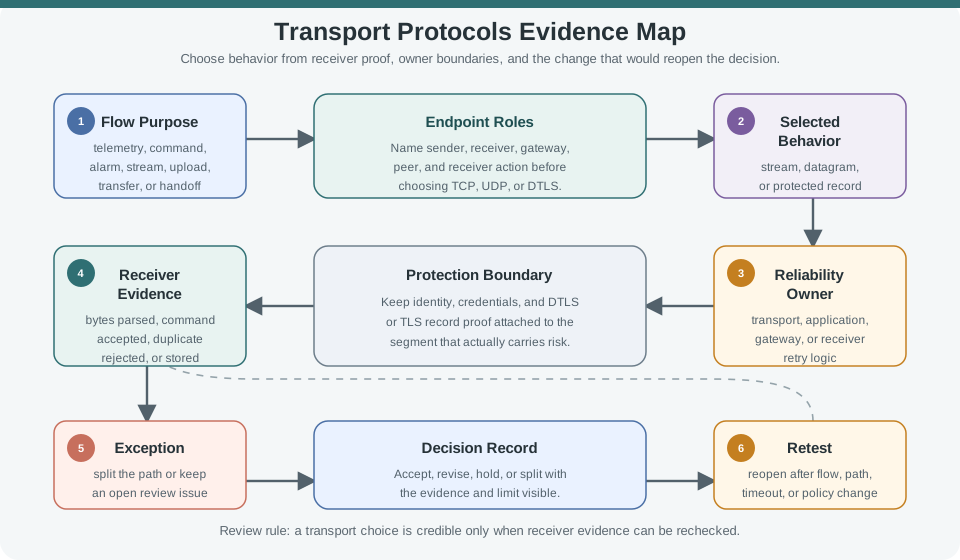
Trace Figure 6.1 from flow purpose and endpoint roles into selected behavior and reliability ownership. Continue through the protection boundary and receiver evidence, then finish with exception review, decision, and retest trigger. This order connects protocol choice to the consequence of one message rather than allowing one generic transport conclusion to cover unlike flows.
Flow Purpose
Identify the telemetry, command, alarm, stream, upload, transfer, or gateway handoff under review.
Selected Behavior
Classify the path as TCP stream, UDP datagram, DTLS-protected datagram, or mixed segment behavior.
Reliability Owner
Name whether acceptance, retry, duplicate handling, and stale-message handling live in transport, application, gateway, or receiver logic.
Retest Trigger
State which flow, endpoint, gateway, timeout, security, or receiver change reopens the decision.
Overview Knowledge Check
6.3 Practitioner: Write the Transport Evidence Record
This section: Practitioner: Write the Transport Evidence Record — A useful transport record is compact enough to retest later.
A useful transport record is compact enough to retest later. It names the exact flow, purpose, endpoint roles, selected behavior, reliability owner, protection boundary, receiver evidence, exception, decision, owner, and retest trigger.
The evidence map becomes operational when its decisions are preserved in a compact record. Inspect Figure 6.2 to see what another reviewer must be able to reconstruct.
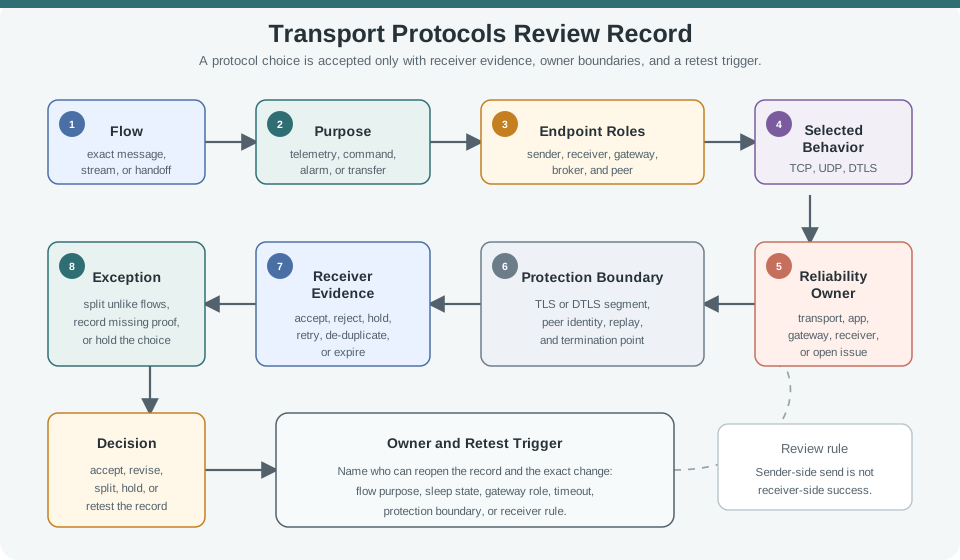
In Figure 6.2, begin with flow, purpose, and endpoint roles, then follow selected behavior into reliability ownership, protection, and receiver evidence. Read the exception before the decision, owner, and retest trigger. That sequence keeps a protocol label from replacing application proof and carries the overview’s flow-first reasoning into a durable review artifact.
Worked Record: Configuration Command
A service sends a configuration command through a gateway to a device. The record should not stop at the cloud-to-gateway transport segment. It also needs gateway handoff evidence, downstream transport behavior, device receiver acceptance, duplicate handling, and the protection boundary for each segment.
A TCP segment, a UDP confirmable exchange, or a mixed path can all be valid if the record shows the receiver action and reliability owner. If the gateway changes transport behavior, split the review into segment records.
Practitioner Knowledge Check
6.4 Under the Hood: Protocol Names Do Not Prove Application Outcomes
This section: Under the Hood: Protocol Names Do Not Prove Application Outcomes — TCP can retransmit bytes inside a connection, but it does not know whether an application message was framed correctly, authorized, applied, rejected, or rolled back.
TCP can retransmit bytes inside a connection, but it does not know whether an application message was framed correctly, authorized, applied, rejected, or rolled back. UDP preserves datagram boundaries, but any required acknowledgement, retry, duplicate handling, ordering, freshness, or receiver acceptance must be visible somewhere else.
DTLS protects UDP records and can provide peer identity and replay handling for a segment. It does not prove sensor truth, command safety, parser correctness, or final device state. When a gateway terminates or translates a path, the transport and protection boundaries should be reviewed separately on both sides.
A useful boundary test follows one message through every place where meaning can change. A cloud service might receive a TCP acknowledgement from a gateway before the gateway queues a downstream UDP datagram. The device might then reject the datagram because the timestamp is stale, the sequence number is repeated, or the command is outside the current authorization window. Each step is legitimate transport evidence, but none of the earlier steps proves the final application outcome.
This is why mixed paths need segment-level records. The upstream segment can be accepted for connection health, ordered bytes, and peer identity while the downstream segment remains open because receiver freshness, duplicate handling, or actuation state is missing. The retest trigger should name exactly which timeout, parser, gateway acknowledgement, credential policy, or receiver rule would make the old transport evidence stale.
TCP Boundary
Connection and ordered byte-stream evidence stop before application message semantics and final receiver action.
UDP Boundary
Datagram identity is visible, but delivery confirmation and ordering belong to another layer when they matter.
DTLS Boundary
Protected records still need application behavior, endpoint scope, replay policy, and retest evidence.
Gateway Boundary
An upstream acknowledgement can happen before downstream delivery or device acceptance, so the handoff needs its own record.
Retest Conditions
Read these conditions as changes to the original evidence contract. A new message consequence changes required behavior; endpoint or gateway changes move state and ownership; retry, duplicate, or parser changes alter the receiver proof; and protection changes alter identity or replay claims. Reopen only the affected flow, but rebuild its record from purpose through receiver action before accepting the new path.
Preserve the earlier accepted record as the comparison baseline. The review should show which assumption changed, which evidence was repeated, and whether rollback restores the former behavior. That history stops a harmless-looking timeout, gateway, credential, or parser edit from silently changing delivery, freshness, duplicate, authorization, or application-state guarantees.
- Retest if a routine telemetry message becomes an alarm, audit record, billing record, or command.
- Retest if endpoint sleep, buffering, memory, connection lifetime, or parser behavior changes.
- Retest if a gateway starts terminating, translating, or acknowledging a segment differently.
- Retest if retry, timeout, duplicate, stale-message, or receiver acceptance rules change.
- Retest if TLS, DTLS, replay handling, identity checks, or security ownership changes.
Under-the-Hood Knowledge Check
6.5 Trace the Command across Two Different Transport Segments
This section: Trace the Command across Two Different Transport Segments — Assume the command leaves the service at 0 ms, reaches the gateway at 30 ms and reaches the device at 430 ms.
Assume the command leaves the service at 0 ms, reaches the gateway at 30 ms and reaches the device at 430 ms. The first transport segment takes 30 ms; the onward delay is 400 ms. If the device confirms the applied setting at 470 ms, the complete observed response time is 470 ms. A gateway receipt at 30 ms is not an acknowledgement that the message changed the sensor.
Give the command a stable identity and an expiry bound appropriate to its purpose. The gateway should preserve that identity when changing transport representation, along with the target device and requested interval. It may acknowledge durable local queueing, but the reply must name that state instead of implying device completion.
Now lose the final response after the device applies the setting. The transport sender cannot infer the physical result from silence. Repeating a desired interval with the same command identity can be designed to leave one final setting, while repeating an action such as toggle may need stronger protection against duplicate execution. The message contract, not the transport name alone, determines the safe recovery.
Predict whether an encrypted cloud-to-gateway connection proves protection on the onward link. It proves only the named segment’s security properties. Check the separate identity and protection boundary where the gateway terminates or translates the message. Next, let the queued command expire while the sensor sleeps. Forwarding it later would violate its purpose even if transport delivery then succeeds.
A useful receiver record distinguishes accepted for delivery, applied, rejected, expired and unknown. These application states sit above transport packet or stream observations. Check a normal path and each relevant failure with the same identifiers so support can locate the boundary that stopped progress.
The module’s matching process matters whenever a gateway joins unlike links. One user-visible command can cross a managed stream, a datagram exchange and a local device interface, each with its own retry and timing rules. Preserve the intended outcome through those changes rather than merging several successful segment records into an unsupported end-to-end success.
6.6 Summary
This section: Summary — The module’s review route begins and ends with one application flow.
The module’s review route begins and ends with one application flow. Name the endpoints and consequence, select stream, datagram, protected-record, or mixed-segment behavior, assign reliability ownership, and prove the receiver action within a stated security boundary. The summary points below preserve that chain and the message, gateway, retry, parser, or policy change that would make its conclusion stale.
Do not merge records merely because flows share a device or network. A replaceable reading, alarm, command, and firmware chunk can demand different acknowledgement, ordering, freshness, duplicate, and recovery behavior. Separate records make those differences visible and let later changes reopen only the affected transport decision.
- Transport protocol review starts with the application flow, endpoint roles, and receiver action.
- TCP, UDP, DTLS, and mixed gateway paths answer different evidence questions.
- Reliability ownership should be explicit: transport, application, gateway, receiver, operations rule, or open issue.
- Receiver evidence prevents sender-side transmission from being mistaken for application success.
- Security boundaries such as TLS and DTLS should be named separately from transport behavior.
- Retest when message consequence, endpoint behavior, gateway ownership, retry policy, receiver rules, or protection boundaries change.
6.7 Key Takeaway
This section: Key Takeaway
Treat a transport choice as an evidence record: name the flow, classify the behavior, assign ownership, prove receiver action, bound the protection path, and record the retest trigger.
6.8 See Also
This section: See Also
Transport Layer Overview
Transport Layer Overview reviews the vocabulary for flows, endpoints, ports, reliability evidence, and protection boundaries.
TCP vs UDP: Comparison and Selection
TCP vs UDP: Comparison and Selection compares stream and datagram behavior before committing to a transport record.
Transport Selection and Scenarios
Transport Selection and Scenarios applies the record across telemetry, commands, uploads, transfers, and gateway handoffs.
DTLS Security Fundamentals
DTLS Security Fundamentals supports UDP transport evidence that needs protected-record and peer-identity review.
Find help
3 reviewed answers.
Where should I start in a module?
Open the module page from the sidebar to see its chapters in order. Use the module map to return to a topic you need.
Modules and pathsReviewed
What can I try when a project does not work?
Check the symptom, then work through the diagnostic steps. Keep the error message and the smallest example that reproduces it.
When you are stuckReviewed
How do interactive examples work?
Use the interactive guide to check how examples and simulations work before changing your project.
Interactive examples guideReviewed