
Datagram
Each UDP send is an independent message boundary rather than part of a continuous byte stream.
Progress saves as you read. Mark sections complete as you go; your progress appears in the sidebar.
This section: Start With One Datagram — Picture a greenhouse node sending soil status every thirty seconds.
Decide What One Missing Message Means
Picture a greenhouse node sending soil status every thirty seconds. Most readings can be replaced by the next one, but a valve command cannot. The product owner must decide which messages may be lost, late, repeated, or out of order before choosing the light send-and-forget path.
Write a receiver rule for each message type. Name its source, event time, sequence, useful lifetime, allowed repeats, and the state it may change. State whether the next reading replaces a missing one, whether the sender retries, and how the receiver rejects an old command.
Inject loss, delay, duplication, reorder, a restarted sender, a restarted receiver, and a false source. Watch both ends. Check that routine status stays useful, alarms become visible, repeated work is safe, and commands cannot act twice or after their deadline. Measure the extra energy and delay of any repair rule.
Keep urgent control near the greenhouse when a missed remote exchange could harm crops or people. A distant store may collect trends, but it must not be the only place that knows whether a valve may open. Reachability alone does not prove trust.
This opening does not choose the right transport for every message. Practitioner writes and tests the receiver contract. Under the Hood examines checksums, ports, message size, loss, ordering, repair, and the security work that sits above the small datagram boundary.
Picture a battery sensor sending one small reading and then going back to sleep. UDP makes that send cheap, but it also leaves delivery, ordering, retry, and acceptance decisions outside the transport itself. The useful question is not whether UDP is simple; it is whether the application record can tolerate what UDP does not promise.
This section: Overview: UDP Is a Datagram Boundary — UDP is a connectionless transport protocol.
UDP is a connectionless transport protocol. It adds source port, destination port, length, and checksum information to application data, then sends each message as an independent datagram without first creating a transport session.
That small transport boundary can be a good fit for IoT traffic when each message has bounded meaning. A routine reading can often be replaced by the next reading. A discovery request may need to reach more than one local endpoint. An application protocol such as CoAP can add acknowledgement behavior only where it is needed.
For example, a greenhouse node might send soil-moisture status every 30 seconds with a sample time and sequence number. If packet 181 is missing but packet 182 arrives within the dashboard freshness window, the receiver can show the newer value and mark the older sample as skipped. That is a reasonable UDP story only because the record names the receiver behavior. The same node's irrigation command would need a different record, because a missed, repeated, or late command can change equipment state.
UDP therefore works best when the review names the message consequence. Replaceable telemetry, local discovery, and one-shot diagnostic events often have tolerances that can be written down. Commands, alarms, billing records, and audit events usually need acknowledgement, identifiers, replay controls, or a different transport pattern. The protocol choice follows the receiver contract, not the other way around.
The review question is not whether UDP is simple. The review question is whether the application record explains what happens when a datagram is missing, duplicated, delayed, stale, or untrusted.
UDP’s appeal and its limit are easiest to see in one exchange. Inspect Figure 3.1 before assigning reliability responsibilities to the application.
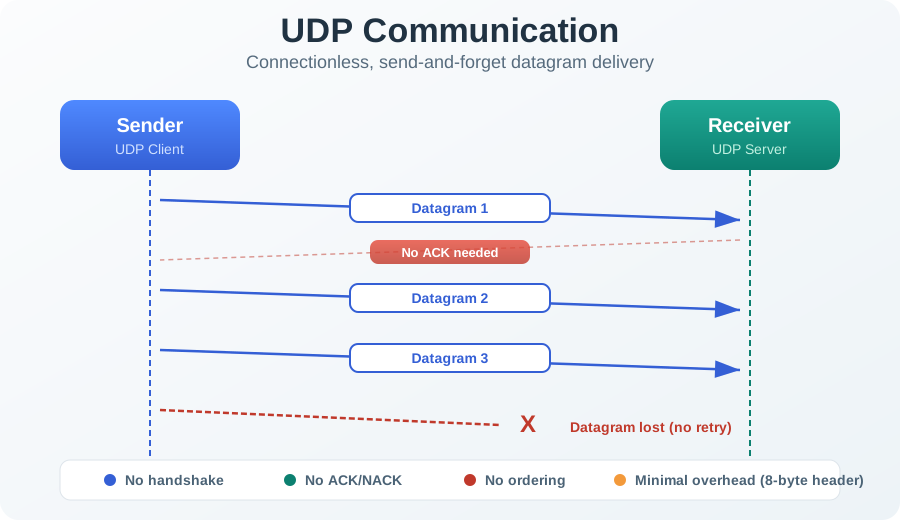
Read Figure 3.1 from the client datagram to the server, then notice the deliberately absent connection setup and transport acknowledgement path. The small header and independent message boundary reduce transport work, but loss, ordering, duplication, backoff, and application confirmation remain outside that promise. This is the boundary the rest of the chapter uses to build a receiver contract rather than calling UDP simply reliable or unreliable.
Each UDP send is an independent message boundary rather than part of a continuous byte stream.
The sender can transmit without first establishing transport connection state with the receiver.
Delivery confirmation, ordering, retry, duplicate handling, and validation live above UDP when they matter.
Changing message meaning, acknowledgement rules, security boundaries, or gateway behavior should trigger another review.
This section: Practitioner: Write the Receiver Contract — Before selecting UDP, write the receiver contract.
Before selecting UDP, write the receiver contract. Name the message purpose, endpoint roles, freshness rule, duplicate behavior, retry ownership, validation boundary, and operational evidence. This turns UDP from a vague preference into a bounded design choice.
The same device can use UDP for routine status while using a different acknowledgement path for commands, configuration, or firmware transfer. Do not copy the UDP decision from one flow to another unless the receiver contract is still true.
A practical contract should be testable from both sides of the path. For a parking-space sensor, the sender record might show datagram ID, sample time, payload schema, destination service, and retry timer. The receiver record should show whether a newer reading replaces an older one, how duplicate IDs are ignored, when a space state becomes stale, and which alert appears if no fresh sample arrives before the timeout.
The contract also needs an owner. If a gateway retries above UDP, the gateway owns retry spacing and duplicate risk. If the device retries, the device owns power cost and stale-message rejection. If the operator accepts loss for a dashboard-only flow, the monitoring system owns the stale-data alarm. Without that owner, UDP failures become invisible until a user notices incorrect state.
This section: Under the Hood: What UDP Does Not Promise — UDP provides port multiplexing, a datagram boundary, length information, and checksum-based corruption detection.
UDP provides port multiplexing, a datagram boundary, length information, and checksum-based corruption detection. It does not create a reliable ordered stream, maintain connection state, confirm delivery, retransmit missing data, suppress duplicates, or apply transport-level flow control.
The checksum is not a security boundary. It can help detect accidental corruption, but it does not authenticate the peer, encrypt the payload, authorize an action, or prevent replay. Protected UDP paths need a separate security review, often at the application or DTLS layer, and commands with side effects need acknowledgement, identifiers, idempotent handling, or a clear failure policy above UDP.
Datagram boundaries are useful because the receiver knows where one UDP payload ends. They are not the same as a business event boundary. A receiver may parse the datagram and still reject it as stale, unauthenticated, duplicated, outside a safety window, or inconsistent with the current device state. Under-the-hood review should therefore ask which field carries identity or freshness, which check rejects repeats, and where rejected datagrams are logged.
UDP also lacks built-in congestion and backpressure behavior. A burst of retries, discovery responses, or telemetry reports can overload a gateway even though each datagram is individually small. The design evidence should name rate limits, retry backoff, multicast response spreading, queue policy, or alarm behavior. If nobody owns those controls, the UDP decision is incomplete even when every single datagram format is valid.
UDP has no listen backlog to exhaust, but a flood can still consume ingress bandwidth, receive-queue space, packet-processing time, and response bandwidth. In the classic closed-port pattern, an attacker sends datagrams across many destination ports, often with a forged source address. The host must inspect each datagram; for a closed port, the IP layer may generate an ICMP Port Unreachable response toward the forged address. The victim then spends both receive and transmit capacity on traffic that never represented a valid application exchange.
| Control | What it bounds | What to observe |
|---|---|---|
| Close unused UDP ports and filter at the edge | Unnecessary host demultiplex and response work | Packets by destination port and firewall-drop reason |
| Ingress and egress source validation | Spoofed-source traffic where the network can enforce address ownership | Invalid-source drops and upstream provider evidence |
| ICMP and application response rate limits | Victim egress and reflection potential | Suppressed replies, response bytes per request byte |
| Per-peer and aggregate service budgets | Parser, authentication, queue, and reply work on open ports | Accepted, rejected, queued, and dropped datagrams by reason |
| Upstream DDoS filtering | Attacks larger than the site's access-link capacity | Provider diversion state, clean traffic rate, residual loss and latency |
Do not let local ICMP suppression become the only mitigation: it reduces response work but cannot recover an already saturated ingress link. Likewise, DTLS can reject unauthenticated application data, but the receiver still spends network and cryptographic work reaching that decision. Capacity tests should include invalid packets, not only successful request throughput, and dashboards should separate link bytes, kernel drops, socket drops, authentication failures, ICMP generation, and application queue depth.
Name whether loss, retry, sequence, acknowledgement, and duplicate handling are owned by the application protocol, device logic, gateway, or operator process.
Name the layer that supplies confidentiality, integrity, peer identity, replay handling, and policy enforcement when the flow needs protection.
Name what prevents retries, discovery responses, or bursty telemetry from creating congestion or receiver overload.
Name where missing, stale, duplicated, rejected, or delayed datagrams become visible during operations.
Keep transport, security, and routing claims separate with the diagram Figure 3.2.

In the diagram Figure 3.2, UDP or TCP: delivery chooses datagram overhead or ordered stream state; DTLS: protect UDP supplies its security boundary; RPL: reach the root selects paths over lossy links. The Boundary rule blocks a DTLS claim from being reused as reliability evidence.
This section: Summary — UDP is a deliberately small transport protocol.
UDP is a deliberately small transport protocol. It gives applications ports, datagram boundaries, length, and checksum behavior without creating a reliable ordered stream. That makes UDP useful for bounded IoT messages, discovery traffic, and application protocols that own their own acknowledgement or retry behavior.
For review, the important evidence is the receiver contract: message meaning, freshness, duplicate handling, retry ownership, protection boundary, operational visibility, and retest triggers.
This section: Key Takeaway
A UDP application record must explain what UDP does not promise: delivery, ordering, retransmission, duplicate suppression, flow control, security, and receiver-side side effects.
This section: See Also
Place UDP inside the wider transport evidence path before comparing protocol behavior.
Contrast UDP datagrams with TCP connection state, byte streams, and acknowledgement evidence.
Use message meaning, receiver behavior, and review evidence to compare transport choices.
Study the application-level reliability patterns often needed above UDP.
3 reviewed answers.
Open the module page from the sidebar to see its chapters in order. Use the module map to return to a topic you need.
Modules and pathsReviewed
Check the symptom, then work through the diagnostic steps. Keep the error message and the smallest example that reproduces it.
When you are stuckReviewed
Use the interactive guide to check how examples and simulations work before changing your project.
Interactive examples guideReviewed