13 DTLS Cost and Performance

More
Depth: Practitioner
Progress saves as you read. Mark sections complete as you go; your progress appears in the sidebar.
13.1 Start With the Protected Path Budget
This section: Start With the Protected Path Budget — Picture a valve that wakes after repair and sends one state report.
Measure Protection on the Message That Matters
Picture a valve that wakes after repair and sends one state report. The first protected exchange may cost far more than the next one, so a steady test can hide the restart risk.
A protocol is an agreed set of rules for an exchange. User Datagram Protocol, or UDP, sends separate messages without a built-in delivery session. Transport Layer Security is a set of rules for protected network sessions. Datagram Transport Layer Security, or DTLS, adapts that protection for UDP traffic. A gateway is the unit that links the valve path to another network or service. Telemetry means facts sent so a system can be observed.
Record message count, bytes, time, memory, energy, retries, and final state for first contact, normal use, resume, and failed contact. Delay one reply and restart each end. Keep the protection rule while changing one cost setting.
Run the test on the real unit and weak site path. A fast desk trace may hide radio loss, slow storage, or a small memory limit. Keep both traces with the release choice.
One trace cannot prove every device or attack. Practitioner builds the decision record. Under the Hood explains why setup, record size, timers, and implementations change the cost.
DTLS performance should be measured on the protected path that the design actually needs. Count handshake messages, record overhead, retransmissions, memory pressure, and wake time against a specific sensor, gateway, or service flow. The right tuning choice is the one that keeps the protection claim while meeting the deployment budget.
13.2 Overview: DTLS Cost Is a Bound on the Protected Path
This section: Overview: DTLS Cost Is a Bound on the Protected Path — DTLS adds handshake negotiation, protected records, and handshake retransmission behavior to UDP traffic.
DTLS adds handshake negotiation, protected records, and handshake retransmission behavior to UDP traffic. The chosen credentials determine which peers are authenticated, and the configured record replay policy determines what duplicate records are rejected. Those choices are useful for IoT paths, but they also change what the device, gateway, and network must carry.
A good DTLS performance decision does not say "secure enough" or "too heavy" in general. It names the protected path, the implementation configuration, the handshake state, the record-size behavior, the resource observations, and the condition that would require another check.
For example, suppose valve-17 reports a short status message through gateway-east after waking from a maintenance reboot. The first exchange may include a full handshake, identity checks, key agreement work, anti-replay setup, and retransmission timers. The same valve, five minutes later, may send protected records over an already-established association or a resumed session. Those traces answer different questions: boot recovery cost, steady-state telemetry cost, and resume-path behavior are not interchangeable evidence.
The packet boundary matters for the same reason. A payload that fits comfortably before protection may still fit after DTLS record metadata, or it may cross the tested path limit and trigger fragmentation, loss, retransmission, or queueing. The useful conclusion is therefore bounded: "this firmware, this library build, this authentication mode, this message shape, this gateway, and this link condition stayed within the observed budget." A broader claim needs broader evidence.
That boundary also protects later maintenance work. If the next release changes the telemetry schema, rotates credentials, moves the gateway, or enables a different cache policy, the old result should not silently travel with the release note. The record should point to the exact retest trigger and the owner who decides whether the previous observation still applies.
Handshake State
A full handshake, a resumed session, a failed handshake, and an already-established session do not have the same cost profile.
Record Boundary
Protected records add metadata and integrity protection. The resulting packet still has to fit the real path without accidental fragmentation.
Resource Record
CPU, memory, storage, queue delay, timeout, retransmission, and reset observations only support the build and path that produced them.
Before tuning one cost, inspect Figure 13.1 to ask which link, key, message, and session facts must stay attached to the protected-path result.
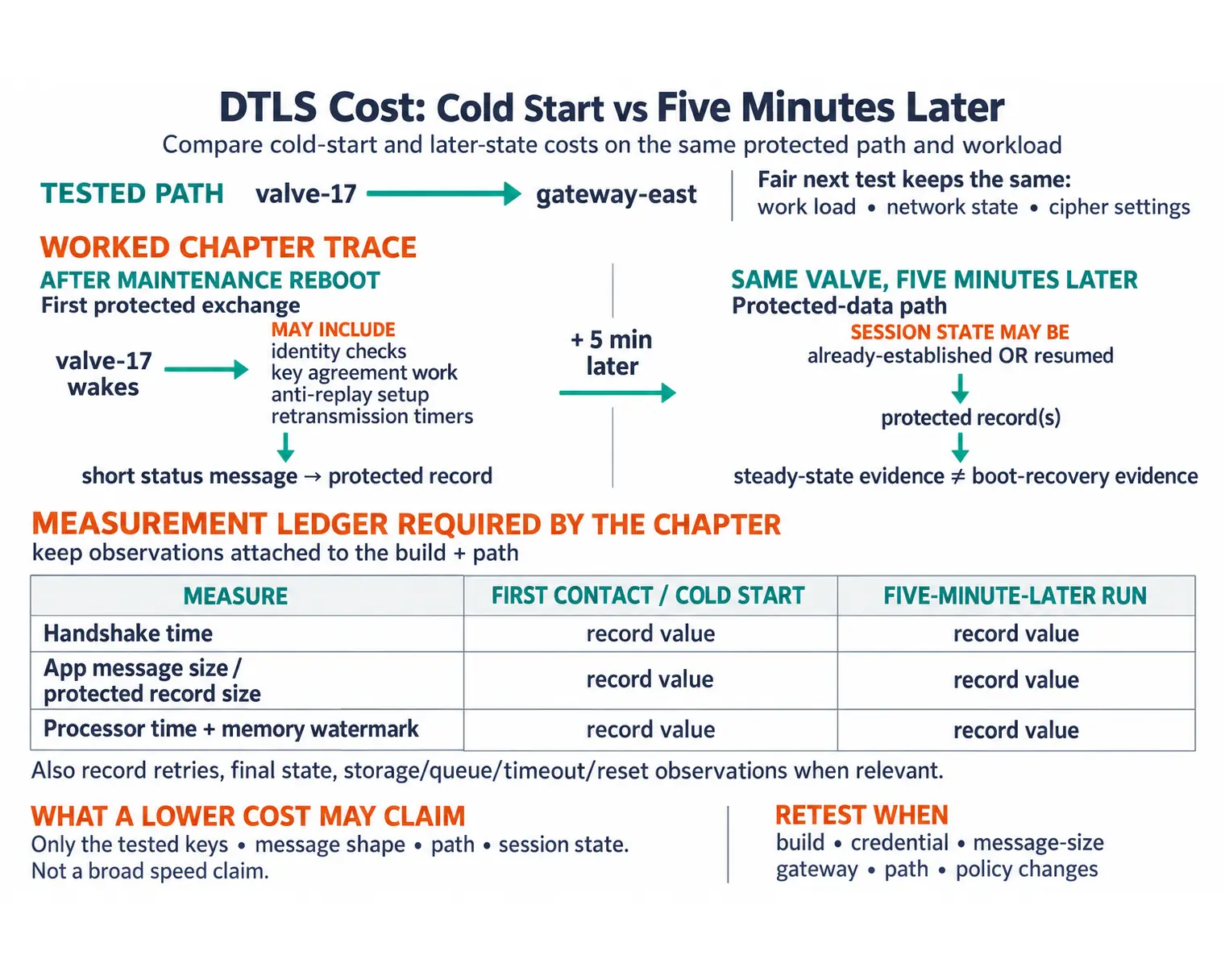
Follow Figure 13.1 from the transport choice and live setup to the measured costs. Read the handshake time, record size, memory, and processor use. Then check the trust line before the pass choice and new-test trigger. A lower cost applies only to the keys, message shape, path, and session state used in that run. It is not a broad speed claim. A fair next test must keep the same work load and network state as well as the same cipher settings.
Safe Scope
This chapter evaluates bounded performance records. It does not rank libraries, set universal acceptance limits, or recommend weakening authentication, replay protection, or cipher-suite choices to make a metric look better.
13.3 Practitioner: Build the Decision Record Before Tuning
This section: Practitioner: Build the Decision Record Before Tuning — Before changing timers, caches, record sizes, or authentication material, write down what the release decision needs to prove.
Before changing timers, caches, record sizes, or authentication material, write down what the release decision needs to prove. A performance record is useful only when another engineer can see what was tested and where the conclusion stops.
A practical record should separate the decision from the tuning idea. If gateway-east shows retries during cold start, first record the tested firmware, credential path, peer identity, message size, loss condition, and observed failure mode. Then decide whether the next action is a timer adjustment, a message-size reduction, a cache-policy review, or a path investigation. Without that separation, the team can accidentally approve a faster trace that changed the security boundary or a retry behavior that only hides the real path problem.
Before changing timeouts, session reuse, or record sizes, preserve the baseline in a form the next reviewer can reproduce. Figure 13.2 shows the minimum evidence that should travel with the tuning decision.
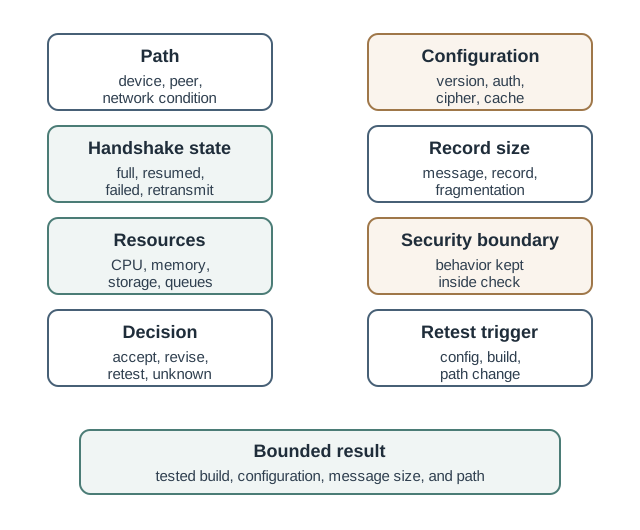
Read Figure 13.2 from path and configuration through handshake state, record behavior, and CPU or memory observations. Check the security boundary before the decision, then finish with the stated limit and retest trigger. The record connects optimization back to the protected behavior: a faster result is acceptable only if the same required peer, record, and failure properties still hold. A named owner must reopen it after a firmware, peer-class, or session-policy change.
Action Rule
If the record cannot identify the DTLS configuration, handshake state, record-size boundary, resource observations, and security boundary, the decision should be revised or marked unknown rather than accepted broadly.
13.4 Under The Hood: Why the Same Stack Can Cost Differently
This section: Under The Hood: Why the Same Stack Can Cost Differently — DTLS cost is not one number because several mechanisms interact.
DTLS cost is not one number because several mechanisms interact. The handshake has flights and retransmission behavior. Record protection changes packet shape. Anti-replay state and session cache behavior affect memory and identity decisions. Link loss and message size decide whether a protected record remains a simple datagram or becomes a recovery problem.
The largest difference is often between setup work and protected-data work. A full handshake can require more message exchanges, more temporary state, and more expensive cryptographic operations than sending one established protected record. A resumed session can reduce repeated setup, but only when the cache entry is still valid, bound to the right peer, and invalidated correctly after credential, firmware, or policy changes. That is why a resumed trace cannot stand in for the first-contact behavior of a device that may cold boot during an outage.
Record protection changes the transport shape even when the application payload stays the same. The implementation may add headers, sequence information, integrity data, and padding or alignment behavior according to the selected configuration. If the protected datagram approaches the path limit, a small application change can move the system from one packet to fragmentation and recovery. On a lossy path, that change can show up as radio awake time, queue growth, retries, duplicate handling, and delayed application delivery rather than as a neat per-record byte count.
State management is part of the performance result too. Anti-replay windows, session caches, timeout state, retransmission queues, and identity records all consume memory or storage. They also create edge cases: a reboot can clear useful state, a gateway replacement can change the peer binding, and a credential rotation can make a cache entry unsafe to reuse. A good under-the-hood check records those mechanisms because they explain why the same source code can pass on a bench path and still need retest on the deployed route.
Peer authentication, key agreement, retransmitted flights, and identity checks can dominate short or infrequent exchanges.
Each protected record carries security metadata. The protected size, path limit, and fragmentation behavior decide whether the packet still fits the intended path.
Session reuse can reduce repeated setup, but cache lifetime, peer binding, invalidation, restart behavior, and credential changes must remain visible.
Datagram loss can cause retransmission, duplicate detection, timeout behavior, and queue pressure that do not appear on a clean path.
CPU and Memory
Observed processor time and memory watermark should come from the same firmware, library build, and authentication path used in the decision.
Message Shape
Application payload size, protected record size, and retransmission behavior are connected. A payload change can invalidate the previous path result.
Security Boundary
If a change lowers cost by altering authentication, replay protection, cipher-suite choice, credential handling, or cache policy, it needs a security check too.
Retest Triggers
Reopen the DTLS cost check when the library, firmware, cipher suite, credential model, session cache policy, message size, gateway, path MTU, or link condition changes in a way that affects the protected path.
13.5 Summary
This section: Summary — DTLS performance is a bounded property of one protected path, configuration, message shape, and session state.
DTLS performance is a bounded property of one protected path, configuration, message shape, and session state. Preserve the baseline first, compare handshake and record behavior separately, and keep CPU, memory, airtime, energy, and security observations attached to the same run. The summary below closes the chapter by turning those measurements into a decision with rollback criteria, ownership, and explicit retest triggers.
A lower cost is useful only if the required identity, replay, protection, and failure behavior still hold. Session resumption, record aggregation, timeout changes, and hardware acceleration can move work between states rather than remove it. The final review therefore compares equivalent protected outcomes and retains the earlier configuration as a recoverable baseline.
- DTLS performance checks should be bounded to a protected path, implementation build, traffic pattern, and configuration.
- Handshake state matters: full handshakes, resumed sessions, failed exchanges, and established sessions support different conclusions.
- Protected record size can change fragmentation, retransmission, queueing, and loss behavior on constrained paths.
- CPU, memory, storage, timer, retransmission, and reset observations should come from the same implementation path being approved.
- Performance changes must not silently weaken authentication, replay handling, credential checks, cipher-suite choices, or cache policy.
- Retest triggers keep old measurements from being reused after material changes.
DTLS cost is not a generic property of the protocol. It is a bounded record about one protected UDP path, one configuration, one traffic shape, and the security behavior that must remain intact.
13.6 See Also
This section: See Also
DTLS Fundamentals and Architecture
DTLS Handshake Protocols
DTLS Threats and Authentication
Transport Optimizations and Implementation
Find help
3 reviewed answers.
Where should I start in a module?
Open the module page from the sidebar to see its chapters in order. Use the module map to return to a topic you need.
Modules and pathsReviewed
What can I try when a project does not work?
Check the symptom, then work through the diagnostic steps. Keep the error message and the smallest example that reproduces it.
When you are stuckReviewed
How do interactive examples work?
Use the interactive guide to check how examples and simulations work before changing your project.
Interactive examples guideReviewed