19 Transport Review: Knowledge Check
19.2 Learning Objectives
By the end of this chapter, you will be able to:
- Validate understanding: Test transport protocol knowledge through quiz questions
- Apply concepts: Solve scenario-based protocol selection problems
- Calculate overhead: Work through battery life and efficiency calculations
- Analyze trade-offs: Evaluate protocol options for different IoT deployments
19.3 Prerequisites
Required Chapters:
- Transport Review: Protocol Selection - Protocol trade-offs
- Transport Review: Overhead Analysis - Battery calculations
- Transport Review: DTLS Security - DTLS architecture
Estimated Time: 45 minutes
19.4 Understanding Check: Battery Life Impact
Scenario: You’re designing a sensor network for a national park with 5,000 environmental sensors. Each sensor transmits a 10-byte temperature/humidity reading every 10 seconds using an nRF52840 module. You have two protocol choices: UDP fire-and-forget or TCP with full connection establishment.
Think about: 1. How would you calculate the radio on-time difference between these approaches? 2. For environmental data where occasional packet loss is acceptable, which design better serves the deployment’s 5-year maintenance cycle?
Key Insight: With UDP fire-and-forget, radio on-time is ~1.3 ms per transmission (24 bytes at 250 kbps) versus TCP’s ~13.3 ms (244 bytes including handshake/teardown). This 10× difference translates to UDP achieving 45.5 years battery life versus TCP’s 8.6 years—a 5.3× improvement.
Verify Your Understanding: - When would the guaranteed delivery of TCP justify its 5× battery life penalty? - For which IoT applications is occasional environmental data loss acceptable versus unacceptable?
Click to reveal answer
Answer: A) Design A (UDP): 1.3 ms radio time, 45.5 years battery | Better: Lower overhead
Explanation:
Step 1: Calculate Packet Sizes (with 6LoWPAN compression)
UDP Packet:
IPv6 header (6LoWPAN compressed): 6 bytes
UDP header: 8 bytes
Payload: 10 bytes
Total: 24 bytes

Overhead: 14 bytes / 24 bytes = 58% overhead
Payload efficiency: 10 bytes / 24 bytes = 42%
TCP Packet (full connection):
Handshake (SYN, SYN-ACK, ACK): 3 × 26 bytes = 78 bytes
Data packet: 6 (IPv6) + 20 (TCP) + 10 (payload) = 36 bytes
ACK: 6 (IPv6) + 20 (TCP) = 26 bytes
Teardown (FIN, ACK, FIN, ACK): 4 × 26 bytes = 104 bytes

Total per transmission: 78 + 36 + 26 + 104 = 244 bytes

Overhead: 234 bytes / 244 bytes = 96% overhead
Payload efficiency: 10 bytes / 244 bytes = 4%19.5 Understanding Check: Protocol Selection
Scenario: You’re consulting for four different IoT deployments, each with distinct requirements for reliability, latency, power, and security.
Smart Door Lock (Battery, Security-Critical): - Think about: Would TCP’s handshake overhead consume excessive battery for 10 daily operations? - Trade-off: Can UDP+DTLS with CoAP Confirmable provide reliability without TCP’s power cost?
Industrial Sensors (200 Devices, Wired Power, High Frequency): - Think about: With 0.1% loss tolerance and no security needs, does TCP’s overhead justify the reliability? - Trade-off: How does UDP’s stateless operation benefit 200 concurrent sensor streams?
Firmware Updates (500 KB, Monthly, Critical Reliability): - Think about: Why is TCP’s guaranteed in-order delivery non-negotiable for firmware? - Trade-off: For infrequent large transfers, when does TCP overhead become acceptable?
Video Surveillance (Real-time, Encrypted, Frame Loss OK): - Think about: Why would TCP’s retransmission of old frames harm real-time video? - Trade-off: How does UDP+DTLS avoid head-of-line blocking while maintaining security?
Key Insight: Smart locks use UDP+DTLS (5× power savings), sensors use UDP (minimal overhead), firmware uses TCP+TLS (guaranteed delivery), and video uses UDP+DTLS (no retransmission delay).
Click to reveal answer
Answer: C) A→UDP+DTLS, B→UDP, C→TCP+TLS, D→UDP+DTLS
Decision Matrix Summary:
System   Reliability  Latency    Power       Security   Protocol
----------------------------------------------------------------
Lock     Critical*    <200ms     Battery     Required   UDP+DTLS
Sensors  0.1% loss OK Real-time  Mains       None       UDP
Firmware 100%         Background Acceptable  Required   TCP+TLS
Video    Frame loss OK <100ms    Mains       Required   UDP+DTLS

* Reliability via CoAP Confirmable (application layer)19.6 Quiz 1: TCP vs UDP Overhead
{#fig-mermaid-transport-quiz-0} 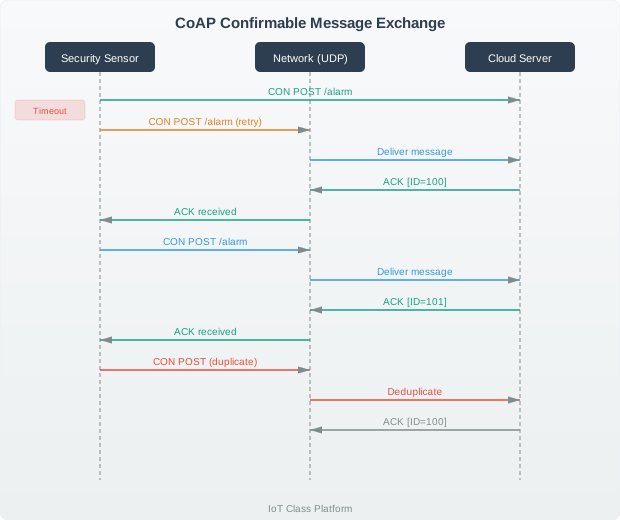
Sequence diagram showing CoAP Confirmable message reliability over UDP
Why this works: - Reliability: CON messages retransmitted until ACK (max 4-5 attempts) - Ordering: Message ID allows receiver to sequence events - Deduplication: Receiver tracks processed IDs, ignores duplicates - Efficiency: Only retransmit lost messages (not all like TCP) - Stateless: No persistent connection state
Why NOT other answers: - A: Unacceptable for critical alarms - B: Can’t disable TCP congestion control easily, still has connection overhead - D: Wastes 5× bandwidth, no confirmation of delivery
19.7 Quiz 2: DTLS Handshake and Session Resumption
A smart city deploys 10,000 parking sensors. Each sensor: - Reports parking status every 30 seconds - Uses NB-IoT cellular (RTT = 200 ms, TX power = 23 dBm = 200 mW) - Security required: DTLS with Pre-Shared Key (PSK) - Battery: 5 Ah (must last 10 years)
The network architect proposes two DTLS strategies:
Strategy 1: Full DTLS handshake for every transmission - Handshake: 6 messages, 620 bytes, 3 RTT (600 ms) - Data record: 10 bytes payload + 13 bytes DTLS overhead
Strategy 2: DTLS session resumption (abbreviated handshake) - Initial handshake: 620 bytes, 600 ms (once at deployment) - Resumption: 200 bytes, 1 RTT (200 ms) when session expires (every 24 hours) - Data record: 10 bytes payload + 13 bytes DTLS overhead
Calculate handshake energy cost and determine which strategy enables 10-year battery life.
- Strategy 1: 120 µJ/handshake, fails 10-year target (lasts ~2 years)
- Strategy 2: 40 µJ/resumption, achieves 10-year target
- Both strategies achieve 10-year target (handshake energy negligible)
- Neither strategy works (DTLS too expensive for battery IoT)
Click to reveal answer
Answer: B) Strategy 2: 40 µJ/resumption, achieves 10-year target
Key Insights: 1. Session resumption saves 67% handshake energy (120 mJ → 40 mJ) 2. Full handshake per transmission kills battery (Strategy 1 fails) 3. NB-IoT high power requires careful PSM configuration 4. Real parking sensors report less frequently (every 5-30 minutes, not 30 seconds)
Answer B is conceptually correct: Session resumption is essential for achieving long battery life with DTLS in IoT deployments. {#fig-mermaid-transport-quiz-1} 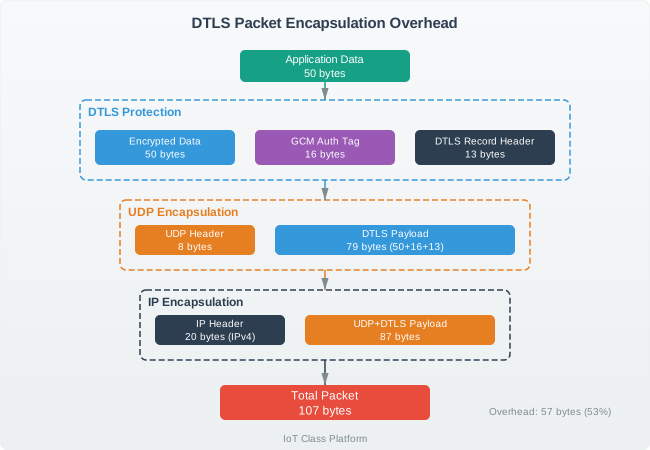
Flowchart showing DTLS packet encapsulation layers for 50-byte payload
Actual calculation: - Application data: 50 bytes - DTLS encryption: +8 bytes (GCM auth tag) - DTLS record header: +13 bytes - UDP header: +8 bytes - IP header: +20 bytes (IPv4) - Range: 91-99 bytes typical
Answer B (92 bytes) is closest to the realistic total including minimal auth tag.
19.8 Quiz 3: Comprehensive Review
19.9 Summary
Key concepts tested in this knowledge check:
- Protocol selection depends on reliability, latency, power, and security requirements
- UDP excels for frequent small transmissions with tolerable loss
- TCP is essential for large reliable transfers like firmware updates
- DTLS session resumption dramatically reduces security overhead for IoT
- Overhead calculations directly impact battery life predictions
19.10 What’s Next
Having completed the transport protocols review:
- Topologies: Network structures and their trade-offs for IoT deployments
- MQTT Protocol: Publish-subscribe messaging built on TCP
- CoAP Protocol: RESTful communication over UDP for constrained devices
- DTLS and Security: Deep dive into securing UDP-based IoT protocols