Evaluate Data Monetization: Assess opportunities and risks in selling IoT-generated insights
Design Sustainable Revenue Models: Balance hardware margins, service fees, and ecosystem value for long-term profitability
Executive Summary: IoT Monetization for Business Leaders
Key Business Value: Successful IoT monetization extends far beyond hardware sales, with recurring revenue streams (subscriptions, services, data) generating 3-5x the lifetime value of one-time product sales. Companies that transition from hardware-only to hybrid revenue models see 40-60% higher valuations due to predictable recurring revenue.
Decision Framework:
Factor
Consideration
Typical Range
Initial Investment
Product development, platform infrastructure
$500K - $10M
Operational Cost
Cloud services, support, compliance
15-25% of revenue
ROI Timeline
Break-even on platform investment
18-36 months
Risk Level
Revenue model transition complexity
Medium-High
When to Choose This Technology:
Products with ongoing customer engagement (daily/weekly usage)
Data generated creates actionable insights for customers or third parties
Clear value proposition beyond hardware (savings, convenience, safety)
Avoid for: Commodity hardware with no differentiation or network effects
Industry Benchmarks:
LTV:CAC Ratio Target: >3:1 (healthy), >5:1 (excellent)
Freemium to Paid Conversion: 5-12% industry average
Subscription Churn: <5% monthly for consumer, <2% for enterprise
Hardware Margin: 40-60% premium over non-connected alternatives
Outcome-Based Revenue Share: 20-30% of documented savings
Minimum Viable Understanding (MVU)
If you only learn three things from this chapter series, make it these:
Hardware margins erode; recurring revenue compounds. Companies that rely solely on hardware sales face declining margins over time, while subscription and service revenue grows with the installed base. A $250 thermostat with no subscription generates $250 once. With a $10/month plan, it generates $610 over three years.
The LTV:CAC ratio is the single most important metric. Lifetime Value must exceed 3x Customer Acquisition Cost for a sustainable business. Every IoT monetization decision should be evaluated against this ratio – from pricing tiers to data products.
Sell insights, not raw data. Raw sensor data has limited value and raises serious privacy concerns. Aggregated, anonymized, and contextualized insights command premium prices while protecting user privacy. The transformation from data to insight is where monetization value is created.
Key Concepts
IoT Business Model: Framework defining how an IoT product or service creates, delivers, and captures economic value.
Recurring Revenue: Ongoing income from subscriptions, data services, or maintenance contracts that follows the initial device sale.
Total Cost of Ownership (TCO): Complete cost of acquiring, deploying, and operating an IoT system over its full lifecycle.
Value Proposition: Clear statement of the benefit an IoT product delivers to a specific customer segment, differentiating it from alternatives.
Platform Business Model: IoT strategy enabling third parties to build applications on top of device data or connectivity infrastructure.
Hardware-as-a-Service (HaaS): Model where customers pay a recurring fee for IoT hardware instead of purchasing it outright, reducing upfront cost barriers.
Churn Rate: Percentage of IoT subscribers who cancel service in a given period; a key metric for recurring revenue business health.
Business Fundamentals: Understanding of revenue, costs, margins, and basic financial metrics
Application Context: Familiarity with IoT use cases from earlier chapters
45.3 Chapter Overview
While understanding IoT business models provides the structural framework for creating value, monetizing IoT requires specific strategies for capturing that value and generating revenue. The transition from traditional product sales to IoT-enabled services demands new thinking about pricing, revenue streams, and value delivery.
45.3.1 The IoT Revenue Landscape
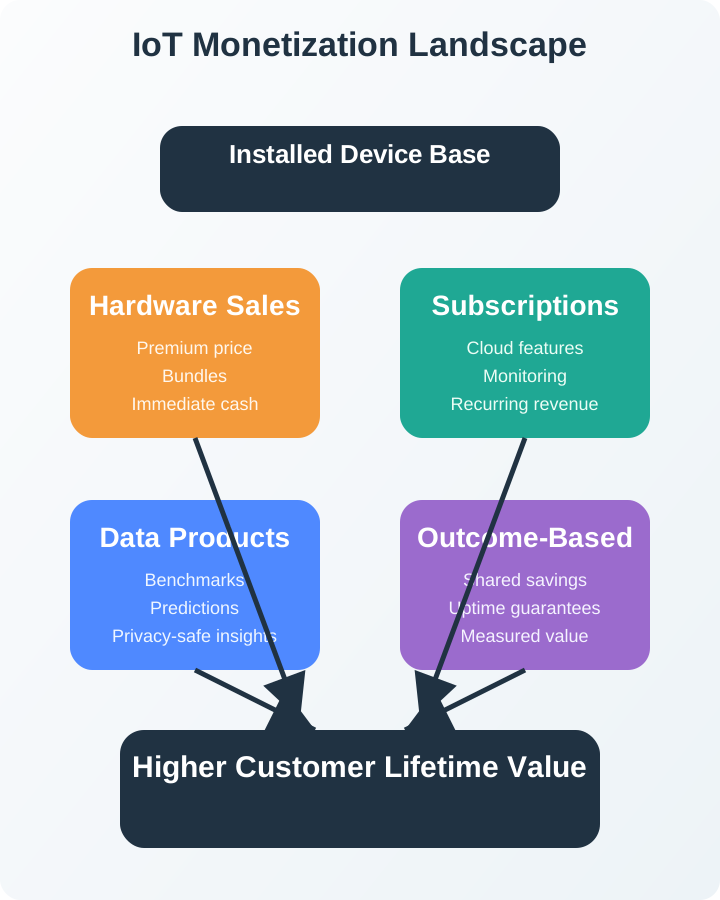
The diagram below shows the four pillars of IoT monetization and how they interconnect. Most successful IoT businesses combine multiple revenue streams rather than relying on a single approach.
45.3.2 Revenue Model Comparison
Understanding when to use each model is critical for IoT product managers. The comparison below keeps the same trade-offs without forcing a wide mobile table:
Hardware Sales: One-time revenue, 40-60% margin, linear scaling, low lock-in, immediate revenue, low delivery risk, best for consumer devices
Subscription: Monthly recurring revenue, 70-90% margin, compounding growth, medium lock-in, 3-6 month ramp, medium risk, best for B2B/B2C SaaS offerings
Data Products: Variable revenue, 80-95% margin, exponential upside, medium-high lock-in, 12-24 month ramp, high privacy risk, best for data-rich verticals
Outcome-Based: Performance-linked revenue, 20-30% share, logarithmic scaling, high lock-in, 6-12 month ramp, high delivery risk, best for industrial IoT
45.3.3 The Revenue Stacking Effect
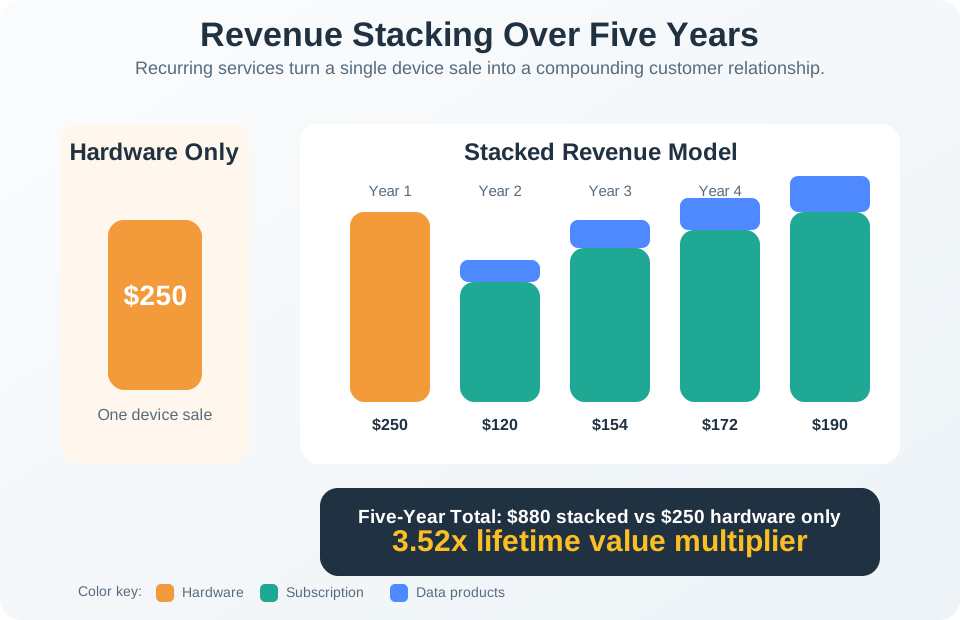
The most successful IoT companies do not rely on a single revenue stream. Instead, they “stack” multiple streams on a single installed base of devices:
Notice how a hardware-only business generates $250 once, but a stacked revenue model yields $250 in year 1, then $370 in year 2 (hardware amortized + subscription), and $450+ per year from year 3 onward as data products mature. Over a 5-year customer lifetime, stacked revenue produces approximately 3.52x the value of hardware-only sales.
Putting Numbers to It: Revenue Stacking Multiplier
Given: $250 hardware, $10/month subscription, $0.50/month data value
Peloton Case Study: Hardware + subscription model with detailed financial metrics
Ring Case Study: Four-phase evolution from hardware to ecosystem platform
Smart Data Pricing Framework: How to charge (usage, time, location), whom to charge (two-sided, sponsored), what to charge for (priority, transactions)
Before diving into the sub-chapters, be aware of the most frequent mistakes IoT companies make when designing their revenue strategies:
Top 5 Monetization Mistakes
Pricing too low at launch. Many startups undercharge to gain traction, then struggle to raise prices later. It is far easier to offer introductory discounts on a fair price than to increase a low price by 50%.
Ignoring the cost of cloud infrastructure. Each connected device incurs ongoing costs for data storage, processing, and bandwidth. A smart home sensor sending data every 30 seconds can cost $2-5/year in cloud costs alone. At 100,000 devices, that is $200K-500K annually before any revenue is generated.
Treating data as “free money.” Collecting user data raises GDPR/CCPA compliance obligations that cost $50K-200K/year for a mid-size deployment. Data monetization revenue must exceed both compliance costs and the risk of reputation damage from privacy incidents.
No recurring revenue from day one. Retrofitting subscriptions onto a product launched as hardware-only creates customer backlash. Design recurring revenue into the product concept, not as an afterthought.
Underestimating churn. A 5% monthly churn rate means you lose half your subscriber base annually. Retention strategies (personalization, habit loops, switching costs) must be budgeted alongside acquisition.
45.5 The Monetization Decision Framework
Use this decision checklist to determine which revenue model best fits your IoT product:
Does the device generate continuous data? If yes, move toward recurring services or data products rather than relying on a one-time device sale.
Do customers need ongoing cloud features such as dashboards, alerts, history, or remote control? If yes, Subscription / Product-as-a-Service is usually the strongest fit because customers keep paying for continuing value.
Is the aggregated data itself valuable to another buyer? If yes, Data Products such as benchmarks, forecasts, and anonymized insights can become an additional revenue stream.
Can value be tied directly to a measured business result such as savings, uptime, or compliance? If yes, Outcome-Based Pricing can align your revenue with the customer’s realized benefit.
If none of the above apply, start with a high-quality hardware sale and add services later only when the value is real.
How It Works: IoT Revenue Stacking
The big picture: IoT companies rarely rely on a single revenue stream. Instead, they “stack” multiple revenue models on the same hardware base to maximize customer lifetime value.
Step-by-step breakdown:
Hardware Sale ($250 one-time): Customer pays upfront for the physical device - Real example: Nest thermostat retails for $249
Subscription Service ($10/month): Customer pays monthly for cloud analytics, remote access, and advanced features - Real example: Ring charges $3-10/month for video storage
Data Insights (variable): Aggregated, anonymized data sold to third parties - Real example: Utilities pay $0.50-$2/month per household for energy pattern data
Why this matters: A hardware-only sale generates $250 once. Revenue stacking generates $250 year one, then $120/year recurring, creating $610 lifetime value over 3 years - 2.4x the hardware-only approach.
Concept Check: Revenue Models
For Beginners: How Do You Actually Make Money with IoT?
Selling a smart device is just the beginning – the real money comes after.
Think of it like a printer: the printer itself is cheap, but you keep buying ink cartridges. IoT works similarly, except instead of ink, you are paying for cloud storage, analytics, and premium features.
Three main ways to monetize IoT:
Strategy
How It Works
Example
Revenue Type
Hardware Sales
Sell the device
Smart thermostat for $250
One-time
Subscriptions
Monthly/annual fees
$10/month for cloud storage
Recurring
Data Insights
Sell patterns (not raw data)
Traffic patterns to city planners
Variable
The math that matters:
Key Formula:  LTV > 3 x CAC

LTV = Lifetime Value (total money from one customer)
CAC = Customer Acquisition Cost (marketing + sales to get them)

Example:
- Thermostat costs $50 in marketing to sell (CAC = $50)
- Customer pays $250 hardware + $10/month for 3 years
- LTV = $250 + ($10 x 36 months) = $610
- LTV:CAC = $610 / $50 = 12.2:1  (Excellent!)
Key insight: The most successful IoT companies think beyond the initial sale. They design products that create ongoing value (and revenue) through services, analytics, and ecosystem integration.
Sensor Squad: The Lemonade Stand Goes Smart!
Hey Sensor Squad! Let’s learn about making money with IoT using a lemonade stand!
Imagine you have a smart lemonade stand with sensors that track how many cups you sell, the weather outside, and how long customers wait in line.
Three ways to make money:
Sell the lemonade (that is like selling hardware) – You charge $2 per cup. Simple!
Sell a “Lemonade Club” membership (that is like a subscription) – For $5/month, members get a cup every day. Even on rainy days when nobody else shows up, your club members still pay!
Share your weather-and-sales data (that is like data monetization) – You notice that when it is above 80 degrees, you sell 3x more cups. The ice cream truck driver would LOVE to know that pattern. You could share it (without telling anyone specific customer names) for $10/week.
The big lesson: Selling lemonade once is nice, but having club members who pay every month? That is how the smart lemonade stand makes the MOST money!
– Sammy the Sensor says: “The smartest businesses make money while they sleep!”
45.6 Knowledge Check
Test your understanding of IoT monetization fundamentals before proceeding to the detailed sub-chapters.
Question 1: Revenue Model Selection
A smart building sensor company sells occupancy sensors at $150 each. Each sensor sends data every 60 seconds to the cloud, costing $3/year in infrastructure. The company is considering adding a $15/month analytics subscription. What is the 3-year LTV per customer under the subscription model?
The calculation: $150 (hardware) + $540 (subscription: $15/month x 36 months) - $9 (cloud costs: $3/year x 3 years) = $681.
Many students forget to subtract infrastructure costs. While $9 seems negligible here, at scale (100,000 sensors), cloud costs reach $300K/year. Always factor in per-device operational costs when calculating true LTV.
Compared to hardware-only LTV of $150, the subscription model yields 4.5x more lifetime value per customer.
Question 2: LTV:CAC Ratio
A consumer IoT company spends $80 to acquire each customer through digital marketing. Their average customer generates $200 in lifetime revenue. What should the company do?
Celebrate – the LTV:CAC ratio of 2.5:1 is healthy
Reduce marketing spend immediately to improve the ratio
Increase LTV through subscription features or reduce CAC – the 2.5:1 ratio is below the 3:1 sustainability threshold
The ratio does not matter as long as revenue exceeds costs
Answer
C) Increase LTV or reduce CAC is the correct answer.
An LTV:CAC ratio of 2.5:1 ($200/$80) is below the widely accepted 3:1 sustainability threshold. At this ratio, the company is spending too much to acquire customers relative to what they earn back.
Two paths to fix this:
Increase LTV: Add a subscription tier, offer premium features, or develop data products. If LTV rises to $240, the ratio becomes 3:1.
Reduce CAC: Optimize marketing channels, improve conversion rates, or leverage word-of-mouth. If CAC drops to $60, the ratio becomes 3.3:1.
Option A is wrong because 2.5:1 is not healthy. Option B might help but simply cutting marketing could reduce customer volume. Option D ignores that poor unit economics will eventually sink the business even if aggregate revenue looks positive.
Question 3: Data Monetization Ethics
A fleet management IoT company collects GPS location data from 50,000 delivery trucks. A retail analytics firm offers $500,000/year for access to this data. Which approach is most appropriate?
Sell the raw GPS data directly – it is the company’s data to monetize
Sell anonymized and aggregated traffic pattern data showing peak delivery times by region
Decline entirely – location data should never be monetized
Sell individual driver routes with names removed
Answer
B) Sell anonymized and aggregated traffic pattern data is the correct answer.
This approach balances revenue generation with privacy protection:
Aggregation prevents identification of individual drivers or customers
Regional patterns (e.g., “Downtown area has 40% more deliveries between 2-4pm”) are valuable to retailers without exposing specific routes
k-anonymity ensures each data point represents at least k individuals
Option A violates privacy regulations (GDPR/CCPA) and breaches trust with drivers and customers. Option C is unnecessarily restrictive – properly anonymized data can be ethically monetized. Option D is insufficient – removing names alone does not prevent re-identification from location patterns. Studies show that as few as 4 spatio-temporal data points can uniquely identify 95% of individuals.
Question 4: Revenue Stacking
A smart home security company currently sells cameras at $200 each (one-time). They want to add recurring revenue. Which combination of revenue streams would most effectively increase customer lifetime value?
Raise the camera price to $300
Add a $10/month cloud storage plan + a $25/month professional monitoring plan
Add a $5/month cloud plan only
Offer a free app with advertising revenue
Answer
B) Cloud storage ($10/month) + professional monitoring ($25/month) is the correct answer.
This creates a two-tier subscription stack:
Basic tier ($10/month): Cloud video storage, 30-day history – appeals to most customers
Premium tier ($25/month): Adds 24/7 professional monitoring, emergency dispatch – appeals to security-conscious customers
3-year LTV comparison:
Option A: $300 (one-time) – only 50% more than current
Option B (basic): $200 + $360 = $560 (2.8x current)
Option B (premium): $200 + $900 = $1,100 (5.5x current)
Option C: $200 + $180 = $380 (1.9x current)
Option D: Advertising on home security creates trust issues and generates minimal revenue ($0.50-2.00 CPM)
Option B mirrors the actual Ring/Nest model that has proven successful at scale. The key is offering differentiated value at each tier so customers self-select into the plan that matches their willingness to pay.
Interactive Quiz: Match Concepts
Interactive Quiz: Sequence the Steps
Label the Diagram
Code Challenge
45.7 Summary
This chapter introduced the landscape of IoT monetization – the strategies, metrics, and decisions that determine whether an IoT business becomes financially sustainable. Key takeaways:
Revenue Stacking: Combining hardware, subscription, and data revenue on a single device base yields 3-5x more lifetime value than hardware alone
LTV:CAC Ratio: The single most important metric; it must exceed 3:1 for sustainability, with 5:1+ indicating excellent unit economics
Data Monetization: Sell aggregated insights, not raw data; comply with GDPR/CCPA and exceed minimum privacy expectations
Pricing Strategy: Price based on value delivered, not cost; design recurring revenue into the product from day one
Common Pitfalls: Avoid underpricing at launch, ignoring cloud costs, treating data as free, retrofitting subscriptions, and underestimating churn
Key Takeaway
In one sentence: Hardware sales alone will not sustain an IoT business – recurring revenue from subscriptions, services, and data generates 5-9x higher lifetime value than one-time product sales.
Remember this rule: Your LTV:CAC ratio must exceed 3:1 to be sustainable. If you are spending $50 to acquire a customer, they must generate at least $150 in lifetime value. Subscriptions compound over time while hardware margins erode – design recurring revenue into your product from day one.
“If we build it, customers will pay for the data.”
Many IoT startups invest heavily in sensor infrastructure assuming data monetization will naturally follow. This is one of the most expensive mistakes in IoT business models.
Real Example: Smart Home Startup Failure
A well-funded startup deployed 50,000 smart thermostats at $200 each (total: $10M hardware). Their business plan projected $500K annual revenue from selling aggregated energy usage patterns to utilities.
What Went Wrong:
Privacy Backlash: Customers felt “spied on” when learning their data would be sold
Low Data Value: Utility companies valued the aggregated data at only $0.02/household/year, not the projected $10/year
GDPR Compliance Cost: Data protection and consent management cost $180K/year, exceeding data revenue
Limited Buyers: Only 2 utilities expressed interest, not the projected 50
The Numbers:
Hardware Investment: $10M
Actual Annual Data Revenue: $1,000 (50,000 homes × $0.02)
Compliance Cost: $180K/year
Net Loss: -$179K/year on data monetization
In 60 Seconds
This chapter covers monetizing iot, explaining the core concepts, practical design decisions, and common pitfalls that IoT practitioners need to build effective, reliable connected systems.
The company pivoted to subscription services ($5/month) which generated $3M/year, making the devices financially viable – but only after burning through $12M in VC funding.
Lessons:
Validate data buyers BEFORE deployment: Secure LOIs (Letters of Intent) from at least 3 potential data customers at your target price point
Privacy-first design: Build consent and transparency into the product from day one, not as an afterthought
Price data realistically: Aggregated consumer data typically sells for $0.01-$0.10/user/year, not $10-$50/user/year
Plan for compliance costs: Budget 15-25% of data revenue for GDPR/CCPA compliance, not <5%
Have a Plan B revenue stream: Data should be supplementary income, not the primary business model
Test Before Scaling: Run a 500-device paid pilot to validate both data value and buyer willingness before investing in 50,000 units.