Start with a proposal that needs numbers before it deserves confidence. The story here is how a learner moves from a broad IoT idea to a bounded sizing and costing argument: count devices, traffic, labor, failures, cloud costs, and the operational improvement that must pay for them.
Chapter Roadmap
This is a long calculation chapter, so use this route through it:
First learn the accounting pattern: CapEx, OpEx, replacement, benefit, uncertainty, and rollout timing.
Then test that pattern on traffic and air-quality examples, where large benefits can hide fragile assumptions.
Next compare flood and weather networks, where sensor placement matters more than raw sensor count.
After that use the calculators and parking exercise to build your own business-case estimate.
Finally check the common misconception: more sensors do not help if calibration and critical locations are wrong.
Checkpoints recap the durable ideas, and calculator sections are places to try the method with your own assumptions.
10.2 Learning Objectives
By the end of this chapter, you will be able to:
Calculate IoT deployment costs: Perform CapEx and OpEx analysis for real projects using 5-year TCO models
Quantify ROI: Measure return on investment for smart city and environmental systems with realistic adoption discounts
Design sensor networks: Determine optimal sensor placement, density, and tiering strategies for maximum data quality
Evaluate trade-offs: Balance cost, coverage, accuracy, and maintainability across different deployment scenarios
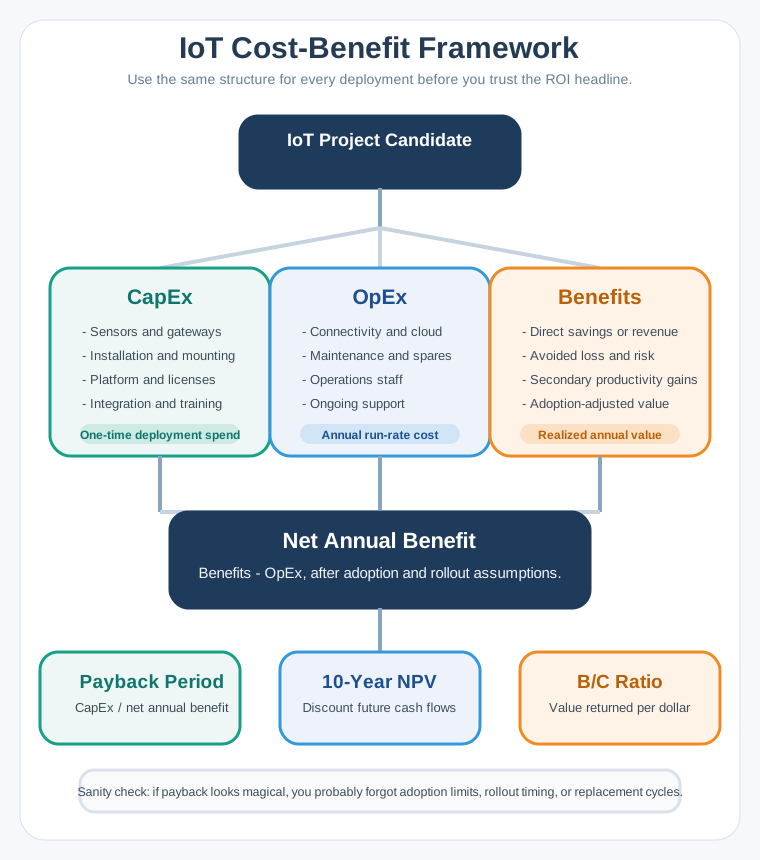
Apply the cost-benefit framework: Structure any IoT business case using CapEx, OpEx, and benefit quantification
Justify tiered sensor strategies: Explain when and why hybrid sensor networks outperform uniform deployments using calibration hierarchy principles
10.3 For Beginners: IoT Worked Examples
This chapter walks through IoT project calculations step by step, like a math textbook with word problems. You will learn how to estimate costs (both upfront hardware and ongoing cloud fees), figure out how many sensors you need, and calculate whether the investment pays for itself. If you have ever compared phone plans to find the best deal, you already understand the basic idea – these examples just apply it to IoT projects.
This chapter assumes familiarity with basic IoT concepts from the IoT Introduction. Understanding of CapEx (Capital Expenditure) and OpEx (Operating Expenditure) is helpful but explained inline. Basic arithmetic and the ability to interpret cost-benefit tables are the primary skills needed.
10.6 Minimum Viable Understanding (MVU)
If you only have 10 minutes, focus on these core takeaways:
The IoT Cost Framework: Every IoT project has three cost layers: (a) CapEx (hardware, installation, software licenses), (b) OpEx (connectivity, maintenance, cloud services, staff), and (c) replacement costs (device end-of-life cycling).
The Tiered Sensor Strategy: Deploy a small number of expensive, high-accuracy reference sensors (5-10%) alongside many cheaper sensors (90-95%). The reference sensors calibrate the low-cost ones, giving you broad coverage without sacrificing data quality.
ROI Calculation Pattern: Quantify annual benefits in dollars (time saved, damage prevented, health costs avoided), subtract annual OpEx, then divide total CapEx by net annual benefit to get payback period.
Coverage beats precision: For most IoT monitoring applications, having more sensors at lower individual accuracy outperforms fewer sensors at higher accuracy, because spatial coverage matters more than point precision.
These four principles apply to virtually every IoT deployment decision you will encounter.
10.7 In 60 Seconds
Worked examples teach the shape of an IoT business case. Start with the decision the system improves, then calculate the full lifecycle cost: devices, installation, connectivity, cloud services, calibration, maintenance, staffing, replacement, and support. Compare that cost with realistic benefits, not theoretical maximums. The most useful estimates show deployment ramp-up, adoption rate, sensor failure, and uncertainty instead of hiding them behind one optimistic payback number.
10.8 Calculation Shape Lessons
The examples in this chapter are useful because they show the structure of an IoT business case. The exact numbers will change by city, vendor, country, installation labor, connectivity plan, maintenance contract, and sensor quality. The transferable skill is knowing which numbers must be gathered before anyone trusts the result. A calculation is not credible because it has many digits; it is credible when the units, assumptions, owners, and uncertainty are visible.
A good IoT calculation starts with the outcome, then works backward to the sensing system. Traffic timing, air-quality monitoring, flood warning, and farm weather networks all need different hardware, but they share the same accounting pattern: upfront deployment cost, recurring operating cost, replacement cost, measurable benefit, uncertainty, and deployment ramp-up. The first question is therefore not “which sensor is cheapest?” It is “which decision will improve, how often does that decision happen, and how much better must the system make it to justify the operating burden?”
That pattern prevents two common mistakes. One mistake is treating the bill of materials as the whole project, leaving out mounting, power, permissions, site visits, calibration, spares, cloud storage, dashboards, integration, cybersecurity review, and support. The other is treating annual benefits as if they appear on day one, even though real deployments phase through procurement, permits, installation, commissioning, user training, and slow adoption. The worked examples make those hidden assumptions visible before they turn into a budget surprise.
Benefit side: Time saved, damage avoided, energy reduced, compliance improved, uptime gained, or decisions made earlier.
Uncertainty side: Adoption rate, weather variability, failure rate, maintenance access, data quality, and delayed rollout.
Use the scenarios as calculation templates, not as current price lists. Copy the structure, then replace the assumptions with locally sourced evidence: quotes from vendors, installation estimates from contractors, historical incident records, maintenance logs, cellular or LoRaWAN coverage checks, cloud retention policies, and the decision threshold that determines whether the data is good enough to act.
10.9 Turn Assumptions into Rows
When building a real project estimate, do not hide assumptions inside a headline ROI. Put each assumption in a row with an owner and a source. A LoRaWAN flood gauge, LTE-M air-quality node, Wi-Fi traffic controller, or BLE environmental logger will have different radio coverage, power, enclosure, calibration, and support costs. If a row says “sensor cost,” split it into device, sensor element, enclosure, mast or mount, power supply, antenna, SIM or network join process, commissioning labor, spares, and replacement interval.
The same rule applies to benefits. A traffic example may price driver time. An air-quality example may depend on health-risk models and policy adoption. A flood-warning example may use expected annual damage. A farm-weather example may depend on frost events and grower behavior. Each one needs a sensitivity check before the payback claim is credible. A single ROI value is less useful than a small table showing conservative, expected, and optimistic cases for deployment speed, adoption, avoided loss, maintenance cost, and sensor failure.
Define the unit. State whether the cost is per sensor, intersection, gateway, field, building, or year.
Separate one-time and recurring costs. Keep CapEx, OpEx, replacement, and staffing in different rows.
Run conservative and optimistic cases. Vary adoption, sensor failure, maintenance visits, connectivity cost, and deployment time.
For a field-ready worksheet, add columns for assumption, unit, quantity, unit cost, timing, source, owner, confidence, and sensitivity range. The source column matters. A vendor quote, a procurement catalog, a city incident database, a maintenance log, and an engineer’s estimate deserve different confidence. The owner column matters too, because someone must be able to update the row when the radio plan changes, labor rates change, or a pilot shows that the maintenance interval is wrong.
Finally, link each cost to a decision. If an air-quality node does not change where warnings are issued, where enforcement happens, or how exposure is reduced, its benefit row is weak. If a flood gauge does not change warning lead time, evacuation action, or asset protection, its benefit row is weak. If a farm-weather station does not change irrigation, frost response, or disease-risk decisions, its benefit row is weak. The spreadsheet should make this trace from sensor to action explicit.
10.10 Sensor Economics Depend on Data Quality
Cheap sensors create coverage, but coverage is useful only when the data can support the decision. A PM2.5 network may combine reference stations, mid-grade optical sensors, and low-cost nodes because calibration drift, humidity, placement, and cleaning affect the measurement. A flood-warning network may prioritize upstream stage gauges, rain gauges, telemetry reliability, and battery-backed gateways over uniform spacing. A traffic network may spend more on controller integration, cabinet access, failsafe timing plans, and fiber or cellular backhaul than on the detector itself.
The technical design must therefore connect cost to data quality. MQTT, CoAP, HTTP APIs, or vendor cloud connectors can move readings, but the business case also needs timestamps, units, calibration state, quality flags, missing-data rules, and maintenance records. Without those, the spreadsheet may look precise while the field system cannot support the decision it promises. For example, a cheap air-quality node without humidity correction and reference calibration may be inexpensive per device but expensive per trustworthy decision.
Calibration: Budget for reference checks, drift correction, sensor cleaning, and replacement intervals.
Availability: Include radio coverage, gateway redundancy, local buffering, battery reserve, and repair access.
Decision quality: Define the minimum spatial density, latency, accuracy, and confidence needed for the action.
Under the hood, the financial model should include the same state transitions that the system must manage: ordered, installed, commissioned, online, calibrated, degraded, offline, repaired, and replaced. Benefits should ramp with those states, not with an idealized launch date. A sensor that is installed but uncalibrated should not count as full data coverage. A gateway that buffers locally during an outage should have different data-loss risk than a device that drops readings. A dashboard that reports stale values should be treated differently from one that marks missing data explicitly.
This is why tiered designs often beat uniform designs. Reference stations, anchor gauges, or high-confidence locations may cost more, but they make the cheaper layer useful by providing calibration, validation, and decision thresholds. The economic question is not the average sensor price; it is the cost per reliable action over the life of the deployment.
Checkpoint: Cost Model Shape
You now know:
A credible IoT estimate separates CapEx, OpEx, replacement, benefit, uncertainty, and rollout timing instead of treating hardware as the whole project.
Tiered sensor plans use a small high-accuracy layer (often 5-10%) to calibrate broad lower-cost coverage (often 90-95%).
Five-year TCO is usually the useful comparison frame because cloud, connectivity, calibration, support, and replacement continue after launch.
10.11 For Kids: Building a Smart City Budget!
Have you ever saved up allowance money to buy something? IoT projects work the same way!
10.11.1 The Sensor Squad Goes Shopping
Our friends need to buy sensors for a smart project. Let’s see how they plan!
Temperature Terry wants to put sensors all around a farm to check for frost:
Temperature sensors: $10 each x 30 = $300
Solar panels: $25 each x 30 = $750
Wi-Fi radios: $15 each x 30 = $450
Grand total: $1,500
But wait! Terry also needs to pay EVERY MONTH for: - Internet service: $5/month = $60/year - Replacing broken sensors: $100/year - Total yearly cost: $160/year
10.11.2 The Big Question
If frost damages $2,000 of crops every year, and the sensor system prevents 80% of that damage:
Money saved: $2,000 x 80% = $1,600 per year
System costs: $160 per year
Net savings: $1,600 - $160 = $1,440 per year
How fast does the $1,500 system pay for itself? $1,500 / $1,440 = about 1 year! After that, it is all savings!
10.11.3 What Did We Learn?
Buying stuff costs money (this is called “CapEx” – Capital Expenditure)
Running stuff costs money too (this is called “OpEx” – Operating Expenditure)
Smart sensors can SAVE more money than they cost! (this is called “ROI” – Return on Investment)
Always add up ALL the costs, not just the price of the sensor!
10.12 IoT Cost-Benefit Framework
Before diving into specific examples, it is essential to understand the analytical framework that applies to every IoT deployment. Whether you are evaluating a smart city investment or a farm sensor network, the same structure applies.
The five worked examples in this chapter apply this framework to progressively different domains. Each example highlights a different scale and design pattern:
Smart traffic: Urban mobility at 4,500 intersections; city-wide deployment matters more than isolated pilots.
Beijing air quality: Megacity health monitoring with 29,911 sensors; hybrid reference and low-cost sensors make block-level coverage affordable.
Generic air quality: A mid-size city network with about 95 stations; three sensor tiers balance regulatory accuracy with spatial coverage.
Flood warning: Agricultural safety across 34 sensors; catchment-wide distributed sensing creates useful lead time.
Weather network: Precision agriculture with 51 stations and loggers; terrain-aware placement beats uniform grids.
With the pattern in place, the first example deliberately starts at large scale. Traffic exposes the danger of reading a huge ROI number without asking when the system actually becomes operational.
10.13 A Note on Numbers
The figures in these worked examples are scenario data for learning the calculation method. Real-world costs vary by region, vendor, labor market, procurement model, connectivity plan, sensor quality, maintenance contract, and project scale. Use these as calibration prompts for your own estimates, not as fixed values or current market quotes. The analytical methodology – not the specific numbers – is the transferable skill.
10.14 Smart Traffic Signal Optimization Budget
Scenario: Los Angeles, California (population 3,970,000) plans to upgrade 4,500 traffic signals with IoT sensors and adaptive timing to reduce average commute times by 12%.
Given:
Current traffic signals: 4,500 across 503 square miles
Average commute time: 32.5 minutes (2nd worst in US)
Daily commuters: 1.85 million people
Signal upgrade cost: $18,500/intersection (sensors, controller, connectivity)
Result: Smart traffic investment of $117M generates $2.16B annual benefit, a payback period under 3 weeks. Every $1 invested returns $18.47 per year. The 12% commute reduction is conservative; Pittsburgh’s Surtrac system achieved 25% reduction.
Key Insight: Traffic signal optimization delivers the highest ROI of any smart city investment because it addresses the #1 urban pain point (congestion) affecting millions daily. However, success requires city-wide deployment; isolated smart intersections create traffic waves at adjacent traditional signals. Budget for 100% coverage from the start.
10.15 Common Mistake: Partial Deployment Trap
Many cities attempt to “pilot” smart traffic systems on a corridor of 50-100 intersections. While this seems prudent, it actually creates negative externalities: optimized intersections push traffic to adjacent non-smart signals, creating new bottlenecks. The Pittsburgh Surtrac pilot showed that city-wide deployment is not a luxury – it is a technical requirement. Budget for 100% signal coverage in Phase 1 or accept that the pilot will underperform expectations.
10.16 Knowledge Check: Traffic Signal ROI
Question 1: A city of 800,000 commuters has an average commute of 28 minutes. They plan to deploy smart traffic signals that reduce commute time by 10%. The average driver’s hourly value is $25. What is the approximate annual value of time saved?
Annual hours: 746,667 × 250 workdays = 186.67 million hours/year
Time saved at 10%: 186.67M × 10% = 18.67 million hours/year
Dollar value: 18.67M × $25 = $466.7 million/year
However, the question says “commute of 28 minutes” which is ambiguous. If 28 minutes refers to a one-way commute: - Daily hours (one-way only): 800,000 × 28/60 × 250 = 93.33M hours/year - Time saved at 10%: 9.33M hours/year - Dollar value: 9.33M × $25 = $233.3 million/year
Answer b is correct if we interpret “commute” as one-way travel. The key lesson: always clarify whether “commute time” means one-way or round-trip. This ambiguity is a common source of error in real ROI calculations, potentially causing 2x overestimates.
Question 2: Why does the worked example describe a payback period of “19.7 days” – is this realistic?
Yes, traffic ROI is always this fast
No, this ignores that benefits ramp up over deployment months, not day one
No, the calculation is fundamentally wrong
Yes, but only for cities above 3 million population
10.18 Answer
b) No, this ignores that benefits ramp up over deployment months, not day one
The 19.7-day payback assumes full benefits from day one. In reality, deploying 4,500 smart intersections takes 12-24 months. Benefits accrue gradually as more intersections come online. The “steady-state” payback period is still extremely attractive (well under one year), but the deployment timeline means actual payback is more like 18-30 months after project start. Always account for deployment ramp-up in your financial models.
10.19 Beijing Air Quality Network
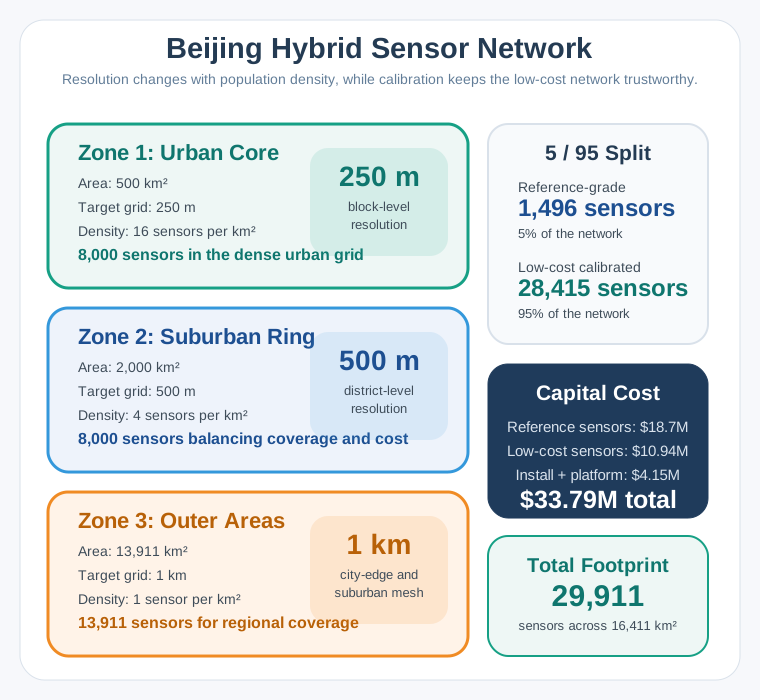
Scenario: Beijing, China (population 21,540,000) deploys a hyperlocal air quality monitoring network to provide block-level PM2.5 alerts and enable pollution-responsive traffic routing.
Given:
City area: 16,411 km^2
Population density varies: 1,200/km^2 (suburbs) to 45,000/km^2 (urban core)
Target resolution: 250m grid in urban areas, 1km grid in suburbs
Reference-grade sensor cost: $12,500 each (meets regulatory standards)
Low-cost sensor cost: $385 each (requires calibration against reference)
Data transmission: NB-IoT at $2.50/month/sensor
Health cost of PM2.5: $95 per ug/m^3 per person per year (WHO estimate)
Dynamic routing reduces exposure in hotspots by 22%
Population-weighted exposure reduction: 8.5 ug/m^3 average
Health benefit: 21.54M people x $95 x 8.5 = $17.4B/year potential
Achievable benefit (15% of population uses routing): $2.61B/year
Calculate alert system value:
High-pollution days: 127/year average
Vulnerable population (children, elderly, respiratory conditions): 4.8M
Alert adoption rate: 45% check daily readings
Exposure avoided through behavior change: 12% on alert days
Health savings: $890M/year
Calculate ROI:
Total annual benefit: $2.61B + $890M = $3.5B
Net benefit: $3.5B - $4.74M = $3.495B/year
Payback period: $33.79M / $3.495B = 3.5 days
Benefit-cost ratio: 736:1 over 10 years
Result: Hyperlocal air quality network investment of $34M generates $3.5B annual health benefit. The hybrid sensor approach (5% reference-grade, 95% low-cost) reduces costs by 85% while maintaining data quality through calibration.
Key Insight: Air quality networks achieve extreme ROI in heavily polluted cities because health costs of PM2.5 exposure are staggering. The key is hyperlocal resolution; city-average readings miss pollution hotspots where interventions matter most. Deploy dense networks in high-population, high-pollution corridors first.
10.19.1 Hybrid Sensor Network Architecture
The Beijing example demonstrates the hybrid sensor strategy that applies broadly to environmental monitoring. Here is how the three zones relate to sensor density and cost.
Beijing hybrid air-quality network using dense urban sensing, wider suburban spacing, and a 5/95 reference-to-low-cost sensor split.
10.20 The 5/95 Rule in Environmental Sensing
The hybrid approach – 5% reference-grade sensors calibrating 95% low-cost sensors – reduces hardware costs by approximately 85% compared to an all-reference deployment while maintaining data quality sufficient for health advisories.
10.21 Tiered Sensor Economics
Given: 100-sensor air quality network, reference vs low-cost comparison
All-reference cost: 100 x $5,000 = $500K
Tiered cost at a 5:95 ratio: (5 x $5,000) + (95 x $300) = $25K + $28.5K = $53.5K
Data quality: Reference sensors calibrate low-cost units every 6 hours, correcting drift and maintaining correlation r > 0.85 with EPA-grade instruments. This 89% cost reduction with <15% accuracy degradation explains widespread adoption of hybrid networks.
This pattern recurs across air quality, water quality, noise monitoring, and soil analysis. The reference sensors serve as “truth anchors” that continuously correct drift and bias in the low-cost network.
10.22 Air Quality Network Check
Question 1: If Beijing used ONLY reference-grade sensors ($12,500 each) for all 29,911 locations instead of the hybrid approach, what would the sensor hardware cost be?
$33.79 million
$133 million
$374 million
$29.9 million
10.23 Answer
c) $374 million
29,911 sensors x $12,500 = $373,887,500, approximately $374 million. The hybrid approach costs $18.7M + $10.94M = $29.64M for sensors, representing a savings of approximately $344 million (92% cost reduction). This is why the hybrid strategy is essential for city-scale deployments.
Question 2: Why does the Beijing example calculate an “achievable benefit” of $2.61 billion rather than the full $17.4 billion potential?
Because the sensors are only 15% accurate
Because only 15% of the population uses the dynamic routing feature
Because pollution routing only works 15% of the time
Because 85% of sensors are low-cost and less reliable
10.24 Answer
b) Because only 15% of the population uses the dynamic routing feature
The full potential ($17.4B) assumes every resident adjusts their route based on air quality data. In reality, only about 15% of the population actively uses pollution-responsive routing apps. This “adoption rate discount” is critical in any IoT benefit calculation. Technology only creates value when people use it. Your business case should always include realistic adoption curves, not theoretical maximums.
Checkpoint: City-Scale ROI
You now know:
A 4,500-intersection traffic upgrade can show an attractive steady-state payback, but a 12-24 month rollout means benefits ramp instead of appearing on day one.
Beijing’s 29,911-sensor example depends on hybrid calibration: 5% reference-grade nodes make the 95% low-cost layer useful.
Adoption rate is not a footnote. The air-quality routing benefit drops from $17.4B potential to $2.61B achievable when only 15% of residents use the feature.
The next examples are smaller, but the design question gets sharper. Instead of asking whether many sensors can be afforded, ask where a sensor has to sit before it changes a decision.
10.25 Urban Air Quality Network Design
Scenario: A city of 500,000 residents is deploying a hyperlocal air quality monitoring network to identify pollution hotspots, support public health advisories, and evaluate the effectiveness of low-emission zones.
Population density: Urban core 8,000/km^2, suburban 2,500/km^2
Major pollution sources: 3 industrial zones, 15 major intersections, 1 port
Air quality parameters: PM2.5, PM10, NO2, O3, CO, temperature, humidity
Regulatory requirement: Data resolution sufficient to trigger health alerts at neighborhood level
Budget: $800,000 for 5-year deployment (capital + operations)
Steps:
Determine spatial resolution requirements: WHO guidelines recommend air quality data at 1-2 km resolution for urban areas. For health advisory purposes, 500m resolution in high-risk areas.
Urban core (50 km^2): 1 km grid = 50 reference points, plus 20 high-priority locations = 70 locations
Suburban (100 km^2): 2 km grid = 25 reference points
Total monitoring locations: 95
Select sensor tiers based on location criticality:
Tier 1 (Reference-grade, $15,000 each): 5 units for regulatory compliance and calibration
Tier 2 (Mid-grade, $3,000 each): 30 units at industrial boundaries, major roads, schools
Tier 3 (Low-cost indicative, $800 each): 60 units for spatial coverage
Sensor costs: (5 x $15,000) + (30 x $3,000) + (60 x $800) = $75,000 + $90,000 + $48,000 = $213,000
Calculate connectivity costs (5-year):
Tier 1/2 sensors (cellular, high reliability): 35 x $15/month x 60 months = $31,500
Tier 3 sensors (LoRaWAN): 60 x $3/month x 60 months = $10,800
LoRaWAN gateways (8 needed for coverage): 8 x $1,200 = $9,600
Total connectivity: $51,900
Infrastructure and installation:
Mounting hardware and enclosures: 95 x $400 = $38,000
Professional installation (Tier 1/2): 35 x $800 = $28,000
Community installation (Tier 3): 60 x $200 = $12,000
Slightly over budget; reduce Tier 3 count to 50 units
Revised total: $784,900 (within budget)
Result: 90-station network providing 500m-1km resolution air quality data across the city.
Key Insight: Urban air quality networks require a tiered sensor strategy. A few expensive reference-grade sensors provide accuracy anchors for calibrating many lower-cost sensors. The 5:30:55 ratio (reference:mid-grade:low-cost) balances spatial coverage with data quality.
10.26 Three-Tier Sensor Check
Question: The generic air quality example uses a 5:30:60 ratio of Tier 1 (reference), Tier 2 (mid-grade), and Tier 3 (low-cost) sensors. If the total budget were cut by 30%, which tier should be reduced FIRST?
Tier 1 (reference-grade) – they are the most expensive per unit
Tier 2 (mid-grade) – they are in the middle and easiest to cut
Tier 3 (low-cost) – reducing spatial coverage has the smallest impact on data quality
All tiers equally – maintain the same ratio
10.27 Answer
c) Tier 3 (low-cost) – reducing spatial coverage has the smallest impact on data quality
Tier 1 reference sensors are non-negotiable: they provide the calibration anchor that makes the entire network trustworthy. Without them, all other sensors produce uncalibrated (and potentially misleading) data. Tier 2 sensors cover critical locations like schools, hospitals, and industrial boundaries where accurate data drives regulatory action. Tier 3 sensors provide spatial density – valuable, but the network still functions with fewer of them. The worked example itself demonstrates this logic: when the budget was exceeded, the solution was to “reduce Tier 3 count to 50 units.”
10.28 Comparing the Two Air Quality Examples
The Beijing and generic city examples tackle the same problem at different scales:
Total sensors: Beijing uses 29,911 sensors; the generic city uses about 85-90.
Sensor tiers: Beijing uses two tiers, reference plus low-cost; the generic city uses reference, mid-grade, and low-cost tiers.
Grid resolution: Beijing ranges from 250 m to 1 km; the generic city ranges from 500 m to 2 km.
Total CapEx: Beijing is $33.79M; the generic city is $784,900 over five years.
Cost per resident: Both examples land near $1.57 per resident.
Connectivity: Beijing uses uniform NB-IoT; the generic city mixes cellular and LoRaWAN.
Note that the cost per resident is remarkably similar despite the 40x difference in scale. This is because both populations and sensor counts scale proportionally. The per-resident cost of approximately $1.50-$2.00 is a useful planning heuristic for municipal air quality networks.
10.29 Flood Early Warning Network
Scenario: A regional water authority is deploying an IoT-based flood early warning system for a 200 km river basin that includes 15,000 hectares of farmland, 3 towns (combined population 45,000), and critical infrastructure.
Given:
River length: 85 km from headwaters to valley floor
Catchment area: 1,200 km^2
Warning time needed: 4 hours minimum for evacuation, 8 hours for livestock relocation
Existing infrastructure: 2 manual river gauges (read daily), 1 weather station
Budget: $350,000 capital, $40,000/year operations
Steps:
Map sensor requirements by zone:
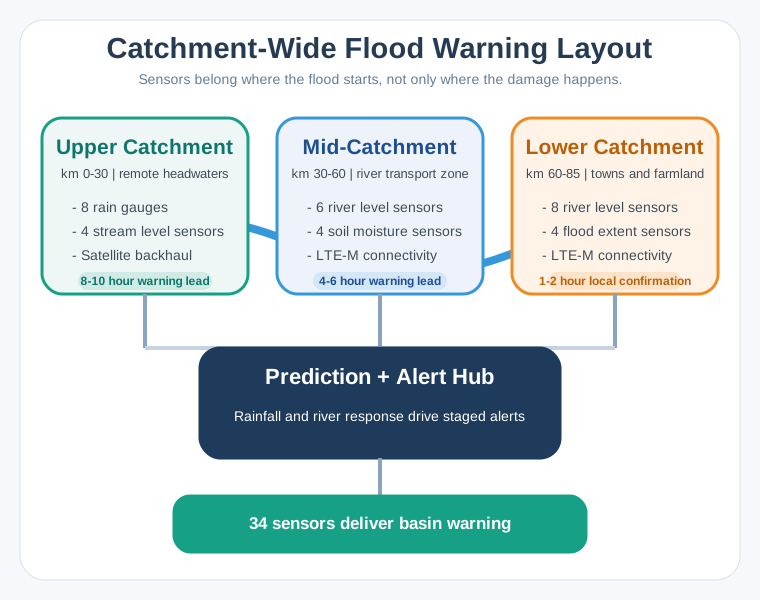
Upper catchment (headwaters to km 30): 8 rain gauges + 4 stream level sensors
Stream/river level (radar or ultrasonic): 18 x $2,500 = $45,000
Soil moisture (capacitive): 4 x $400 = $1,600
Flood extent (pressure transducer): 4 x $800 = $3,200
Total sensors: $59,400
Design connectivity architecture:
Upper catchment (no cellular): Satellite connectivity
Mid/lower catchment: LTE-M cellular
5-year connectivity cost: $41,460
Implement prediction and alerting system:
Hydrological model calibration: $45,000
Edge computing at central hub: $12,000
Alert system (SMS, sirens, radio integration): $35,000
Mobile app development: $25,000
Total software/alerting: $117,000
Installation and infrastructure:
Solar power systems (upper catchment): $9,600
Mounting structures: $20,400
Professional installation: $45,000
Total installation: $75,000
Calculate flood damage prevention value:
Average annual flood damage: $2.8 million
Damage reduction with 4-hour warning: 40-60%
Expected annual savings: $1.1-1.7 million
System payback: 3-4 months of average flood season
Result: 34-sensor flood warning network providing 6-10 hour advance warning for valley communities.
Key Insight: Flood early warning systems require sensors distributed across the ENTIRE catchment, not just at the point of interest. Upper catchment rainfall data provides the critical 6-10 hour lead time needed for effective response.
10.29.1 Catchment-Wide Sensor Distribution
The flood warning example illustrates a fundamental principle: sensors must be placed where the phenomenon originates, not where the impact occurs. Rain in the upper catchment causes flooding in the lower valley 6-10 hours later.
Catchment-wide flood-warning design placing sensors upstream so alerts arrive hours before downstream impacts.
10.30 Point-of-Impact Monitoring Pitfall
The instinct in flood warning is to place sensors near the towns and farms that need protection. This is the most common design error. By the time river levels rise at the valley floor, it is too late for meaningful evacuation. The 6-10 hour lead time comes from upstream rain gauges, not downstream level sensors. The downstream sensors confirm the model’s predictions and trigger final-stage alerts, but the early warning value comes from the headwaters.
10.31 Knowledge Check: Flood Warning Design
Question 1: The flood warning system uses satellite connectivity in the upper catchment. Why not use cheaper LTE-M cellular like the mid and lower zones?
Satellite is more accurate for weather data
There is no cellular coverage in the remote upper catchment
Satellite connectivity has lower latency
Regulatory requirements mandate satellite for flood sensors
10.32 Answer
b) There is no cellular coverage in the remote upper catchment
Upper catchment areas (headwaters) are typically remote mountainous terrain with no cellular infrastructure. Satellite connectivity costs more ($15/month vs $8/month for LTE-M in this example) but is the only option. This is a practical constraint that directly affects OpEx. When budgeting IoT deployments across diverse geography, always audit connectivity availability before selecting communication technology.
Question 2: The system prevents $1.1-1.7 million in annual flood damage. The CapEx is $350,000 and annual OpEx is $40,000. What is the approximate payback period?
About 2 weeks
About 4 months
About 1 year
About 3 years
10.33 Answer
b) About 4 months
Using the midpoint benefit estimate ($1.4M/year): - Net annual benefit: $1.4M - $40K = $1.36M - Payback period: $350K / $1.36M = 0.26 years, approximately 3.1 months
This assumes average flood damage occurs annually. In practice, floods are episodic – some years have no damage, others have catastrophic events. A more conservative approach uses the expected annual damage (probability x damage), which is what the $2.8M figure represents. The system’s 40-60% damage reduction capability yields $1.1-1.7M in expected annual savings.
10.34 Weather Station Coverage
Scenario: A regional agricultural extension service is deploying automated weather stations to support precision farming decisions across a 12,000 km^2 region with varied topography.
Given:
Service area: 12,000 km^2 with 2,400 farms (average 500 hectares each)
Add 30 low-cost temperature-only loggers ($350 each) for frost monitoring
Use elevation-based interpolation between stations
Final placement: 21 full stations + 30 temperature loggers
21 x $8,500 + 30 x $350 = $189,000
Validate spatial accuracy:
Temperature prediction error: RMSE = 1.2C (within 1.5C requirement)
Frost alert accuracy: 97.3% (exceeds 95% target)
Calculate value delivered to farmers:
Frost damage prevented: $504K/year
Irrigation water savings: $340K/year
Disease prevention: $180K/year
Total annual farmer benefit: $1.024M
Result: Network of 21 automated weather stations + 30 supplementary temperature loggers provides 97.3% frost alert accuracy across 12,000 km^2, with annual farmer benefits of $1.024M. Capital cost of $189,000 pays back in 2.2 months.
Key Insight: Weather station network design must account for spatial correlation distances that vary dramatically with terrain complexity. The hybrid approach (full stations at key sites + temperature loggers in complex terrain) achieves 95%+ accuracy at 35% of the cost of uniform full-station deployment.
10.35 What Is “Correlation Distance”?
Correlation distance is how far apart two points can be while still having similar measurements. In flat coastal terrain, temperature 22 km away is still predictable from your sensor – the correlation distance is 22 km. In mountainous uplands, a valley 6 km away may have completely different conditions. This concept determines how many sensors you need: shorter correlation distance means more sensors per square kilometer.
10.36 Weather Station Placement
Question: The upland zone (5,000 km^2) with a 6 km correlation distance would need 177 full weather stations. The hybrid approach uses 12 full stations plus 30 temperature loggers. What key assumption makes this dramatic reduction possible?
Temperature loggers are just as accurate as full weather stations
Elevation-based interpolation models can fill the gaps between stations
Upland areas are not important for agricultural decisions
The 95% frost alert target does not apply to upland zones
10.37 Answer
b) Elevation-based interpolation models can fill the gaps between stations
The 12 full stations at “key sites” (ridgelines, valley bottoms, temperature inversion zones) provide ground truth at locations that best characterize the terrain’s microclimates. The 30 temperature loggers fill in the spatial gaps. Between all these measurement points, elevation-based interpolation (using a digital elevation model) predicts temperature at unmeasured locations. The RMSE of 1.2 degrees C confirms this approach works. The key design skill is selecting the 12 “key sites” that capture the terrain’s dominant temperature patterns – this requires local meteorological expertise, not just uniform grid placement.
10.38 Cross-Example Comparison
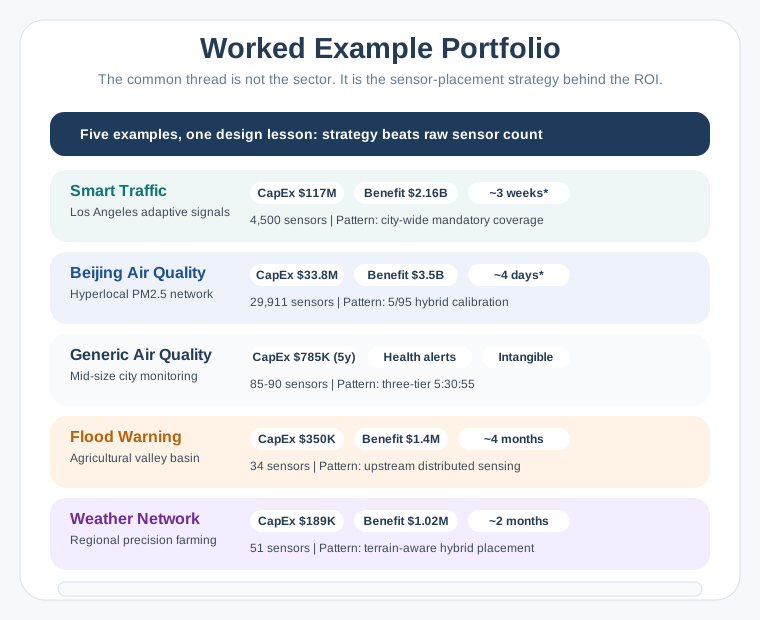
The five worked examples span very different scales, domains, and sensor strategies. These are the key comparisons:
Portfolio comparison showing why deployment strategy, payback assumptions, and sensor placement matter across five IoT examples.
Note: Payback periods marked with assume instantaneous full deployment, which is unrealistic. Real payback accounts for deployment ramp-up and should be 3-5x longer than the theoretical calculation.
Smart traffic in Los Angeles: $117M CapEx, $2.16B annual benefit, about three weeks theoretical payback, 4,500 intersections, and mandatory city-wide deployment.
Air quality in Beijing: $33.8M CapEx, $3.5B annual benefit, about four days theoretical payback, 29,911 sensors, and 5/95 hybrid calibration.
Generic air quality: $785K five-year cost, health-alert benefits, intangible payback, about 85-90 sensors, and a 5:30:55 three-tier strategy.
Flood warning: $350K CapEx, $1.4M annual benefit, about four months payback, 34 sensors, and upstream distributed sensing.
Weather network: $189K CapEx, $1.02M annual benefit, about two months payback, 51 stations or loggers, and terrain-aware hybrid placement.
10.39 Knowledge Check: Cross-Example Analysis
Question 1: Which of the five examples has the MOST reliable payback estimate, and why?
Smart Traffic – because it has the largest benefit
Beijing Air Quality – because health costs are well-documented by WHO
Flood Warning – because flood damage is directly measurable and historically documented
Weather Network – because frost damage is the simplest to quantify
10.40 Answer
c) Flood Warning – because flood damage is directly measurable and historically documented
Flood damage has decades of insurance and disaster relief records providing reliable annual damage estimates. The $2.8M average annual damage figure comes from historical data. In contrast, traffic time savings depend on behavioral assumptions (driver hourly value), air quality benefits depend on epidemiological models (health cost of PM2.5), and weather station benefits aggregate multiple indirect effects. The flood warning example has the shortest chain of assumptions between investment and measurable outcome.
Question 2: What common thread runs through ALL five examples regarding sensor placement?
More sensors always produce better results
The most expensive sensors should be deployed first
Sensor placement strategy matters more than sensor count
Urban deployments always need more sensors than rural ones
10.41 Answer
c) Sensor placement strategy matters more than sensor count
Every example demonstrates that WHERE you place sensors matters more than HOW MANY you deploy: - Traffic: 100% intersection coverage matters more than sensor quality at each intersection - Beijing: Dense grids in high-population corridors matter more than uniform city coverage - Generic city: Tier 1 reference sensors at regulatory sites matter more than Tier 3 spatial density - Flood: Upper catchment placement matters more than adding sensors at the valley floor - Weather: Key-site selection in complex terrain matters more than uniform grid spacing
This is arguably the single most important lesson in IoT network design.
Checkpoint: Placement Strategy
You now know:
Flood warning uses 34 sensors across the catchment because upstream rain and river data creates the 6-10 hour lead time.
The weather example reaches 97.3% frost alert accuracy across 12,000 km^2 with 21 full stations plus 30 temperature loggers.
Across all five examples, critical placement beats uniform density: city-wide intersections, high-population pollution corridors, upstream gauges, and terrain-aware weather sites all matter more than sensor count alone.
Now shift from reading worked examples to manipulating the same assumptions. The calculators below are not price lists; they are rehearsal spaces for coverage, sensor tiers, OpEx, adoption, and rollout timing.
10.42 Concept Relationships
Understanding how the key concepts in IoT cost-benefit analysis relate to each other helps you build complete business cases:
CapEx (capital expenditure): Depends on hardware costs, installation labor, and software licenses. It enables initial deployment, but teams often forget that professional installation can add 20-50% of hardware cost.
OpEx (operating expenditure): Depends on connectivity fees, maintenance, cloud services, and staff. It enables ongoing operations, and over five years it often equals or exceeds CapEx.
Tiered sensor strategy: Depends on location criticality and calibration hierarchy. It enables cost-effective spatial coverage, but it is often confused with “more sensors always means better data.”
Adoption rate: Depends on user behavior, technology access, and training. It determines realized benefits, so theoretical maximum value must be discounted to achievable use.
Payback period: Depends on CapEx and net annual benefit after OpEx. It supports investment justification, but naive calculations often assume instant deployment.
ROI (return on investment): Depends on total benefits, total costs, and discount rate. It supports comparative evaluation, but only when five-year TCO is included.
Spatial correlation distance: Depends on terrain complexity and measurement type. It drives sensor density; weather may correlate across 22 km in flat terrain but only 6 km in mountains.
Reference sensors: Depend on regulatory compliance and calibration accuracy. They make low-cost sensor networks valid; 5-10% of the fleet may carry most of the data-quality burden.
How These Concepts Work Together:
Start with benefits quantification (what measurable outcome justifies investment?)
Design tiered sensor strategy (match sensor quality to location criticality)
Minimum 3 reference sensors: Always deploy at least 3 for calibration redundancy
Terrain matters: Complex terrain needs 11x more sensors than flat terrain for same area coverage
Cost savings: Tiered approach typically achieves 75-90% cost reduction vs. all-reference deployment
What to Observe:
How terrain complexity dramatically affects sensor count
Why the tiered strategy saves money while maintaining data quality
The importance of maintaining reference sensors even when over budget
10.45 Inline Concept Check: Mid-Chapter Review
Question 1: You’re evaluating two IoT projects with identical CapEx ($500K) and annual benefits ($200K). Project A has $20K/year OpEx, Project B has $80K/year OpEx. What are the payback periods?
Both have the same payback period because CapEx is identical
Project A: 2.5 years, Project B: 3.1 years
Project A: 2.8 years, Project B: 4.2 years
Cannot determine without knowing deployment timeline
c) Project A: 2.8 years, Project B: 4.2 years
Calculation:
Project A: Net annual benefit = $200K - $20K = $180K. Payback = $500K / $180K = 2.78 years
Project B: Net annual benefit = $200K - $80K = $120K. Payback = $500K / $120K = 4.17 years
OpEx dramatically affects payback even when CapEx and gross benefits are identical. This is why OpEx is often the forgotten element that sinks IoT business cases.
Question 2: An air quality network proposal suggests deploying 100 identical $5,000 reference-grade sensors in a uniform grid. Based on the worked examples, what’s the primary flaw in this approach?
100 sensors are not enough for city-scale coverage
Uniform grid placement ignores location criticality and lacks the tiered strategy (5% reference, 95% low-cost) that provides both accuracy and spatial coverage
Reference-grade sensors are too expensive to use in large quantities
Air quality networks should use mobile sensors on buses, not fixed stations
b) Uniform grid placement ignores location criticality and lacks the tiered strategy (5% reference, 95% low-cost) that provides both accuracy and spatial coverage
The Beijing example shows that a 5% reference / 95% low-cost hybrid approach reduces hardware costs by 85% while maintaining data quality through calibration. The uniform grid of expensive sensors wastes money on spatial coverage that could be achieved with low-cost sensors, while the lack of location prioritization (schools, hospitals, industrial boundaries) means critical areas may not have adequate instrumentation.
10.46 Interactive ROI Calculator
Calculate the return on investment for your own IoT deployment using the framework from this chapter.
This interactive tool applies the CapEx/OpEx/Benefit framework from the worked examples:
Select or create a project type - Presets load typical values, or use “Custom”
Adjust the sliders to match your project’s costs and benefits
Watch the metrics update in real-time to see payback period, ROI, and viability
Pay special attention to:
The difference between theoretical and actual payback (deployment timeline matters!)
How adoption rate dramatically affects net benefits
The benefit-cost ratio (3:1 or higher indicates strong projects)
Common Patterns:
If payback > 3 years, the project may struggle to get funding approval
If OpEx > 20% of CapEx annually, look for ways to reduce ongoing costs
If adoption rate < 15%, invest in user training and change management
10.48 Build an IoT Business Case
Scenario: Your city (population 250,000) wants to deploy a smart parking system across downtown (800 parking spaces in 12 multi-level garages). Real-time availability data reduces circling time by an average of 8 minutes per parker.
Average daily parkers: 2,400 (workdays), 1,800 (weekends)
Driver hourly value: $27
Fuel cost savings: $0.85 per avoided circling event
Annual operating days: 260 workdays + 105 weekend days
Your Task (Step-by-Step):
Calculate CapEx:
Sensors: _________ x $125 = $_________
Gateways: _________ x $2,400 = $_________
Installation: _________ x $45 = $_________
Total CapEx: $_________
Calculate Annual OpEx:
Connectivity: _________ x $8 x 12 = $_________/year
Cloud platform: $_________/year
Sensor replacement: _________ x 12% x $125 = $_________/year
Total OpEx: $_________/year
Calculate Annual Time Savings:
Workday savings: _________ parkers x 8 min x 260 days / 60 = _________ hours
Weekend savings: _________ parkers x 8 min x 105 days / 60 = _________ hours
Total annual hours saved: _________
Dollar value: _________ x $27 = $_________
Calculate Fuel Savings:
Annual parking events: (_________ x 260) + (_________ x 105) = _________
Fuel savings: _________ x $0.85 = $_________
Compute ROI:
Total annual benefit: Time + Fuel = $_________
Net annual benefit: $_________ - $_________ (OpEx) = $_________
Payback period: $_________ (CapEx) / $_________ = _________ years
What to Observe:
Is your payback period under 3 years? (Typical threshold for municipal projects)
What percentage of total 5-year costs is OpEx vs. CapEx?
If the city only deployed sensors in 6 of 12 garages (50% coverage), how would that affect the benefit calculation?
10.49 Solution
CapEx:
Sensors: 800 x $125 = $100,000
Gateways: 12 x $2,400 = $28,800
Installation: 800 x $45 = $36,000
Total CapEx: $164,800
Annual OpEx:
Connectivity: 12 x $8 x 12 = $1,152/year
Cloud platform: $15,000/year
Sensor replacement: 800 x 12% x $125 = $12,000/year
Total OpEx: $28,152/year
Annual Time Savings:
Workday savings: 2,400 x 8/60 x 260 = 83,200 hours
Weekend savings: 1,800 x 8/60 x 105 = 25,200 hours
Total: 108,400 hours
Dollar value: 108,400 x $27 = $2,926,800
Fuel Savings:
Annual events: (2,400 x 260) + (1,800 x 105) = 813,000
Fuel savings: 813,000 x $0.85 = $691,050
ROI:
Total benefit: $2,926,800 + $691,050 = $3,617,850
Net benefit: $3,617,850 - $28,152 = $3,589,698
Payback period: $164,800 / $3,589,698 = 0.046 years = 17 days
Key Insights:
Smart parking has extreme ROI because it addresses a daily pain point for thousands of people
OpEx ($28K/year) is only 17% of CapEx, much lower than typical IoT projects (where OpEx often equals CapEx over 5 years)
5-year TCO: $164,800 + ($28,152 x 5) = $305,560, vs. 5-year benefits of $18,089,250 = 59x return
Checkpoint: Build Your Own Case
You now know:
The calculator section turns the same framework into adjustable inputs: coverage area, terrain, sensor tiers, CapEx, OpEx, adoption rate, and deployment months.
The parking exercise shows a complete row-by-row case: 800 sensors, 12 gateways, installation labor, connectivity, cloud platform, replacement, time savings, fuel savings, and payback.
A 17-day theoretical parking payback is still a prompt to check coverage, adoption, rollout timing, and OpEx before presenting the number as a budget promise.
10.50 Interactive Quiz: Match Concepts
10.51 Interactive Quiz: Sequence the Steps
10.52 Label the Diagram
10.53 Code Challenge
10.54 Summary
10.54.1 Key Takeaways
These five worked examples demonstrate a consistent analytical framework for evaluating IoT deployments across very different domains:
The CapEx/OpEx/Benefit framework applies universally. Every IoT business case needs all three components quantified before calculating ROI. Omitting OpEx (the most commonly forgotten element) produces dangerously optimistic projections.
Tiered sensor strategies are almost always superior to uniform deployments. Whether the tiers are reference-vs-low-cost (air quality), full-station-vs-loggers (weather), or upstream-vs-downstream (flood), the principle is the same: invest more per unit at critical locations, less per unit for spatial coverage.
Adoption rate is the biggest variable in benefit calculations. The Beijing example shows a 6.7x difference between theoretical maximum ($17.4B) and achievable benefit ($2.61B) based solely on adoption rate (15%). Always discount theoretical benefits by realistic adoption curves.
Deployment ramp-up invalidates naive payback calculations. The traffic example’s “19.7-day payback” assumes instant deployment of 4,500 intersections. Real deployments take 12-24 months, stretching payback to 18-30 months. Always model the deployment timeline in your financial projections.
Sensor placement strategy trumps sensor count. In every example, WHERE sensors are placed matters more than HOW MANY are deployed. This is the core design skill for IoT network engineers.
10.54.2 Common Patterns Across Examples
Hybrid sensor tiers: Air quality, weather, and flood examples all use high-accuracy anchors plus lower-cost coverage. A useful starting rule is 5-10% high-accuracy anchors and 90-95% lower-cost coverage.
Coverage versus precision: Traffic and air-quality examples show that full coverage at lower precision can beat partial coverage at high precision.
Placement over quantity: Flood and weather networks depend on expert site selection more than uniform grid spacing.
Realistic benefit discounting: Every example must multiply theoretical maximum value by a realistic adoption rate, often 10-30%.
OpEx discipline: Recurring costs often equal or exceed CapEx over the project life, so plan for five-year TCO instead of Year 1 hardware.
10.55 Apply IoT Patterns
When building your own IoT business case:
Start with the benefit, not the technology. What measurable outcome justifies the investment?
Identify the critical sensing locations through domain expertise, not uniform grids.
Design a tiered sensor strategy matching sensor quality to location criticality.
Calculate 5-year TCO including OpEx, not just CapEx.
Discount benefits by realistic adoption rates – typically 15-30% for public-facing systems.
Model the deployment timeline and compute payback from project start, not from full deployment.
10.56 Knowledge Check
10.57 Quiz: IoT Worked Examples
10.58 Sensor Density Misconception
“More sensors always produce better data quality.”
This is one of the most expensive assumptions in IoT network design. The worked examples in this chapter demonstrate the opposite: strategic sensor placement matters more than sensor count.
Real Case Study: Municipal Air Quality Network Failure
A mid-size city (population 600,000) deployed 200 identical air quality sensors in a uniform 1km grid across the city, believing “maximum coverage” would provide the best data.
The Deployment:
200 sensors × $800 each = $160,000 hardware
Installation: $40,000
5-year connectivity: $60,000
Total investment: $260,000
What Went Wrong:
After 18 months, an independent audit revealed:
Industrial hotspots undersampled: The city’s 3 industrial zones (12% of area, 65% of pollution) had the same sensor density as residential parks. Result: pollution peaks went undetected because sensors were too far from emission sources.
Residential areas oversampled: 88 sensors in low-variability residential zones generated nearly identical readings. 70 of these sensors could have been removed with <5% impact on data quality.
Calibration impossible: All 200 sensors were the same low-cost model ($800). With no reference-grade sensors for calibration, measurements drifted 15-30% over 12 months, making the data unreliable for health alerts.
Missed critical locations: Schools, hospitals, and highways (where vulnerable populations concentrate) received no special instrumentation.
DO: Install reference sensors in Month 1, calibrate low-cost sensors before relying on their data
Test Your Understanding:
If you have a $200K budget for an IoT sensor network, which approach is better?
250 sensors at $800 each
5 sensors at $15K + 30 sensors at $3K + 50 sensors at $800 = 85 sensors total
The answer depends on your domain, but B is almost always superior because it provides the calibration anchors and location prioritization that A completely lacks. Fewer sensors, thoughtfully placed and tiered, outperform many sensors uniformly distributed.
10.59 What’s Next
Next:Common Pitfalls covers mistakes that kill IoT projects and how to avoid them.
 Checkpoint: Cost Model Shape