If you only have 5 minutes, here is what matters most:
IoT pricing is not just hardware markup – the real revenue comes from software subscriptions and data services that follow the initial device sale
Network effects create winner-take-most outcomes – early user base often matters more than early profits; platforms with 5x more users attract exponentially more developers and integrations
Use hybrid open/proprietary strategies – open at the commodity layer (connectivity protocols like MQTT and Matter) and proprietary at the value layer (AI models, analytics, user experience)
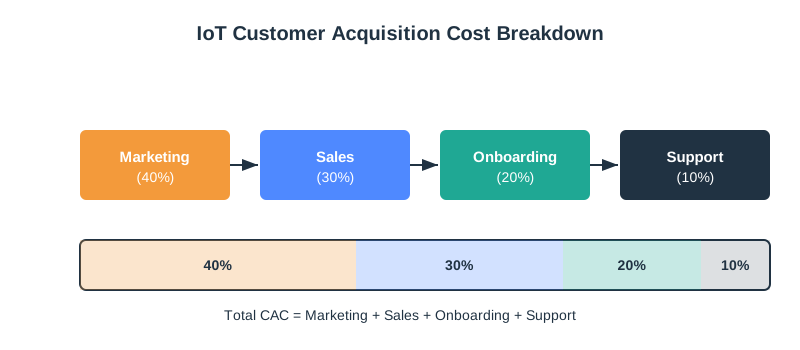
Target LTV:CAC > 3:1 – if you spend $180 acquiring a customer, their lifetime value should exceed $540 to build a sustainable business
One sentence to remember: Price your IoT product based on the ongoing value it creates, not the cost of the hardware inside it.
For Beginners: Pricing Your IoT Product
Common pricing strategies:
Strategy
When to Use
Example
Premium pricing
Unique features, clear value
+50% price for “smart” version
Freemium
Need user base, network effects
Free basic tier, paid analytics
Subsidized hardware
Want ecosystem lock-in
Echo sold below cost for Alexa revenue
Outcome-based
Enterprise, measurable results
Pay only when savings achieved
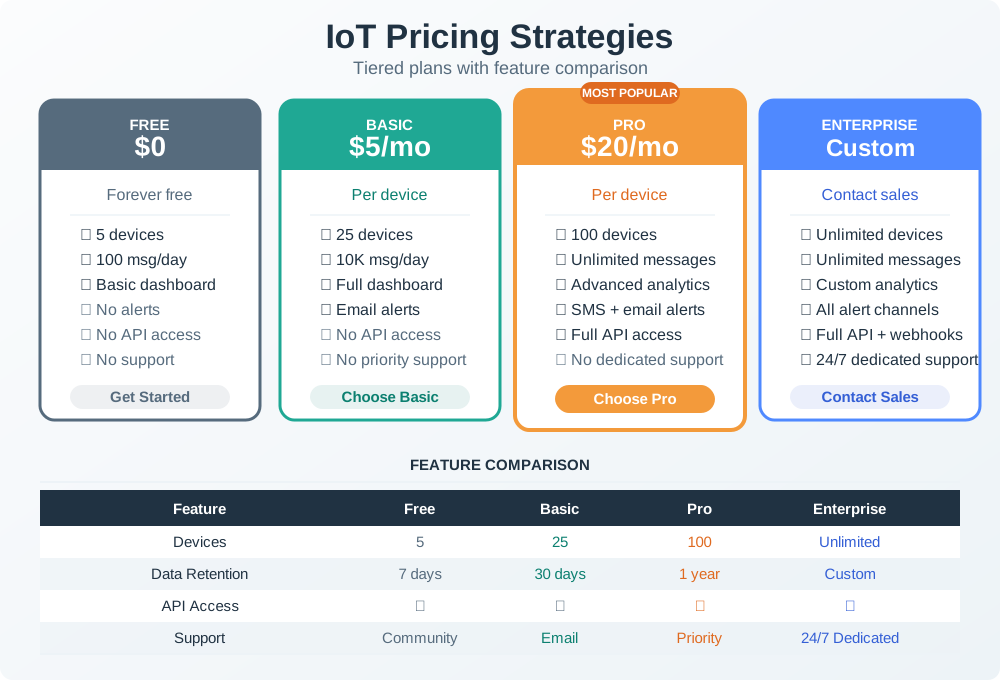
Subscription tier example:
Tier
Price
Features
FREE
$0
Device app, local only, no cloud
BASIC
$10/month
Cloud storage, 7-day history, email alerts
PRO
$30/month
AI insights, unlimited history, priority support
Key insight: Network effects mean early market share is critical. In many IoT markets, there will be only 1-3 major winners. Sometimes losing money early to build users is the right strategy.
48.2 Pricing Strategies
⏱️ ~10 min | ⭐⭐ Intermediate | 📋 P03.C05.U04
IoT Pricing Strategies Overview
Figure 48.1
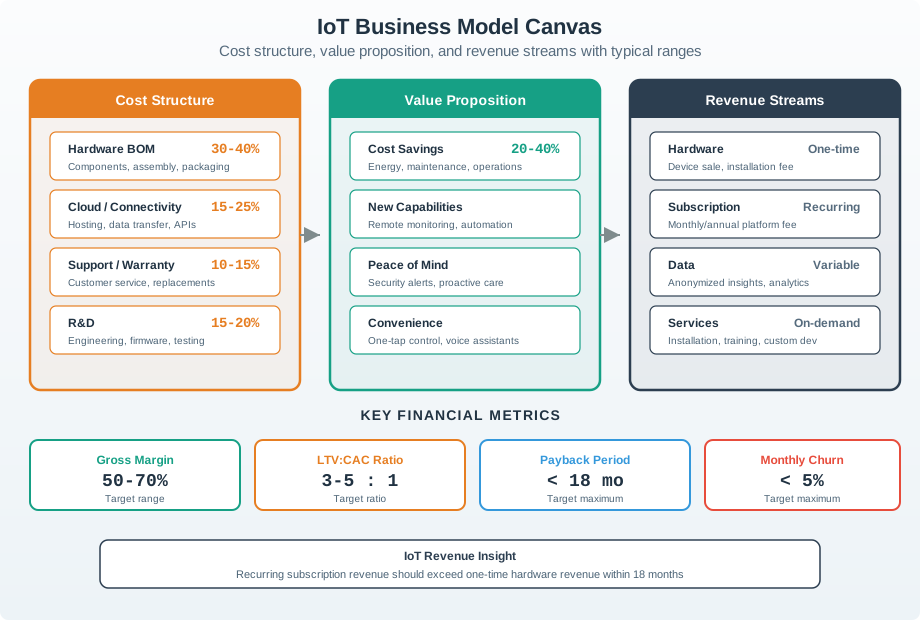
IoT Business Model Canvas showing three main sections flowing left to right. Cost Structure section (orange): Hardware BOM 30-40%, Cloud/Connectivity 15-25%, Support/Warranty 10-15%, R&D 15-20%. Value Proposition section (teal): Cost Savings 20-40%, New Capabilities, Peace of Mind, Convenience. Revenue Streams section (navy): Hardware One-time, Subscription Recurring, Data Variable, Services On-demand. Bottom section Key Financial Metrics (gray): Gross Margin Target 50-70%, LTV:CAC Ratio Target 3-5:1, Payback Period Target less than 18 months, Monthly Churn Target less than 5%.
Figure 48.2: Alternative view: IoT Business Model Canvas with Typical Ranges - This diagram adapts the Business Model Canvas framework specifically for IoT products, showing typical percentage ranges for costs and target metrics. Cost structure (orange) breaks down where money goes: hardware BOM, cloud services, support, and R&D. Value proposition (teal) shows what customers actually pay for: savings, new capabilities, peace of mind, and convenience. Revenue streams (navy) show the four main monetization channels. The metrics row (gray) provides industry benchmarks. Students can use this as a template when evaluating or designing IoT business models.
Interactive Tool: Total Cost of Ownership Calculator
Calculate the full 3-year TCO for your IoT product to ensure accurate pricing.
Key Insight: If cloud costs (\({totalCloudCost.toFixed(2)}) exceed hardware costs (\){hardwareCost.toFixed(2)}), your pricing model must account for ongoing operational expenses, not just hardware markup.
How It Works: Time-of-Use Dynamic Pricing
The big picture: Dynamic pricing adjusts rates based on real-time supply and demand. Unlike static pricing ($0.30/kWh flat rate), time-of-use pricing charges different rates for different time periods to shift demand away from peak hours.
Step-by-step breakdown:
Define Time Periods (based on grid load data): Off-peak 10 PM-6 AM, shoulder 6-10 AM and 6-10 PM, peak 10 AM-6 PM - Real example: California’s PG&E uses these three periods for residential EV charging
Set Price Ratios (3x differential): Off-peak $0.15/kWh, shoulder $0.25/kWh, peak $0.45/kWh - Real example: 3x spread is industry standard based on utility studies showing 15-25% demand shift
Publish 24 Hours Ahead (predictability): Tomorrow’s rates visible today in app, email, and SMS notifications - Real example: ChargePoint shows next-day pricing at 6 PM daily
Automate Charging (user convenience): Car charges automatically when rates drop below threshold, app shows cost savings vs. peak - Real example: Tesla’s charging scheduler saved users $180/year average in 2024
Why this matters: A user charging 50 kWh per week at peak ($0.45) pays $1,170/year. Same usage shifted to off-peak ($0.15) costs $390/year - saving $780 (67% reduction). The price signal alone shifts 20% of demand without requiring new infrastructure.
Putting Numbers to It: Time-of-Use Savings Impact
Given: EV charging 50 kWh/week, peak vs off-peak rates
Grid-scale impact: If 20% of 1M EVs shift from peak to off-peak, that’s 200K × $780 = $156M annual consumer savings while reducing peak grid stress by ~2,600 MW (equivalent to avoiding one $3B power plant).
48.3 Dynamic Pricing Framework
Most IoT products launch with fixed pricing – a monthly subscription or a per-device fee. But IoT systems generate real-time data about demand, usage patterns, and environmental conditions that can unlock a more sophisticated approach: dynamic pricing.
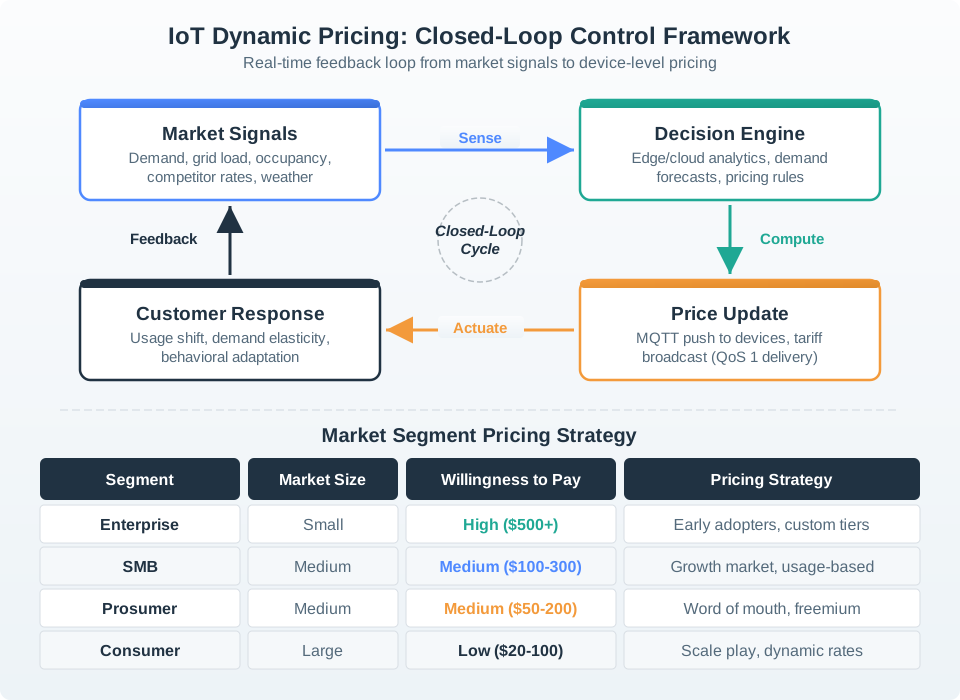
Instead of static prices, dynamic pricing adjusts rates based on real-time conditions. Think of this as a closed-loop control system (the same feedback loop concept from control theory, applied to economics):
The practical implementation lives where business metrics meet device control:
Networking chapters explain how to push those updated tariffs to devices securely (MQTT QoS 1 ensures delivery).
Edge and cloud analytics chapters show how to run the demand forecasts that feed the decision engine.
This chapter gives you the business logic for deciding when dynamic pricing adds value rather than just confusing users.
48.3.1 When Dynamic Pricing Works
Dynamic pricing is not universally appropriate. It works best when supply and demand fluctuate significantly and customers can adjust their behavior in response to price signals.
Use Case
Why It Works
Example
EV Charging
Time-of-use rates align with grid capacity
$0.15/kWh off-peak vs $0.45/kWh peak
Industrial Equipment
Demand varies, capacity is fixed
Per-cycle pricing based on queue depth
Cloud Services
Resource utilization drives costs
Spot pricing for compute resources
Ride Sharing
Supply/demand imbalances create surges
Surge pricing during high demand
Smart Parking
Occupancy varies by time and location
$1/hr downtown peak vs $0.25/hr off-peak
48.3.2 When to Avoid Dynamic Pricing
Not every IoT product should use dynamic pricing. The following conditions make it a poor fit:
Behavioral Economics: Price signals alone (no physical constraints) shift behavior. Users respond to loss aversion (avoiding higher peak rates) more than gain seeking (earning off-peak discounts).
48.4 Market Dynamics and Competition
⏱️ ~12 min | ⭐⭐⭐ Advanced | 📋 P03.C05.U05
48.4.1 Network Effects
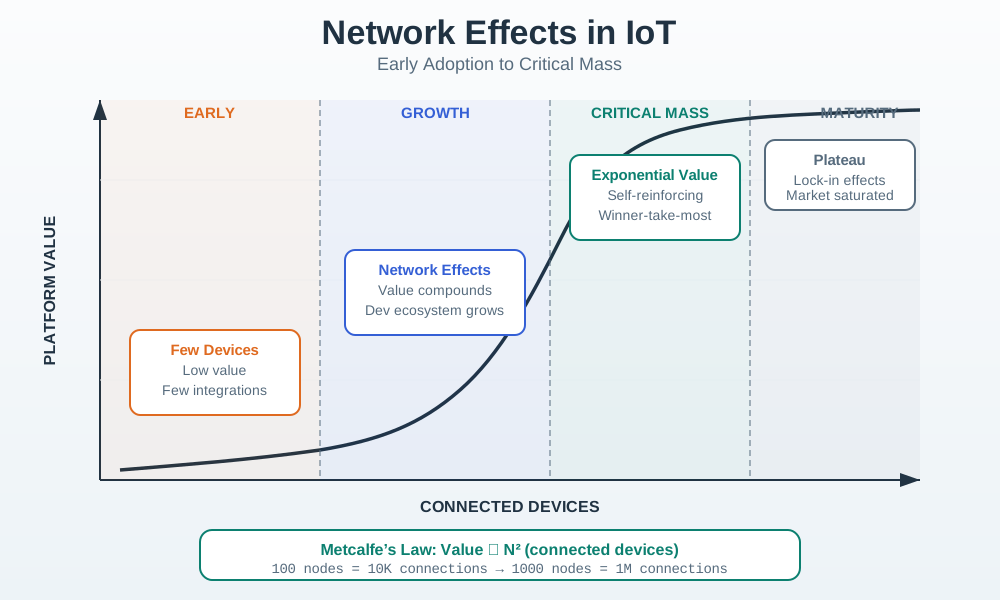
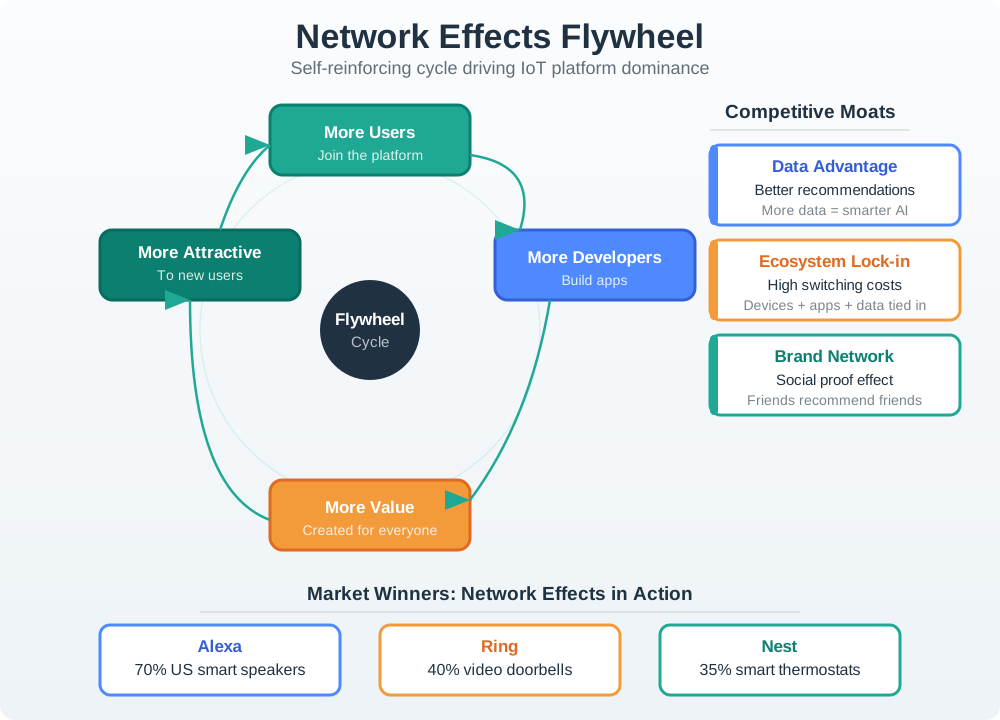
Network effects are the single most powerful force in IoT market dynamics. When each additional user makes the product more valuable for all existing users, the result is a self-reinforcing growth cycle that creates “winner-take-most” markets. Understanding this dynamic is essential for pricing strategy because it often justifies early-stage losses in exchange for long-term market dominance.
Network Effects in IoT Platforms
Figure 48.3
Network effects flywheel diagram showing self-reinforcing cycle. Flywheel section shows circular flow: More Users Join Platform leads to More Developers Build Apps leads to More Value Created leads to More Attractive to New Users which leads back to More Users. Competitive Moats section shows three outcomes: Data Advantage with better recommendations, Ecosystem Lock-in with switching costs, and Brand Network with social proof. Examples section shows market winners: Alexa 70% US smart speakers, Ring 40% video doorbells, Nest 35% smart thermostats.
Figure 48.4: Alternative view: Network Effects Flywheel - This diagram shows network effects as a self-reinforcing flywheel rather than linear phases. More users attract more developers who create more value that attracts more users - a virtuous cycle. The flywheel creates three competitive moats: data advantages for better recommendations, ecosystem lock-in increasing switching costs, and brand network effects through social proof. Real winners like Alexa (70% US smart speaker share), Ring (40% video doorbells), and Nest (35% smart thermostats) demonstrate how early network effects lead to market dominance. Students can see why first-mover advantage matters in IoT platforms.
Value increases as more users join the platform, creating winner-take-all or winner-take-most markets. Example: Smart home ecosystems become more valuable as more devices and integrations are available.
Monetization implications:
Early market share critical for long-term success
May justify initial loss leaders to build network
Pricing power increases with market dominance
48.4.2 Switching Costs
Once a customer adopts your IoT platform, the effort and expense required to change creates both technical and psychological barriers. For monetization, switching costs are a double-edged sword: they protect revenue from existing customers but can deter new customers who fear lock-in.
Sources of switching costs in IoT:
Switching Cost Type
What the Customer Loses
Typical Impact
Data migration
Historical sensor data, trained ML models, custom dashboards
API connections, automation rules, third-party links
Weeks of engineering time
Learning curve
Team familiarity, trained operators, documented processes
3-6 months productivity dip
Regulatory recertification
Compliance documentation, audit trails
$10K-100K+ in regulated industries
Real-world example: A factory running 500 temperature sensors on Platform A faces an estimated $200K switching cost to Platform B (reinstallation labor + data migration + 3 months of dual-system operation + retraining). Even if Platform B saves $50K/year, the payback on switching alone is 4 years – which effectively locks in the customer.
Strategic implication: Build switching costs through value (deep integrations, rich historical data, trained models) rather than friction (proprietary connectors, data export restrictions). Value-based lock-in creates loyalty; friction-based lock-in creates resentment and regulatory risk.
48.4.3 Commoditization Risk
IoT hardware is rapidly commoditizing. An ESP32 module costs $2-4; generic temperature sensors cost under $1. When hardware becomes indistinguishable, price competition drives margins to near zero. The companies that thrive are those that differentiate through software, services, and data – layers that are harder to replicate.
Commoditization Defense Ladder
Use this ladder to decide where your IoT product should compete:
Commodity layer: hardware and basic connectivity. ESP32 modules, temperature sensors, Wi-Fi, MQTT, and CoAP are easy for competitors to copy. Compete here only when cost, supply chain, or certification is your advantage.
Service layer: cloud operations and device management. Reliable updates, monitoring, onboarding, and support justify recurring fees because customers pay for lower operational risk.
Insight layer: analytics, automation, and user experience. This is where margins are strongest. Trained models, historical data, workflow integration, and polished interfaces are difficult to clone quickly.
Pricing implication: keep commodity layers open and efficient, then charge for the service and insight layers where the customer sees continuing value.
Defensive strategies against commoditization:
Continuous software innovation – Regular OTA updates with new features keep the product fresh and justify ongoing subscriptions (Nest adds new energy-saving algorithms quarterly)
Unique data analytics – Two years of historical sensor data trained on your ML models is not something a competitor can replicate overnight
Superior user experience – Apple charges premium prices partly because HomeKit’s UX is more polished than open alternatives
Ecosystem depth – The more devices and integrations in your ecosystem, the harder it is for any single competitor to replicate the full experience
Brand trust – In safety-critical IoT (medical, industrial), brand reputation and regulatory track record command premium pricing
48.4.4 Open vs. Proprietary
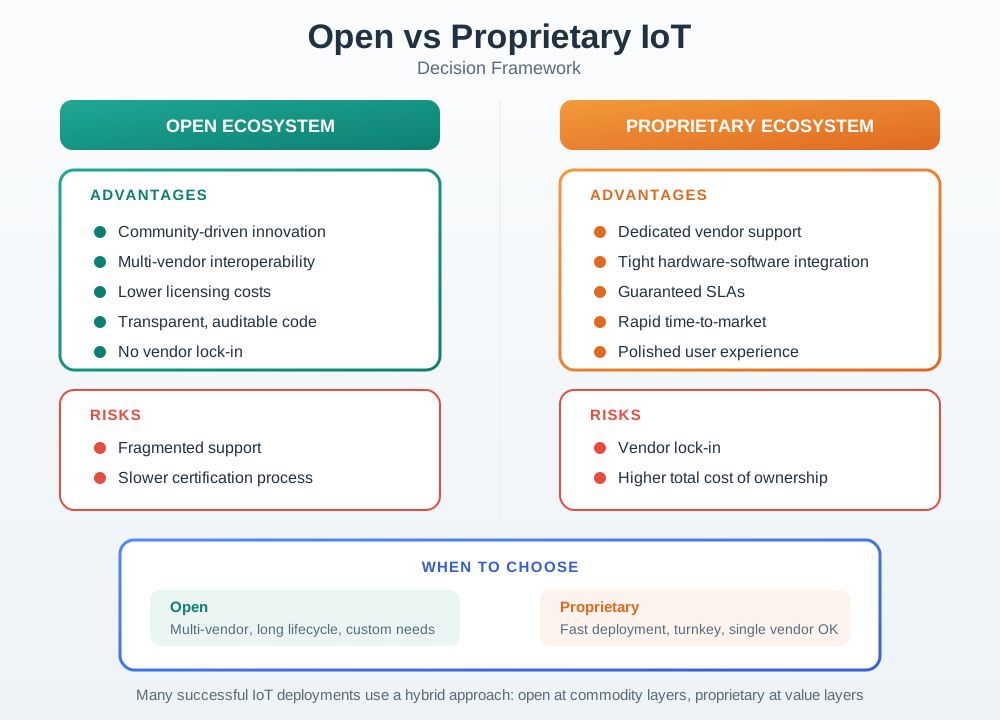
One of the most consequential strategic decisions in IoT is which technology layers to open and which to keep proprietary. Open too much and you cannot capture value; close too much and you cannot build an ecosystem. The diagram below shows the traditional open/proprietary decision framework.
Flowchart diagram
Figure 48.5
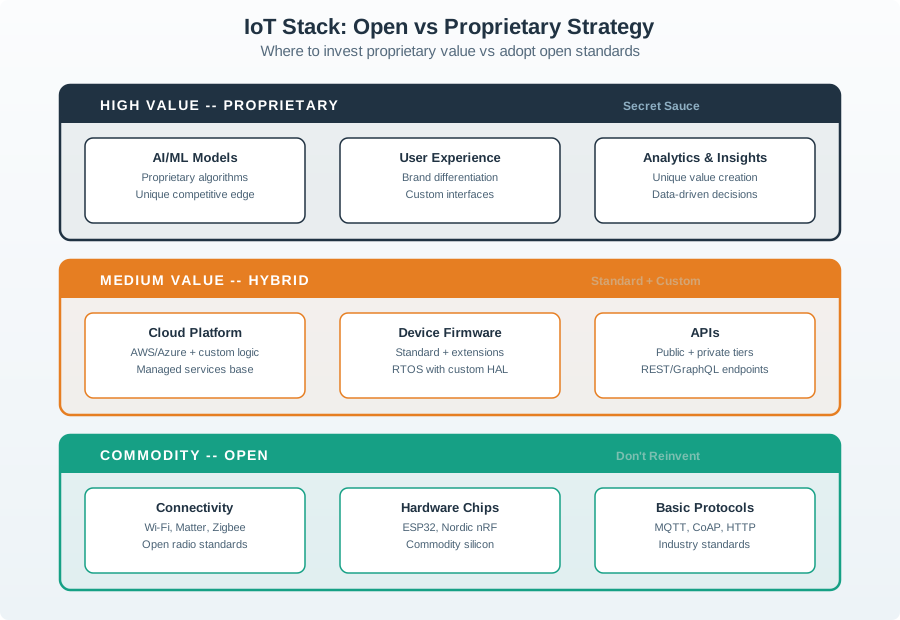
The alternative view below maps this decision to the IoT technology stack, showing that the answer depends on which layer you are deciding about.
Three-layer IoT technology stack showing open vs proprietary strategy. Top layer High Value - PROPRIETARY (navy): AI/ML Models as secret sauce, User Experience for brand differentiation, Analytics and Insights for unique value. Middle layer Medium Value - HYBRID (orange): Cloud Platform using AWS/Azure plus custom, Device Firmware with standard plus extensions, APIs with public plus private tiers. Bottom layer Commodity - OPEN (teal): Connectivity using Wi-Fi Matter Zigbee, Hardware Chips like ESP32 Nordic, Basic Protocols like MQTT CoAP.
Figure 48.6: Alternative view: IoT Stack - Where to Be Open vs Proprietary - This layered diagram shows the strategic decision of openness as a function of the technology stack. Bottom layer (commodity, teal): Connectivity protocols (Wi-Fi, Matter, Zigbee), hardware chips (ESP32, Nordic), and basic protocols (MQTT, CoAP) should be open - competing here wastes resources. Middle layer (hybrid, orange): Cloud platform, device firmware, and APIs use standard components with custom extensions. Top layer (high value, navy): AI/ML models, user experience, and analytics should be proprietary - this is your “secret sauce” and source of competitive advantage. Students can map any IoT product to this stack to identify where to invest vs. standardize.
Open approach (e.g., Zigbee, Z-Wave, Matter): - Accelerates ecosystem growth - Reduces customer concerns about lock-in - Harder to capture value long-term
Proprietary approach (e.g., Apple HomeKit): - Greater control over ecosystem and monetization - Can optimize entire stack for performance - Risk of being displaced by open alternatives
Hybrid strategies often most effective: - Open at commodity layers (connectivity, basic protocols) - Proprietary at value-add layers (analytics, AI, unique features)
48.5 Monetization Challenges and Best Practices
⏱️ ~10 min | ⭐⭐ Intermediate | 📋 P03.C05.U06
Even with a sound pricing strategy, IoT companies face recurring challenges that can undermine monetization. The four challenges below appear in nearly every IoT business – understanding them helps you build defenses into your pricing model from the start.
48.5.1 Demonstrating ROI
Challenge: IoT value is often indirect, delayed, or distributed across multiple departments. A factory manager may see sensor data but struggle to quantify how much downtime it prevented.
Solutions:
Approach
How It Works
Example
ROI Calculator
Web tool that estimates savings based on customer inputs
“Enter your downtime cost per hour and number of machines – see projected savings”
Pilot Program
30-90 day trial with measurable KPIs agreed in advance
“We reduced unplanned downtime by 23% across 50 machines during the pilot”
Case Studies
Quantified before/after metrics from real customers
“Customer X saved $1.2M/year in energy costs using our HVAC optimization”
Risk-Sharing
Pricing tied to measured outcomes
“Pay 20% of documented savings – if we save you nothing, you pay nothing”
The ROI demonstration problem is especially acute in IoT because benefits often cross organizational boundaries. Energy savings benefit the facilities team, while the IT team bears the implementation cost. Successful IoT vendors help customers build internal business cases that address all stakeholders.
48.5.2 Balancing Privacy and Monetization
Challenge: The more granular the data you collect, the more monetization opportunities exist – but also the greater the privacy risk. Smart home energy data reveals when occupants are home, their sleep patterns, and daily routines. Selling or misusing this data destroys trust.
Solutions (from least to most privacy-preserving):
Transparent data policies – Tell users exactly what you collect and why; consent must be informed and specific
Meaningful user controls – Let users opt out of specific data uses without losing core product functionality
Anonymization and aggregation – Sell insights about 10,000 homes, not individual household patterns
Federated learning – Train ML models on-device so raw data never leaves the customer’s network
Differential privacy – Add mathematical noise to datasets so individual records cannot be re-identified
Privacy Pitfall
Nest Thermostat controversy (2014): When Google acquired Nest for $3.2B, users feared their home data would be used for advertising. Even though Google initially promised data separation, the perception of privacy invasion caused significant backlash. The lesson: privacy perception matters as much as technical reality. Build privacy into your monetization model from Day 1, not as an afterthought.
48.5.3 Managing Price Transitions
Challenge: Moving from free to paid or changing pricing models risks alienating your user base. The most dangerous moment in an IoT company’s life is when it starts charging for something that was previously free.
Best practices for price transitions:
Grandfather existing users at current pricing for 12-24 months – they are your early adopters and word-of-mouth engine
Clearly communicate added value before the price change takes effect (“Here are the 5 new features you get for the new price”)
Phase in gradually – move from free to $5/month before jumping to $15/month
Provide 60-90 day notice – surprise price changes trigger the highest churn rates
Offer annual discounts – lock in committed users before the transition
48.5.4 Scaling Economics
Challenge: Unit economics must improve with scale, but many IoT businesses discover that cloud costs and customer support scale linearly while revenue growth plateaus.
Critical metrics and healthy targets:
Metric
Healthy Target
Warning Sign
How to Improve
LTV:CAC Ratio
> 3:1
< 2:1
Reduce churn, increase ARPU, lower CAC
Gross Margin
50-70% (software)
< 40%
Shift revenue mix toward services
Monthly Churn
< 3%
> 5%
Improve onboarding, add engagement features
CAC Payback
< 12 months
> 18 months
Optimize marketing channels, improve conversion
Net Revenue Retention
> 110%
< 90%
Upsell existing customers, reduce downgrades
Interactive Tool: LTV and Unit Economics Calculator
Calculate customer lifetime value and assess business health with key SaaS metrics.
Key Insight: Reducing churn from % to 3% increases LTV by %. Small improvements in retention have outsized impact on unit economics.
Sensor Squad: How Do IoT Companies Make Money?
Sammy the Sensor says: “Hey kids! Have you ever wondered how smart devices make money? Let me explain with a lemonade stand!”
The Lemonade Stand Story:
Imagine you build a super-smart lemonade stand. The stand itself costs you $50 to build (that is like the IoT hardware). But the real magic is the app on your tablet that:
Tells you when to make more lemonade (before the rush!)
Shows which flavors sell best on hot days
Sends your parents a report of how much you earned
Here is the pricing secret: You do not just sell lemonade for $1 a cup. You also charge other kids $5/month to use your smart lemonade app at THEIR stands! That monthly fee (called a “subscription”) is where the REAL money comes from.
Why does this work?
The stand (hardware) you sell once – $50, done
But the app (software) earns you $5 every single month, forever!
After 10 months: $50 from the app > $50 from the stand
Lila the Light adds: “And here is the cool part – the more kids who use the app, the better it gets! It learns from ALL the stands what flavors sell best. That is called a ‘network effect’ – more users = more value for everyone!”
Try This at Home: Think of a smart device in your house (like a smart speaker or thermostat). Does your family pay a monthly fee for it? What features does that fee unlock?
Concept Check: LTV Optimization Strategies
48.6 Concept Relationships
Concept
Builds On
Leads To
Related Modules
Dynamic Pricing
Market supply/demand curves, price elasticity
Revenue optimization, demand shaping
Transport Protocols (congestion pricing analogy), Edge Computing (real-time decision making)
Adding too many features before validating core user needs wastes weeks of effort on a direction that user testing reveals is wrong. IoT projects frequently discover that users want simpler interactions than engineers assumed. Define and test a minimum viable version first, then add complexity only in response to validated user requirements.
2. Neglecting Security During Development
Treating security as a phase-2 concern results in architectures (hardcoded credentials, unencrypted channels, no firmware signing) that are expensive to remediate after deployment. Include security requirements in the initial design review, even for prototypes, because prototype patterns become production patterns.
3. Ignoring Failure Modes and Recovery Paths
Designing only for the happy path leaves a system that cannot recover gracefully from sensor failures, connectivity outages, or cloud unavailability. Explicitly design and test the behaviour for each failure mode and ensure devices fall back to a safe, locally functional state during outages.
Label the Diagram
💻 Code Challenge
48.7 Summary
48.7.1 Key Takeaways
Concept
Key Insight
Number to Remember
Total Cost of Ownership
Cloud costs often exceed hardware costs over device lifetime
Hardware 30-40%, Cloud 15-25% of TCO
Dynamic Pricing
Works when supply/demand fluctuate and customers can adjust behavior
3x price differential shifts 15-25% of demand
Network Effects
Early user base matters more than early profits in platform markets
5x users = exponentially more developers
Open vs. Proprietary
Open commodity layers, protect value layers
Bottom = open, Top = proprietary
Switching Costs
Build lock-in through value, not friction
$200K+ typical factory platform switch
Unit Economics
LTV must justify acquisition spend
LTV:CAC target > 3:1
Churn Management
Small churn improvements have outsized LTV impact
4% to 3% monthly churn = 33% LTV increase
48.7.2 Formulas to Remember
TCO = Hardware + (Cloud x Months) + (Support x Years) + R&D allocation
This chapter covers pricing & market dynamics, explaining the core concepts, practical design decisions, and common pitfalls that IoT practitioners need to build effective, reliable connected systems.
Result:
Tiered pricing generates $413.80 vs $293.20 = +41% higher LTV
Pro tier customers (20%) contribute 60% of subscription revenue despite being the smallest segment
Free tier (25%) still generates hardware margin and creates ecosystem lock-in
Key Insight:
The tiered approach succeeds because:
Value-based segmentation: Commercial users willingly pay 4x for features they need (API, multi-site)
Friction-free entry: Free tier eliminates subscription hesitation for price-sensitive buyers
Upgrade path: Users start Free, upgrade to Standard when they see value, some graduate to Pro
No revenue cannibalization: The flat $8 tier would under-monetize commercial customers while over-pricing casual users
Decision Rule: Use tiered pricing when:
Customer willingness-to-pay varies by >3x between segments
Features can be clearly differentiated by value (not just limits)
Support costs scale with tier (avoid giving expensive support to low-paying customers)
Try It Yourself: Design a Three-Tier Pricing Model
Time: 30 minutes | Difficulty: Intermediate | Challenge: Design subscription tiers for a real IoT product
Scenario: You are launching a smart air quality monitor for homes. The device costs $89, cloud costs $0.60/device/month, and you have identified three customer segments:
Health-Conscious (40%): Want real-time alerts for poor air quality, willing to pay for peace of mind
Data Enthusiasts (35%): Want historical trends, correlations with outdoor air quality, API access
Budget Buyers (25%): Want basic functionality, skeptical of subscriptions
Your Task:
Design three subscription tiers (Free, Standard, Premium)
Assign features to each tier based on customer segments
Set monthly prices for Standard and Premium
Calculate 3-year blended LTV across all tiers
Justify why your pricing will maximize revenue while minimizing churn