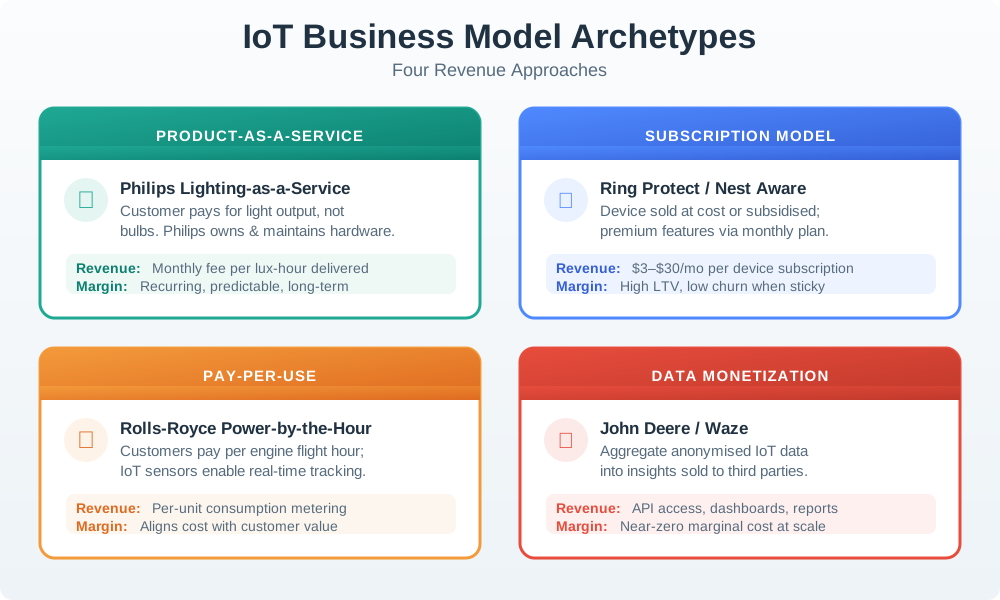
Picture comparing several IoT businesses and asking why some became durable while others stayed pilots. This chapter reads business-model case studies as patterns: who pays, who benefits, what data improves the service, and which operational costs can quietly break the model.
Chapter Roadmap
First, read each public case as a transfer test: what changed in the offer, what connectivity proves, and what would break the economics.
Then, compare Product-as-a-Service with subsidized ecosystem models so ownership, payback, and recurring value stay separate.
Next, test data monetization against consent, buyer value, and unit economics before assuming that stored telemetry is revenue.
Finally, use the quizzes and summary metrics to decide which model can scale in a new IoT context.
Checkpoint callouts pause the business-model flow; deep-dive sections hold calculators, derivations, and verification detail you can collapse during a first pass.
37.2 Learning Objectives
By the end of this chapter, you will be able to:
Analyze Business Model Transformations: Explain how traditional companies transition to IoT-enabled service models
Evaluate Financial Impact: Calculate the revenue and margin improvements from Product-as-a-Service
Identify Success Factors: Assess the key elements that enable successful IoT business model shifts
Apply Lessons Learned: Extract actionable insights from real-world case studies
37.3 IoT Business Case Studies
A business model is simply how a company makes money. These case studies show how real companies changed from selling physical products once (like selling a light bulb) to offering ongoing services (like charging a monthly fee to keep a building perfectly lit). Think of it as the difference between buying a DVD and subscribing to a streaming service – the streaming model builds a longer relationship and often earns more over time.
Key Concepts
IoT Business Model: Framework defining how an IoT product or service creates, delivers, and captures economic value.
Recurring Revenue: Ongoing income from subscriptions, data services, or maintenance contracts that follows the initial device sale.
Total Cost of Ownership (TCO): Complete cost of acquiring, deploying, and operating an IoT system over its full lifecycle.
Value Proposition: Clear statement of the benefit an IoT product delivers to a specific customer segment, differentiating it from alternatives.
Platform Business Model: IoT strategy enabling third parties to build applications on top of device data or connectivity infrastructure.
Hardware-as-a-Service (HaaS): Model where customers pay a recurring fee for IoT hardware instead of purchasing it outright, reducing upfront cost barriers.
Churn Rate: Percentage of IoT subscribers who cancel service in a given period; a key metric for recurring revenue business health.
Business Concepts: Understanding of revenue, margin, CapEx vs OpEx
Strategic Thinking: Familiarity with competitive positioning concepts
37.5 MVU: Minimum Viable Understanding
Core concept: Real-world IoT business transformations succeed by shifting from one-time product sales to recurring service revenue – the hardware becomes a platform for long-term customer relationships, not the end product.
Why it matters: Connected products change when revenue is captured, who owns operating risk, and how long the provider must keep delivering value. Public examples such as Philips/Signify’s Lighting-as-a-Service at Schiphol show the pattern; the financial models below are labeled when they are illustrative rather than reported company economics.
Key terms to know:
Lighting-as-a-Service (LaaS): Selling illumination outcomes via subscription instead of light fixtures
Razor-and-Blade: Subsidizing hardware to drive recurring ecosystem revenue
Data Monetization: Converting sensor data into sellable insights with proper consent
Customer Lifetime Value (LTV): Total revenue from a customer over their entire relationship
37.6 Asset Tracking Unit Economics
The deeper subsidised-hardware arithmetic now lives in Asset Tracking Unit Economics Contracts, covering per-device recurring margin, LTE-M connectivity cost, cloud cost, hardware subsidy payback, reporting-frequency sensitivity, churn risk, lifecycle state, and cost tags that let finance reconcile telemetry with subscription economics.
37.7 Case Studies as Transfer Tests
An IoT business-model case study is useful only when it helps you decide what can transfer to a different product, customer segment, or operating environment. The common weak reading is “Company X used connected devices and created recurring revenue, so we should copy that model.” The stronger reading separates the business mechanism from the headline. Philips/Signify’s managed lighting example is not just a story about efficient LEDs; it is a transfer test for contracts where the provider can measure the outcome, finance the asset, maintain the installed base, and price the service below the customer’s alternative cost. Rolls-Royce’s Power-by-the-Hour pattern is not just “charge by usage”; it works because engine hours are measurable, maintenance risk is central to customer value, and the provider has operational capability that the customer is willing to outsource.
Use a three-question transfer filter. First, what changed in the offer: ownership, risk, payment timing, data rights, or decision support? Second, what connected capability made that change credible: metering, remote diagnostics, firmware updates, identity, billing, or analytics? Third, what evidence would break the model in your context: churn, support cost, financing cost, regulatory limits, poor telemetry quality, or weak customer willingness to pay? A case study becomes actionable when the answer includes both the attractive model and the failure condition.
Can the customer keep seeing value after the device is installed?
What does connectivity prove?
Uptime, consumption, maintenance state, entitlement, environmental condition, or user behavior
Is the signal auditable enough for billing or renewal decisions?
Who owns operating risk?
Provider, customer, channel partner, insurer, cloud operator, or data producer
Does the party paid for the service also control the largest cost driver?
What can invalidate the economics?
Churn, subsidy payback, cloud cost, field service labor, privacy constraints, or sales cycle length
Which assumption would make the public case fail in this deployment?
A case-study transfer filter that turns public examples into evidence records for a new IoT business model.
37.8 Facts, Assumptions, Decisions
When you use public IoT case studies in a product review, keep a visible boundary between verified facts, illustrative economics, and your team’s decision assumptions. Verified facts are things the public source actually supports: a named customer, a business-model pattern, a published launch, a service scope, a pricing mechanism, or a stated operational outcome. Illustrative economics are teaching models such as a 36-month LTV, a hardware subsidy payback, or a 15-year NPV comparison. They can be valuable, but they should stay labeled because they are not the company’s reported financials unless the source says so. Decision assumptions are the numbers your team must own: attachment rate, device bill of materials, Stripe Billing or Chargebee subscription cost, LTE-M or NB-IoT connectivity cost, cloud ingestion on AWS IoT Core or Azure IoT Hub, warehouse and transformation cost in BigQuery, Snowflake, or dbt, support burden, warranty exposure, churn, and sales cycle.
The practical workflow is to build one case-study brief per model pattern. Start with a one-sentence old model and new model. Add the connected capability that changes the money flow. Then map the evidence chain from device telemetry to commercial decision. For a lighting service, that chain may run from occupancy and energy data to uptime evidence, maintenance scheduling, service invoices, and renewal proof. For an agricultural data product, it may run from machine telemetry and field context to aggregation, anonymization, consent records, analytics outputs, and buyer value. For a subsidized consumer device, it may run from identity, entitlement, subscription status, engagement, and payment retention to LTV:CAC.
The review should end with an explicit decision. “Copy Philips” is not a decision. “Pilot outcome-based lighting in three buildings only if metered uptime, maintenance cost, and financing terms keep gross margin above target after six months” is a decision. It names the model, the operating evidence, the financial guardrail, and the moment when the team should stop, revise, or scale.
37.9 Case Study as Data Contract
Under the hood, an IoT business-model case study is a chain of contracts across devices, data, money, and obligations. The device contract defines what telemetry is captured, how trustworthy it is, and which events can be used for operational or billing claims. A usage-priced compressor, lighting system, or engine-service model needs readings that are timestamped, attributable to the correct asset, resilient to outage, and reconciled when a gateway reconnects. The data contract defines identity, consent, retention, aggregation, and lineage. This is where a data-monetization case can fail: the buyer may want benchmarks, but the platform still needs a lawful and trusted path from raw farm, building, home, or fleet telemetry to an aggregated product that cannot expose an individual customer.
The commercial contract translates those signals into money. Subscription models need entitlement state, plan changes, failed-payment handling, taxation, and revenue recognition. Usage models need metering windows, dispute handling, minimum fees, overage logic, and audit trails. Outcome models need a defensible counterfactual or a narrower proxy, such as measured hours of operation instead of “failures prevented.” The operating contract then determines who pays when the model works in the spreadsheet but not in the field: device returns, truck rolls, firmware defects, cloud outages, cybersecurity incidents, consent withdrawal, and customer-success labor.
This is why case studies should be read with architecture diagrams and unit economics beside them. AWS IoT Core, Azure IoT Hub, MQTT brokers, device identity services, billing platforms, data warehouses, and CRM systems are not background plumbing; they define what the business can prove. If the architecture cannot connect telemetry to entitlement, service cost, customer account, and consent status, the model’s revenue line is fragile. A mature case-study review therefore produces two artifacts: a narrative model record that executives can understand and a data-contract checklist that engineers, finance, legal, and customer-success teams can test before launch.
Checkpoint: Transfer Evidence
You now know how to separate a public case into verified facts, illustrative economics, and team-owned decision assumptions.
You can trace the contract chain from telemetry to billing, consent, service cost, and renewal proof.
You can reject a weak case-study copy when the provider cannot measure the outcome or control the largest operating risk.
37.10 Read an IoT Case Study
Use each case study as a business-model evidence record, not only as a success story.
Name the old model. Identify what the organization sold or operated before connectivity changed the offer.
Name the connected capability. Find the sensor, platform, data, or service loop that made the new model possible.
Trace the money flow. Separate one-time hardware revenue, recurring service revenue, operational savings, and data-driven value.
Check the risk boundary. Record what could break the model: financing, churn, maintenance cost, consent, security, or adoption.
Canvas practice: Before comparing the cases, sketch one model record with five fields: customer problem, connected capability, revenue mechanism, cost driver, and renewal evidence. Use the Business Model Fundamentals canvas if you need the full nine-block view.
37.11 Incremental Examples
Beginner Example: A lighting supplier moves from selling fixtures to charging for maintained illumination. The key shift is from product margin to recurring service value.
Intermediate Example: A device maker discounts hardware to grow an ecosystem. The review must compare lost device margin with recurring subscriptions, consumables, or platform revenue.
Advanced Example: A fleet platform sells aggregated operational insights. The review must test whether consent, data quality, customer segmentation, and support costs make the data product defensible.
37.12 Peloton, Ring, and Data Pricing
Use these case patterns when comparing consumer IoT models:
Peloton: premium hardware creates the installed base, but the recurring class subscription carries the long-term margin. The risk is unit economics: high customer acquisition cost and inventory exposure can pull the LTV:CAC ratio below a healthy target.
Ring: affordable hardware acts as a wedge into the home. Recurring value comes from optional video storage, multi-device attach, neighborhood/network effects, and ecosystem integration; privacy governance is part of the business model, not an afterthought.
Smart data pricing: connectivity can be charged by usage, time, location, priority, transaction, or third-party sponsorship. In cellular IoT, pooled or sponsored connectivity can be more valuable than charging every user directly because it removes adoption friction and enables service revenue.
Review move: compare the first sale, the recurring revenue mechanism, the customer trust boundary, and the metric that proves the model is sustainable.
37.13 Concept Check: Revenue Shift
What question distinguishes a product sale from a service model?
Answer: ask when value is captured. A product sale captures most value at purchase; a service model captures value repeatedly as the provider maintains outcomes or insights.
37.14 Concept Check: Case Study Risk
Why can a financially attractive IoT service still fail?
Answer: the model may depend on adoption, uptime, financing, data rights, maintenance cost, or security controls that the spreadsheet does not prove.
37.15 Try It Yourself
Pick one case study in this chapter and write a four-line model record: old model, connected capability, recurring value mechanism, and strongest risk assumption.
IoT Business Models are like choosing how to run the coolest clubhouse in town!
Imagine the Sensor Squad has built an amazing treehouse with smart lights, a weather station, and a snack machine. Now they need to decide how to let their friends use it!
37.17.1 Three Treehouse Sharing Models
Sammy the Sensor had an idea first: “Let’s sell the treehouse for $100! We build it, they buy it, done!”
But Lila the LED disagreed: “What if we DON’T sell it? Instead, we charge $2 per week to use it, AND we keep the lights working perfectly. That way, after one year they’ve paid us $104 – more than selling it once – and they never have to fix anything!”
Max the Microcontroller had a THIRD idea: “What if we give the treehouse away for FREE, but charge for the amazing snack machine and weather reports? Kids will love the free treehouse so much, they’ll happily pay $1/week for snacks and cool weather facts!”
Bella the Battery did the math:
Sammy’s Plan
Lila’s Plan
Max’s Plan
Sell for $100 once
$2/week = $104/year
Free treehouse + $1/week snacks = $52/year
We’re done after sale
We fix everything forever
We need amazing snacks!
Friend owns it
We still own it
Friend gets it free
One friend = $100
One friend = $104+
Ten friends = $520!
“Max’s plan works best when LOTS of kids join!” cheered Bella. “The more kids use the treehouse, the more snacks we sell!”
The Sensor Squad learned that in business, sometimes a company earns steadier long-term revenue by renting, servicing, or bundling a connected product instead of treating the device sale as the whole business.
37.17.2 Key Words for Kids
Word
What It Means
Subscription
Paying a little bit regularly, like a magazine delivery
Razor-and-Blade
Give away the handle cheaply, make money on the blades!
Service
Doing something helpful for someone regularly
Lifetime Value
All the money one customer pays you over many years
37.18 Lighting-as-a-Service Shift
The treehouse example shows the intuition; now the chapter turns to the first enterprise case. Keep the same question in mind: what changes when the provider sells an operating result instead of only shipping a connected asset?
Company Background:
Philips Lighting (now Signify) moved part of its commercial lighting business from one-time fixture sales toward managed service contracts. The strategic problem was familiar for IoT: LED fixtures last longer and become easier to compare, so the provider needs a way to earn from performance, maintenance, upgrades, and energy outcomes rather than only the initial hardware sale.
The Business Model Shift:
In 2015, Schiphol Group, Cofely, and Royal Philips announced a Lighting-as-a-Service arrangement for Schiphol airport terminal buildings. The public case states that Schiphol pays for the light it uses while Philips remains owner of the fixtures and installation, with the service partners responsible for performance, durability, and end-of-life reuse or recycling.
Revenue Model Transformation:
Metric
Traditional Fixture Purchase
Lighting-as-a-Service
Change
Revenue Type
One-time hardware sale plus maintenance projects
Recurring service payment for light used
From CapEx purchase to OpEx service
Customer Payment
Large upfront fixture purchase
Lower upfront payment; recurring service fee
Adoption friction moves from capital budget to operating budget
Asset Ownership
Customer owns luminaires and replacement risk
Provider retains ownership of lighting assets
Provider has incentive to design durable, repairable equipment
Maintenance
Customer or facilities contractor manages failures
Service provider manages performance and durability
Operational burden shifts away from the customer
Circularity
End-of-life handling is a customer problem
Provider plans reuse/recycling at end of life
Product design and service economics become linked
Energy Savings
Customer captures savings after purchase
Contract can align service fee with efficient illumination
Efficiency becomes part of the value proposition
Verified Schiphol Case Facts (2015)
Schiphol pays for the light it uses rather than buying the luminaires outright.
Philips retains ownership of the fixtures and installation.
Philips and Cofely are responsible for performance, durability, and end-of-life reuse or recycling.
Public case material reports substantially lower energy consumption compared with conventional lighting.
Illustrative Financial Model: Schiphol-Style Lighting Service
The following numbers are a teaching model for a large facility. They are not reported Schiphol contract pricing.
Traditional Purchase Model (illustrative):
10,000 LED fixtures at $150 each = $1.5M upfront
Annual maintenance: $75K/year x 15 years = $1.125M
Energy cost: $500K/year x 15 years = $7.5M
Total 15-Year Cost: $10.125M
Customer owns aging equipment after 15 years
Lighting-as-a-Service Model (illustrative):
Zero upfront hardware cost
Monthly service fee: $18K/month x 180 months = $3.24M
Energy savings assumption: 50% reduction ($250K/year saved)
Provider guarantees performance and handles maintenance
Gross profit: $3.24M - $2.7M = $540K (16.7% margin on revenue, paid over time)
Additional value: Retained customer relationship enables future upsell (smart building integration, data analytics)
37.19 Deep dive: Putting Numbers to It
Let’s calculate the Net Present Value (NPV) of both models using a 5% discount rate to account for time-value of money:
Traditional Purchase NPV:
NPV_purchase = -$1.5M - sum from year 1 to 15 of ($75K + $500K) / (1.05)^year.
Result: -$1.5M - $5.93M = -$7.43M.
LaaS Model NPV:
NPV_LaaS = -sum from year 1 to 15 of ($216K/year - $250K/year) / (1.05)^year.
Result: -sum of -$34K discounted each year = +$351K.
The customer actually makes money with LaaS (positive NPV of $351K) while the traditional purchase has $7.43M negative NPV. Factoring in the time-value of money, LaaS delivers $7.43M + $351K = $7.78M more value than purchasing.
Why This Model Works:
Customer Value Proposition:
Financial: Lower upfront capital requirement and potential energy savings
Operational: Reduced maintenance burden and performance accountability
Strategic: CapEx to OpEx shift improves balance sheet ratios
Risk Transfer: Provider assumes more maintenance and obsolescence risk
Solution: Conservative engineering margins, insurance policies for large installations
Competitive Advantage:
This business model creates a moat competitors struggle to replicate:
Capital Requirements: Requires financing capacity for equipment that is paid back over time
Service Capability: Needs reliable maintenance operations, not just product sales
Data Platform: Connected lighting generates building analytics (occupancy, energy patterns) enabling smart building upsells
Brand Trust: Customers must believe the provider can honor a long service contract
Observed Lesson:
The reported Schiphol arrangement is important because it shows a real enterprise buyer accepting a service model for a physical asset. The launch evidence is not a claimed margin multiple; it is the shift in ownership, maintenance responsibility, circular design incentive, and customer payment model.
Lessons for IoT Business Models:
Outcome-Based Beats Product-Based: Customers pay for illumination outcomes, not hardware
Risk Transfer Creates Value: Assuming maintenance/obsolescence risk justifies premium pricing
Long Contracts Enable Investment: 10-15 year contracts justify upfront hardware spending
Data May Create Second Revenue Stream: Connected lights can support smart building analytics, but only with clear permission and value exchange
Patient Capital Required: Service models need time because the provider earns back equipment investment over the contract life
This case demonstrates how IoT business models can transform commodity hardware into service revenue through risk transfer, outcome-based pricing, and operational accountability.
37.20 Lighting-as-a-Service Proposal
This proposal comparison is an illustrative campus-scale model. It uses round numbers to teach TCO and NPV reasoning; it is not reported Schiphol contract pricing.
Scenario: A university campus facilities manager receives two proposals for replacing 50,000 aging fluorescent fixtures across 15 buildings.
Proposal A (Traditional): Purchase 50,000 LED fixtures outright at $200 each = $10M upfront. Estimated 15-year maintenance cost: $3.75M ($250K/year). Annual energy cost: $1.2M (calculated at $0.12/kWh, 200W average per fixture, 12 hours/day).
Proposal B (LaaS): Zero upfront cost. Monthly service fee: $45K/month ($540K/year) for 15 years = $8.1M total. Philips guarantees 99.5% uptime, handles all maintenance, replaces fixtures after 7 years, and commits to 50% energy reduction vs. current fluorescent system.
Question: Which proposal delivers better Total Cost of Ownership over 15 years?
Risk transfer: Philips bears technology obsolescence risk (new LED tech in years 8-15 automatically deployed)
Key Insight: The LaaS model’s value comes primarily from energy savings ($9M vs $18M) enabled by newer, more efficient LED technology and continuous optimization—not just from avoiding maintenance costs. The upfront CapEx elimination is a secondary benefit that improves financial metrics but doesn’t drive the economic case.
Checkpoint: Service Economics
You now know why the illustrative campus model compares a $10M upfront purchase with a $45K/month service proposal over 15 years.
You can recompute the headline comparison: $31.75M traditional TCO versus $17.1M LaaS TCO, a $14.65M reduction before discounting.
You can explain why energy savings, maintenance responsibility, and retained provider ownership matter more than the absence of upfront hardware alone.
37.21 Deep dive: LaaS vs Traditional TCO
Use this calculator to compare Total Cost of Ownership between traditional hardware purchase and Lighting-as-a-Service models.
md`#### Results (${contract_years}-Year Analysis)| Metric | Traditional Purchase | Lighting-as-a-Service | Difference ||--------|---------------------|----------------------|------------|| **Initial Hardware** | ${"$"}${d3.format(",.0f")(traditional_hardware)} | $0 | ${"$"}${d3.format(",.0f")(traditional_hardware)} || **Maintenance** | ${"$"}${d3.format(",.0f")(traditional_maintenance_total)} | Included | ${"$"}${d3.format(",.0f")(traditional_maintenance_total)} || **Energy (total)** | ${"$"}${d3.format(",.0f")(traditional_energy_total)} | ${"$"}${d3.format(",.0f")(laas_energy_total)} | ${"$"}${d3.format(",.0f")(traditional_energy_total - laas_energy_total)} || **Service Fees** | $0 | ${"$"}${d3.format(",.0f")(laas_total)} | -${"$"}${d3.format(",.0f")(laas_total)} || **Total Nominal Cost** | ${"$"}${d3.format(",.0f")(traditional_total)} | ${"$"}${d3.format(",.0f")(laas_with_energy)} | **${"$"}${d3.format(",.0f")(savings)} (${savings_pct}% savings)** || **Total NPV (5%)** | ${"$"}${d3.format(",.0f")(npv_traditional)} | ${"$"}${d3.format(",.0f")(npv_laas)} | **${"$"}${d3.format(",.0f")(npv_savings)}** |**Key Insight**: ${savings >0?`LaaS delivers ${"$"}${d3.format(",.0f")(savings)} in nominal savings (${savings_pct}%) and ${"$"}${d3.format(",.0f")(npv_savings)} in NPV savings, primarily through energy efficiency and avoided maintenance costs.`:`At current parameters, traditional purchase is more cost-effective. Consider higher energy rates or longer contracts to improve LaaS economics.`}`
Show code
// Visualization: Cost Breakdown Comparison{const width =640;const height =400;const margin = {top:40,right:120,bottom:60,left:80};const data = [ {model:"Traditional",category:"Hardware",value: traditional_hardware,color:"#2C3E50"}, {model:"Traditional",category:"Maintenance",value: traditional_maintenance_total,color:"#7F8C8D"}, {model:"Traditional",category:"Energy",value: traditional_energy_total,color:"#E67E22"}, {model:"LaaS",category:"Service Fees",value: laas_total,color:"#16A085"}, {model:"LaaS",category:"Energy",value: laas_energy_total,color:"#E67E22"} ];const svg = d3.create("svg").attr("width", width).attr("height", height).attr("viewBox", [0,0, width, height]).attr("style","max-width: 100%; height: auto;");const models = ["Traditional","LaaS"];const x0 = d3.scaleBand().domain(models).range([margin.left, width - margin.right]).padding(0.2);const categories = ["Hardware","Maintenance","Energy","Service Fees"];const y = d3.scaleLinear().domain([0, d3.max(data.map(d => d.model==="Traditional"? traditional_total : laas_with_energy))]).nice().range([height - margin.bottom, margin.top]);// Group data by model and stackconst stacked = d3.stack().keys(categories).value((d, key) => {const item = data.find(i => i.model=== d.model&& i.category=== key);return item ? item.value:0; }) (models.map(model => ({model})));const colorMap = {"Hardware":"#2C3E50","Maintenance":"#7F8C8D","Energy":"#E67E22","Service Fees":"#16A085" };// Draw stacked bars svg.append("g").selectAll("g").data(stacked).join("g").attr("fill", d => colorMap[d.key]).selectAll("rect").data(d => d).join("rect").attr("x", d =>x0(d.data.model)).attr("y", d =>y(d[1])).attr("height", d =>y(d[0]) -y(d[1])).attr("width", x0.bandwidth());// X axis svg.append("g").attr("transform",`translate(0,${height - margin.bottom})`).call(d3.axisBottom(x0)).selectAll("text").style("font-size","14px").style("font-weight","bold");// Y axis svg.append("g").attr("transform",`translate(${margin.left},0)`).call(d3.axisLeft(y).tickFormat(d =>`${"$"}${d3.format(".2s")(d)}`)).selectAll("text").style("font-size","12px");// Y axis label svg.append("text").attr("transform","rotate(-90)").attr("y", margin.left-60).attr("x",-(height /2)).attr("text-anchor","middle").style("font-size","14px").text(`Total Cost (${contract_years} years)`);// Title svg.append("text").attr("x", width /2).attr("y",20).attr("text-anchor","middle").style("font-size","16px").style("font-weight","bold").text(`${contract_years}-Year TCO Comparison: Traditional vs LaaS`);// Legendconst legend = svg.append("g").attr("transform",`translate(${width - margin.right+10}, ${margin.top})`); categories.forEach((cat, i) => { legend.append("rect").attr("x",0).attr("y", i *25).attr("width",15).attr("height",15).attr("fill", colorMap[cat]); legend.append("text").attr("x",20).attr("y", i *25+12).style("font-size","12px").text(cat); });return svg.node();}
Try adjusting: Increase energy rates or operating hours to see how energy savings drive LaaS value proposition. Notice how the NPV savings are higher than nominal savings due to deferred LaaS payments.
37.22 Deep dive: Discount Rates in Long Contracts
The Mistake: Comparing 15-year contract costs without applying time-value-of-money discounting. $540K paid in Year 15 is worth far less than $540K paid in Year 1.
Why It Matters: At a 5% discount rate, the $8.1M nominal LaaS payment stream is worth only $6.2M in present value terms. The traditional purchase’s $10M upfront payment stays at $10M PV because it’s paid immediately.
Correct Approach: Always calculate Net Present Value (NPV) for multi-year IoT contracts: - NPV = Σ (Payment_year / (1 + discount_rate)^year) - Use your organization’s Weighted Average Cost of Capital (WACC) as the discount rate - Factor in tax implications: CapEx may be depreciable, OpEx is immediately deductible
Real Impact: In the university example above, proper NPV analysis would show LaaS savings of $18M (not $14.65M) because the deferred payments have lower present value than the upfront hardware purchase.
Decision Framework for Product-as-a-Service Evaluation:
Factor
Traditional Purchase
Product-as-a-Service
Winner
Upfront Cost
$10M
$0
PaaS
15-Year TCO (nominal)
$31.75M
$17.1M
PaaS
15-Year TCO (NPV at 5%)
$28.5M
$10.6M
PaaS
Balance Sheet Impact
CapEx (depreciates)
OpEx (immediate expense)
PaaS
Technology Risk
Customer owns obsolescence
Vendor upgrades included
PaaS
Flexibility
Owns assets, can sell
Locked into 15-year contract
Purchase
37.23 Philips Business Model Journey
After the financial model, step back from the spreadsheet and look at the operating journey. The timeline matters because service revenue only becomes durable when financing, maintenance, customer trust, and circular asset handling mature together.
The following diagram illustrates the key stages of Philips’ transformation from traditional hardware sales to Lighting-as-a-Service, showing how each phase built upon the previous one.
Philips Lighting transformation, 2010-2023
2010
Commodity squeeze begins
LED fixtures become easier to compare, making service, financing, and maintenance more important differentiators.
2015
Launch Lighting-as-a-Service
Philips shifts from selling fixtures outright to charging for illumination outcomes, starting with Schiphol Airport.
2018
Recurring revenue scales
Managed lighting contracts turn the buyer relationship into a long-running operating account instead of a one-time fixture sale.
2020
Global service footprint expands
LaaS reaches airports, hospitals, warehouses, and offices while Philips leans on service operations and financing at scale.
The transformation worked because Philips paired lower customer upfront cost with long contracts, uptime guarantees, and retained ownership of the lighting infrastructure.
Philips LaaS journey at a glance
2010
Hardware pressure rises
LED fixtures look like a commodity business, so Philips needs a defensible revenue model.
2015
Sell light, not fixtures
Customers pay monthly for illumination outcomes while Philips owns maintenance and replacement risk.
2018
Contracts validate the model
Recurring service contracts show that lighting can be sold as an operating outcome, not only as installed equipment.
2023
Service becomes strategic
Managed services remain strategically useful because they connect efficiency, maintenance, upgrades, and asset circularity.
Philips’ shift from fixture sales toward managed Lighting-as-a-Service contracts, using Schiphol as the public launch example.
Figure 37.1
37.24 IoT Business Model Comparison Framework
This diagram compares the four major IoT business model archetypes covered in these case studies, showing how each generates revenue differently.
IoT business model archetypes
Product-as-a-Service
Example: Philips LaaS
Revenue: Outcome-based subscription
Signal: Provider retains asset and service responsibility
Subscription / Razor-and-Blade
Example: Smart speaker ecosystem model
Revenue: Hardware subsidy plus recurring services
Signal: Subsidy only works when attach-rate revenue repays it
Pay-per-Use
Example: Rolls-Royce Power-by-the-Hour
Revenue: Metered usage tied to customer activity
Signal: Price follows actual consumption, not ownership
Data Monetization
Example: Agricultural telemetry insights
Revenue: Aggregated analytics sold to third parties
Signal: Governance and consent matter as much as the data itself
Comparison of the four major IoT business model archetypes and the revenue logic behind each one.
Figure 37.2
37.25 Knowledge Check: Case Study Analysis
37.26 Razor-Blade Economics
Lighting-as-a-Service keeps the provider close to the asset. The next pattern does the opposite at first: it lowers the entry-device price and bets that recurring ecosystem value will repay the subsidy before churn catches up.
37.27 Razor-and-Blade Check
Scenario: A smart-speaker provider sells a hub below cost to grow its installed base. The ecosystem model below is illustrative: it assumes revenue from music subscriptions, smart-home purchases, and shopping margin. The point is to test whether the recurring attach-rate revenue repays the hardware subsidy.
Think about:
If the provider loses $75 per device but earns $594 over 3 years under these assumptions, what’s the net profit per customer?
Would this strategy work if ecosystem LTV was only $150 instead of $594?
Key Insight: A razor-and-blade strategy sells or subsidizes the entry device to drive recurring services. Low-cost hardware reduces adoption barriers, but the model fails if attach rates, retention, or service margin do not repay the subsidy.
Low adoption barrier: $59 price point vs $200+ competitors
Ecosystem lock-in: Voice shopping, music, smart home create switching costs
High-margin services: 70-80% gross margin on digital services vs 20-30% on hardware
Platform network effects: More devices leads to more developers leads to better ecosystem leads to more devices
Calculation note: The $594 LTV is a scenario assumption, not a reported company metric. In a real model, product teams should validate attach rate, retention, margin, and attribution before subsidizing hardware.
Similar Razor-and-Blade Models:
HP Instant Ink pattern: Printers and ink subscriptions show how recurring consumables can subsidize competitive hardware pricing
Peloton: Bikes with monthly class subscriptions ($1,495 bike, $528/year subscription)
If a smart-speaker device costs $110 to manufacture and sells for $59 (a $51 subsidy), but the ecosystem generates $594 over 3 years, would the strategy still work if only 50% of customers actively used ecosystem services (reducing LTV to $297)? What would happen to the ROI ($297 - $51 = $246 vs $519)?
37.28 Razor-and-Blade Check
Checkpoint: Subsidy Payback
You now know that a smart-speaker-style subsidy must be recovered by attach-rate revenue, retention, and margin.
You can recompute the chapter’s baseline: $594 over 36 months minus a $75 hardware loss leaves $519 net profit per customer.
You can explain why the same model becomes fragile if ecosystem LTV drops to $150 or if active usage cuts the revenue base.
37.29 Deep dive: Razor-and-Blade ROI
Calculate the return on investment for hardware subsidy strategies such as a smart-speaker ecosystem model.
md`#### Financial Analysis (3-Year Horizon)| Metric | Value ||--------|-------|| **Hardware Subsidy** | ${subsidy >0?`-${"$"}${d3.format(",.0f")(subsidy)}`:`+${"$"}${d3.format(",.0f")(-subsidy)} profit`} || **Monthly Ecosystem Revenue** | ${"$"}${d3.format(",.2f")(total_monthly)} || **36-Month LTV** | ${"$"}${d3.format(",.0f")(ltv_36)} || **Net Profit (3 years)** | ${net_profit_36 >0?`${"$"}${d3.format(",.0f")(net_profit_36)}`:`-${"$"}${d3.format(",.0f")(-net_profit_36)}`} || **ROI** | ${roi_pct}% || **Breakeven Timeline** | ${breakeven_months !=="N/A"?`${breakeven_months} months`: breakeven_months} |**Revenue Breakdown**:- Music subscriptions: ${"$"}${d3.format(",.2f")(music_revenue_monthly)}/month (${music_attach}% attach)- Smart home platform fees: ${"$"}${d3.format(",.2f")(smart_home_revenue_monthly)}/month (${smart_home_attach}% attach)- Voice shopping margin: ${"$"}${d3.format(",.2f")(shopping_revenue_monthly)}/month (${shopping_attach}% attach)${net_profit_36 >0?`**Strategy is viable**: The ${subsidy >0?`${"$"}${subsidy} hardware subsidy`:'profitable hardware sale'} generates ${"$"}${d3.format(",.0f")(net_profit_36)} net profit over 3 years with ${roi_pct}% ROI, breaking even in ${breakeven_months} months.`:`**Strategy needs adjustment**: Current parameters yield negative profit. Increase ecosystem revenue, reduce subsidy, or improve attach rates.`}`
Show code
// Visualization: Cumulative Profit Over Time{const width =640;const height =300;const margin = {top:40,right:40,bottom:50,left:70};const months =Array.from({length:37}, (_, i) => i);const cumulative = months.map(m => (total_monthly * m) - subsidy);const data = months.map((m, i) => ({month: m,profit: cumulative[i]}));const svg = d3.create("svg").attr("width", width).attr("height", height).attr("viewBox", [0,0, width, height]).attr("style","max-width: 100%; height: auto;");const x = d3.scaleLinear().domain([0,36]).range([margin.left, width - margin.right]);const y = d3.scaleLinear().domain([d3.min(cumulative), d3.max(cumulative)]).nice().range([height - margin.bottom, margin.top]);// Zero line svg.append("line").attr("x1", margin.left).attr("x2", width - margin.right).attr("y1",y(0)).attr("y2",y(0)).attr("stroke","#7F8C8D").attr("stroke-width",1).attr("stroke-dasharray","4,4");// Area under curveconst area = d3.area().x(d =>x(d.month)).y0(y(0)).y1(d =>y(d.profit)).curve(d3.curveMonotoneX); svg.append("path").datum(data).attr("fill", net_profit_36 >0?"#16A085":"#E74C3C").attr("fill-opacity",0.3).attr("d", area);// Lineconst line = d3.line().x(d =>x(d.month)).y(d =>y(d.profit)).curve(d3.curveMonotoneX); svg.append("path").datum(data).attr("fill","none").attr("stroke", net_profit_36 >0?"#16A085":"#E74C3C").attr("stroke-width",2.5).attr("d", line);// X axis svg.append("g").attr("transform",`translate(0,${height - margin.bottom})`).call(d3.axisBottom(x).ticks(12)).selectAll("text").style("font-size","11px"); svg.append("text").attr("x", width /2).attr("y", height -10).attr("text-anchor","middle").style("font-size","12px").text("Months");// Y axis svg.append("g").attr("transform",`translate(${margin.left},0)`).call(d3.axisLeft(y).tickFormat(d =>`${"$"}${d3.format(",.0f")(d)}`)).selectAll("text").style("font-size","11px"); svg.append("text").attr("transform","rotate(-90)").attr("y",15).attr("x",-(height /2)).attr("text-anchor","middle").style("font-size","12px").text("Cumulative Profit");// Title svg.append("text").attr("x", width /2).attr("y",20).attr("text-anchor","middle").style("font-size","14px").style("font-weight","bold").text(`Razor-and-Blade ROI: Breakeven at Month ${breakeven_months !=="N/A"?Math.ceil(parseFloat(breakeven_months)) :"N/A"}`);// Breakeven markerif (breakeven_months !=="N/A"&&parseFloat(breakeven_months) <=36) {const be_month =parseFloat(breakeven_months); svg.append("circle").attr("cx",x(be_month)).attr("cy",y(0)).attr("r",5).attr("fill","#E67E22"); svg.append("text").attr("x",x(be_month)).attr("y",y(0) -10).attr("text-anchor","middle").style("font-size","11px").style("fill","#E67E22").style("font-weight","bold").text(`Breakeven: ${breakeven_months}mo`); }return svg.node();}
Try adjusting: Lower the retail price to increase subsidy, then watch how attach rates impact breakeven time. Notice how small attach rate improvements dramatically change ROI.
37.30 Common Misconception: Data Monetization
Once recurring value is clear, data can look like the obvious next revenue stream. This section slows that instinct down: telemetry becomes revenue only when a buyer, consent model, and insight product already exist.
37.31 More Data Is Not More Revenue
The Misconception:
Many IoT companies assume that collecting massive amounts of sensor data automatically creates monetization opportunities. The belief is: “We’ll gather all the data we can, then figure out how to monetize it later.”
Why This Is Wrong:
Storage Costs Exceed Revenue: Storing 1 TB of IoT time-series data costs $23-50/month (AWS S3/Timestream). A smart building with 500 sensors generating 1 MB/day each creates 15 TB/month = $345-750/month storage cost. Without a clear buyer for this data, it’s pure expense.
Data Without Insights Has No Value: Raw sensor readings (temperature: 22.3C, humidity: 45%) are worthless. Buyers pay for actionable insights such as which schedule change lowers HVAC energy use. The transformation from data to insight requires analytics infrastructure (additional cost).
Privacy Regulations Block Monetization: GDPR, CCPA, and sector-specific regulations (HIPAA healthcare, FERPA education) severely restrict what data can be sold and how it must be anonymized. Compliance costs ($50K-500K for data governance systems) often exceed potential revenue.
Anonymization Reduces Value: To legally sell data, companies must anonymize it (remove PII). But anonymization eliminates 60-80% of commercial value—advertisers pay 10x more for identified user data ($50/user/year) vs anonymized cohorts ($5/user/year).
Real-World Failures:
Company
Data Collection Strategy
Outcome
Lesson
Fitbit (pre-Google)
Collected detailed health data, explored selling to insurers
User backlash, privacy concerns, strategy abandoned
Users don’t trust health data monetization
Facebook Portal
Smart display collecting conversation patterns for ad targeting
Poor sales (privacy concerns), discontinued 2022
In-home surveillance too invasive for consumers
Smart TV manufacturers (Vizio)
Sold viewing data to advertisers without clear consent
$2.2M FTC fine (2017), required explicit opt-in
Implied consent insufficient, explicit required
Ring (pre-acquisition)
Police partnerships accessing doorbell footage
Public outcry, policy changes, trust damage
Law enforcement data sharing harms brand
The Correct Approach:
Wrong Strategy
Right Strategy
Revenue Impact
Collect everything, monetize later
Define monetization strategy first, collect only needed data
Problem Identified: Farmers need yield optimization recommendations
Data Collected: Soil moisture, yield maps, weather (not GPS tracking, not personal data)
Insight Generated: “Plant corn variety X in northeast field for 12% yield increase”
Revenue Model: Sell aggregated, consented insight products to seed companies, insurers, or research partners while giving operational analytics back to participating farmers
Consent Model: Farmers explicitly opt-in, retain data ownership, can revoke access
Result: Data revenue is tied to trust, transparency, and a clear value exchange rather than raw data extraction
Key Insight: Data monetization requires a clear buyer, defensible value proposition, and robust consent framework before collecting a single byte. “Big data” without “big insights” is just expensive storage.
Checkpoint: Governed Data Revenue
You now know why data monetization starts with the buyer’s decision instead of a broad collection plan.
You can name the cost and trust gates: storage, analytics, compliance, explicit opt-in, aggregation, anonymization, and revocation.
You can use the agricultural telemetry example to test whether insight revenue and farmer value exchange are both defensible.
37.32 Deep dive: Data Unit Economics
Calculate whether your IoT data monetization strategy is financially viable after accounting for collection, storage, and compliance costs.
md`#### Unit Economics Analysis| Metric | Monthly | Yearly ||--------|---------|--------|| **Revenue (${num_sensors} sensors)** | ${"$"}${d3.format(",.0f")(total_revenue_monthly)} | ${"$"}${d3.format(",.0f")(total_revenue_monthly *12)} || **Storage Cost** | ${"$"}${d3.format(",.0f")(storage_cost_monthly)} (${total_data_tb_per_month.toFixed(2)} TB) | ${"$"}${d3.format(",.0f")(storage_cost_monthly *12)} || **Analytics Cost** | ${"$"}${d3.format(",.0f")(analytics_cost_per_user * num_sensors)} | ${"$"}${d3.format(",.0f")(analytics_cost_per_user * num_sensors *12)} || **Compliance Cost** | ${"$"}${d3.format(",.0f")(compliance_fixed_monthly)} | ${"$"}${d3.format(",.0f")(compliance_fixed_monthly *12)} || **Total Cost** | ${"$"}${d3.format(",.0f")(total_cost_monthly)} | ${"$"}${d3.format(",.0f")(total_cost_monthly *12)} || **Net Profit** | ${net_profit_monthly >=0?`${"$"}${d3.format(",.0f")(net_profit_monthly)}`:`-${"$"}${d3.format(",.0f")(-net_profit_monthly)}`} | ${net_profit_yearly >=0?`${"$"}${d3.format(",.0f")(net_profit_yearly)}`:`-${"$"}${d3.format(",.0f")(-net_profit_yearly)}`} || **Profit per Sensor** | ${profit_per_sensor >=0?`${"$"}${profit_per_sensor.toFixed(2)}`:`-${"$"}${(-profit_per_sensor).toFixed(2)}`} | ${profit_per_sensor >=0?`${"$"}${(profit_per_sensor *12).toFixed(2)}`:`-${"$"}${(-profit_per_sensor *12).toFixed(2)}`} |**Breakeven Threshold**: ${breakeven_sensors >0?`${d3.format(",")(breakeven_sensors)} sensors needed to break even`:"Cannot break even at current pricing"}${net_profit_monthly >0?`**Strategy is viable**: Generating ${"$"}${d3.format(",.0f")(net_profit_monthly)}/month (${"$"}${profit_per_sensor.toFixed(2)}/sensor) profit after all costs. Scale to increase margins.`:`**Strategy not viable**: Losing ${"$"}${d3.format(",.0f")(-net_profit_monthly)}/month. Either increase insight revenue to ${"$"}${((total_cost_monthly / num_sensors) + analytics_cost_per_user).toFixed(2)}/sensor, reduce costs, or reach ${d3.format(",")(breakeven_sensors)} sensors.`}`
Show code
// Visualization: Cost vs Revenue Breakdown{const width =640;const height =350;const margin = {top:40,right:40,bottom:100,left:80};const categories = [ {label:"Revenue",value: total_revenue_monthly,color:"#16A085",type:"revenue"}, {label:"Storage",value:-storage_cost_monthly,color:"#2C3E50",type:"cost"}, {label:"Analytics",value:-(analytics_cost_per_user * num_sensors),color:"#3498DB",type:"cost"}, {label:"Compliance",value:-compliance_fixed_monthly,color:"#7F8C8D",type:"cost"}, {label:"Net Profit",value: net_profit_monthly,color: net_profit_monthly >=0?"#16A085":"#E74C3C",type:"net"} ];const svg = d3.create("svg").attr("width", width).attr("height", height).attr("viewBox", [0,0, width, height]).attr("style","max-width: 100%; height: auto;");const x = d3.scaleBand().domain(categories.map(d => d.label)).range([margin.left, width - margin.right]).padding(0.2);const y = d3.scaleLinear().domain([d3.min(categories, d => d.value) *1.1, d3.max(categories, d => d.value) *1.1]).nice().range([height - margin.bottom, margin.top]);// Zero line svg.append("line").attr("x1", margin.left).attr("x2", width - margin.right).attr("y1",y(0)).attr("y2",y(0)).attr("stroke","#000").attr("stroke-width",2);// Bars svg.selectAll("rect").data(categories).join("rect").attr("x", d =>x(d.label)).attr("y", d => d.value>=0?y(d.value) :y(0)).attr("height", d =>Math.abs(y(d.value) -y(0))).attr("width", x.bandwidth()).attr("fill", d => d.color);// Value labels on bars svg.selectAll("text.value").data(categories).join("text").attr("class","value").attr("x", d =>x(d.label) + x.bandwidth() /2).attr("y", d => d.value>=0?y(d.value) -5:y(0) +15).attr("text-anchor","middle").style("font-size","11px").style("font-weight","bold").text(d =>`${"$"}${d3.format(",")(Math.abs(Math.round(d.value)))}`);// X axis svg.append("g").attr("transform",`translate(0,${height - margin.bottom})`).call(d3.axisBottom(x)).selectAll("text").style("font-size","12px").attr("transform","rotate(-45)").attr("text-anchor","end");// Y axis svg.append("g").attr("transform",`translate(${margin.left},0)`).call(d3.axisLeft(y).tickFormat(d =>`${"$"}${d3.format(".2s")(d)}`)).selectAll("text").style("font-size","11px"); svg.append("text").attr("transform","rotate(-90)").attr("y",15).attr("x",-(height /2)).attr("text-anchor","middle").style("font-size","12px").text("Monthly Amount ($)");// Title svg.append("text").attr("x", width /2).attr("y",20).attr("text-anchor","middle").style("font-size","14px").style("font-weight","bold").text(`Data Monetization Unit Economics (${num_sensors} sensors)`);return svg.node();}
Try adjusting: Increase sensor count or insight revenue to reach profitability. Notice how fixed compliance costs create a minimum viable scale threshold. At small scale, compliance is prohibitive.
37.33 Data Monetization Decision Framework
This flowchart illustrates the correct decision process for IoT data monetization, contrasting the common “collect everything” mistake with a consent-led approach that starts from a buyer problem.
Data monetization decision framework
Step 1: Define the buyer and decision
Start with the person paying for the insight: a seed company, insurer, energy buyer, or operator with a concrete decision to improve.
Step 2: Work backward to required data
Collect only the telemetry needed to support that decision instead of warehousing every possible sensor feed.
Step 3: Build analytics before scaling collection
Raw data has little value on its own. The commercial product is the recommendation, score, or benchmark derived from it.
Step 4: Secure consent and governance
Use explicit opt-in, clear ownership boundaries, anonymization, and revocation paths before turning data into revenue.
Step 5: Validate unit economics
Launch only when insight revenue exceeds collection, storage, analytics, and compliance costs on a per-customer basis.
Wrong path to avoid
No buyer yet: collecting everything first creates storage cost, governance risk, and no defensible product.
No insight layer: raw telemetry dumps rarely command premium pricing.
No consent model: privacy backlash and regulatory exposure can erase the revenue upside.
Mobile checklist for data monetization
Start with a paying use case
Name the buyer and the operational decision you will improve.
Collect only what supports that use case
Extra telemetry adds cost and compliance exposure without improving revenue.
Turn telemetry into an insight product
Dashboards, benchmarks, and recommendations are what customers actually buy.
Require explicit consent
Opt-in, anonymization, and revocation rights keep the business durable.
Warning
If you still do not know who pays for the insight, stop before scaling data collection.
A decision framework that starts with a clear buyer and insight product before any large-scale IoT data collection or monetization effort.
37.34 Data Monetization Knowledge Check
37.35 Business Model Quiz
The final activities ask you to classify the models without flattening them into “recurring revenue.” Use the proof metric from each checkpoint: service margin, subsidy payback, governed insight value, network effects, or metered usage.
37.36 Quiz: Business Model Identification
37.37 Business Case Links
Concept
Relates To
Relationship
Product-as-a-Service
Subscription Pricing
Philips/Signify LaaS shows how retained provider ownership can turn lighting into a managed service outcome
Razor-and-Blade
Customer Acquisition Cost
A hardware subsidy is viable only when recurring attach-rate revenue repays the entry-device loss
Data Monetization
Privacy Regulation
Agricultural telemetry monetization requires explicit consent, aggregation, anonymization, and value sharing
Platform Models
Network Effects
Smart-home platforms become more valuable when manufacturers, developers, and consumers reinforce each other
Cross-module connection: Pricing Strategies explains how to calculate optimal subscription prices using customer willingness-to-pay, competitive benchmarks, and value-based pricing for Product-as-a-Service models like Philips LaaS.
Checkpoint: Model Selection
You now know how to distinguish Product-as-a-Service, razor-and-blade, data monetization, platform, and usage-based models.
You can connect each model to its proof metric: payback and service margin, LTV-to-subsidy ratio, governed insight revenue, network effects, or metered usage.
You can carry those distinctions into the matching, ordering, label, and code quizzes without treating all recurring revenue as the same pattern.
37.38 Quiz: Business Model Cases
37.39 Quiz: Business Model Shift
Common Pitfalls
37.40 Illustrative Math Is Not Proof
Scenario models are useful for learning, but they are not public company financials unless the source actually reports them. Keep assumptions visible: hardware subsidy, monthly margin, attach rate, churn, contract length, discount rate, and support cost. If those assumptions change, the business-model conclusion may flip.
37.41 2. Ignoring Payback Timing
A model can show attractive lifetime value and still fail in cash terms. Subsidized hardware, installation labor, onboarding, and service operations are paid early, while recurring revenue arrives slowly. Always pair LTV:CAC with payback period and churn risk before scaling.
37.42 Consent Before Monetizing
Data monetization fails when the provider collects broadly and searches for a buyer later. Start with the decision the buyer needs, collect only the required data, give the data producer a clear benefit, and preserve opt-in, revocation, aggregation, and anonymization boundaries.
37.43 Label the Diagram
37.44 💻 Code Challenge
37.45 Summary
This chapter examined one verified IoT business model transformation and several illustrative financial models that show how connected-product revenue patterns work.
37.45.1 Key Takeaways
Product-as-a-Service changes ownership and risk: Philips/Signify’s Lighting-as-a-Service at Schiphol shows how a provider can retain lighting assets, manage performance, and sell an operating outcome rather than only fixtures.
Razor-and-Blade subsidies need evidence: A hardware subsidy only works when measured attach-rate revenue, retention, and margin repay the entry-device loss within the target payback window.
Data monetization requires strategy before collection: Successful data businesses start with a clear buyer and work backward to required data. Collecting everything without a plan creates storage, governance, and trust costs with no revenue path.
Patient capital is non-negotiable: IoT service models often require the provider to fund hardware, onboarding, support, and maintenance before the contract has fully repaid the investment.
Consent and governance enable sustainability: Data monetization without explicit consent leads to regulatory fines (Vizio: $2.2M), user backlash (Fitbit), and brand damage (Ring). Revenue sharing and granular opt-in create trust.
37.45.2 Critical Metrics Across Models
Model
Key Metric
What to Check
Product-as-a-Service
Payback and service margin
Contract life must cover equipment, maintenance, financing, and support
Razor-and-Blade
LTV-to-subsidy ratio
Recurring attach-rate revenue must repay the hardware loss before churn
Data Monetization
Insight revenue per user vs. collection cost
Must stay positive after consent, governance, storage, and compliance work
Platform
Network effect strength
Each participant group should make the others more valuable
Pricing Strategies — How to calculate subscription prices, freemium tiers, and outcome-based pricing models
Go-to-Market Strategy — B2B launch strategies, sales cycles, and pilot-to-scale frameworks for IoT products
Financial Metrics and Analysis — Master LTV, CAC, churn rate, payback period calculations for SaaS and IoT business models
37.47 In 60 Seconds
This chapter covers business model case studies, explaining the core concepts, practical design decisions, and common pitfalls that IoT practitioners need to build effective, reliable connected systems.
 Checkpoint: Transfer Evidence