5 IoT Security Architecture

More
Depth: Practitioner
Progress saves as you read. Mark sections complete as you go; your progress appears in the sidebar.
5.1 In 60 Seconds
This section: In 60 Seconds — An IoT security architecture is not a generic system diagram with locks added to it.
An IoT security architecture is not a generic system diagram with locks added to it. It is a reviewable map that shows what must be protected, where trust changes, which controls sit on each path, and what evidence proves those controls are active. The useful question is not “Does this architecture look secure?” The useful question is “Which asset, boundary, identity, command, data flow, and operations record support the security claim?”
A good architecture review is specific. It traces a request, message, update, or administrative action from its entry point to the protected asset. It then checks whether the path has independent controls for identity, authorization, data protection, validation, monitoring, and recovery.
5.2 Learning Objectives
This section: Learning Objectives
By the end of this chapter, you will be able to:
- Read an IoT architecture as a set of protected assets, flows, and trust boundaries.
- Place security controls where they reduce realistic architectural risk.
- Distinguish an architecture claim from the evidence that supports it.
- Use attack paths to check whether controls are independent and complete.
- Record residual risk without overstating what the architecture guarantees.
5.3 Quick Check: IoT Security Threat
This section: Quick Check: IoT Security Threat
5.4 Key Ideas
This section: Key Ideas — The design record must show assets, flows, identities, and trust boundaries.
The design record must show assets, flows, identities, and trust boundaries. It also needs controls, logs, and recovery.
5.5 Architecture Review Lens
This section: Architecture Review Lens — Most IoT diagrams show devices, gateways, networks, services, dashboards, and update paths.
Most IoT diagrams show devices, gateways, networks, services, dashboards, and update paths. A security architecture review adds four questions to that diagram:
At each device, gateway, service, and update boundary, ask what is protected, who may act, which control decides, and what evidence shows the result.
This lens keeps the chapter focused on security architecture. It avoids treating architecture as a generic list of layers.
A useful review of Architecture Review Lens must preserve the sequence implied when “An IoT security architecture review maps protected assets, data and command flows, trust boundaries, controls, and operational evidence” is explicit in the diagram. Figure 5.1 gives that sequence named checkpoints.
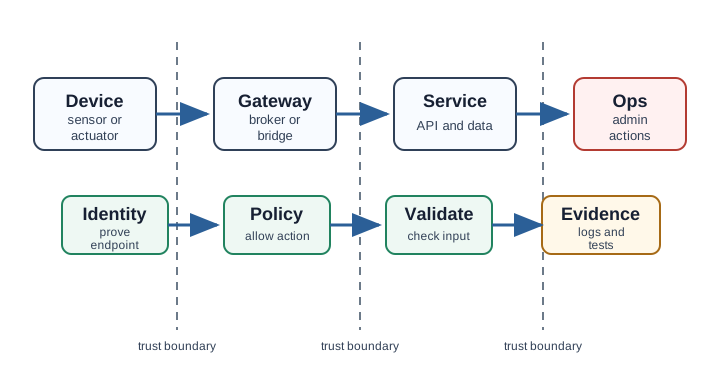
Follow the labeled evidence in Figure 5.1: actuator establishes context, Identity exposes the decisive step, and trust boundary shows where the result lands. That reading explains “An IoT security architecture review maps protected assets, data and command flows, trust boundaries, controls, and operational evidence” is explicit in the diagram. The chapter can now use Architecture Review Lens as an engineering criterion.
The map links an actuator and identity to a trust boundary. Test allowed and denied commands.
5.6 Trust Boundaries
This section: Trust Boundaries — A trust boundary appears wherever assumptions change.
A trust boundary appears wherever assumptions change. In IoT, common boundaries include:
- A physical device that can be accessed outside the operations team.
- A local network that connects devices with different roles.
- A gateway that translates between device protocols and service APIs.
- A broker that routes messages between publishers and subscribers.
- A service account or operator account that can change configuration.
- An update channel that can change device software.
- A data store that contains sensitive readings, events, or audit records.
Every boundary should have a named control and evidence. For example, “device to gateway” may require device identity, transport protection, replay resistance, payload validation, and connection logs. “operator to management service” may require strong authentication, role authorization, change approval, and audit trails.
The boundary is also where overclaims often appear. Encryption across one link does not prove that a command is authorized. A signed update does not prove that rollback and recovery are defined. A segmented network does not prove that a compromised maintenance account is limited.
5.7 Control Placement
This section: Control Placement — Control placement means deciding where a control belongs in the path.
Control placement means deciding where a control belongs in the path. Good placement is tied to the thing being protected.
Place identity controls near entry points. Devices, users, services, gateways, and maintenance tools should identify themselves before trusted actions are accepted.
Place authorization where decisions are made. A broker topic policy, API role check, gateway command filter, or device-side command rule should match the asset and action being protected.
Place validation before routing or execution. Messages, payloads, update metadata, and configuration changes should be checked before they affect device state or service records.
Place monitoring where failure would matter. Logs are useful when they capture denied actions, unusual flows, policy changes, and control failures that operators can review.
Place recovery near the blast radius. A security architecture should name how to disable a credential, isolate a segment, roll back a change, or restore a trusted state.
5.8 Attack Paths as Architecture Tests
This section: Attack Paths as Architecture Tests — An attack path is a route from an entry point to a protected asset.
An attack path is a route from an entry point to a protected asset. The goal is not to provide misuse instructions. The goal is to check whether the architecture still limits harm when one control is weak, bypassed, or misconfigured.
For each important asset, trace at least one path:
- Start with the protected asset or action.
- Name the entry point that can reach it.
- Mark each trust boundary on the route.
- List the controls at each boundary.
- Check which controls share the same credential, key, administrator, or network assumption.
- Record the evidence and any residual risk.
The risk in Attack Paths as Architecture Tests is skipping a necessary intermediate decision. Figure 5.2 prevents that shortcut by showing how “A security architecture evidence loop traces one protected asset path through flow, trust boundary, control placement, evidence, review decision, record, and design feedback” is explicit in the diagram.
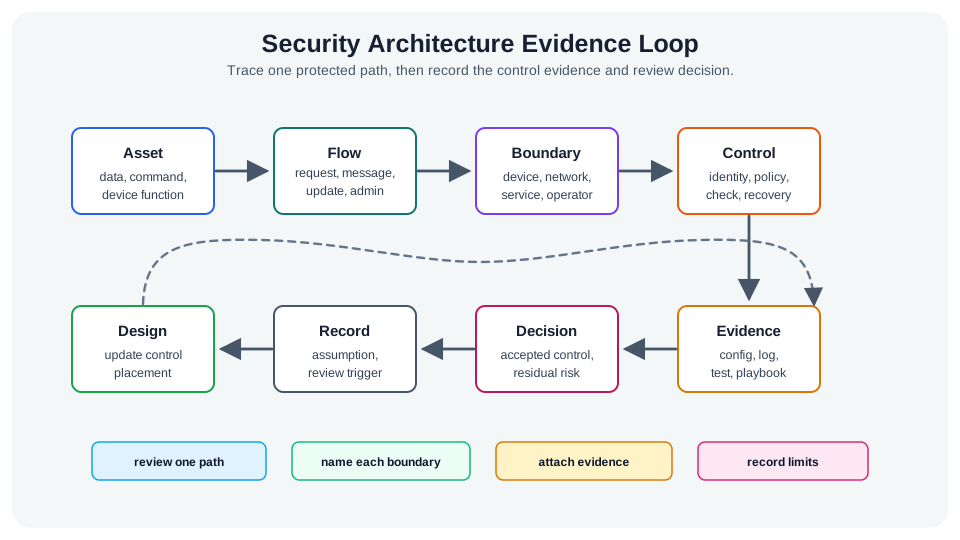
Figure 5.2 makes three checkpoints explicit: Asset, test, playbook, and record limits. The movement between them reveals “A security architecture evidence loop traces one protected asset path through flow, trust boundary, control placement, evidence, review decision, record, and design feedback” is explicit in the diagram. Keep that relationship in view as Attack Paths as Architecture Tests becomes an implementation or review decision.
Use the simulator below as a dry run. Start with one everyday IoT action, such as unlocking a door, installing firmware, or accepting a sensor reading. Then ask which identity is allowed, which boundary it crosses, which control checks it, and which record would prove the decision later.
5.9 Evidence Records
This section: Evidence Records — An evidence-bound architecture review can stay lightweight, but it should be explicit.
An evidence-bound architecture review can stay lightweight, but it should be explicit. For each important flow, record:
For each flow, log its asset, boundary, control, owner, expected act, and real result.
Evidence should be selective and directly connected to the flow being reviewed. A configuration file, access policy, test result, log sample, update record, or incident playbook can all be useful when they answer a specific security question.
5.10 Review Questions
This section: Review Questions — Ask who may cross each boundary, what happens on a denied request, and which log or test would let another reviewer repeat the check.
Use these questions to keep the review focused:
Ask who may cross each boundary, what happens on a denied request, and which log or test would let another reviewer repeat the check.
5.11 Common Pitfalls
This section: Common Pitfalls
-

Wrong: Layer names prove security. Tie each asset and flow to a control and proof.
5.11.1 Treating a Layer Diagram as a Security Architecture
Layer names become useful security information when they connect protected assets to flows, trust boundaries, controls, and evidence. Labels such as device, network, and service identify parts of a system, but do not explain who may issue a command or how operators would detect a failed control.
Review the diagram by tracing a specific action from its entry point to the asset it affects. Identify where trust changes, where identity is checked, and where authorisation decisions occur. Connect those controls to access policies, test results, or logs that support the stated behavior. Include monitoring and recovery on the same path. This gives reviewers a basis for assessing the security claim beyond the presence of labeled layers.
5.11.2 Counting One Dependency Multiple Times
Several controls may all depend on the same administrative account, credential store, or policy path. If that dependency fails, the layers may fail together. Mark shared dependencies during review.
5.11.3 Ignoring the Management Plane
Maintenance accounts, update services, configuration dashboards, and support workflows often have authority to change system behavior. Reviewing telemetry alone can leave these administrative routes outside the security assessment, even though they affect protected devices and services.
Trace a management action from the operator or service account through the relevant trust boundaries to the configuration or software it changes. Identify the authentication, role authorisation, change approval, and validation controls on that path. Check audit records and test results for evidence of permitted and denied actions. Also examine shared administrative dependencies and the recovery steps available if a credential or change causes harm. Network segmentation by itself does not establish how a compromised maintenance account is limited.
5.12 Knowledge Check
This section: Knowledge Check
5.13 Matching Quiz
This section: Matching Quiz
5.14 Ordering Quiz
This section: Ordering Quiz
5.15 The Weakest Path Sets the Risk
This section: The Weakest Path Sets the Risk — IoT security is not a feature you add to one component; it is a property of the entire path from sensor to cloud.
IoT security is not a feature you add to one component; it is a property of the entire path from sensor to cloud. Defense in depth places independent controls at each layer - device, gateway, network, and cloud - so that no single failure exposes the system. But the flip side is unforgiving: an attacker does not attack your strongest control, they attack your weakest, taking the cheapest path to the goal. The overall strength is closer to the minimum of the layers than the sum.
This reframes where effort should go. A system with hardware-protected keys in the cloud but a default admin password on the device is not “mostly secure”; it is as strong as that default password, because that is the door the attacker uses. Mapping the layers and honestly finding the weakest one matters more than polishing the strongest.
Intuition only: think like an attacker choosing the easiest way in. Money spent hardening an already-strong layer buys little; money spent raising the weakest layer buys the most.
A reviewable architecture also has to show the path being protected. Start with one asset or action, such as a door-unlock command, a firmware update, or a health reading. Trace the device, gateway, service, and operations path that can affect it. Mark each place where trust changes, then ask what proves identity, what authorizes the action, what validates input, and what evidence would show a failure. This prevents a layer diagram from becoming decoration; every box and arrow must answer a security question.
Why look now? The surrounding argument assumes that a useful architecture review follows a protected path across trust boundaries and ties each control to evidence that can be inspected. Figure 5.1 lets you verify that assumption inside The Weakest Path Sets the Risk.
The important evidence in Figure 5.1 is the relationship among actuator, Identity, and trust boundary. The first frames the issue, the second changes or constrains it, and the third makes the result visible. In this way the visual demonstrates a useful architecture review follows a protected path across trust boundaries and ties each control to evidence that can be inspected and advances The Weakest Path Sets the Risk.
5.15.1 Layers to Defend
Device
Credentials, secure boot, key storage, and locked debug ports at the physical edge.
Gateway
Authentication, filtering, and patching where field protocols meet the backhaul.
Network
Transport encryption, segmentation, and mutual authentication between parties.
Cloud
Access control, key management, and monitoring where data comes to rest.
5.15.2 Overview Knowledge Check
5.16 Trace the Cheapest Path Before You Spend
This section: Trace the Cheapest Path Before You Spend — Assess a design by listing each layer’s controls and tracing the cheapest path an attacker could take to the goal.
Assess a design by listing each layer’s controls and tracing the cheapest path an attacker could take to the goal. The strongest security investment is whatever raises the current weakest layer, not whatever improves an already-strong one.
5.16.1 Worked Example: Tracing the Cheapest Path
Consider a deployment with these layer strengths:
- Device: default admin password, no secure boot - weak.
- Local link: unencrypted - weak.
- Gateway: patched and authenticated - strong.
- Cloud: mutual TLS, multi-factor access, hardware-protected keys - very strong.
The attacker ignores the cloud entirely. They log into the device with the default password, read the unencrypted local traffic, and reach the data - never touching the strong layers. Pouring more budget into the already-excellent cloud changes nothing. Fixing the default credential and encrypting the local link - the two weakest layers - is what actually raises the system’s security. Defense in depth works only when every layer is credible, because the attacker always probes for the one that is not.
5.16.2 Layer Investment Ledger
Use the ledger as a decision tool, not a compliance worksheet. For each row, write the asset affected, the boundary crossed, and the observable proof you would expect after the fix. Replacing a default password is not complete until provisioning shows unique credentials, old shared credentials are refused, and logs prove failed attempts are visible. Encrypting the local link is not complete until both peers authenticate each other, weak protocol versions are disabled, and packet capture or test output confirms that sensitive payloads are not readable on the field network. These evidence checks keep the review from rewarding work that sounds secure but does not change the cheapest path.
When budget is limited, separate urgent exposure from architectural cleanup. A weakness on the live command path needs immediate remediation or compensating controls such as segment isolation, credential rotation, or command disablement. A weakness off the protected path may still matter, but it should not outrank the path an attacker can already use.
5.16.3 Practitioner Knowledge Check
5.17 Trust Starts With a Verifiable Root
This section: Trust Starts With a Verifiable Root — At the device layer, the foundation of the whole security architecture is a root of trust and the secure boot chain built on it.
At the device layer, the foundation of the whole security architecture is a root of trust and the secure boot chain built on it. Secure boot works by having each stage cryptographically verify the signature of the next before executing it: an immutable ROM boot stage checks the bootloader, the bootloader checks the operating system or firmware, and that checks the application. The chain needs a protected trust anchor; one common design uses boot ROM with a fused key or key hash, while other designs can use a protected key in a secure element. Every stage inherits trust from the one that verified it, all the way down to that immovable anchor.
The subtlety is that the chain is only as trustworthy as its weakest verification. If any stage loads the next without checking a signature, trust is broken from that point up: a properly verified bootloader that then launches an unsigned application gives an attacker a foothold despite the “secure boot” label. Likewise, if an attacker can replace the protected anchor or use an unlocked bootloader to bypass verification, they can break the chain even if the later stages are signed. Trust cannot be stronger than its anchor or its weakest link, the same principle as the layers above. The complementary discipline is least privilege: authentication proves who a component is, but authorization must still limit what it may do, so a compromised or spoofed component cannot pivot beyond its role.
Architecture review turns those mechanics into questions. Which public key or hash anchors boot verification? Is it stored in immutable ROM, one-time-programmable fuses, a TPM, or a secure element, and who can update it? Which firmware image formats are signed, which rollback counters prevent an old vulnerable image from loading, and what recovery path exists if a good update fails? At runtime, which component can request a key operation, and does the authorization rule live inside the protected boundary or in ordinary application code? The answers decide whether “secure boot” and “hardware key storage” are real architecture controls or just product labels.
5.17.1 Foundations of Device Trust
Verify each stage
Every boot stage checks the next's signature before running it; a skipped check breaks the chain above.
Immutable anchor
The root must be protected against unauthorized change, for example with a fused key and boot ROM, or the whole chain can be forged.
Least privilege
Authentication proves identity; authorization must still bound what each component can do.
No trust above a gap
An unsigned stage or unlocked bootloader invalidates the trust of everything that runs after it.
5.17.2 Under-the-Hood Knowledge Check
5.18 Summary
This section: Summary — Security architecture is the connection between a threat model and a reviewable design.
Security architecture is the connection between a threat model and a reviewable design. It names protected assets, traces flows, marks trust boundaries, places controls, and records evidence. The review should not accept a generic layer diagram as proof of security. It should ask what each control protects, where it sits, what it depends on, and what evidence supports the claim.
The strongest architecture reviews also plan for failure. They check whether controls are independent, whether monitoring can reveal problems, and whether recovery steps can limit harm after a control fails.
5.19 Key Takeaway
This section: Key Takeaway — Security architecture should make assets, flows, identities, trust boundaries, controls, monitoring, and recovery paths visible in one design.
Security architecture should make assets, flows, identities, trust boundaries, controls, monitoring, and recovery paths visible in one design.
5.20 Concept Relationships
This section: Concept Relationships — Link each asset and flow to its identity, control, logs, and recovery path.
Link each asset and flow to its identity, control, logs, and recovery path.
5.21 What’s Next
This section: What’s Next — Next, connect this review lens to Security Overview Design Principles, where architecture choices become design principles such as least privilege, secure defaults, fail-safe behavior, and defense in depth.
Next, connect this review lens to Security Overview Design Principles, where architecture choices become design principles such as least privilege, secure defaults, fail-safe behavior, and defense in depth.
For more focused practice, review Threat Modelling and Mitigation and Cyber Security Defense in Depth.
Find help
3 reviewed answers.
Where should I start in a module?
Open the module page from the sidebar to see its chapters in order. Use the module map to return to a topic you need.
Modules and pathsReviewed
What can I try when a project does not work?
Check the symptom, then work through the diagnostic steps. Keep the error message and the smallest example that reproduces it.
When you are stuckReviewed
How do interactive examples work?
Use the interactive guide to check how examples and simulations work before changing your project.
Interactive examples guideReviewed