Apply NIST Cybersecurity Framework five core functions (Identify, Protect, Detect, Respond, Recover) to map security activities for IoT systems
Implement ETSI EN 303 645 thirteen provisions including no default passwords and secure updates for consumer IoT
Design IEC 62443 zone-and-conduit architectures with appropriate security levels (SL 1-4) for industrial IoT deployments
Develop FDA-compliant cybersecurity documentation including SBOM and vulnerability management plans for medical devices
Evaluate and select appropriate compliance frameworks based on industry sector, risk profile, and regulatory requirements
In 60 Seconds
IoT security compliance — with GDPR, HIPAA, IEC 62443, ETSI EN 303 645, and sector-specific regulations — establishes legally mandated minimum security baselines and creates accountability mechanisms for IoT data handling and device security. The critical distinction is that compliance is necessary but not sufficient for security: meeting regulatory requirements provides a floor, not a ceiling, and actual security requires going beyond compliance to address all realistic threats.
For Beginners: IoT Security Compliance Frameworks
Security frameworks and standards provide structured approaches to protecting IoT systems. Think of them as building codes for digital security – just as building codes ensure houses are structurally safe, security frameworks ensure IoT systems follow proven practices for protecting data and devices against threats.
Sensor Squad: Following the Safety Rules!
“Compliance is a big word that means following the rules!” Max the Microcontroller explained. “Different industries have different rule books for IoT security. If you make medical devices, the FDA has rules. If you make consumer gadgets, ETSI has rules. If you work with US government systems, NIST has rules.”
Sammy the Sensor asked, “But why do we need so many different rule books?”
“Because different devices face different risks!” Lila the LED answered. “A smart toy needs different security than an insulin pump. The insulin pump could hurt someone if hacked, so it has much stricter rules. NIST uses five steps: Identify what you have, Protect it, Detect problems, Respond to incidents, and Recover afterward. It is like a five-step recipe for staying safe.”
“The ETSI EN 303 645 standard has thirteen simple provisions for consumer IoT,” Bella the Battery said. “Rule number one: no universal default passwords. Rule two: implement a way to report vulnerabilities. Rule three: keep software updated. These sound basic, but if every IoT manufacturer followed just these thirteen rules, most of the major IoT attacks in history would never have happened! Compliance is not just about passing an audit – it is about genuinely protecting people.”
39.2 IoT Security Compliance Quick Reference
Time: ~20 min | Level: Intermediate
Key Concepts
GDPR: The EU General Data Protection Regulation — applies to any IoT system processing personal data of EU residents, requiring data minimisation, purpose limitation, consent, and breach notification.
IEC 62443: An international standard for industrial cybersecurity defining security levels (SL 1–4) for zones and conduits in industrial IoT systems — the primary compliance framework for industrial automation and SCADA.
ETSI EN 303 645: A European consumer IoT security standard establishing thirteen baseline requirements including prohibition of universal default passwords and a vulnerability disclosure policy.
HIPAA: The US Health Insurance Portability and Accountability Act — applies to IoT medical devices and health monitoring systems handling protected health information (PHI), requiring technical, physical, and administrative safeguards.
FCC IoT security labelling: A US programme requiring IoT devices to meet minimum security criteria to display a government-endorsed label, creating market incentives for security improvements in consumer devices.
Software Bill of Materials (SBOM): A machine-readable inventory of all software components in IoT firmware, increasingly required by regulations to enable rapid vulnerability response when CVEs affecting component libraries are disclosed.
Understanding threats and vulnerabilities is essential, but demonstrating compliance with security standards is often required for IoT deployments in regulated industries. This section provides practical guidance on major security compliance frameworks and their application to IoT systems.
Security Compliance Framework Comparison
Different industries and regions require compliance with specific security standards:
Framework
Scope
IoT Relevance
Key Requirements
Certification Required
Industry Focus
NIST Cybersecurity Framework
US federal agencies + voluntary adoption
High - comprehensive IoT guidance
Identify, Protect, Detect, Respond, Recover
No (self-assessment)
Cross-industry
ISO/IEC 27001
Information security management
High - applies to all IT/IoT systems
ISMS, risk assessment, security controls
Yes (3rd party audit)
Cross-industry
IEC 62443
Industrial control systems
Critical for IIoT
Security levels (SL 1-4), zone segmentation
Yes (component/system certification)
Industrial IoT, OT
ETSI EN 303 645
Consumer IoT security
Very high - designed specifically for IoT
13 provisions (no default passwords, secure updates, etc.)
Vulnerability testing, known vulnerability assessment
Yes (UL certification)
Consumer electronics, IoT
FIPS 140-2/3
Cryptographic modules
Critical for government/regulated use
Cryptographic algorithm and implementation validation
Yes (NIST validation)
Government, financial, healthcare
PCI DSS
Payment card data security
Medium for payment IoT
Secure network, encryption, access control
Yes (QSA audit)
Retail IoT, payment terminals
39.3 NIST Cybersecurity Framework for IoT
The National Institute of Standards and Technology (NIST) provides comprehensive IoT security guidance through multiple publications, with the Cybersecurity Framework being widely adopted across industries.
The European standard EN 303 645 defines 13 security provisions specifically for consumer IoT devices. This is becoming a global baseline for IoT security.
39.4.1 The 13 Provisions
#
Provision
Requirement
IoT Implementation
Verification
1
No default passwords
Unique passwords per device OR user-set password on first use
Generate unique password per device, printed on label
Test: Can device be accessed with default credentials?
2
Implement vulnerability disclosure policy
Public contact point for security researchers
security@company.com, HackerOne program
Test: Is security contact publicly documented?
3
Keep software updated
Security updates for defined support period
OTA updates, automatic update mechanism
Test: Can device receive and install updates?
4
Securely store sensitive data
Encrypt credentials and personal data
AES-256 encryption for stored passwords, keys in Secure Element
Test: Extract firmware and search for plaintext secrets
5
Communicate securely
Use TLS/DTLS for network communications
TLS 1.3 with certificate validation, no plaintext protocols
Test: Packet capture shows encrypted traffic
6
Minimize exposed attack surfaces
Disable unused services, ports, protocols
Close unnecessary ports, disable debug interfaces in production
Test: Port scan reveals only required services
7
Ensure software integrity
Verify firmware authenticity before installation
Cryptographic signature verification, secure boot
Test: Can unsigned firmware be installed?
8
Ensure personal data is secure
Comply with data protection regulations (GDPR)
Encryption, access control, data minimization
Test: Review data collection and storage practices
9
Make systems resilient to outages
Graceful degradation, local operation capability
Device functions locally during internet outage
Test: Disconnect from internet, verify local operation
10
Examine system telemetry data
Monitor security events and anomalies
Log security events, integrate with SIEM
Test: Generate security event, verify logged
11
Make it easy for users to delete personal data
User-accessible data deletion mechanism
Factory reset, cloud account deletion with data removal
Deliverable: User guide, security policy, validation test results
39.4.3 The Cost of Non-Compliance: Real Enforcement Actions
The EU Cyber Resilience Act (CRA), entering force in 2027, makes ETSI EN 303 645 provisions legally binding. But enforcement is already happening through consumer protection agencies:
150,000 cameras with shared admin credentials (Provision 1)
Accessed by hackers; showed Tesla factories, hospitals, jails. $2.95M FCC fine
2023
Amazon (Alexa/Ring)**
Retained children’s voice recordings after deletion requests (Provision 11)
$30.8M combined FTC settlement
2024
EU RED delegated act**
Products without ETSI compliance marks
Cannot carry CE marking; blocked from EU sale entirely
Key insight for IoT startups: Compliance is not optional overhead – it is market access. A product blocked from the EU loses 450 million potential customers. The 26-week implementation roadmap above costs approximately $50K-$100K in engineering time. The Verkada fine alone ($2.95M) would have funded compliance for 30-60 products.
39.4.4 Real-World ETSI Compliance Examples
Good Example: Philips Hue
Provision 1: Requires user to set password on first setup
Provision 3: Regular automatic firmware updates
Provision 5: Encrypted communication with cloud services
Provision 7: Signed firmware updates verified before installation
Bad Example: Many cheap IP cameras
Provision 1: Ships with “admin/admin” default credentials
The U.S. Food and Drug Administration (FDA) provides cybersecurity guidance for medical devices, including IoT devices like insulin pumps, pacemakers, and remote patient monitoring systems.
39.6.1 FDA Premarket Guidance (2023)
Requirement
Description
Example for IoT Medical Device
SBOM (Software Bill of Materials)
List of all software components including versions
Document all third-party libraries, OS components, open-source code
Cybersecurity Risk Management
Threat modeling and risk assessment
STRIDE analysis, attack tree, FMEA for cybersecurity
Worked Example: Achieving ETSI EN 303 645 Compliance for a Smart Thermostat
Product: ConnectTherm Pro - A Wi-Fi smart thermostat with mobile app control, learning algorithms, and integration with smart home platforms (Alexa, Google Home).
Business Context: European startup launching in UK, France, Germany. EU Radio Equipment Directive (RED) delegated act mandates ETSI EN 303 645 compliance for CE marking. Non-compliance = unable to sell in EU (450M population market).
Compliance Gap Analysis (Initial Product vs ETSI Requirements):
Provision
Requirement
Current State
Compliance Gap
Remediation Cost
1: No default passwords
Unique password per device OR user-set on first use
Ships with default “admin:admin”
NON-COMPLIANT
Generate unique 12-char password per device, print on label ($0.05/device)
2: Vulnerability disclosure
Public security contact
No security contact listed
NON-COMPLIANT
Create security@connecttherm.com, publish on website (1 hour)
HTTPS to cloud, but certificate validation disabled
PARTIALLY COMPLIANT
Enable certificate pinning (3 days)
6: Minimize attack surface
Disable unused services
Telnet enabled on port 23 for debugging
NON-COMPLIANT
Disable Telnet in production builds (1 hour)
7: Software integrity
Verify firmware authenticity
No signature verification
NON-COMPLIANT
Covered by Provision 3 fix
8: Personal data protection
GDPR compliance
Collects temperature schedule (personal data), no data minimization
PARTIALLY COMPLIANT
Add privacy policy, data retention limits (1 week legal)
9: Resilient to outages
Local operation during internet outage
Requires cloud connection for all operations
NON-COMPLIANT
Add local schedule execution (2 weeks)
10: Monitor telemetry
Log security events
No logging
NON-COMPLIANT
Add syslog to cloud (1 week)
11: Delete personal data
User-accessible deletion
No data deletion feature
NON-COMPLIANT
Add “delete my data” button in app (1 week)
12: Easy installation
Security guidance for users
Quick start guide has no security section
NON-COMPLIANT
Add 1-page security setup guide (2 days)
13: Input validation
Sanitize external input
SQL queries use string concatenation
NON-COMPLIANT
Migrate to parameterized queries (1 week)
Implementation Plan (8 weeks to full compliance):
Week 1-2: Critical Gaps (Provisions 1, 6)
Provision 1: Firmware change to generate unique password on first boot using ESP32 hardware RNG. Format: 3 random words + 3 digits (e.g., “horse-battery-staple-429”). Print password on QR code sticker affixed to device. User scans QR code during setup instead of typing “admin”.
Bootloader verification: Before flashing, verify signature using public key in bootloader
Cost: 60 hours development + €2,000 HSM hardware
Provision 9: Local operation during internet outage
Current: Device bricks when cloud is unreachable
Fix: Store active schedule in local flash memory. If cloud unavailable >60 seconds, execute schedule locally. Resume cloud sync when connection restored.
ROI: Infinite (compliance is mandatory for market access)
Verification (Self-Assessment Checklist):
After 8-week implementation, conduct internal audit: - ✅ Provision 1: Port scan shows no default credentials accepted - ✅ Provision 2: security@connecttherm.com responds to test vulnerability report - ✅ Provision 3: Attempt to flash unsigned firmware → rejected by bootloader - ✅ Provision 4: Extract flash memory via UART → data is encrypted - ✅ Provision 5: Wireshark capture shows TLS 1.3 to cloud - ✅ Provision 6: Port scan shows only 443 (HTTPS), 80 (HTTP redirect), no Telnet - ✅ Provision 7: Covered by Provision 3 verification - ✅ Provision 8: Privacy policy published, GDPR-compliant - ✅ Provision 9: Disconnect internet → thermostat continues operating on schedule - ✅ Provision 10: Failed login attempts logged to CloudWatch - ✅ Provision 11: App “Delete My Data” button wipes all user data - ✅ Provision 12: Quick start guide includes security setup section - ✅ Provision 13: SQL injection payload '; DROP TABLE schedules; -- is rejected
Outcome: Product certified ETSI EN 303 645 compliant, earns CE marking, approved for sale in EU. Compliance badge displayed on product packaging increases consumer trust and differentiates from non-compliant competitors.
Decision Framework: Selecting the Right Security Compliance Framework for Your IoT Product
Different industries and markets require different security frameworks. This table helps you select which frameworks apply to your product.
If your product is…
Required Framework(s)
Certification Type
Estimated Compliance Cost
Time to Certification
Consequence of Non-Compliance
Consumer IoT sold in EU (smart home, wearables)
ETSI EN 303 645 (mandatory 2025+)
Self-declaration (but auditable)
€20K-€50K engineering
2-3 months
Cannot obtain CE marking → blocked from EU sale
Consumer IoT sold in US (cameras, locks, thermostats)
UL 2900-1 (cybersecurity standard) + ioXt Alliance
3rd party lab testing
€30K-€100K (lab fees + fixes)
4-6 months
Not legally required, but retailers (Best Buy, Amazon) may refuse to stock non-certified products
Industrial IoT (factory sensors, PLCs, SCADA)
IEC 62443-4-2 (component security)
3rd party certification
€50K-€200K (depends on SL)
6-12 months
Not legally required, but customers (OEMs, industrial firms) contractually require it
Medical IoT (patient monitors, infusion pumps, pacemakers)
FDA Cybersecurity Guidance (premarket) + UL 2900-2-1 (medical-specific)
FDA approval required
€200K-€500K (regulatory + testing)
12-24 months
Cannot sell in US without FDA clearance. EU requires MDR compliance.
Low-risk (environmental sensors): NIST CSF (best practice), ETSI EN 303 645 (if EU)
What’s your budget?
<€20K: NIST CSF (self-assessment), ETSI EN 303 645 (self-declaration)
€20K-€100K: UL 2900-1, IEC 62443-4-2 (SL1/SL2)
€100K-€500K: FDA premarket, FIPS 140-3, IEC 62443-4-2 (SL3/SL4)
€500K+: Aviation (DO-326A), automotive type-approval (UN R155 + ISO 21434)
Multiple Frameworks (Common Combinations):
Many products require compliance with multiple frameworks: - Medical device in EU: FDA + ETSI EN 303 645 + MDR (EU Medical Device Regulation) - Industrial PLC in US: IEC 62443-4-2 + UL 2900-1 + NIST CSF - Smart meter in EU: ETSI EN 303 645 + IEC 62443 (if SCADA integrated) + GDPR - Government IoT in US: NIST SP 800-53 + FIPS 140-3 + FedRAMP (if cloud component)
Best For (Summary): - Startups (limited budget): Start with NIST CSF (free, self-assessment) + ETSI EN 303 645 (if EU target) - Consumer products: ETSI EN 303 645 (mandatory EU), UL 2900-1 (market expectation US) - Industrial products: IEC 62443-4-2 (customer contracts require it) - Medical products: FDA premarket guidance (no choice - regulatory requirement) - Government contracts: NIST SP 800-53 + FIPS 140-3 (contractual requirement)
The “Good Enough” Baseline (if uncertain): If you’re unsure which framework applies, start with ETSI EN 303 645 (13 provisions). It covers 80% of IoT security best practices and is becoming the de facto global baseline even outside the EU. Cost is reasonable (€20K-€50K), and many other frameworks (UL 2900, IEC 62443, NIST CSF) have overlapping requirements, so ETSI compliance accelerates achieving other certifications.
Common Mistake: Treating Compliance as a One-Time Checklist Instead of Continuous Process
The Mistake: Many IoT manufacturers treat security compliance as a one-time project. They hire consultants, pass the audit, obtain the certification, and then consider security “done.” The compliance documentation sits on a shelf while the product evolves, new vulnerabilities are discovered, and the threat landscape changes. No one updates the security controls or re-verifies compliance until the next audit cycle (often years later).
Why This Fails:
Products Evolve, But Security Controls Don’t: After achieving IEC 62443 certification, a manufacturer adds new features (cloud integration, third-party API, mobile app) without updating the threat model or re-assessing security controls. The new features introduce vulnerabilities (API injection, cloud misconfiguration) not covered by the original certification. The product is certified but insecure.
Vulnerability Disclosure Requires Ongoing Response: ETSI EN 303 645 Provision 2 requires a vulnerability disclosure policy. But having security@company.com is useless if no one monitors it. A security researcher reports a critical firmware vulnerability via the published email. The email sits unread for 6 months. The researcher publicly discloses the vulnerability (responsible disclosure period expired). The company is compliant on paper but violated in practice.
Regulations Change, Certifications Expire: IEC 62443-4-2 certification is valid for 3 years. After certification, the standard is updated (IEC 62443-4-2 Edition 2.0 in 2024 adds new requirements). The manufacturer continues selling products certified under the old standard. Customers assume the product meets the latest standard. Contract disputes arise. Legal liability increases.
Zero-Day Vulnerabilities Emerge: A product achieves UL 2900-1 certification in 2022. In 2023, a critical vulnerability is discovered in the OpenSSL library used by the product (similar to Heartbleed 2014). The manufacturer does not monitor CVE databases or security advisories. Customers deploy thousands of devices with the known vulnerability. A breach occurs. Customers sue, arguing the manufacturer failed to maintain security despite certification.
Audit Evidence Becomes Stale: NIST SP 800-53 requires audit logging (AU-2). The manufacturer configures logging for certification. Six months later, a DevOps engineer disables logging to “improve performance.” No one notices because security reviews only happen during annual audits. When an incident occurs, there are no logs to investigate. The organization was compliant at audit time but non-compliant during the breach.
In 2019, security researchers discovered critical vulnerabilities in Medtronic MiniMed insulin pumps (CVE-2019-10964, CVE-2019-10965): - Unencrypted wireless communication allowed attackers to replay commands, delivering unauthorized insulin doses (life-threatening) - The pumps had FDA clearance based on 2006 cybersecurity standards
Timeline of Compliance Failure:
2006: Pumps certified under FDA guidance (minimal cybersecurity requirements at the time)
2013: FDA issues updated cybersecurity guidance (wireless medical devices must encrypt communications)
2018: FDA Premarket Guidance mandates threat modeling and SBOM
2019: Researchers report unencrypted communication vulnerability (violates 2013 and 2018 guidance)
2020: FDA orders firmware update for 4,000+ implanted pumps
Root Cause: Medtronic treated 2006 FDA clearance as permanent. They did not re-assess the devices against updated guidance (2013, 2018) or monitor for emerging cryptographic vulnerabilities. The pumps were “certified” but remained dangerously insecure for 13 years.
The Correct Approach (Compliance as Continuous Process):
Threat Intelligence: Participate in ISAOs (Information Sharing and Analysis Organizations) for your sector (ICS-CERT for industrial, FDA MedWatch for medical)
Responsible Disclosure Response SLA: Acknowledge vulnerability reports within 48 hours, provide fix timeline within 30 days, deploy patch within 90 days (coordinated disclosure standard)
3. Continuous Compliance Auditing:
Self-Assessment Cadence: Quarterly internal audits using ETSI EN 303 645 checklist
Automated Scanning: Weekly Nessus/OpenVAS scans for new vulnerabilities
Penetration Testing: Annual 3rd-party pentest to verify controls remain effective
Regression Testing: Security test suite runs on every firmware build (CI/CD integration)
4. Regulatory Change Tracking:
Subscribe to Updates: IEC 62443 working group mailing list, FDA cybersecurity page, ETSI notifications
Impact Assessment: When new regulation published (e.g., EU Cyber Resilience Act 2027), assess gap within 30 days
Roadmap Integration: Schedule compliance work 12 months before regulatory deadline (not 1 month)
5. Version Control for Compliance Artifacts:
Threat Model: Store in Git, update quarterly or when architecture changes
SBOM: Auto-generate on every build using CycloneDX/SPDX tools, publish on website
Security Test Results: Store in version control with firmware version linkage
Audit Evidence: Immutable logs (WORM storage) proving controls were active at any point in time
6. Customer Communication:
Security Bulletin Page: https://company.com/security lists all CVEs, patches, EOL dates
Proactive Notifications: Email customers immediately when critical vulnerability discovered (don’t wait for them to ask)
Compliance is not a finish line. It’s an ongoing responsibility. The moment you stop monitoring, patching, and updating security controls, your compliance certification becomes a false promise. Security frameworks are living documents. Your compliance must be equally alive. The Medtronic insulin pump case proves that a 13-year-old certification is worthless against modern threats. Continuous compliance is not optional overhead - it’s the minimum viable security practice for responsible IoT manufacturers.
Putting Numbers to It: Compliance Coverage Calculation
Quantitative measurement of security framework compliance using control implementation percentage and weighted scoring.
ISO 27001 Control Coverage Formula: \[\text{Coverage} = \frac{\text{Implemented Controls} + 0.5 \times \text{Partially Implemented}}{\text{Total Required Controls}}\]
Working through an example: Given: IoT manufacturer pursuing ISO 27001 certification (114 Annex A controls) - Fully implemented: 87 controls - Partially implemented: 18 controls - Not implemented: 9 controls
Result: Average finding severity = 4.9 (between Medium and High - significant compliance debt requiring remediation)
In practice: Compliance is binary (certified or not), but coverage calculation shows progress and gaps. 84.2% ISO 27001 coverage means 9 critical controls missing - certification will fail. ETSI 80.8% means product cannot legally ship in EU (requires 100%). Weighted finding score (4.9) guides budget allocation: prioritize the 2 Critical findings (score 10 each) over the 4 Low findings (score 1 each). Quantifying compliance debt enables CFO to understand: “We need $40K to close the 19.2% gap and obtain certification.”
Key Insight: Frameworks are complementary, not competing. ETSI tells you WHAT (13 provisions), NIST tells you HOW (5-function process), IEC 62443 tells you security LEVEL (SL 1-4), ISO 27001 provides AUDIT structure. Most products need multiple frameworks.
1. Treating compliance as achieved once controls are implemented
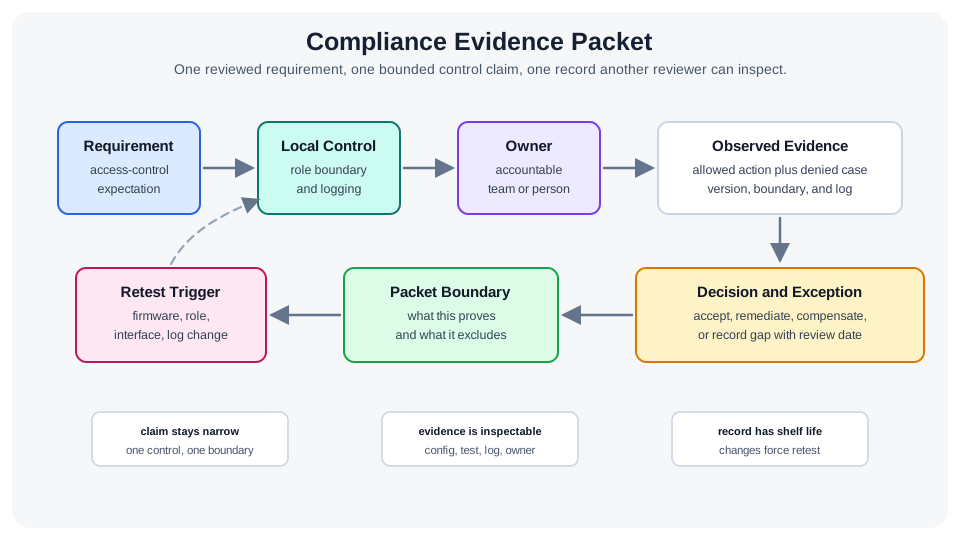
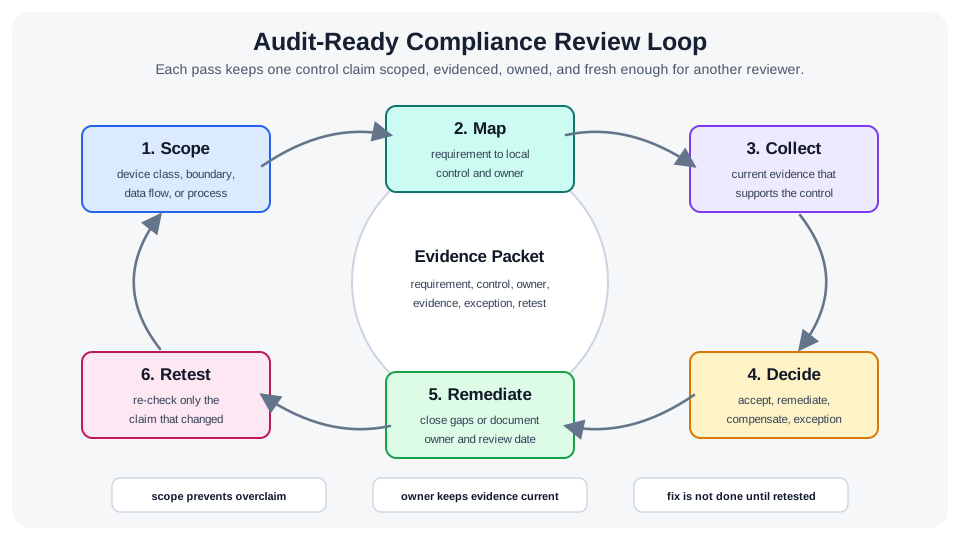
Compliance requires ongoing maintenance: certificates expire, logs fill up, access control lists drift. Implement automated compliance monitoring and schedule periodic audits to verify that controls continue to function correctly.
2. Assuming compliance in one jurisdiction covers all deployment locations
A device compliant with ETSI EN 303 645 in Europe may not satisfy California’s SB-327 IoT security law or HIPAA requirements in the US. Audit compliance requirements for every jurisdiction where devices are deployed.
3. Conflating compliance audit results with actual security posture
A compliant system may still have significant vulnerabilities not covered by the applicable standard. Use compliance as a minimum baseline and supplement it with threat modelling, penetration testing, and vulnerability management.
4. Not involving legal and privacy teams in compliance programme design
IoT security engineers who design compliance programmes without legal input may miss regulatory nuances, misinterpret requirements, or fail to document compliance evidence in a format acceptable to auditors. Involve legal counsel from the start.