11 IoT Attack Scenarios
Conditions, Boundaries, Controls, Evidence, and Retest
IoT attack scenarios, defensive scenario review, attack path evidence, IoT threat review, mitigation evidence, residual risk
11.1 Start Simple: Test One Expected Block
Start with one expected refusal. A sensor identity should publish telemetry, but it should not change an actuator command route or publish outside its assigned topic. A defensive scenario asks whether that refusal is actually shown by policy, logs, and denied-case evidence.
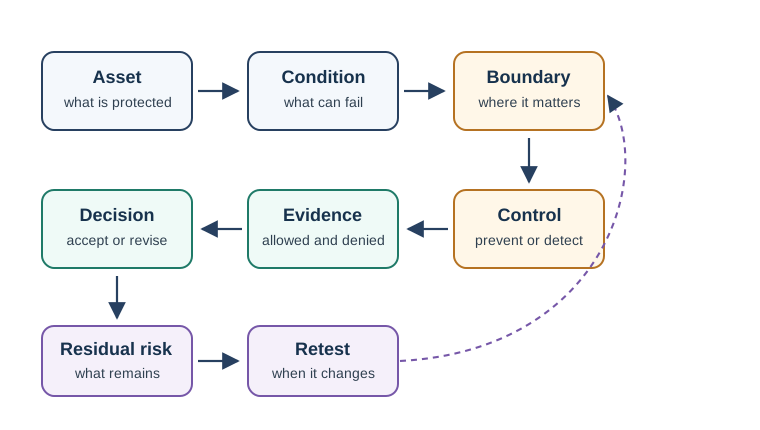
That is why this chapter treats scenarios as review packets. The scenario does not need a misuse recipe; it needs a condition, a boundary, a control that should respond, evidence for both allowed and denied cases, residual risk, and a retest trigger.
11.2 A Scenario Is a Defensive Review Packet
An attack scenario is useful when it tests whether a threat model is specific enough to act on. It is not a misuse recipe. A good scenario record names the protected asset, the condition that makes harm plausible, the trust boundary involved, the control that should reduce the risk, the evidence that supports the control, and the trigger that requires retest.
The important shift is from narrative to evidence. A dramatic story about an attacker is not a review. A scenario record asks a bounded question: what condition is being reviewed, what evidence would confirm or weaken the control claim, what mitigation fits the condition, and what residual risk remains.
For example, a warehouse gateway might review the condition “an enrolled sensor identity can publish readings outside its assigned zone.” The packet names telemetry and the dispatch record as assets, the device-to-gateway publish boundary, the expected topic or route authorization, the schema validation rule, accepted-message evidence, denied out-of-zone evidence, and residual risk if only the gateway enforces the rule. Retest is triggered by a topic change, schema change, gateway rule change, or dispatch-decision change.
If you only need the intuition, this layer is enough: a scenario is a compact defensive packet. It states a plausible condition, marks the boundary, names the expected control, lists the evidence for the allowed and denied cases, and records residual risk and a retest trigger.
Think of a fire drill. The point is not to set a real fire; it is to test whether the alarm sounds, the exits open, and people respond, and to record what failed. A scenario does the same for security controls: it checks whether the expected control and its evidence exist, without performing the attack.
The One-Minute View
A condition, not a recipe
State the reviewed condition defensively. “An identity can publish outside its assigned topic” is enough to drive review.
Evidence over narrative
The value is the evidence requested at the boundary, not the drama of the story around it.
Denied case and residual risk
A scenario closes only with denied-case evidence, recorded residual risk, and a retest trigger.
Beginner Examples
- “A device identity can publish outside its assigned topic” is a usable condition; a step-by-step publish exploit is not needed and should be avoided.
- Testing only the expected, allowed path does not show that the boundary blocks the unwanted one.
- “Encryption is on” does not answer a command-authorization condition; the right control must fit the condition.
Overview Knowledge Check
If you can describe a scenario as a defensive evidence packet, you can stop here. Continue to Practitioner to build one and match a mitigation.
11.3 Build a Scenario Record and Match Mitigations
Start with the asset and a reviewed condition stated in defensive terms. Then mark the boundary, name the control expected there, and collect evidence for both the allowed case and the denied case before deciding on a mitigation.
Walkthrough: From Asset to Retest Trigger
- Name the asset or protected action.
- State the condition in defensive terms, without misuse steps.
- Mark the boundary where the condition matters and the affected security property.
- Identify the control expected to prevent, detect, limit, or recover.
- Collect evidence for the control, including the denied case.
- Decide whether the mitigation is accepted, revised, or retested.
- Record residual risk and the retest trigger.
Scenario Families and Their Evidence
Scenarios group by the security question they test. The families below are prompts for evidence-bound review, not a list of every possible threat. Select a mitigation because it fits the condition, not because it is generally good.
Availability scenarios include denial-of-service conditions where a service cannot answer legitimate devices or users. In a simple DoS review, one source or path overwhelms capacity or sends malformed traffic that the receiver cannot handle safely. In a DDoS review, many compromised devices send the pressure at once; when those devices are centrally controlled they form a botnet. The Mirai lesson is the defensive pattern: default or weak credentials plus reachable services can turn ordinary IoT devices into attack traffic, so the evidence should cover unique credentials, constrained remote access, rate behavior, monitoring, isolation, and recovery.
Use Taxonomies to Check Coverage
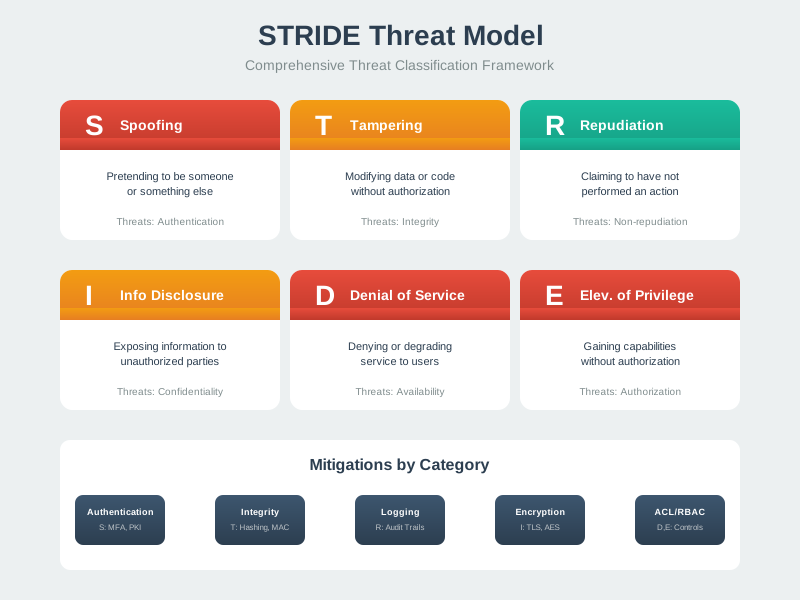
Threat taxonomies are useful after the scenario family is named because they reveal missing assets or paths. A broad taxonomy may group threats as physical, resource, personnel, and technical conditions. In IoT reviews the technical bucket often expands into credential discovery, privilege escalation, cryptanalysis, denial of service, data capture or manipulation in transit, and application exploitation through code injection, reverse engineering, input manipulation, or API abuse. Those labels are prompts for review evidence; they are not findings until they are tied to a concrete asset and boundary.
An IoT asset pass should cover more than the device. Include infrastructure such as routers, gateways, power supply, firewalls, access brokers, IDS or IPS, and authentication systems; platform and backend services such as web services, cloud infrastructure, data mining, data processing, device management, and usage records; information at rest, in transit, and in use; device hardware, firmware, software, sensors, and actuators; companion ecosystem devices such as phones, tablets, management consoles, and embedded systems; and communications assets such as LAN, WAN, VPN, PAN, Bluetooth LE, Zigbee, Z-Wave, Wi-Fi, MQTT, CoAP, LoRaWAN, 6LoWPAN, and NB-IoT.
A threat pass can then look for nefarious activity or abuse, eavesdropping and hijacking, outages, IT-asset loss, failures or malfunctions, disasters, and physical attacks. Typical rows include malware, exploit kits, targeted attacks, DDoS, counterfeit devices, privacy attacks, information modification, man-in-the-middle paths, IoT communication protocol hijacking, interception, network reconnaissance, session hijacking, replayed messages, software vulnerabilities, third-party failures, device modification, and sabotage. The scenario record should state which affected assets are in scope and which are deliberately out of scope.
For impact ranking, use the scenario wording to keep the review concrete: controller-to-actuator link compromise, sensor value or threshold manipulation, actuator setting sabotage, administration-system takeover, protocol-vulnerability exploitation, privileged command injection through a system console, stepping-stone hosts, botnet DDoS, power-source or battery-reading manipulation, and ransomware. Rank these by the protected action and consequence in the local system; “high” or “crucial” only matters when the evidence shows which people, processes, devices, or services would be affected.
11.3.1 Critical Scenario Review Records
When a scenario is judged critical, keep the record defensive and evidence-led. An administration-system compromise review should ask whether one management foothold could take over devices, gateways, software, phones, tablets, or sensitive information across the IoT environment. The evidence is not a misuse procedure; it is the control record: device and component inventory, constrained administration paths, signed code or runtime integrity checks, authenticated software installation, restore-to-secure-state capability, default-credential removal, least privilege, strong authentication, event logging, behavior monitoring, and product-lifecycle ownership.
A sensor-value manipulation review should focus on the accepted data path. For an industrial robot or actuator system, the condition is that calibration parameters, thresholds, or sensor values can be changed or accepted in a way that drives wrong decisions. The review should request configuration-control records, tamper-detection evidence, data input validation, output filtering, safety-aware design limits, behavior monitoring, and training or operating procedures for the people who maintain those values.
A botnet or privileged command-injection review should focus on exposed management paths, weak or default credentials, debug modes, and whether a compromised device can reach command-and-control infrastructure or recruit peers. Evidence should cover closed or justified ports, unique credentials, disabled insecure defaults, least-privilege command permissions, signed software, constrained outbound traffic, monitoring for unusual device behavior, isolation, and recovery. The point is to show whether the system can prevent, detect, contain, and recover from the condition before it cascades.
Worked Scenario Review
A gateway receives device telemetry, forwards selected commands, and can install signed configuration bundles. The condition under review: telemetry from an enrolled device can influence a service decision, but the review has not shown rejected-message evidence for malformed or out-of-scope messages.
Asset and boundary
Stored telemetry, the service decision record, and the publishing device identity. Boundary: the device-to-gateway publish path and the gateway-to-service forwarding path. Property: integrity of accepted telemetry and accountability for publish decisions.
Evidence needed
Enrollment record, topic or route authorization, message schema and validation rule, a log of accepted telemetry from the assigned identity, and a log of rejected out-of-scope or invalid messages.
Decision and residual risk
Do not close until validation and denied-action evidence exist. If gateway validation exists but service validation does not, revise control placement. The claim covers only the reviewed path; retest on schema, route, transformation, or decision-rule change.
Practitioner Knowledge Check
If you can build a scenario record and match a fitting mitigation, you can stop here. Continue to Under the Hood for denied-case reasoning, residual risk, and scope discipline.
11.4 Denied-Case Evidence, Residual Risk, and Scope
The deeper layer is where scenario discipline matters. A scenario fails as a review tool when it closes on allowed behavior alone, picks a generic control, or overstates what the evidence proves.
Why Denied-Case Evidence Matters
Allowed-case evidence shows the happy path works. It does not show the boundary blocks the unwanted action, which is the boundary’s actual job. A rejected-identity log, a denied-command audit record, or a dropped out-of-policy message is the evidence that the control enforces a limit, not just permits the expected flow. A scenario that records only success has tested convenience, not security.
Choosing a Control That Fits the Condition
The most common control error is reaching for a familiar control regardless of the condition. Transport protection does not satisfy a command-authorization gap, because the gap is about whether the recognized actor may invoke the command, not whether the channel is confidential. Match the control to the affected property: identity and authorization for misuse conditions, integrity and validation for data-manipulation conditions, segmentation and quotas for availability conditions.
Residual Risk Without Overclaiming
Evidence supports only the reviewed path. A scenario that validated one telemetry schema has not proven every future message type, topic, or analytics rule is protected. Record residual risk plainly: what remains possible, why it is accepted for now, who owns it, and what change reopens the review. An honest “covers the reviewed path only” is stronger than a broad “the gateway is secure.”
Include the Operations Path
Provisioning, support, update, monitoring, and recovery paths can change a scenario’s outcome. A command path that is well authorized in normal operation may have an emergency-override route with weaker checks; a data path may be protected in production but exported by a support tool. Scenarios should include these operational paths whenever they touch the asset.
Keeping It Defensive
State the condition and the affected property, not step-by-step misuse. “A viewer role can change settings if authorization is only checked at login” is enough to drive review. The discipline keeps the chapter useful to defenders and avoids turning a scenario record into an operational playbook for misuse.
Common Mistakes
- Writing operational instructions. Describe reviewed conditions and defensive evidence, not misuse recipes.
- Closing on allowed behavior alone. Without a denied case, the boundary is unproven.
- Choosing a generic control. A control must fit the condition and the affected property.
- Omitting the operations path. Provisioning, support, update, monitoring, and recovery can change the scenario.
- Forgetting retest triggers. Decisions expire when identities, commands, schemas, routes, policies, or recovery workflows change.
Under-the-Hood Knowledge Check
At this depth a scenario is a continuous defensive record: asset and condition lead to a boundary, an expected control, allowed and denied evidence, a fitting mitigation, residual risk with an owner, and a retest trigger. The scenario tests whether the threat model is specific enough to act, without ever becoming a misuse guide.
11.5 Summary
- An attack scenario is a defensive review packet that tests whether a threat model is specific enough to act on.
- A scenario record names the asset, condition, boundary, expected control, evidence, residual risk, and retest trigger.
- Scenario families (identity misuse, data manipulation, command-authorization gaps, update or configuration weakness, disclosure, availability) are prompts for evidence-bound review.
- Denied-case evidence proves the boundary blocks the unwanted action; allowed-case evidence alone does not.
- A control must fit the condition, and residual risk must be recorded without overclaiming.
Attack scenarios should trace the path from condition to impact and show which controls detect, block, or limit each step, with denied-case evidence and a retest trigger, never as step-by-step misuse instructions.
11.6 See Also
Threat Modelling and Mitigation
Trace a scenario back to scope, assets, boundaries, and the mitigation record it tests.
Cyber Security Defense in Depth
Check whether a scenario's mitigations depend on one control or several independent controls.
Threats STRIDE Framework
Use category prompts to find the conditions a scenario should review.