24 IoT Software Vulnerabilities
More
Depth: Practitioner
Progress saves as you read. Mark sections complete as you go; your progress appears in the sidebar.
24.1 Start With The First Bug Report
This section: Start With The First Bug Report — Picture a field app that accepts a temperature value far outside the device range and then draws it as a real alarm.
Turn a Vague Bug Into a Closed Evidence Chain
Picture a field app that accepts a temperature value far outside the device range and then draws it as a real alarm. The support worker sees a bad screen; the software owner must find where untrusted input became trusted state and what property was lost.
Follow the impossible temperature from the first bug report to closure.
-
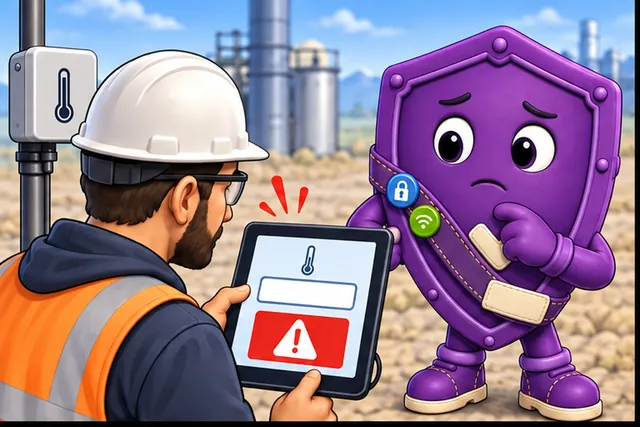
A field app accepts an impossible temperature and shows a real alarm.
-
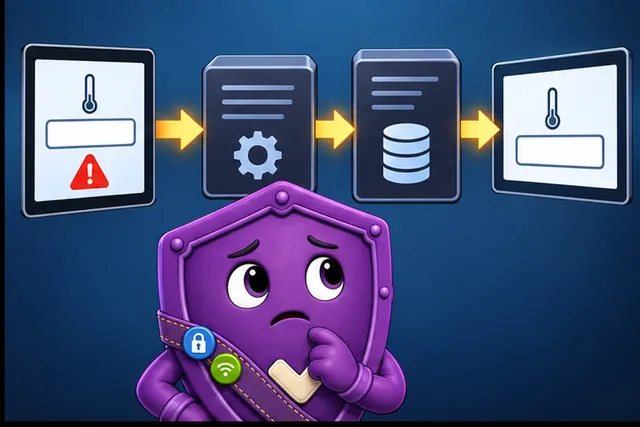
Untrusted input became trusted state somewhere in the software path.
-
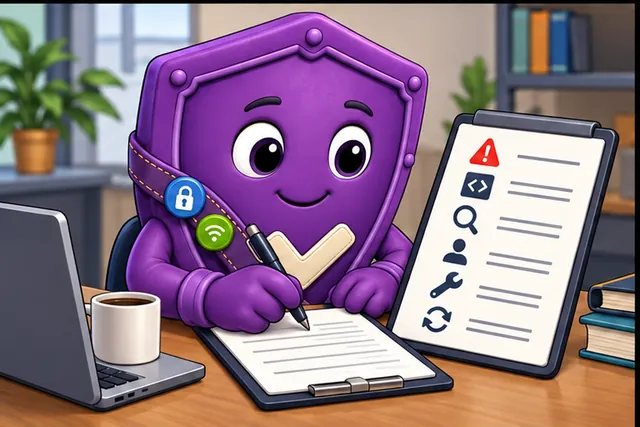
Save the bad input, affected version, failed check, owner, fix, and retest.
-
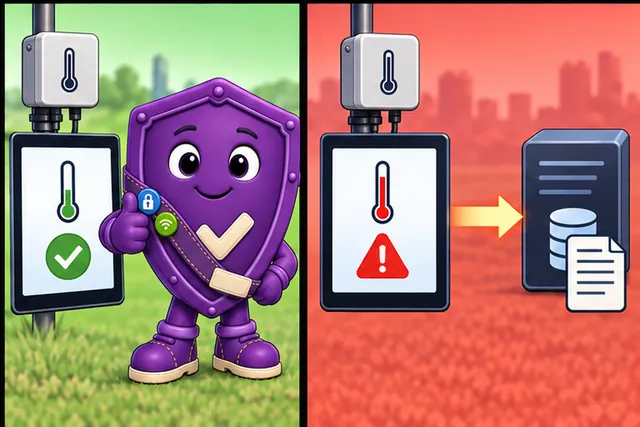
The normal reading still works while harmful input is refused and recorded.
Record the exposed path, exact input, affected version, expected check, actual result, possible harm, owner, fix, and retest. Keep the report defensive: enough detail to reproduce and close the fault, but no unnecessary instructions for abusing a live service.
Try empty, overlong, repeated, wrongly typed, wrongly signed, and out-of-order input in a safe test setting. Restart the service, deny permission, use an old dependency, and check the record shown to the user. A fix passes only when the normal path still works and the harmful path is rejected with a useful record.
A software update is not proof of safety. The changed code, built package, installed version, settings, and running service must match. Reopen the review when an input path, dependency, permission, or update method changes.
Practitioner builds the finding and repair test. Under the Hood explains memory, input parsing, identity checks, dependency chains, update trust, and why one closed class does not prove that all software faults are gone.
Use this defensive closeout:
- Save the exact harmful input.
- Name the boundary that trusted it.
- State the property placed at risk.
- Record the affected build version.
- Write the expected safe result.
- Fix the narrow root cause.
- Test the normal path again.
- Test the harmful path again.
- Install the fixed build cleanly.
- Check the running version matches.
- Keep the failed case as a test.
- Reopen after boundary changes.
Picture a field technician opening a bug report that says the dashboard accepts a sensor value it should reject. The useful response is not “the software is insecure.” The useful response is to name the input path, the boundary where data becomes trusted, the control that should have stopped it, and the evidence needed after the fix.
That is the core habit for software vulnerability review. Every finding becomes a small chain: exposed path, security property at risk, missing or weak control, remediation, and retest. In everyday IoT work, this keeps a parser issue, dependency alert, authorization mistake, or update-path flaw tied to the device behavior it could change. Start simple by writing one bug report as a path plus a retest, then build outward to priority, ownership, and release evidence.
24.2 Overview: Software Sits Between Everything
This section: Overview: Software Sits Between Everything — Software vulnerabilities matter in IoT because software sits between device data, management actions, user interfaces, gateways, cloud services, and update paths.
Software vulnerabilities matter in IoT because software sits between device data, management actions, user interfaces, gateways, cloud services, and update paths. A weak parser, an unsafe input path, a missing authorization check, a vulnerable dependency, or an unclear remediation process can expose data or change device behavior.
This chapter keeps the review defensive. The goal is not attack procedure. It is to recognize vulnerability classes, connect each finding to evidence, decide which control reduces the risk, and record what must be retested after a fix. A broad statement such as "the dashboard has vulnerabilities" is not reviewable; a useful finding names the affected input or action path, the weak control, the supporting evidence, and the change that would close it.
The first scoping move is to name the boundary where data becomes trusted. That may be an HTTP handler, MQTT topic, gateway parser, dashboard renderer, update manifest, or dependency imported into a reachable service. Once the boundary is named, the finding can point to the exact validation, authorization, encoding, monitoring, or dependency-control evidence that is missing.
If you only need the intuition, this layer is enough: a software finding is useful only when it names the affected path and the security property at risk, maps to a missing or weak control, and is closed only after retest evidence.
Think of software as the plumbing between rooms. A vulnerability class is a category of leak: a cracked joint is an input-handling flaw, an unlocked valve is an authorization flaw, and an old corroded pipe is a vulnerable dependency. You do not fix "the plumbing." You fix the specific joint and then pressure-test it, which is the retest. Use Figure 24.1 to locate that joint in the complete software evidence path before naming a fix.
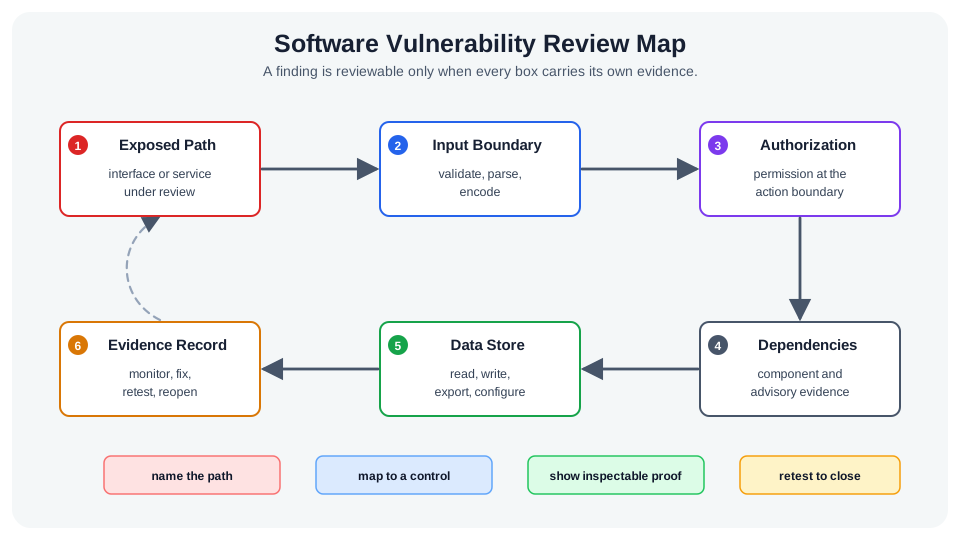
Read Figure 24.1 from the exposed path toward the fix record. The input boundary identifies where untrusted data enters; authorization decides whether the authenticated actor may perform the requested action; dependency and data-store checks expose inherited and retained risk. Monitoring then supplies evidence of accepted, rejected, and failed behavior, while the fix record ties remediation to a retest. This map is the chapter's running discipline: every broad vulnerability label must become a specific path, control, and observed result.
The One-Minute View
Name the path
State which interface, action, parser, or dependency is affected. "The dashboard has vulnerabilities" is not a finding.
Classes are questions
Vulnerability classes are defensive prompts to ask better questions, not scripts for attack.
A fix is not done until retested
Close a finding only after retest evidence shows it is fixed, or accept it with a clear exception.
Beginner Examples
- "Passed a vulnerability scan" is not evidence of a safe path; the review still needs the affected path and control checked.
- Validating input is not the same as encoding output; both can be needed for the same field.
- A dependency "present in the build" is different from one "reachable in the deployed path," and they are prioritized differently.
Overview Knowledge Check
If you can describe a reviewable finding, you can stop here. Continue to Practitioner to classify findings and map controls.
24.3 Practitioner: Classify, Map Controls, Prioritize, Retest
This section: Practitioner: Classify, Map Controls, Prioritize, Retest — Software vulnerability review starts by naming the path under review, which in IoT may cross a device interface, gateway service, broker, dashboard, mobile app, update service, database, or cloud API.
Software vulnerability review starts by naming the path under review, which in IoT may cross a device interface, gateway service, broker, dashboard, mobile app, update service, database, or cloud API. The workflow turns each finding into a decision a reviewer can repeat and audit.
Walkthrough: The Review Loop
- Scope the affected software path and the protected data or action.
- Confirm the finding in a safe test environment or from trustworthy evidence.
- Classify the weakness without documenting misuse procedure.
- Map the missing or weak control.
- Prioritize by exposure, impact, privilege, control coverage, and recovery path.
- Apply a fix, isolation control, update, or documented exception.
- Retest the original path and the related control.
- Record evidence, owner, and future retest triggers.
Once a path is named, the review needs an order that reduces risk without turning verification into an exploit exercise. Figure 24.2 separates safe confirmation from classification, remediation, and closure.
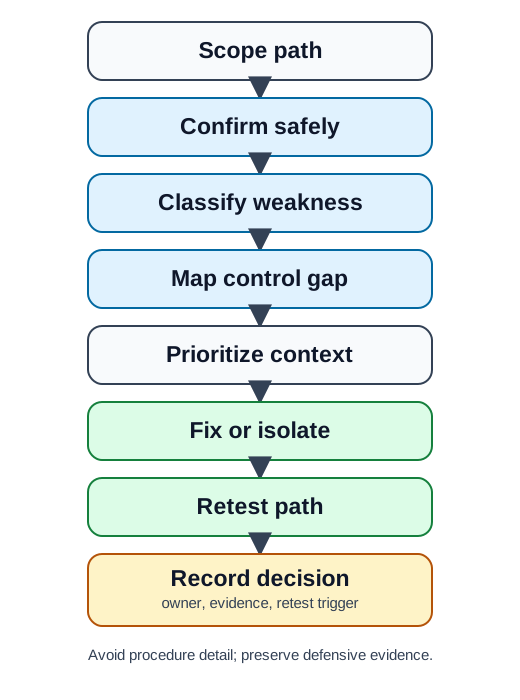
Follow Figure 24.2 from scope to record. Scope fixes the authorized component, data, and test boundary; safe confirmation establishes the observed behavior without unnecessary harm. Classification names the failed control, prioritization accounts for exposure and consequence, and remediation changes the responsible boundary. Retesting must exercise the original path and related denied case before the owner records evidence and a future trigger. The loop therefore closes a finding with reproducible proof rather than with a patch description alone.
Common Vulnerability Classes
Classes are patterns that help reviewers ask better questions. They often overlap; record each weak control separately so each fix can be tested separately.
The class list becomes actionable at the point where untrusted data changes meaning. Inspect Figure 24.3 to distinguish syntactic acceptance, action permission, destination-safe representation, storage, and monitoring.
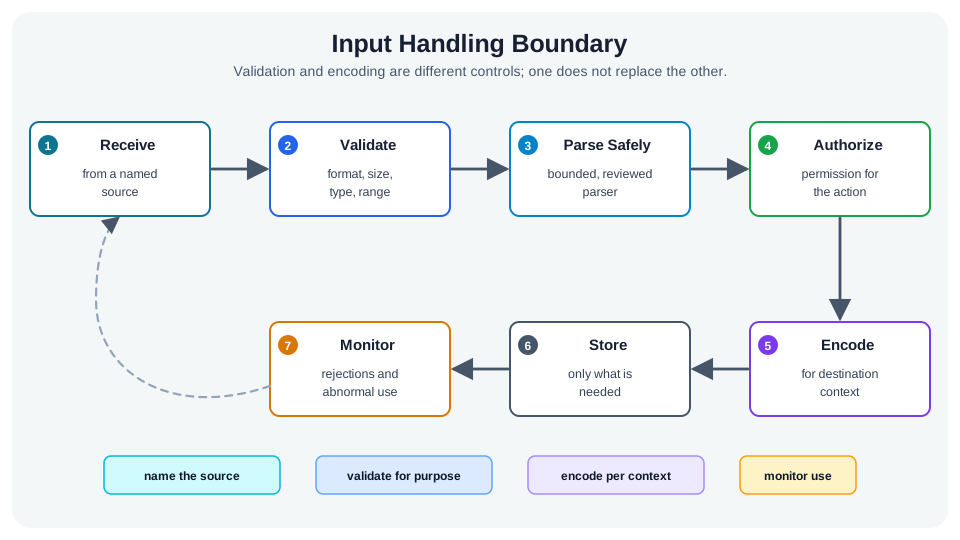
Read Figure 24.3 left to right. Receive identifies the source and channel; validation constrains type, size, range, and structure; parsing turns the bounded representation into data. Authorization then decides whether this actor may request the action, and context-specific encoding prevents accepted data from becoming HTML, SQL, XML, log, or command syntax at its destination. Minimal storage and monitored rejections complete the trail. This ordered boundary explains why validation, authorization, and encoding are complementary controls rather than interchangeable labels.
Input Handling: Validation Is Not Encoding
Input handling protects the point where untrusted data becomes application state, database content, rendered output, device command parameters, or configuration. A defensible sequence is: receive from a named source; validate format, size, type, and range for the intended action; parse with a bounded, reviewed parser; authorize the action before applying the data; encode for the destination context (HTML, SQL, logs, or device commands); store only what is needed; and monitor rejections and parse errors. The key distinction: validation decides whether input is acceptable for a purpose, while encoding prevents accepted data from being interpreted as a different kind of instruction in a later context. They are different controls, and one does not replace the other.
In a browser-facing IoT dashboard, the HTML-output version of that failure is cross-site scripting (XSS) or HTML code injection: attacker-controlled text is rendered as markup or script instead of inert content. The review should name the output context, escape or sanitize for that context, retest the rendered page, and keep enough evidence to prove the value cannot become executable HTML.
The same boundary rule applies before data reaches SQL or XML processors. SQL injection is a query-construction failure: accepted text is allowed to change the database instruction instead of remaining a value. XML injection is a structure-construction failure: accepted text is allowed to create or alter XML elements, attributes, or parser behavior. A defensive review should ask for parameterized queries or equivalent prepared statements, context-aware XML construction, parser limits, rejected malformed-input evidence, and action-level authorization for any database or configuration change. Do not close the finding just because the input looked valid at the web form.
Authorization at Action Boundaries
Many findings are not about whether an identity can log in. They are about what the identity may do once recognized. Authorization should be checked at each sensitive action: read telemetry or user-associated data, change configuration, send a command, export logs or keys, enroll or retire a device, or change alert, access, or update policy. Authentication names the actor; authorization decides whether that actor may take the action. Do not accept "it is behind authentication" as proof a path is safe.
Worked Review
A gateway dashboard accepts device names, shows telemetry, lets operators change sampling intervals, and uses several protocol libraries. A weak review says "the dashboard passed a vulnerability scan." A stronger review separates the finding types.
Input and authorization
Device names are validated and encoded for HTML output; rejected values are logged without storing unsafe content; sampling-interval changes require an explicit management permission, and denied actions are audited.
Dependency evidence
The dashboard and gateway libraries have an inventory; advisory review identifies which components handle exposed input; updated components are retested against dashboard and gateway paths.
Scoped decision
"Accepted for this release after encoding, action authorization, dependency review, and retest logs were checked. Reopen after any rendering, device-command, role-policy, parser, or dependency change."
Practitioner Knowledge Check
If you can classify findings, separate validation from encoding, and check authorization at actions, you can stop here. Continue to Under the Hood for memory safety, supply chain, and secure development.
24.4 Under the Hood: Memory Safety, Supply Chain, and Secure Software Development Lifecycle (SDLC)
This section: Under the Hood: Memory Safety, Supply Chain, and Secure Software Development Lifecycle (SDLC) — Firmware and native services written in languages without automatic bounds checking must handle buffers, object lifetimes, and parser states carefully.
The deeper layer covers the classes that need more than a single control check: memory safety in native code, how injection and deserialization arise, supply-chain exposure, and the development process that keeps findings from recurring.
Memory Safety
Firmware and native services written in languages without automatic bounds checking must handle buffers, object lifetimes, and parser states carefully. The defensive review focuses on boundary checks, use of safe or hardened libraries, evidence of fuzz testing on input parsers, crash handling, and update readiness, rather than on attack mechanics. Memory-unsafe code that parses untrusted input is a high-value review target because a single malformed message can corrupt state. Where the platform allows, memory-safe languages and compiler mitigations reduce the size of this class.
Injection and Insecure Deserialization
Injection happens when accepted data is later interpreted as instructions in another context, for example a value treated as part of a query, a command, or rendered markup. The defense is context-aware output encoding or parameterized handling at the boundary where the interpretation occurs; input validation alone does not prevent it, because validated data can still be misinterpreted downstream. Insecure deserialization is a related parser-trust failure: software reconstructs objects or state from structured input and trusts that input too much. Both are input-handling failures at heart, which is why the input sequence separates validate, parse, authorize, and encode into distinct steps.
Dependency and Supply Chain
IoT software bundles application packages, protocol libraries, operating-system packages, firmware modules, dashboard frameworks, and build tools. A dependency finding should be grounded in inventory and advisory evidence: component name and use, version or build identifier, advisory source, exposure path in this system, control coverage while a fix is pending, an update or replacement or isolation decision, and a retest result. Distinguish "present in the build" from "reachable in the deployed path": a component that is present but unreachable still matters but should not be prioritized like one that handles exposed input or sensitive data. Updating a dependency is not complete until the path that uses it is retested, because the update can change behavior.
Prioritizing by Context
A severity label alone is not enough. Prioritize by whether the path is reachable by untrusted users, devices, services, or networks; whether the weakness affects sensitive data, management actions, update paths, or safety-relevant commands; what privilege is required to reach it; whether an independent control such as segmentation, allow rules, rate limits, or a gateway policy already limits impact; and whether a safe update or rollback path exists for the fix. A finding matters because of the protected path and its context in this system, not because of a severe label in isolation.
Secure Development Lifecycle
Vulnerability work spans releases, so the record must preserve context: why a decision was made and what must be rechecked if the interface, dependency, parser, role, or update mechanism changes. A secure development lifecycle builds this review, testing, and retest into development rather than bolting it on afterward, so that input handling, authorization, dependency review, and memory-safety checks are part of how software is built and shipped.
Common Mistakes
- Treating scans as complete evidence without checking the affected paths.
- Recording a finding without naming the data, action, or control at risk.
- Fixing validation but forgetting output encoding.
- Checking authorization only at login rather than at sensitive actions.
- Prioritizing only by generic severity instead of system context.
- Updating a dependency without retesting the path that uses it.
- Closing a finding without preserving owner, evidence, exception, and retest trigger.
Under-the-Hood Knowledge Check
At this depth, software vulnerability review is a continuous, evidence-bound practice: classify the weak control, separate validation from encoding, treat injection and deserialization as input-trust failures, ground dependency findings in reachability and advisory evidence, prioritize by context, and build the checks into the development lifecycle so fixes hold across releases.
24.5 Summary
This section: Summary
- A software finding is reviewable only when it names the affected path, the security property, and the weak control, and is closed after retest.
- Common classes are input handling, authorization, memory safety, dependency, configuration, and error handling, and they often overlap.
- Validation decides whether input is acceptable; encoding prevents accepted data from being reinterpreted in a later context.
- Injection and insecure deserialization are input-trust failures; dependency findings need reachability and advisory evidence, not just presence.
- Prioritize by system context, and build review, testing, and retest into the development lifecycle so fixes hold across releases.
Software-vulnerability control requires dependency review, input validation, output encoding, memory safety, action-level authorization, configuration hygiene, patching, and test evidence, prioritized by exposure and reachability rather than a severity label alone.
24.6 See Also
This section: See Also
IoT Security Fundamentals
The asset, threat, control, and evidence vocabulary that underpins each vulnerability finding.
IoT Security OTA Updates
How a trustworthy update path supports remediation and rollback after a software fix.
Intrusion Detection for IoT
Monitoring evidence for failed checks, rejected input, and abnormal software behavior.
Find help
3 reviewed answers.
Where should I start in a module?
Open the module page from the sidebar to see its chapters in order. Use the module map to return to a topic you need.
Modules and pathsReviewed
What can I try when a project does not work?
Check the symptom, then work through the diagnostic steps. Keep the error message and the smallest example that reproduces it.
When you are stuckReviewed
How do interactive examples work?
Use the interactive guide to check how examples and simulations work before changing your project.
Interactive examples guideReviewed