8 IoT Security Frameworks
More
Depth: Practitioner
Progress saves as you read. Mark sections complete as you go; your progress appears in the sidebar.
8.1 In 60 Seconds
This section: In 60 Seconds — Picture a connected lock whose review says only that it follows a familiar framework.
Turn One Framework Label Into a Test
Picture a connected lock whose review says only that it follows a familiar framework. The label does not show which local control exists or whether anyone tested it.
A gateway means the boundary system that connects local devices to another network or service. Telemetry means records a system sends about readings, state, and health.
Choose one narrow claim, such as blocking a sensor identity from sending commands. Map it to a local control, try one allowed and one denied action, and keep the rule, evidence, owner, result, and retest trigger.
This runway does not prove that the whole system is secure or compliant. The deeper sections compare framework lenses, architecture layers, local controls, evidence, scope, and review boundaries.
A security framework is not a badge that makes an IoT system safe. It is a lens that helps a reviewer ask sharper questions: which device, gateway, service, identity, update path, or monitoring record is under review, and what evidence proves the control is really there?
Start simple. Pick one claim, such as “telemetry identities cannot send commands” or “updates are verified before install.” Choose the framework lens that fits that claim, map its language to a local control, ask for inspectable evidence, record the narrow decision, and write down what change would force a retest.
For everyday IoT work, that habit matters more than the framework name. A door lock, sensor gateway, thermostat, or factory controller can all cite a familiar framework. The useful review is the one that turns the citation into a concrete question, a local control, and a record someone else can check.
8.2 Key Ideas
This section: Key Ideas — A framework label becomes useful only when it maps a local IoT risk to a control, owner, evidence record, and retest.
A framework label becomes useful only when it maps a local IoT risk to a control, owner, evidence record, and retest.
A Framework Is a Lens, Not a Certificate
An IoT security framework is a structured set of questions and expectations that helps a reviewer look at a device, gateway, cloud service, or deployment in an organized way. The most important thing to understand first is what a framework does not do: naming a framework does not make a system secure, and a framework name on its own is not evidence. Frameworks help you ask better questions and request the right records. The answer still has to come from the system itself — its configuration, logs, tests, and design notes.
Used well, a framework turns a vague worry into a concrete evidence request. "Is this gateway secure?" is not reviewable. "Which framework lens fits this question, what local control does it map to, and what record proves the control is present?" is. The discipline is to keep the framework as a lens over real assets and trust boundaries, never as a substitute for them.
If you only need the intuition, this layer is enough: choose the framework lens that matches your review question, map its language to a specific IoT asset or boundary, ask for inspectable evidence, record what is confirmed or missing, and name the change that would require a retest.
Think of an eye chart and a pair of glasses. The chart and the lens do not improve your eyesight; they help an examiner measure it accurately and decide what correction is needed. A security framework is the lens: it sharpens what you look for, but the condition of the system is what you are actually measuring. Different lenses bring different details into focus, which is why the lens is chosen to fit the question.
Before treating a framework name as proof, inspect the diagram in Figure 8.1. Its worked review turns one local IoT question into a mapped control, a verification test, inspectable evidence, a narrow decision, and retest triggers. This is the boundary A Framework Is a Lens, Not a Certificate must preserve.
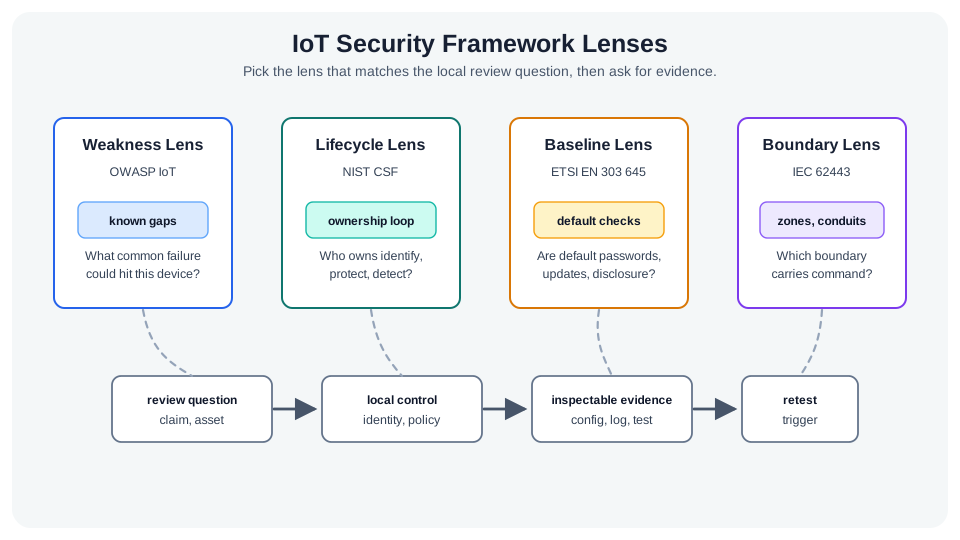
Use Figure 8.1 to follow the connected-lock review from OBSERVED GAP through the Weakness lens and LOCAL CONTROL, then inspect the allowed and denied actions, the evidence rows, the finding rules, and RETEST WHEN. The sequence shows why a framework name is a lens rather than proof: the conclusion depends on the system’s own rules, tests, logs, and deployment records.
The One-Minute View
Question before framework
Start with the system and the review question, then pick the lens that fits, not a favorite framework you force every question into.
Map to local controls
Every framework term must point to a real IoT asset, identity, interface, update path, or monitoring signal, not just to a document.
Evidence and retest
A finding is defensible only with inspectable evidence and a recorded trigger that says when the review must be repeated.
Beginner Examples
Taken together, these checks make the section reviewable. That order prevents a control name from being treated as proof and connects the visual to the chapter's evidence-led review sequence.
Overview Knowledge Check
If you can describe a framework as a lens over real controls and evidence, you have the core idea. Continue to Practitioner to choose a lens and run a framework review.
Choose a Lens and Run the Review
The first practitioner decision is which lens fits the question, because each framework is strongest for a different kind of review. The point is not to memorize every framework but to match the lens to what you are actually trying to confirm.
A weakness lens (OWASP IoT Top 10) fits when the question is whether common IoT failure patterns are present — default or weak credentials, insecure network services, weak ecosystem interfaces, missing secure-update mechanisms, or unprotected data in transit and at rest. A lifecycle lens (the NIST Cybersecurity Framework) fits when the question is whether security work is organized and repeatable across functions such as identify, protect, detect, respond, and recover. A baseline lens (ETSI EN 303 645) fits consumer IoT questions about minimum expected behaviors, such as eliminating universal default passwords, providing a vulnerability-disclosure path, keeping software updated, and protecting personal data. An industrial boundary lens (IEC 62443) fits operational-technology questions about zones, conduits, system roles, and separation. A management-system lens (ISO/IEC 27001) fits questions about ownership, risk treatment, control operation, and review cadence.
The lens follows the question, not the other way around. If the question is "Can a telemetry-only identity issue actuator commands?", an access-control and boundary lens matters far more than a broad program-maturity lens.
The Framework Review Flow
Whatever lens you pick, the review runs the same way: define scope, choose the lens, map framework language to a local control, ask for inspectable evidence, decide the gap, and name the retest trigger.
The operational meaning of The Framework Review Flow sits in its named hand-offs. Figure 8.2 is worth examining because “The review flow: scope the claim, choose the lens, map it to a local control, inspect evidence, decide the gap, assign ownership, and name the retest trigger” is explicit in the diagram.
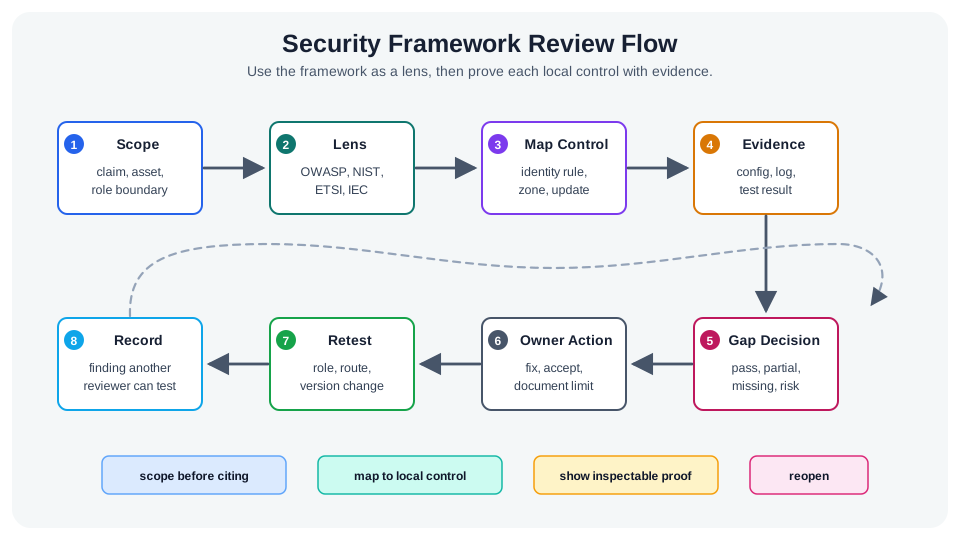
The concrete story in Figure 8.2 is carried by Scope, missing, risk, and reopen. Reading those labels as separate responsibilities makes clear that “The review flow: scope the claim, choose the lens, map it to a local control, inspect evidence, decide the gap, assign ownership, and name the retest trigger” is explicit in the diagram. This is the connection between the visual and the chapter’s treatment of The Framework Review Flow.
Matching Lenses to Review Questions
Worked Review (Defensive)
Review question: do devices reject commands from telemetry-only identities? The lens is a weakness lens focused on weak authorization and ecosystem interfaces. The mapped control states that a telemetry identity may publish telemetry but must not publish actuator commands.
Evidence to inspect
Broker or gateway authorization rules; recorded tests where a telemetry identity is denied a command; logs of denied command attempts; and deployment notes for topics, routes, and any gateway bypass paths.
Decision
Confirmed if rules and tests show command rejection. Partial if rules exist but no rejected-command test is recorded. Missing if command and telemetry identities share one role.
Retest trigger
Reopen after role changes, topic or route changes, broker-rule changes, or gateway firmware or policy changes. Record accepted residual risk with an owner.
Practitioner Knowledge Check
If you can pick a lens that fits the question and run the review flow to a decision, you can stop here. Continue to Under the Hood for evidence quality, defense in depth, and the framework review record.
Evidence Quality, Layering, and the Review Record
The deeper layer is where a framework review becomes defensible. A single framework statement often touches several IoT layers at once, and the work is to turn that statement into specific, inspectable evidence at each layer rather than a single broad claim.
One Statement, Many Layers
Consider a framework expectation such as "the device updates securely." In an IoT system that single phrase reaches into device identity and boot state, the local network and gateway path, cloud APIs and user management, the update signing and recovery mechanism, and the monitoring and response records that show updates actually applied. A defensible review decomposes the statement and asks for evidence at each relevant layer, so a confirmation at one layer is not mistaken for proof across all of them.
Evidence Quality, Not Just Presence
Evidence is not all equal, and a review should grade it. Direct evidence — a configuration, a log of a denied action, a passing test — is strongest. Indirect evidence supports a claim without proving it outright. A diagram alone is the weakest form, because it shows intent rather than enforcement. The recurring mistake is treating a diagram or a vendor statement as if it were a denied-action log. When evidence is indirect or missing, the honest record says so and marks the assumption separately, so a later reviewer knows exactly what remains unconfirmed.
Frameworks Encourage Defense in Depth
A second reason frameworks span layers is that good security does not rest on a single control. Defense in depth means arranging independent, layered controls so that the failure of any one does not expose the asset — strong identity, segmentation, least privilege, integrity verification, monitoring, and recovery each carry part of the load. A framework review is a natural place to check this: if every mapped control traces back to the same single mechanism, the review should record that concentration as a risk rather than a strength.
The Framework Review Record
Keep the record small enough that a second reviewer can see how each framework phrase became a local evidence request. The fields below are the minimum that make a finding narrow and reproducible.
To judge The Framework Review Record rather than merely name it, first establish how the review record keeps a framework finding narrow by linking the question, lens, local control, evidence quality, decision, owner, and retest trigger. Figure 8.3 is the evidence map for that judgment.
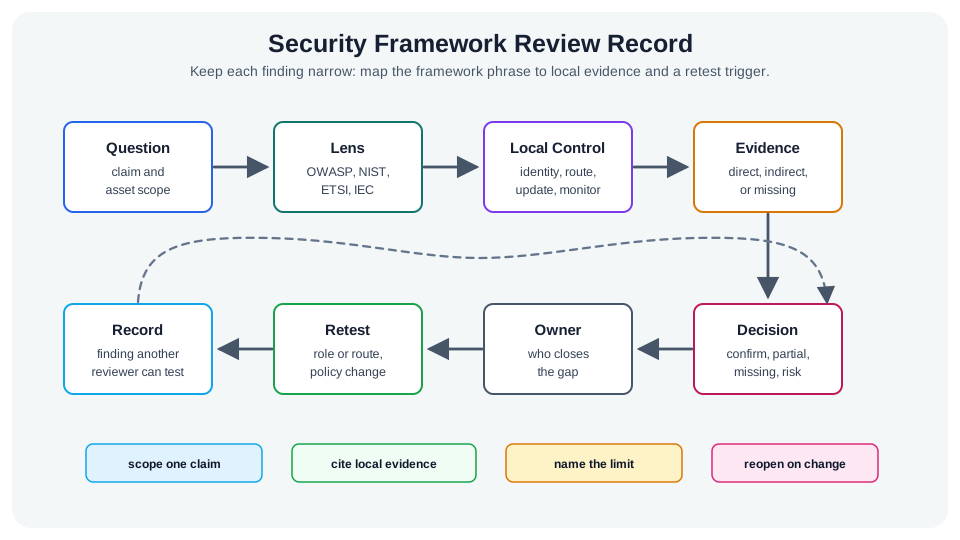
Start Figure 8.3 at Question, but do not stop there: missing, risk changes the interpretation, and reopen on change closes the account. This progression is the diagram’s proof that the review record keeps a framework finding narrow by linking the question, lens, local control, evidence quality, decision, owner, and retest trigger. It is also the narrative bridge from The Framework Review Record to implementation.
Common Mistakes
Under-the-Hood Knowledge Check
At this depth, a framework review is one continuous evidence record: a scoped question leads to a fitting lens, the lens maps to local controls across device, network, update, and monitoring layers, evidence is graded rather than assumed, defense in depth is checked rather than hoped for, and a finding closes only when a narrow decision and a named retest trigger support it.
8.3 Summary
This section: Summary — Use a framework to group risk and guards.
Use a framework to group risk and guards. Close a finding with a test and scope.
Frameworks help when they organize risk, controls, and evidence into a reviewable record; they do not replace system-specific threat modelling. Match the lens to the question, map every framework term to a real IoT control across the layers it touches, grade the evidence honestly, and close a finding only when a narrow decision and a named retest support it.
8.4 See Also
This section: See Also
Security Overview Architecture
See where framework controls land in trust boundaries and control placement.
Security Overview Design Principles
Turn recurring framework ideas, such as least privilege, into design review questions.
Threat Modelling and Mitigation
Expand the threat-question side of framework review into scope, threats, and mitigations.
Cyber Security Defense in Depth
See how layered, independent controls reduce reliance on any single mechanism.
Find help
3 reviewed answers.
Where should I start in a module?
Open the module page from the sidebar to see its chapters in order. Use the module map to return to a topic you need.
Modules and pathsReviewed
What can I try when a project does not work?
Check the symptom, then work through the diagnostic steps. Keep the error message and the smallest example that reproduces it.
When you are stuckReviewed
How do interactive examples work?
Use the interactive guide to check how examples and simulations work before changing your project.
Interactive examples guideReviewed