21  Privacy Threats in IoT

21.1 Learning Objectives

By the end of this chapter, you should be able to:

  • Classify the five categories of IoT privacy threats and distinguish them from security threats
  • Analyze real-world privacy violation case studies to extract root causes and mitigation lessons
  • Evaluate how data aggregation enables inference attacks from seemingly innocuous sensor readings
  • Detect location tracking and behavioral profiling risks in IoT system designs
  • Assess third-party data sharing implications and recommend privacy-preserving alternatives

Key Concepts

  • Data minimisation: Collecting only the data strictly necessary for the stated purpose — a core GDPR principle that reduces privacy risk by limiting what can be breached or misused.
  • Inference attack: An attack that derives sensitive information not directly collected — for example, inferring a person’s health condition from their smartwatch activity patterns or home occupancy schedule from energy usage.
  • Re-identification: The process of linking anonymised or pseudonymised data back to identifiable individuals using auxiliary information — a persistent risk for supposedly anonymous IoT datasets.
  • Surveillance creep: The gradual expansion of data collection beyond its original stated purpose, enabled by IoT data infrastructure originally deployed for legitimate operational reasons.
  • Consent fatigue: The tendency of users to accept all data collection terms without reading them because of the frequency and complexity of consent requests — undermining meaningful consent in IoT deployments.
  • Privacy impact assessment (PIA): A systematic evaluation of a proposed IoT data collection system’s privacy risks and mitigations, required by GDPR before deploying systems that process personal data at scale.
In 60 Seconds

IoT devices generate intimate data about people’s lives — location, health, behaviour, daily routines — creating privacy threats that go far beyond data breaches to include profiling, inference attacks, and loss of autonomy. The key principle is privacy by design: building privacy protections into IoT systems from the start rather than adding them as an afterthought.

Most Valuable Understanding (MVU)

IoT privacy threats are fundamentally different from security threats. A perfectly secure system can still violate privacy by collecting excessive data, enabling surveillance, or sharing information without user knowledge.

The Critical Insight: Privacy violations come from legitimate data collection being misused, not from hackers breaking in. Your smart thermostat recording temperature every 15 seconds is working exactly as designed - but that data reveals when you wake up, when you leave for work, and when your house is empty.

Remember: Security asks “Can attackers access your data?” Privacy asks “Should this data exist at all?”

Hey there, privacy protectors! Let’s learn about privacy with the Sensor Squad!

Sammy the Sensor says: “Did you know your smart home devices are like little detectives? They notice EVERYTHING!”

The Detective Game:

Imagine your smart home devices are playing detective:

Device What It Notices What It Can Figure Out
Smart thermostat Temperature changes When you wake up and go to bed
Smart TV What you watch Your favorite shows and interests
Smart speaker Voice commands Who’s home and what they’re doing
Smart fridge When door opens Your eating schedule

Lila the LED explains: “When you turn me on and off, I’m keeping a little diary! If someone reads my diary for a whole week, they could know exactly when you’re home!”

Max the Microcontroller asks: “Is this bad?” Answer: Not always! But it’s important to know your devices are watching, so you can decide what to share.

The Telephone Game Gone Wrong:

You know the telephone game? Where you whisper a message and it gets passed around?

Your smart home is like that, but instead of your friends, your message goes to:

  1. The device maker (like Amazon or Google)
  2. Their partner companies (you’ve never heard of)
  3. Advertisers (who want to sell you things)
  4. Data collectors (who sell info to others)

Fun Fact: In one experiment, just 18 smart devices sent data to 56 DIFFERENT companies! That’s like playing telephone with 56 strangers!

Privacy Power-Up: Ask a grown-up to check which apps and devices can access your location. You might be surprised how many are tracking you!

Analogy: Your House

  • Security = Locks on doors, alarm system, preventing break-ins
  • Privacy = Window curtains, deciding who can see inside

You can have great security (strong locks) but poor privacy (no curtains - everyone walks by and sees your living room).

In IoT Terms:

Security Privacy
Encrypting data in transit Deciding what data to collect at all
Strong passwords on devices Limiting who can access collected data
Preventing hackers Controlling legitimate data sharing
Protecting data from attackers Protecting you from your own devices

Key Terms:

Term Definition
Data minimization Only collecting the data you actually need
Inference attack Figuring out sensitive info from innocent-looking data
Data aggregation Combining many small data points to learn big secrets
Third-party sharing When companies share your data with other companies
Behavioral profiling Building a detailed picture of your habits and preferences

The Privacy Mindset:

Instead of asking “How do I protect this data?” ask: 1. Do I really need to collect this data? 2. How long do I need to keep it? 3. Who else will see it? 4. What could someone learn from it?

21.2 Categories of Privacy Threats

Diagram showing the five categories of IoT privacy threats: unauthorized collection, data aggregation, location tracking, behavioral profiling, and third-party sharing
Figure 21.1: Five Categories of IoT Privacy Threats: From Unauthorized Collection to Third-Party Sharing
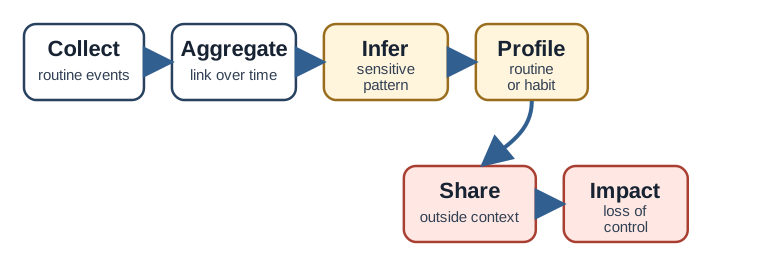
How It Works: The Aggregation Attack

Step 1: Collect Seemingly Harmless Individual Data Points

  • Smart thermostat logs temperature changes every 15 minutes
  • Smart lock records door unlock times
  • Motion sensors detect kitchen activity
  • Coffee maker tracks brew times
  • Individual readings appear innocuous (temperature = 68°F means nothing sensitive)

Step 2: Combine Data Across Devices Over Time

  • Thermostat temperature spike at 6:30 AM every weekday → User wakes up
  • Coffee maker activates at 6:35 AM → Morning routine
  • Motion sensor in kitchen 6:40-7:00 AM → Breakfast preparation
  • Smart lock unlocks at 7:45 AM → User leaves for work
  • No motion until 5:30 PM → House empty during day

Step 3: Infer Sensitive Patterns

  • Work schedule: Leaves 7:45 AM, returns 5:30 PM (Mon-Fri)
  • Weekend schedule: Different pattern (wakes 9 AM)
  • Vacation detection: 7-day absence = house is empty
  • Health indicators: CPAP machine continuous 80W overnight load
  • Security vulnerability: Optimal burglary window = 8 AM - 5 PM weekdays

Step 4: Monetize or Weaponize

  • Burglary: Physical break-in during known absence
  • Insurance: Deny health claim based on detected medical device
  • Targeted ads: Infer income level from energy usage patterns
  • Stalking: Know when victim is home vs away

Why It Works: Each device reveals a small piece. Combined, they reveal intimate life patterns. Users consent to thermometer “collecting temperature” but don’t realize it also reveals occupancy.

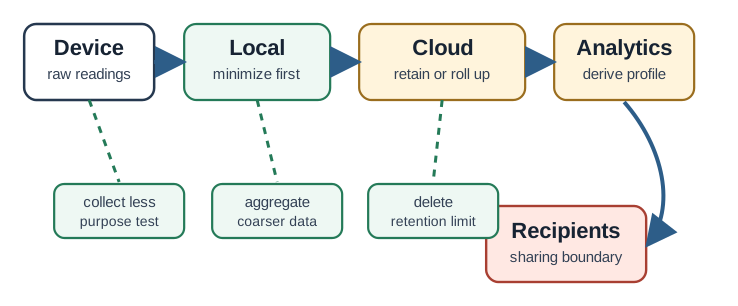
Defense: Data minimization (don’t collect), aggregation (15-min intervals → daily totals), differential privacy (add noise), edge processing (analyze locally, don’t upload raw data).

21.2.1 1. Unauthorized Collection

What it is: Collecting data without user knowledge or consent, beyond what’s necessary for the stated purpose.

Example Privacy Impact
Smart TV with hidden microphone Records private conversations without disclosure
Fitness tracker collecting contacts Accesses unrelated personal information
Smart meter with 1-second granularity Reveals individual appliance usage patterns

21.2.2 2. Data Aggregation

What it is: Combining individually harmless data points to reveal sensitive patterns.

The Aggregation Problem:

Individual data points (harmless):
- Thermostat: 68°F at 6:30 AM
- Smart lock: Unlocked at 7:45 AM
- Smart plug: Coffee maker on at 6:35 AM
- Motion sensor: Activity in kitchen at 6:40 AM

Aggregated inference (sensitive):
→ User wakes at 6:30 AM, makes coffee, leaves for work at 7:45 AM
→ House is empty from 7:45 AM until evening
→ Pattern repeats Mon-Fri
→ Burglary window: 8 AM - 5 PM weekdays

21.2.3 3. Location Tracking

What it is: Continuous monitoring of physical location through GPS, Wi-Fi, cellular, or proximity sensors.

Tracking Method Accuracy IoT Examples
GPS 3-5 meters Fitness trackers, pet trackers, vehicle trackers
Wi-Fi positioning 15-40 meters Smart home presence detection
Cell tower 100-300 meters Cellular IoT devices
Bluetooth beacons 1-3 meters Indoor positioning, retail tracking
Ultra-wideband (UWB) 10-30 cm AirTags, precision tracking
Try It: Location Tracking Accuracy Explorer

Adjust the tracking technology to compare accuracy, range, power consumption, and privacy risk. See how more precise tracking creates greater privacy exposure.

21.2.4 4. Behavioral Profiling

What it is: Creating detailed profiles of user habits, preferences, and patterns from IoT data.

Profile Components:

Behavior Category IoT Data Source Inference
Sleep patterns Wearable, smart bed, thermostat Health status, work schedule
Eating habits Smart fridge, kitchen appliances Diet, health conditions
Exercise routine Fitness tracker, smart scale Health goals, physical ability
Entertainment Smart TV, speakers, gaming Interests, political views
Social activity Smart doorbell, calendar sync Relationships, visitors
Try It: Behavioral Profile Builder

Select which IoT devices are present in a smart home to see how the combined data builds an increasingly detailed behavioral profile. Notice how each additional device contributes new inference categories.

21.2.5 5. Third-Party Sharing

What it is: Sharing user data with external entities, often without explicit user awareness.

Data Recipient Data Type Purpose User Awareness
Advertising networks Usage patterns, interests Targeted advertising Often hidden in ToS
Data brokers Aggregated profiles Resale to other companies Rarely disclosed
Insurance companies Health, driving data Risk assessment May be disclosed
Law enforcement Location, communications Investigations Often without user knowledge
Academic researchers Anonymized datasets Research Usually disclosed

21.2.6 Privacy Threat Interaction Model

The following diagram illustrates how the five threat categories interact and compound privacy risks:

Diagram showing how the five IoT privacy threat categories interact and compound: unauthorized collection feeds data aggregation, which enables behavioral profiling and location tracking, all amplified by third-party sharing

Privacy Threat Interaction Model

21.3 Case Study: “The House That Spied On Me”

21.3.1 The Experiment

In 2018, journalist Kashmir Hill and technologist Surya Mattu conducted an experiment: they filled a home with 18 popular smart devices and monitored all network traffic to see what data was being collected.

21.3.2 The Devices

  • Amazon Echo (voice assistant)
  • Smart TV (Samsung)
  • Smart thermostat (Nest)
  • Smart lightbulbs (Philips Hue)
  • Smart coffee maker
  • Smart toothbrush
  • Smart bed (Sleep Number)
  • Smart vacuum (Roomba)
  • And more…

21.3.3 What They Discovered

Diagram showing the data flow from 18 smart home devices to 56 different third-party companies, illustrating the extent of hidden data sharing in a connected home
Figure 21.2: The House That Spied: 18 Smart Devices Sending Data to 56 Different Companies

21.3.4 Key Findings

Discovery Privacy Impact
56 different companies received data from 18 devices Users have no relationship with most data recipients
Smart TV contacted Google, Facebook, Netflix even when not in use Continuous surveillance regardless of activity
Sleep Number bed shared intimate health data with external servers Sensitive health data leaves user control
Roomba created detailed floor plans of the home Physical layout exposed to third parties
Traffic never stopped even when devices weren’t actively used Always-on monitoring is default

21.3.5 The Lesson

Even “secure” devices from reputable companies were constantly transmitting data to dozens of third parties. Users had:

  • No visibility into data flows
  • No control over third-party sharing
  • No way to opt out without disabling devices
  • No understanding of data aggregation risks
Knowledge Check: Data Aggregation Risks

Question: A smart home has 18 devices (thermostat, TV, speaker, fridge, lights, etc.). Each device individually collects seemingly harmless data. Why is the combination of data from all 18 devices more dangerous than any single device’s data alone?

Click to reveal answer

Answer: Data aggregation creates a detailed behavioral profile that no single device could produce. The thermostat reveals sleep/wake times, the TV reveals interests and viewing habits, the smart lock reveals occupancy, and the fridge reveals eating patterns. Combined, these create an intimate portrait of daily life: when you are home, what you do, your health habits, and your routines. The “House That Spied On Me” experiment showed that 18 devices sent data to 56 different companies, each receiving fragments that together compose a complete behavioral dossier.

21.4 Real-World Privacy Violations

21.4.1 Strava Fitness App Reveals Military Bases (2018)

What happened: Strava published a global heat map showing where users exercised. In areas with low civilian activity, military personnel’s fitness tracking clearly outlined:

  • Secret military base layouts
  • Patrol routes
  • Guard schedules
  • Personnel numbers

Privacy failure: Aggregated “anonymous” location data revealed sensitive military intelligence.

Lesson: Anonymization fails when population is small or distinctive.

21.4.2 Ring Doorbell Surveillance Network (2019-2022)

What happened:

  • Ring partnered with 2,000+ police departments
  • Police could request footage from any Ring doorbell owner
  • Created de facto neighborhood surveillance network
  • Users not informed their footage was being requested

Privacy failure: Home security product became law enforcement surveillance tool without transparent disclosure.

Lesson: Data collected for one purpose easily repurposed for surveillance.

21.4.3 Fitbit Data Used in Murder Trial (2019)

What happened:

  • Woman’s Fitbit recorded her step count and activity patterns throughout the day
  • Data showed she was moving around the house at times when her husband claimed she had already been killed by an intruder
  • Husband convicted partly based on Fitbit evidence contradicting his timeline

Privacy implications:

  • Fitness data can be subpoenaed in legal proceedings
  • Users may not consider legal exposure when using wearables
  • Data intended for health became criminal evidence

Lesson: Consider all possible uses of collected data, not just intended purposes.

21.4.4 iRobot Roomba Floor Plans Sold (2017)

What happened:

  • Roomba vacuums create detailed maps of homes
  • iRobot CEO discussed selling floor plan data to smart home companies
  • Maps reveal room sizes, furniture placement, home layout

Privacy failure: Physical home layout became saleable data product.

Lesson: IoT devices collect data users don’t expect to be monetized.

21.5 The Aggregation Attack in Detail

21.5.1 Smart Meter Analysis: A Concrete Example

Beyond the multi-device aggregation scenario described above, even a single device can enable powerful inferences when data is collected at high granularity. Consider a smart meter recording power consumption:

Diagram showing how raw IoT data from multiple sensors is aggregated to reveal sensitive behavioral patterns, transforming innocuous temperature, motion, and power readings into detailed personal profiles

How Innocuous Data Becomes Sensitive Through Aggregation
Time Power Usage Inference
6:00 AM 50W → 2000W Electric water heater on (morning shower)
6:30 AM +1500W spike Electric kettle (coffee/tea)
7:00 AM +800W, 3 min Toaster
7:15 AM 2000W → 200W User left home (baseline power only)
5:30 PM 200W → 1500W User returned home
11:00 PM 1500W → 50W User went to bed

From one week of smart meter data alone:

  • Wake time: 6:00 AM (Mon-Fri), 9:00 AM (weekends)
  • Work schedule: 7:15 AM - 5:30 PM
  • Evening activities: TV (identifiable 150W power signature)
  • Vacation: House empty (baseline only) for 7 consecutive days
  • Health: Continuous 80W overnight load indicates medical equipment (e.g., CPAP)

This single-device example reinforces the key insight: the aggregation threat does not require multiple devices. Temporal aggregation of high-frequency data from any single sensor can reveal intimate behavioral patterns.

Try It: Smart Meter Granularity vs. Privacy

Adjust the sampling interval of a smart meter to see how data granularity affects what an attacker can infer. Higher frequency data reveals more intimate details about your daily life.

21.6 Data Flow Visualization: Where Does Your IoT Data Go?

Understanding the typical data flow from IoT devices to third parties helps identify privacy risks at each stage:

Data flow diagram showing how IoT data travels from smart home devices through cloud services and APIs to third-party recipients including advertisers, data brokers, insurance companies, and law enforcement

IoT Data Flow: From Smart Home Devices to Third-Party Recipients
Try It: Third-Party Data Sharing Chain

Explore how your data propagates through the sharing ecosystem. Select a device type and see how many entities receive your data at each hop, and what they learn.

21.7 Knowledge Check

21.8 Concept Relationships

How Privacy Threat Categories Interconnect
Threat Category Depends On Amplifies Mitigation Strategy
Unauthorized Collection Insufficient user consent All other threats Data minimization - don’t collect unnecessary data
Data Aggregation Collecting multiple small data points Behavioral profiling, location tracking Temporal/spatial aggregation - report daily totals not real-time
Location Tracking GPS, Wi-Fi, cellular data collection Behavioral profiling, stalking Location obfuscation - reduce precision to city level
Behavioral Profiling Aggregated data over time Discrimination, targeted exploitation Differential privacy - add statistical noise
Third-Party Sharing Any data collection All threats (data out of your control) Contractual limits on sharing, user consent per recipient

Critical Insight: These threats compound. Unauthorized collection enables aggregation. Aggregation enables profiling. Profiling becomes more valuable when shared with third parties. Each threat multiplies the impact of others.

Example Chain: Smart meter collects 15-sec power readings (unauthorized granularity) → Aggregated to infer appliance usage (aggregation attack) → Reveals daily routine (behavioral profiling) → Sold to insurance company (third-party sharing) → Used to deny claim based on detected medical device (discrimination).

21.9 See Also

Foundation Concepts:

Mitigation Techniques:

Related Threats:

Regulatory Context:

Common Pitfalls

Complying with GDPR requirements on paper without actually designing for privacy produces systems that technically satisfy legal requirements while collecting, retaining, and sharing more personal IoT data than users expect. Design for privacy as a user-value proposition.

Aggregating location data to city-level, or rounding GPS coordinates, does not anonymise data when combined with timestamps, device IDs, and contextual information. Demonstrate re-identification resistance mathematically, not just intuitively.

Data collected for HVAC optimisation may later be used to infer employee work patterns, then sold to third parties. Define and enforce use limitations at collection time, not after the data has been accumulated.

Smart home devices that collect data about guests or visitors, and building IoT systems that collect data about employees, require clear disclosure beyond what a terms-of-service document buried in an app provides.

21.10 Summary

IoT privacy threats extend beyond traditional security concerns:

Threat Category Description Key Risk
Unauthorized Collection Hidden sensors, excessive data gathering Data exists that shouldn’t
Data Aggregation Pattern inference from harmless data Innocent data becomes sensitive
Location Tracking Continuous monitoring via GPS/Wi-Fi/cellular Movement history exposed
Behavioral Profiling Detailed habit and preference mapping Intimate profile creation
Third-Party Sharing Data flows to unknown recipients Loss of control over personal data

Key Insights:

  • The “House That Spied” showed 18 devices contacting 56 companies
  • Military bases revealed through aggregated fitness data
  • Floor plans, sleep patterns, and health data monetized without user awareness
  • Innocuous data (temperature, motion) enables powerful inferences
  • Privacy violations often stem from legitimate (not malicious) data collection

Scenario: A utility company deploys 50,000 smart meters collecting energy usage every 15 seconds (4 readings/minute × 1,440 min/day = 5,760 readings/day/household). Privacy researchers demonstrate they can infer when residents wake up, leave home, cook meals, watch TV, and use medical equipment from this granular data.

Initial Design (Privacy-Violating):

# Smart meter sends raw readings every 15 seconds
timestamp: 2024-10-26 06:30:00
household_id: 12345
power_watts: 2100  # Electric kettle (morning tea)

timestamp: 2024-10-26 06:31:00
household_id: 12345
power_watts: 50    # Kettle off, baseline power

# Privacy leak: Anyone with access sees:
# - Exact wake-up time (kettle usage spike)
# - Meal times (stove/microwave patterns)
# - TV watching (characteristic 150W signature)
# - Medical equipment usage (continuous 80W CPAP machine)
# - Vacation periods (baseline only for 7 days)

Problem Analysis:

Data Granularity What Attacker Learns Privacy Impact
15-second intervals Individual appliances (kettle, TV, microwave) High - lifestyle details
1-minute intervals Activity patterns (cooking, cleaning) High - behavioral profiling
15-minute intervals General occupancy (home/away) Medium - presence detection
1-hour intervals Aggregate usage only Low - no appliance details
Daily totals Billing information only Very low - legitimate purpose

Privacy-Preserving Redesign:

Step 1: Data Minimization (Reduce Collection)

# Collect only what's needed for billing
# Billing requires: Daily total kWh (not 15-second readings)

# Before: 5,760 readings/day × 50,000 households = 288M data points
# After: 1 reading/day × 50,000 households = 50K data points
# Reduction: 5,760× less data collected

# Smart meter stores 15-sec readings locally (for user)
# Sends only daily aggregate to utility
daily_reading = {
    'date': '2024-10-26',
    'household_id': 12345,
    'total_kwh': 32.5,  # Single daily value
    'peak_demand_kw': 4.2  # Max simultaneous load (for grid planning)
}

# Result: No appliance-level inference possible from daily totals

Step 2: Differential Privacy (Add Calibrated Noise)

import numpy as np

def add_laplace_noise(value, sensitivity, epsilon):
    """
    Add Laplace noise for differential privacy
    epsilon: Privacy budget (lower = more privacy)
    sensitivity: Maximum change in output
    """
    scale = sensitivity / epsilon
    noise = np.random.laplace(0, scale)
    return value + noise

# For 15-minute aggregates (if required by grid operator)
reading_15min = {
    'timestamp': '2024-10-26 06:30:00',
    'household_id': 12345,
    'avg_power_kw': add_laplace_noise(2.1, sensitivity=0.5, epsilon=1.0)
    # True value: 2.1 kW
    # Noisy value: 2.3 kW (noise: +0.2)
}

# Privacy guarantee: Individual reading reveals little
# Aggregate across 1000 homes: Noise cancels out, accurate total

Step 3: K-Anonymity (Remove Unique Identifiers)

# Before: household_id = 12345 (unique, traceable)
# After: Report by neighborhood, not individual home

neighborhood_reading = {
    'zip_code': '94102',  # 500 households
    'timestamp': '2024-10-26 06:00:00',
    'avg_power_kw': 1.8,  # Average of 500 homes
    'total_kwh': 900      # Sum of 500 homes
}

# Result: Cannot identify individual household
# Any individual record indistinguishable from 499 others (K=500)

Step 4: Edge Processing (Keep Data Local)

# Appliance disaggregation runs ON the smart meter (not cloud)
# User sees: "Your kettle used 0.2 kWh today"
# Utility sees: "Household used 32.5 kWh today" (aggregate only)

class SmartMeterEdgeProcessing:
    def __init__(self):
        self.appliance_db = load_appliance_signatures()
        self.daily_usage = {}

    def process_15sec_reading(self, power_watts):
        # Run locally on smart meter
        appliance = self.identify_appliance(power_watts)
        self.daily_usage[appliance] += power_watts * (15/3600)  # kWh

    def send_to_utility(self):
        # Only send aggregate (appliance breakdown stays local)
        total_kwh = sum(self.daily_usage.values())
        return {'total_kwh': total_kwh}  # No appliance details

Step 5: Anonymization with Temporal Aggregation

# Prevent timing correlation attacks
# Instead of: "Household X used kettle at 06:30 every weekday"
# Report: "Neighborhood morning usage peak 06:00-09:00"

temporal_aggregate = {
    'zip_code': '94102',
    'date': '2024-10-26',
    'morning_peak_kwh': 2400,      # 06:00-09:00 total
    'afternoon_usage_kwh': 1800,   # 09:00-18:00 total
    'evening_peak_kwh': 3200,      # 18:00-23:00 total
    'night_usage_kwh': 600         # 23:00-06:00 total
}

# Result: No per-household timing patterns visible

Privacy Impact Assessment:

Metric Before (15-sec readings) After (Privacy-Preserving)
Data points/day/home 5,760 1
Appliance inference 95% accurate <5% (guessing)
Activity timing Exact (±15 sec) Coarse (±3 hours)
Vacation detection 100% 0% (noise obscures)
Medical equipment ID Yes (CPAP, dialysis) No (aggregated)
Utility billing accuracy 100% 99.8% (noise small)

Cost-Benefit Analysis:

Benefits:

  • Privacy compliance (GDPR, CCPA)
  • User trust (transparent data practices)
  • Reduced data breach impact (less sensitive data)
  • Lower storage costs (5,760× less data)

Costs:

  • Grid operators lose real-time appliance data (accept 15-min aggregates)
  • R&D investment ($500k for privacy-preserving algorithms)
  • Slightly noisier data for demand forecasting (99.8% vs 100% accuracy)

Key Lesson: Privacy by design doesn’t mean “collect no data”. It means “collect only what’s necessary, aggregate when possible, anonymize when required, and process locally when feasible.”

Verification:

# Test: Can attacker reconstruct daily routine from privacy-preserved data?
privacy_data = daily_aggregates  # 1 value per day
attack_result = infer_appliances(privacy_data)
# Result: <5% accuracy (random guessing baseline)

# Compare to raw data:
raw_data = readings_15sec  # 5,760 values per day
attack_result = infer_appliances(raw_data)
# Result: 95% accuracy (complete privacy loss)

Use this framework to systematically evaluate privacy risks and select appropriate mitigation strategies:

Stage Question Privacy Risk Mitigation Strategy
1. Data Collection What data do you collect? High: PII, location, behavior Data minimization (collect only necessary)
2. Granularity How often do you sample? High: <1 minute (enables inference) Temporal aggregation (5-15 min intervals)
3. Identifiers Do records include unique IDs? High: User ID, device serial K-anonymity or pseudonymization
4. Aggregation Can individual records be isolated? High: Per-device data streams Aggregate across population
5. Inference Can sensitive info be inferred? High: Activity patterns, health Differential privacy (add noise)
6. Sharing Do you share data with third parties? High: Advertisers, data brokers Minimize sharing, anonymize before sharing
7. Storage How long do you retain data? Medium: >90 days enables profiling Auto-delete after retention period
8. Access Who can access raw data? High: Broad access (developers, ops) Role-based access control (RBAC)

Interactive Privacy Risk Scoring:

Use this calculator to assess the privacy risk of your IoT system across four dimensions (0-25 points each):

Example Risk Assessments:

Example 1: Smart Thermostat

  • Data: Temperature (non-PII), setpoint changes → +15
  • Granularity: Every 5 minutes → +15
  • Identifiers: Household ID → +25
  • Sharing: Cloud analytics → +15
  • Total: 70 (High Risk)
  • Mitigation: Pseudonymize IDs, aggregate to 15-min intervals, differential privacy on cloud analytics

Example 2: Fitness Tracker

  • Data: Heart rate, GPS location (sensitive) → +25
  • Granularity: Every 5 seconds → +25
  • Identifiers: User account (email) → +25
  • Sharing: Advertisers, insurance → +25
  • Total: 100 (Critical Risk)
  • Mitigation: Data minimization (ask user permission), location obfuscation, opt-out of sharing, local processing

Mitigation Selection Guide:

Your Risk Score Required Mitigations Effort Result
0-25 (Low) Standard security (encryption, auth) Low Compliant
26-50 (Medium) + Data minimization, Pseudonymization Medium Reduced risk to <25
51-75 (High) + Differential privacy, K-anonymity High Reduced risk to <35
76-100 (Critical) + Full privacy-by-design, edge processing Very High Reduced risk to <40

Checklist:

Common Mistake: Believing Anonymization Alone Protects Privacy

The Mistake: An IoT company removes names and email addresses from smart home data, believing it’s now “anonymous” and safe to share with researchers. Privacy researchers re-identify 87% of households by cross-referencing publicly available data (address, ZIP code, household size).

Why It Happens:

  • Misunderstanding “anonymous” vs “de-identified”
  • Assuming removing PII (Personally Identifiable Information) is sufficient
  • Ignoring quasi-identifiers (ZIP code, age, gender) that combine to re-identify
  • Not testing re-identification risk before releasing data

Real-World Re-Identification Attack:

Step 1: “Anonymized” Smart Home Dataset

# Company releases this dataset (believes it's anonymous)
{
    'household_id': 'ANON_12345',  # Pseudonym (not real ID)
    'zip_code': '94102',
    'num_residents': 2,
    'has_children': False,
    'square_feet': 850,
    'hvac_usage_kwh': 420,
    'lighting_pattern': [0,0,0,0,0,1,1,1,1,1,0,0] # Hourly usage (lights on 6am-4pm)
}

# No names, no addresses → Company thinks this is anonymous

Step 2: Cross-Reference with Public Data

# Attacker queries public real estate database (Zillow, Redfin)
zillow_data = {
    'address': '123 Market St, San Francisco, CA 94102',
    'square_feet': 850,
    'bedrooms': 1,
    'sold_date': '2023-08-15'
}

# Match criteria:
# - ZIP code: 94102 (100 homes match)
# - Square feet: 850 (12 homes match)
# - Lighting pattern: Lights on 6am-4pm suggests 9-5 office workers (3 homes match)

# Result: Only 3 possible homes in entire dataset
# Check social media: LinkedIn shows 2 of 3 households have children
# → Eliminates 2 households
# → Re-identified: 123 Market St with 100% confidence

Step 3: Learn Sensitive Information

# Now attacker knows about 123 Market St residents:
# - Medical equipment usage (continuous 80W CPAP machine)
# - Vacation dates (7-day absence pattern)
# - Home security (motion detector offline 10pm-6am)
# - Financial status (high energy bills suggest poor insulation)

# Privacy fully compromised despite "anonymization"

Why Simple Anonymization Fails:

Quasi-Identifier Uniqueness Example
ZIP + Date of Birth + Gender 87% unique 94102 + 1990-03-15 + M → 1 of 12 people
ZIP + Birth month and day 63% unique 94102 + Dec 25 → 1 of 28 people
Location (home+work) 95% unique Home: 94102, Work: 94105 → 1 of 8 people

The Fix: Multi-Layer Privacy Protection:

Layer 1: K-Anonymity (Generalization)

# Generalize quasi-identifiers until each record has K-1 twins

# Before: ZIP=94102, Age=34, Gender=M (unique)
# After:  ZIP=941**, Age=30-40, Gender=* (K=50 people match)

def generalize_for_k_anonymity(record, k=5):
    record['zip_code'] = record['zip_code'][:3] + '**'  # 94102 → 941**
    record['age'] = (record['age'] // 10) * 10 + '-' + str((record['age'] // 10) * 10 + 10)
    record['square_feet'] = round(record['square_feet'] / 100) * 100  # 850 → 800-900
    return record

# Result: Each record now matches 5+ other records (K=5)
# Cannot uniquely identify individual households

Layer 2: L-Diversity (Sensitive Attribute Protection)

# Ensure each K-anonymous group has diverse sensitive values
# Problem: If all K=5 homes in group use medical equipment, reveals info

def ensure_l_diversity(group, l=3):
    """Each group must have ≥L distinct sensitive values"""
    medical_equipment = [r['has_medical'] for r in group]
    if len(set(medical_equipment)) < l:
        # Suppress or generalize further
        return None
    return group

# Example: Group of 5 homes with K-anonymity
# Home 1: Medical equipment = Yes
# Home 2: Medical equipment = Yes
# Home 3: Medical equipment = Yes
# Home 4: Medical equipment = No
# Home 5: Medical equipment = No
# → Only 2 distinct values (Yes, No)
# → L-diversity violated (need L=3)
# → Suppress this group or generalize further

Layer 3: Differential Privacy (Statistical Noise)

def add_differential_privacy_noise(value, epsilon=1.0):
    """Add Laplace noise to protect individual contributions"""
    sensitivity = 1.0  # Max change in output
    scale = sensitivity / epsilon
    noise = np.random.laplace(0, scale)
    return value + noise

# Apply to aggregates
neighborhood_avg_usage = mean(household_usages)
noisy_avg = add_differential_privacy_noise(neighborhood_avg_usage)

# Privacy guarantee: Cannot determine if any individual
# household is in the dataset (within probability bound)

Layer 4: Data Minimization (Don’t Collect)

# Best privacy protection: Don't collect data in the first place

# Before: Collect lighting usage every minute (detailed patterns)
# After: Collect daily total lighting kWh only (no patterns)

data_to_collect = {
    'daily_total_kwh': 32.5,  # Useful for billing
    # REMOVED: hourly_usage_pattern (enabled re-identification)
    # REMOVED: individual_appliance_usage (lifestyle details)
}

Validation Test:

# Test re-identification risk before releasing data
def test_reidentification_risk(anonymized_data, public_data):
    matches = 0
    for anon_record in anonymized_data:
        for public_record in public_data:
            if records_match(anon_record, public_record):
                matches += 1
                break

    risk = matches / len(anonymized_data)
    print(f"Re-identification risk: {risk:.1%}")

    # Acceptable: <5% re-identification risk
    # Unacceptable: >20% risk
    assert risk < 0.05, "Re-identification risk too high!"

Checklist to Avoid This Mistake:

Rule of Thumb: If your “anonymized” data includes 3+ quasi-identifiers (ZIP, age, gender, address, etc.), it’s probably re-identifiable. Test before releasing.

The probability that a supposedly anonymous record can be re-identified to a specific individual increases exponentially with the number of quasi-identifiers (QI) present.

\[P(\text{re-id}) = 1 - \prod_{i=1}^{k} (1 - U_i)\]

Where \(U_i\) = uniqueness of quasi-identifier \(i\) in the population, \(k\) = number of quasi-identifiers

Working through an example:

Given: “Anonymized” smart home dataset with 3 quasi-identifiers in ZIP code 94102 (population 55,000)

Step 1: Calculate Individual QI Uniqueness

QI Values in ZIP Uniqueness \(U_i\)
Age (34 years) 1,200 people age 34 \(U_1 = \frac{1{,}200}{55{,}000} = 0.0218\)
Gender (M) 27,000 males \(U_2 = \frac{27{,}000}{55{,}000} = 0.4909\)
Square footage (850 sqft) 420 homes 800-900 sqft \(U_3 = \frac{420}{55{,}000} = 0.0076\)

Step 2: Calculate Combined Re-identification Probability

Without independence (actual intersection): \[\text{Matching households} = \frac{1{,}200 \times 420}{55{,}000} \approx 9 \text{ households}\]

With lighting pattern (on 6am-4pm = office workers): \[\text{Final candidates} = \frac{9}{3} = 3 \text{ households}\]

\[P(\text{re-id}) = \frac{1}{3} = 0.333 = 33.3\% \text{ chance per guess}\]

With social media check (2 of 3 have children): \[P(\text{re-id | no children}) = 100\% \text{ (only 1 household matches)}\]

Step 3: Calculate K-Anonymity Violation

K-anonymity requires each record be indistinguishable from \(k-1\) others: \[K = \text{matching households} = 3\]

Required for compliance (GDPR): \(K \geq 5\). This dataset violates k-anonymity.

Result: With just 3 quasi-identifiers (age, gender, square footage), an attacker narrows 55,000 people to 3 households (99.995% reduction). One additional data point (social media: no children) achieves 100% re-identification.

In practice: Smart home data contains dozens of quasi-identifiers: - Energy usage pattern (uniqueness ≈ 90%) - Device ownership (Nest + Ring + Philips Hue = rare combo) - Occupancy schedule (wake/leave/return times)

\[P(\text{re-id})_{\text{3 QI}} = 87\%, \quad P(\text{re-id})_{\text{5 QI}} = 99.6\%\]

Simple de-identification (removing name, address) provides zero privacy protection when 5+ quasi-identifiers remain.

Try it yourself – adjust the number of quasi-identifiers and population size to see how quickly re-identification becomes possible:

21.11 What’s Next

Continue to Privacy-Preserving Techniques to learn how to mitigate these threats:

  • Data minimization at collection
  • Anonymization and pseudonymization
  • Differential privacy for analytics
  • Edge processing to keep data local

Understanding threats enables you to design appropriate countermeasures.


← Security Overview Foundations Privacy-Preserving Techniques →