19 Intrusion Detection for IoT

More
Depth: Practitioner
Progress saves as you read. Mark sections complete as you go; your progress appears in the sidebar.
A water pump that usually reports once a minute suddenly scans nearby addresses and sends traffic at midnight. Intrusion detection turns those unusual signals into an intrusion-detection alert for review. It adds visibility, but only a tested response can turn that visibility into protection.
Firmware is the software installed on the pump. A gateway is the device joining its sensor network to another system.
19.1 Follow an Odd Packet Into an Investigated Intrusion-detection alert
This section: Follow an Odd Packet Into an Investigated Intrusion-detection alert — Read Figure 19.1 from device or network event through collection, feature or rule, detection, intrusion-detection alert, and reviewer outcome.
Read Figure 19.1 from device or network event through collection, feature or rule, detection, intrusion-detection alert, and reviewer outcome. Each step can lose context. Preserve device identity, observation time, rule or model version, and the packets or counters that support the intrusion-detection alert.
Figure 19.2 compares visibility points. A gateway sensor can see traffic crossing zones but may miss peer-to-peer radio activity. A device agent can see local process or authentication events but consumes device resources and may be unavailable on constrained hardware. Cloud logs see service behavior after traffic leaves the site. Placement follows the threat path.
Figure 19.3 then walks triage, enrichment, classification, containment or dismissal, recovery, and rule feedback. The return step is important: a confirmed benign maintenance burst can refine the rule, while a confirmed attack should lead to both containment and a search for similar evidence.
Suppose 200 pumps each make one approved connection per minute. During a firmware rollout, each also contacts one update host. A naive “more than one destination” rule could create 200 false alerts. A better record knows the rollout window and approved host but still flags a pump scanning 40 unrelated addresses in 10 s.
Measure detection with labelled trials. If the test set contains 20 attack events and the intrusion detector alerts on 18, recall is (18/20=90%). If it raises 30 alerts total and 18 are true, precision is (18/30=60%). Both numbers matter: missed attacks and excessive reviewer load are different risks.
Predict response checks. Replay the approved update and expect no high-severity scan intrusion-detection alert. Generate the 40-address test and expect an intrusion-detection alert containing the pump, window, destinations, and rule version. Disable the gateway collector and expect a health alert showing lost visibility. Finally mark the test outcome and verify that the review record reaches closure rather than leaving a permanent unexplained intrusion-detection alert.
Keep a response clock. Record intrusion-detection alert time, first review, containment choice, restored service, and closure evidence. A fast intrusion-detection alert that waits unseen for hours does not meet a rapid detection claim.
Protect detection components and logs from the devices they observe. A compromised pump should not be able to erase its gateway evidence or disable collector health without a separate alert.
Retest the intrusion-detection alert after any rule change.
19.2 Start With the Story: A Strange Signal Needs a Reviewer
This section: Start With the Story: A Strange Signal Needs a Reviewer — Picture a sensor that contacts a new address at 02:00 but still passes its health check.
Follow One Strange Signal to a Recorded Decision
Picture a sensor that contacts a new address at 02:00 but still passes its health check. The signal matters only if a reviewer can see its context, limits, and next action.
A gateway means the boundary system that joins local devices to another network or service.
Replay one expected flow, one new destination, one burst, and one event outside the gateway’s view. Keep device identity, gateway and rule versions, time, path, baseline, alert, blind spot, reviewer, decision, and response evidence.
This test covers named signals and observation points, not complete security. The deeper sections connect device, network, identity, and operations evidence to detection, review, tuning, blocking, and recovery.
At 02:00, a gateway sees one sensor send more DNS requests than usual and then contact an address it has never used. Nothing has failed yet, and the firewall may still allow the flow. The useful question is whether the team can turn that signal into a reviewable alert: which device, which zone, which baseline, which rule, which owner, and which response evidence?
This chapter starts there because intrusion detection is not magic protection. It is an evidence pipeline. Device, network, identity, and operations signals gain context, detection logic marks a pattern, and a reviewer decides whether to investigate, tune, block, or close the finding. The strongest design is honest about what each sensor can see and what remains blind.
19.3 Overview: Detection Adds Visibility, Not Security
This section: Overview: Detection Adds Visibility, Not Security — Intrusion detection watches device behavior, network paths, identity events, and operational logs so that suspicious activity can be reviewed before it becomes invisible or repeated.
Intrusion detection watches device behavior, network paths, identity events, and operational logs so that suspicious activity can be reviewed before it becomes invisible or repeated. It does not make a system secure by itself. A useful intrusion detection design names what it can see, what it cannot see, how alerts are triaged, and what evidence supports each response decision.
For IoT, detection is strongest when it is tied to normal device behavior: expected destinations, message rates, management actions, authentication outcomes, firmware or configuration events, and zone boundaries. The goal is not to generate more alerts. The goal is fewer, clearer, evidence-backed findings that a responder can investigate.
Every detection claim should also name its observation boundary. A gateway collector may see broker authentication failures and unusual destination changes, but it may miss local device-to-device traffic inside the same segment. A host log may show a firmware update attempt, but it may not show whether another device was probed afterward. That boundary keeps the alert honest: it tells the reviewer what the evidence can prove, what remains blind, and which other control must supply the missing view.
If you only need the intuition, this layer is enough: an intrusion detection system (IDS) turns observable signals into reviewable alerts. It provides visibility when preventive controls are bypassed, misconfigured, or under attack; it does not replace authentication, segmentation, update integrity, or recovery.
Think of a security camera versus a lock. The lock prevents entry; the camera does not. The camera gives a reviewable record so you can see what happened and respond. An IDS is the camera. A system that also blocks the door inline is closer to an intrusion prevention system (IPS). Cameras everywhere with nobody reviewing the footage produce noise, not safety. Use Figure 19.1 to see the full path from observation to a recorded response before choosing a detection rule.
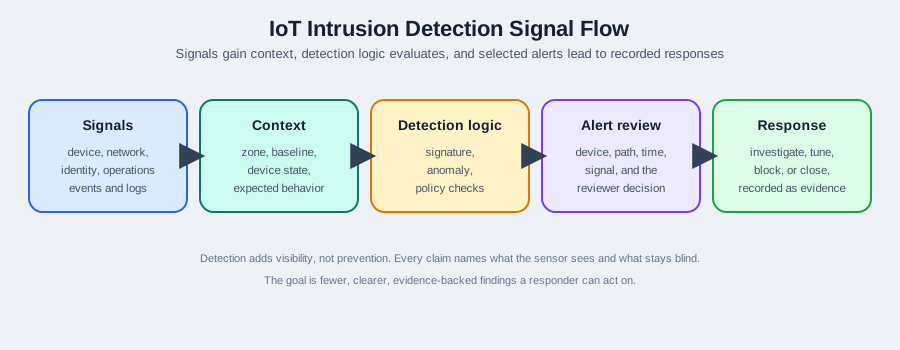
Read Figure 19.1 from signals to evidence. Device, network, identity, and operational observations first gain context such as expected peer, role, time, and firmware state. Signature, anomaly, and policy logic evaluate that contextualized activity; only selected events become alerts. Human or automated review then decides what the alert means and records the response. The pipeline is the chapter’s running narrative: detection adds visibility only when signals can travel all the way to a reviewable decision.
The One-Minute View
It observes and alerts
An IDS watches and reports. An IPS may also block inline, which adds power and risk.
It does not replace prevention
Authentication, segmentation, update integrity, and recovery are separate controls; detection adds visibility on top.
Fewer, clearer findings win
More alerts is not better detection. A trustworthy alert names device, path, time, signal, and decision.
Beginner Examples
- "The IDS protects the network" is not a claim. "The sensor observes traffic between the device zone and the gateway" is.
- A baseline learned during a maintenance window or an outage models abnormal behavior as normal.
- An alert with no device identity, zone, or owner is hard to trust and harder to act on.
Overview Knowledge Check
If you can describe detection as a visibility control, you can stop here. Continue to Practitioner for methods, placement, and alert review.
19.4 Practitioner: Signals, Methods, Placement, and Alert Review
This section: Practitioner: Signals, Methods, Placement, and Alert Review — Write detection as an evidence claim.
Write detection as an evidence claim. Instead of "the IDS protects the network," state what the system observes and what a reviewer can confirm: which traffic a sensor sees, which baseline records expected behavior, which rules detect known patterns, and what each alert contains.
Walkthrough: Designing for Reviewable Alerts
- Name the visible signals. Decide which traffic and logs should be observable for each device zone.
- Place sensors or collectors where those signals can actually be seen.
- Define detection logic. Signatures, baselines, and policy checks for expected behavior.
- Review alerts with context. Device identity, path, timing, and operational state.
- Record the response and retest after rule, firmware, or network changes.
Three Detection Methods
Most IoT reviews need all three methods. The question is not which is best; it is which evidence each method provides and where each is blind.
Inspect Figure 19.2 from the device zone outward to decide where visible evidence supports a signature, baseline, or policy claim and where blind spots remain.
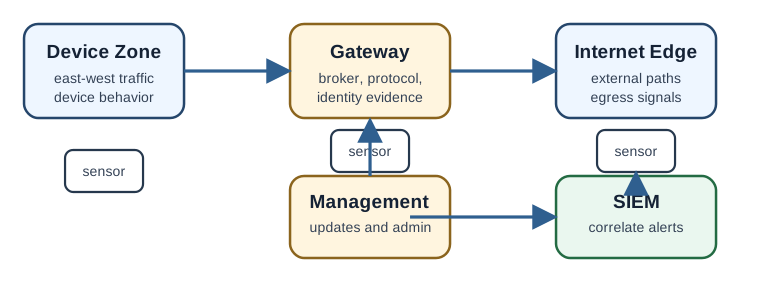
In Figure 19.2, begin inside the device zone. A sensor there may see peer traffic that never leaves the site. Then follow the path through the gateway and internet edge. A sensor on the staff path sees admin access. The SIEM can join names, alerts, and work logs from several sources. No point sees all events. Encrypted data, host-only state, off-path traffic, and missing logs each create a blind spot. Record those limits so the chosen method claims only the evidence it can truly observe.
Sensor Placement Determines Evidence
A sensor cannot alert on traffic it never sees, and a network sensor cannot inspect host state that never leaves the device. Common options:
- Device-zone sensor: observes east-west device traffic and unexpected device-to-device paths.
- Gateway or broker sensor: observes mediated telemetry, commands, authentication outcomes, and protocol errors.
- Management-path sensor: observes administrative actions, update traffic, and configuration changes.
- Internet-edge sensor: observes inbound probes, outbound command-and-control indicators, and data leaving the environment.
- SIEM or log platform: correlates network, identity, device, gateway, and operational records.
State the blind spots explicitly. An edge sensor may miss lateral movement inside an IoT zone; a gateway sensor may miss cloud-side identity misuse unless identity logs are integrated.
The Alert Review Record
Every alert should lead to a recorded, testable decision: incident, benign maintenance, known noisy rule, needs more evidence, or control change required. Inspect Figure 19.3 to see the fields that turn a detector output into one of those accountable outcomes.
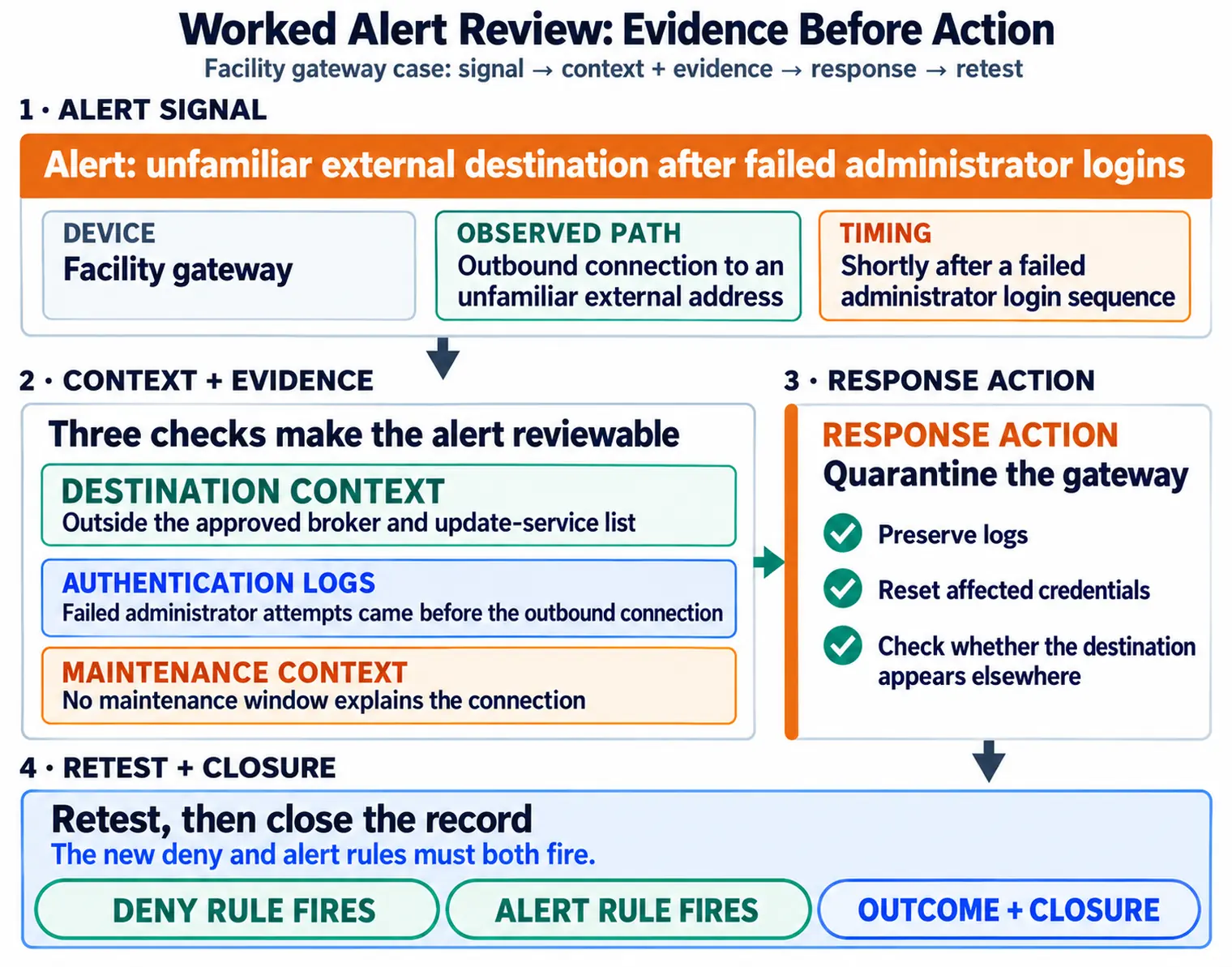
Follow Figure 19.3 from alert signal through context check, evidence decision, response action, and retest trigger. The initial signal says what crossed a rule or baseline; context tests whether maintenance, role, zone, or timing explains it. Supporting evidence justifies the classification, the response names an owner and action, and the trigger states when the rule or decision must be revisited. This record closes the detection pipeline by making clear whether an alert changed the incident state, the control, or merely the detector’s tuning.
An alert review record should include the device or identity involved; the zone, destination, and protocol; the detection method and the baseline or rule violated; supporting logs or packets; the decision and response owner; and a retest trigger such as a rule change, new firmware, or network change. Without this record, alert handling becomes memory and opinion.
Worked Review
A facility gateway normally sends telemetry to a broker and receives configuration commands through a management service. A new alert reports that the gateway contacted an unfamiliar external address shortly after a failed administrator login sequence.
Weak review
"The IDS detected suspicious traffic." No identity, path, timing, or operational context, so no decision can be defended.
Stronger review
The destination is outside the approved broker and update-service list; auth logs show failed admin attempts before the outbound connection; no maintenance window explains it.
Response and retest
Quarantine the gateway, preserve logs, reset affected credentials, check whether the destination appears elsewhere, and retest that the new deny and alert rules both fire.
Practitioner Knowledge Check
If you can design for reviewable alerts and triage one with context, you can stop here. Continue to Under the Hood for IDS versus IPS, blind spots, and the error trade-off.
19.5 Under the Hood: IDS vs IPS, Blind Spots, and the Error Trade-off
This section: Under the Hood: IDS vs IPS, Blind Spots, and the Error Trade-off — The deeper layer explains the decisions that make detection trustworthy: whether to block inline, how to place network and host sensors, and how to choose where to sit on the false-positive and false-negative curve.
The deeper layer explains the decisions that make detection trustworthy: whether to block inline, how to place network and host sensors, and how to choose where to sit on the false-positive and false-negative curve.
IDS, IPS, and Inline Risk
An IDS observes and alerts and is usually safer to deploy because it does not sit in the traffic path. An IPS observes and blocks inline, which can reduce exposure quickly but can also block legitimate traffic if rules are too broad or poorly tuned. Detect-only mode is often appropriate during baseline learning, maintenance windows, and early rollout. Inline blocking should have rollback and exception procedures before it protects operational traffic. For IoT this matters more than usual, because blocked device traffic can affect physical processes, safety-relevant workflows, or field maintenance. A good IPS review asks what the block protects, what legitimate path it could interrupt, who can override it, and what log proves the action.
Network and Host Detection
Network-based detection inspects traffic at a boundary; it sees paths and destinations but cannot see host state that never leaves the device. Host-based detection runs on the device, where it can observe process, configuration, and integrity state, but it adds compute, memory, and update burden that many constrained IoT devices cannot carry. The two are complementary: network sensors see reachability and movement, host signals (where the device can support them) see local change. The review should record which is present and what each cannot see.
The False-Positive and False-Negative Trade-off
Every detection threshold sits between two error types. A false positive flags benign activity as suspicious; a false negative misses real malicious activity. Lowering a threshold catches more real events but raises false positives and analyst fatigue; raising it reduces noise but raises false negatives and missed incidents. Tuning is the act of choosing where to sit on that curve for a given device class and risk, not a search for a magic value. Suppression rules deserve the same scrutiny as detection rules, because an over-broad suppression converts true positives into silent false negatives.
Baselines and Blind Spots
Anomaly detection is only as good as its baseline. A baseline built during abnormal operation models the wrong normal; a stale baseline drifts as devices, firmware, and traffic change. Encrypted traffic is a structural blind spot for payload signatures, which is one reason behavioral signals (destinations, timing, volume) matter for IoT. Document which devices form the baseline, which features are measured, which period is treated as normal, which maintenance events are excluded, and how often the baseline is reviewed or reset.
Triage Categories
When recording a triage result, use precise categories so automatic responses stay separate from investigated findings: expected (explained by normal operation or maintenance), suspicious (unexplained but not confirmed), confirmed (evidence supports an incident), and inconclusive (evidence is insufficient for a decision). The category should drive a response proportional to confidence.
Common Mistakes
- Deploying before naming visibility. Decide which traffic and logs are observable first.
- Treating more alerts as better detection. Quality and reviewability matter more than volume.
- Building a baseline during abnormal operation. The model then treats the wrong behavior as normal.
- Suppressing noisy alerts without recording why. Silent suppression hides true positives.
- Using inline blocking without a rollback path. A bad rule can interrupt safety-relevant traffic.
- Reviewing alerts without device identity, zone, or owner. The decision cannot be defended later.
Under-the-Hood Knowledge Check
At this depth, IoT intrusion detection is a set of deliberate choices: visible signals, fitting detection methods, network and host placement with named blind spots, a chosen position on the error curve, and alert review records that connect signals to proportional, retestable responses.
19.6 Summary
This section: Summary — Intrusion detection turns a visible signal into a claim that a person or rule can review.
Intrusion detection turns a visible signal into a claim that a person or rule can review. A signature matches known bad form, an anomaly compares current behavior with a sound baseline, and a policy check tests an allowed boundary. Their value depends on placement because a device sensor, gateway, staff path, and central log each see different events. Blocking raises the risk further and needs a safe rollback. Tuning must keep both missed attacks and noisy alerts visible. Every alert should retain the source facts, confidence, likely impact, reviewer, chosen response, and the new evidence that would reopen the decision.
- Intrusion detection turns observable signals into reviewable alerts; it adds visibility but does not replace preventive controls.
- Signature, anomaly, and policy detection each provide different evidence and have different blind spots; most IoT reviews need all three.
- Sensor placement determines what can become evidence, and network and host detection see different things.
- IPS adds inline blocking, which needs rollback and exception procedures, especially where device traffic affects physical processes.
- Tuning chooses a position on the false-positive and false-negative curve; alert review records connect signals to proportional responses.
Intrusion detection for IoT needs device-aware baselines, network and host context, identity evidence, alert triage by confidence, and a response path that avoids unsafe disruption, recorded so a later reviewer can defend each decision.
19.7 See Also
This section: See Also
Network Segmentation for IoT
Zones and expected paths give boundary sensors the context that makes alerts interpretable.
Cyber Security Defense in Depth
Detection is the layer that reveals when preventive controls are bypassed or fail.
Common IoT Security Mistakes
See how weak baselines, noisy rules, and missing response records turn into avoidable gaps.
Find help
3 reviewed answers.
Where should I start in a module?
Open the module page from the sidebar to see its chapters in order. Use the module map to return to a topic you need.
Modules and pathsReviewed
What can I try when a project does not work?
Check the symptom, then work through the diagnostic steps. Keep the error message and the smallest example that reproduces it.
When you are stuckReviewed
How do interactive examples work?
Use the interactive guide to check how examples and simulations work before changing your project.
Interactive examples guideReviewed