9 Advanced Security Concepts

More
Depth: Practitioner
Progress saves as you read. Mark sections complete as you go; your progress appears in the sidebar.
9.1 In 60 Seconds
This section: In 60 Seconds — Picture a field device that claims to prove its software state before sending readings.
Turn the Security Label Into a Refusal Test
Picture a field device that claims to prove its software state before sending readings. The label sounds strong, but the service still needs to know what was measured, who checked it, how old the proof is, and what happens when the proof fails.
Telemetry means readings and status sent by that device. Write one narrow claim: only the approved firmware version may send telemetry into this service for this period. Name the measured state, verifier, accepted result, protected path, evidence record, and response owner.
Try an old version, a changed setting, a missing proof, a replayed proof, an expired result, and a verifier outage. The service should refuse or restrict the unsafe case, keep a clear reason, and preserve a recovery path that does not silently widen trust.
This single claim does not prove the whole device is secure. The deeper sections show how measured state, isolated execution, key change, automated detection, response plans, limits, and expiry make advanced controls reviewable.
Advanced security is not about adding impressive labels to an IoT design. It is about making a stronger claim only when the system can show stronger evidence: what state was measured, who checked it, what decision was made, what the evidence does not prove, and what happens when the control fails.
Start simple. Pick one claim, such as “only approved firmware may publish telemetry” or “an isolated key can sign but not be exported.” Then ask for the measurement, verifier, policy, log, boundary test, and response record that make the claim reviewable. If any part is missing, the concept is still useful, but the claim is not complete yet.
For everyday IoT work, that habit keeps advanced controls honest. Attestation, cryptographic agility, trusted execution, automated detection, and response playbooks all matter, but each one should end as a narrow evidence-backed statement someone else can retest after a firmware, policy, key, or architecture change.
9.2 Key Ideas
This section: Key Ideas — State what the control proves, where it fails, and when to test it again.
State what the control proves, where it fails, and when to test it again.
Stronger Claims Need Stronger Evidence
Advanced security is not a collection of impressive words. It is the discipline of making a stronger security claim only when you have stronger evidence to back it. Terms such as attestation, trusted execution, cryptographic agility, and automated detection are powerful when they answer a specific threat-model question, and weak when they are dropped into a design as labels with no scope, no failure behavior, and no way to check them.
The unifying habit for this whole chapter is a small loop: every advanced concept must produce a claim (what should be true), evidence (why it should be accepted), and limits (what the evidence does not prove). If a concept cannot fill in those three, it is decoration, not security.
If you only need the intuition, this layer is enough: "the device uses attestation" is not a claim. A claim says what state is measured, who verifies it, what result is accepted, what happens on failure, and when the evidence expires.
Think of a car advertised as "5-star safety rated." The badge is reassuring, but an engineer wants the crash-test data: which impacts were tested, at what speeds, and what the test did not cover. The rating is a summary of evidence, not a substitute for it. Advanced security concepts deserve the same scrutiny: show the test, the conditions, and the gaps.
For example, a smart-building gateway may combine secure boot, TPM-backed attestation, signed updates, and network isolation. The advanced claim is not that the gateway is "secure." A reviewable claim is narrower: telemetry is accepted only from firmware measurements that match an approved release, stale reports are rejected with a nonce check, and failed devices move to a quarantine segment until an operator closes the event. That statement gives a reviewer something concrete to test.
What follows relies on a precise reading of Stronger Claims Need Stronger Evidence. Figure 9.1 establishes that reading by showing how the review record keeps advanced work honest: a narrow gateway-identity claim, the asset and boundary it protects, the denied case, the accepted case, and the retest trigger that makes old evidence stale.
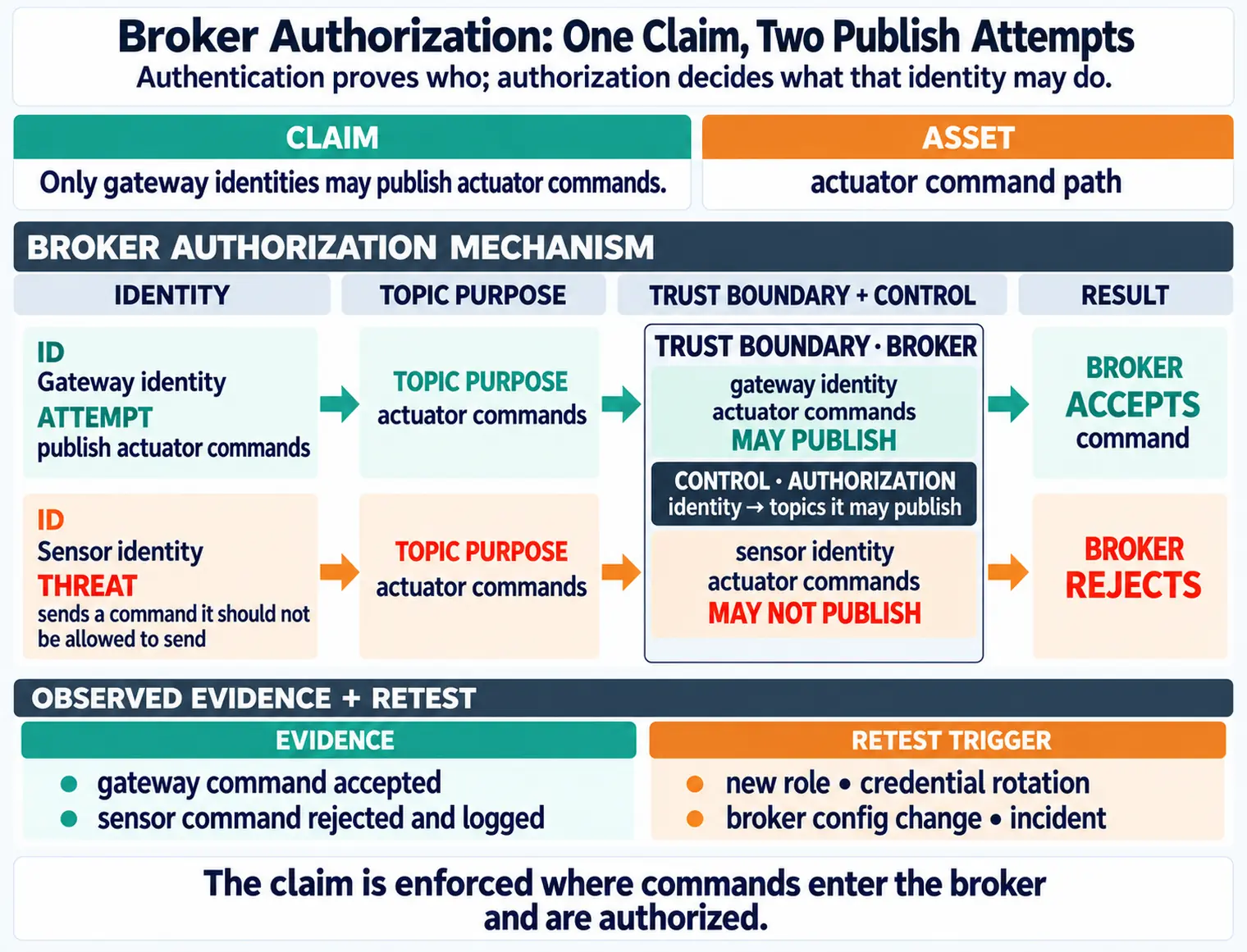
Figure 9.1 names the evidence needed here: CLAIM, Threat, and Retest trigger. Their relationship supports the specific conclusion that the review record keeps advanced work honest: a narrow gateway-identity claim, the asset and boundary it protects, the denied case, the accepted case, and the retest trigger that makes old evidence stale. That conclusion reconnects the visual to Stronger Claims Need Stronger Evidence and to the proof expected downstream.
The One-Minute View
A concept is a claim
Attestation, isolation, and agility each make a specific, narrow claim, not a blanket guarantee of security.
Always state the limit
Every advanced control protects against some risks and not others. Naming the limit is part of the claim.
Define failure behavior
What happens when the measurement, verifier, or automated decision is wrong is as important as the happy path.
Beginner Examples
Taken together, these checks make the section reviewable. That order prevents a control name from being treated as proof and connects the visual to the chapter's evidence-led review sequence.
Overview Knowledge Check
If you can turn a concept into a claim with evidence and a limit, you have the core idea. Continue to Practitioner to run the advanced review loop on real controls.
Practitioner: Review Advanced Controls as Claims
Advanced controls become reviewable when you start from the assumption they are meant to reduce, write one narrow claim, attach evidence, then record limits, failure behavior, and retest triggers. The aim is a modest, defensible record, not an impressive label.
The Review Sequence
- State the assumption. What does the control try to stop the system from blindly trusting: physical access, boot state, identity, communication, or operator authority?
- Write a narrow claim. One sentence that another reviewer can test.
- Identify the reviewed object. The measured state, isolated asset, algorithm policy, or automated decision.
- Attach evidence. Configuration, measurement, logs, signing records, boundary tests, or response records.
- Record limits and failure behavior. What the evidence does not prove, and what happens when the control is wrong.
- Define retest triggers. Firmware, signing policy, identity policy, isolation boundary, detection rule, or playbook changes.
Advanced control names can encourage claims broader than their evidence. Inspect Figure 9.2 before completing the review sequence, because it forces each concept into the same narrow record of assumption, proof, limit, failure behaviour, and change trigger.
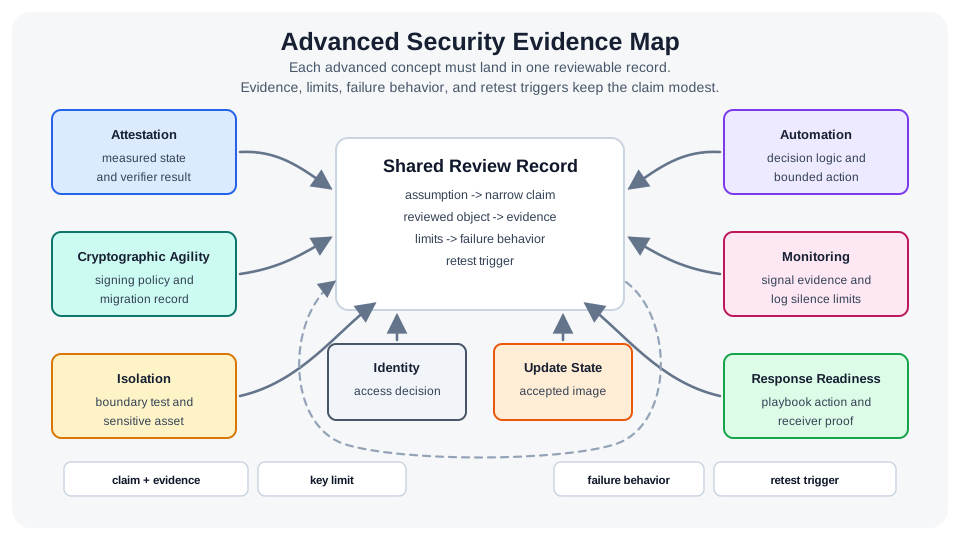
At the centre of Figure 9.2, the Shared Review Record binds assumption to narrow claim, reviewed object to evidence, and limits to failure behavior. Around it, Attestation contributes measured state and verifier result, Cryptographic Agility contributes signing policy and migration record, while Isolation and Automation contribute boundary tests and bounded decision logic. The common record prevents any one advanced mechanism from being mistaken for complete system trust.
Per-Concept Evidence and Its Key Limit
Worked Review Record
A gateway uses secure boot, attestation, isolated key storage, and automatic isolation when attestation fails. The claim under review is: only gateways in an accepted boot and firmware state may publish telemetry to the service.
Evidence observed
Boot records show the firmware state that started; attestation reports include a firmware measurement and device identity; the service checks the attestation result before accepting telemetry; signing keys live outside normal application code; a failed attestation denies telemetry and raises an operations event.
Evidence gaps
No record shows how algorithm or signing-policy changes are tested; the key-use isolation boundary is described but not tested; the response record does not say when automatic denial requires human review.
Conclusion
Accept the scoped claim about telemetry access after accepted attestation. Do not accept a broader claim about migration readiness or operational response maturity until the gaps are closed.
Practitioner Knowledge Check
If you can review each control as a claim with evidence, limits, and failure behavior, you can use advanced concepts responsibly. Continue to Under the Hood for the mechanisms and how the controls depend on one another.
Under the Hood: Mechanisms and Their Dependencies
The deeper layer explains how each advanced control actually works and, just as important, what it quietly depends on. Advanced controls often fail not because one is weak, but because several share a hidden assumption that turns into a single point of failure.
Attestation: Report, Do Not Confuse With Enforce
In remote attestation, a device measures its own state, such as the digest of each boot stage and firmware image, into a protected location, then signs a report with a hardware-backed key so a remote verifier can check it. Two details make or break it. First, freshness: the verifier should supply a nonce so a captured old report cannot be replayed as if it were current. Second, the difference from secure boot: secure boot enforces by refusing to run unverified code, while attestation reports a measurement for a verifier to judge. A measurement without a verifier that acts on it is just a number. And even a passing attestation proves only that the observed state matched an accepted reference at measurement time; it does not prove the running code is free of defects.
A reliable account of Attestation: Report, Do Not Confuse With Enforce must show both responsibility and outcome. Figure 9.3 links those ideas through the claim that remote attestation becomes reviewable when the nonce, signed measurement, verifier policy, and accept-or-reject behavior are all visible.
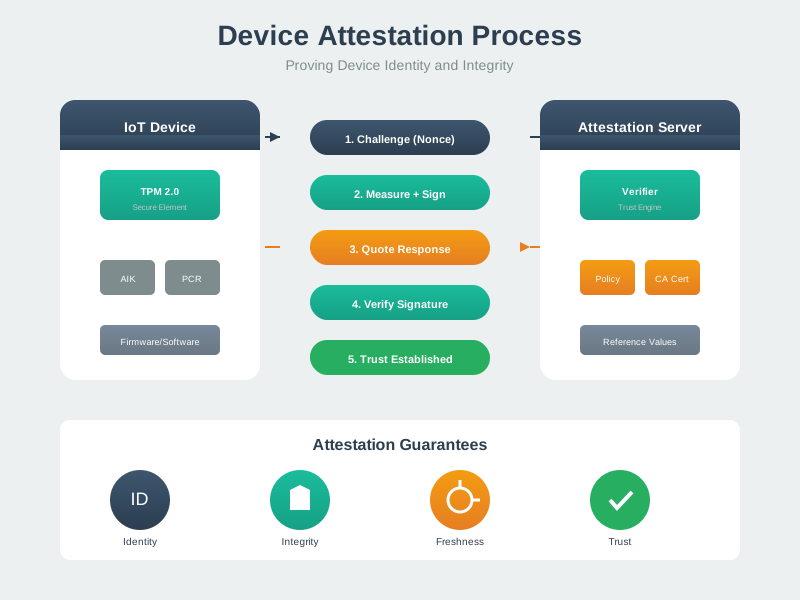
Read Figure 9.3 as a technical claim anchored by REQUEST, Freshness, and Anomaly or request for broader privilege. The labels expose distinct stages or roles that together show remote attestation becomes reviewable when the nonce, signed measurement, verifier policy, and accept-or-reject behavior are all visible. This interpretation keeps Attestation: Report, Do Not Confuse With Enforce connected to the system behavior being designed.
Cryptographic Agility: Plan for Algorithms Aging
IoT devices often outlive the cryptographic choices they shipped with, and algorithms weaken over time as analysis and computing power advance, which is the motivation behind planning for migrations such as post-quantum readiness. Agility is the property that lets a system change algorithms, key sizes, certificate profiles, or signing policies without a redesign. Mechanically it needs version or policy negotiation, an overlap window where old and new choices both validate during migration, and explicit refusal of retired choices afterward. Agility is not the same as strength: a system can be agile and still run a weak algorithm, or strong today but unable to migrate tomorrow.
Isolation and Trusted Execution: Mind the Bypass
Isolation separates security-sensitive work, such as key use, measurement, and command authorization, from general application code, so that an ordinary software fault cannot reach the protected asset. A trusted execution environment is one way to provide that separation. The review must describe the boundary by its allowed interactions: which callers may enter, what data crosses, and what is refused. The classic blind spot is the privileged path: a recovery, debug, or maintenance route that bypasses the boundary is part of the boundary, and an unreviewed bypass quietly defeats the isolation it appears to provide.
A useful TEE review also names the two execution worlds. The rich execution environment runs normal applications, public drivers, and most operating-system services; the trusted execution environment keeps trusted applications, trusted OS services, selected drivers, and protected peripherals behind a smaller boundary. Shared memory and message calls are expected, but they are the reviewed doorway, not a free bridge. For an IoT lock, meter, or gateway, the question is whether credential use, firmware measurement, or command approval stays in the trusted side when the ordinary application side is compromised.
Detection and Response: Bounded, Reversible, Accountable
Automated detection and response reduce delay, but a detector has two ways to be wrong: a false positive that flags a healthy device and a false negative that misses a real problem. An automated action that denies, isolates, revokes, or rolls back can itself cause an outage. Bounded automation pairs a confidence boundary with a response: low-confidence signals inform, high-confidence signals act, and disruptive actions carry a human checkpoint and a recovery path. Tuning feedback closes the loop so false positives, missed detections, and expected maintenance windows are handled rather than repeated.
The Dependency Trap
The advanced risk that beginners miss is interdependence. Attestation depends on a trustworthy measurement path, protected attestation key, and verifier policy; automatic isolation depends on correct identity and segmentation; cryptographic agility depends on signing-key custody and a working update flow. If these controls share one anchor, one key, or one assumption, then defeating that single thing defeats the whole advanced stack at once. Reviewing each control as independent is the mistake; the strength of the design is whether the controls fail independently.
Common Pitfalls
Under-the-Hood Knowledge Check
At this depth, advanced security is the careful pairing of stronger claims with stronger, interdependent evidence. Attestation reports measured state, agility keeps cryptography changeable, isolation guards sensitive work, and bounded automation acts accountably, but each is only as trustworthy as the anchors it shares. The best advanced reviews stay modest: a narrow claim, real evidence, a stated limit, defined failure behavior, and a retest trigger.
9.3 Summary
This section: Summary — For each advanced control, name the trust choice and a test others can repeat.
For each advanced control, name the trust choice and a test others can repeat.
Advanced security concepts are useful when they clarify trust decisions, control interactions, residual risk, and operational verification, each expressed as a narrow claim with evidence, a stated limit, defined failure behavior, and a retest trigger.
9.4 See Also
This section: See Also
IoT Security Secure Boot
See the root of trust and measured state that attestation reports and depends on.
IoT Hardware Vulnerabilities
Review where hardware trust and isolation can actually begin, and how they can be bypassed.
Threat Modelling and Mitigation
Define the assumptions and threats that each advanced control is meant to reduce.
Find help
3 reviewed answers.
Where should I start in a module?
Open the module page from the sidebar to see its chapters in order. Use the module map to return to a topic you need.
Modules and pathsReviewed
What can I try when a project does not work?
Check the symptom, then work through the diagnostic steps. Keep the error message and the smallest example that reproduces it.
When you are stuckReviewed
How do interactive examples work?
Use the interactive guide to check how examples and simulations work before changing your project.
Interactive examples guideReviewed