21 WirelessHART TDMA and Channels
More
Depth: Practitioner
Progress saves as you read. Mark sections complete as you go; your progress appears in the sidebar.
21.1 Start With the Story
This section: Start With the Story — Picture a refinery sensor that reports valve pressure once each cycle.
Follow One Scheduled Packet Across Bad Air
Picture a refinery sensor that reports valve pressure once each cycle. Nearby welding makes one radio channel noisy. The network manager must give the reading a planned send time, a changing channel, and another route so one bad patch of air does not hide the process state.
Write the path for one packet. Record sender, receiver, time slot, channel offset, route choice, retry chance, priority, and final reader. Keep the common clock and schedule version with the trace. State how much delay and loss the process can accept.
Add narrow interference, block one channel, lose a relay, fill the schedule, shift a clock, restart a node, and repeat a packet. Check delivery, retry count, channel quality, route change, queue growth, and end time. Use repeated evidence before removing a channel, then retest the smaller set under load.
Keep urgent process protection local when the planned network delay cannot meet a safe stop. A distant system may plan and review the schedule, but loss of that service must not erase the last known safe plan. Mark late or missing data honestly.
This opening does not size a whole plant network or prove every source of noise. Practitioner builds the slot, channel, and route test. Under the Hood examines clock sync, repeating schedules, channel maps, blacklists, graph routes, capacity, and repair.
WirelessHART reliability depends on choreography: devices transmit in assigned time slots and move across channels so one bad frequency does not ruin the network. The schedule is invisible until a fault makes it visible.
Read this chapter as a timing and channel evidence story. Follow one packet through its slot, offset, hop, route, and retry behavior, then decide what the logs prove about interference, blacklisting, and capacity.
Checkpoint: Key Concepts
This section: Checkpoint: Key Concepts
- TDMA: Time Division Multiple Access; WirelessHART devices transmit only in scheduled time slots.
- Superframe: A repeating schedule of slots assigned by the Network Manager.
- Link: A scheduled sender, receiver, slot, channel offset, and link option.
- Channel hopping: Each scheduled transmission maps to a channel from the active hopping set.
- Channel blacklist: A managed list of channels excluded because evidence shows persistent local interference.
- Graph routing: A redundant route model that gives the schedule more than one next-hop option.
- Coexistence evidence: Packet delivery, retries, channel quality, and spectrum observations used to tune the schedule and blacklist.
21.2 In 60 Seconds
This section: In 60 Seconds — WirelessHART avoids random radio access for normal process traffic.
WirelessHART avoids random radio access for normal process traffic. The Network Manager builds a time-synchronized schedule, assigns transmit and receive links, and maps those links onto a hopping sequence. TDMA prevents scheduled neighbors from talking over each other; channel hopping reduces repeated exposure to the same interferer; blacklisting removes persistently poor channels; graph routing gives messages alternate scheduled paths when a link is unhealthy.
21.3 Learning Objectives
This section: Learning Objectives
By the end of this chapter, you should be able to:
- Explain how a WirelessHART TDMA schedule turns mesh communication into planned slot activity.
- Distinguish slot timing, channel offset, channel hopping, and channel blacklisting.
- Describe how graph routing and TDMA scheduling must be planned together.
- Identify coexistence evidence that supports a blacklist or schedule change.
- Troubleshoot common symptoms such as retries, missed slots, stale blacklists, and path imbalance.
21.4 Quick Check: WirelessHART Schedule
This section: Quick Check: WirelessHART Schedule
21.5 Prerequisites
This section: Prerequisites
Review these local chapters first:
- WirelessHART Fundamentals for the protocol roles and HART background.
- WirelessHART Network Management for Network Manager responsibilities and graph routing.
- Networking Basics for MAC-layer access methods and mesh terminology.
21.6 Why WirelessHART Uses Scheduled Access
This section: Why WirelessHART Uses Scheduled Access — Industrial monitoring traffic is often periodic, long-lived, and operationally important.
Industrial monitoring traffic is often periodic, long-lived, and operationally important. WirelessHART uses scheduled access because the system should know when a device is expected to speak, which neighbor should listen, and which alternate link can carry the packet if the preferred path is unhealthy.
In a contention-based network, a device first competes for the medium. That can be acceptable for best-effort traffic, but it makes worst-case timing harder to reason about when many devices report at once or when interference forces retries. WirelessHART instead reserves communication opportunities. The resulting schedule is more complex to manage, but it gives the Network Manager a clear control surface: add slots, move links, change routes, adjust blacklists, or reduce offered load.
21.7 Determinism From Slots, Resilience From Hopping
This section: Determinism From Slots, Resilience From Hopping — WirelessHART reliability comes from two MAC-layer mechanisms working together.
WirelessHART reliability comes from two MAC-layer mechanisms working together. TDMA divides time into fixed 10 ms slots, and a message plus its acknowledgement fit inside one slot, so communication is scheduled rather than contended. A device knows exactly when it may transmit. On top of that, the network hops channels by using a different frequency across scheduled opportunities, so no single narrowband interferer can block every report for long.
Scheduling gives determinism: predictable timing for process data. Hopping gives resilience: interference on one channel is less likely to dominate every scheduled transmission. Neither is enough by itself for a plant. Together they make 2.4 GHz usable for monitored industrial traffic that must arrive with known freshness and quality evidence.
Use the schedule as arithmetic, not decoration. A 1 second superframe has 100 slot positions at 10 ms each. If 10 vibration sensors each report every 20 seconds, a simple upstream budget with one normal opportunity and one retry opportunity needs 10 x 2 = 20 scheduled upstream opportunities per 20-second reporting cycle before forwarding, health reports, joins, or downstream commands. If those reports travel through two hops, the next router also needs scheduled forwarding opportunities, so the path consumes more than the sensor’s first transmit slot.
Channel hopping changes the risk profile of those opportunities. If the same sensor used the same RF channel for every report, one local interferer could damage many consecutive updates. When slot timing and channel offset select different active channels, the failure pattern becomes evidence: are retries spread across the active set, clustered on one channel, clustered on one route, or clustered after a schedule revision? The answer determines whether the fix is a blacklist, route change, schedule change, or field investigation.
WirelessHART preserves HART application meaning but rebuilds the lower layers. Figure 21.1 aligns the wired and wireless stacks before the schedule is examined.

The APPLICATION row in Figure 21.1 keeps the same HART commands on both sides, but NETWORK changes from point-to-point to mesh forwarding. At DATA LINK, 10 ms TDMA plus channel offset introduces the manager-owned schedule whose hopping and blacklist evidence the next sections inspect.
21.8 TDMA Schedule Anatomy
This section: TDMA Schedule Anatomy — A WirelessHART schedule is built from repeating superframes.
A WirelessHART schedule is built from repeating superframes. Each superframe contains time slots. A scheduled link tells a device what to do in a particular slot: transmit, receive, advertise, or remain idle. The schedule also carries a channel offset, which is combined with network time to choose the actual RF channel for that transmission.
The important distinction is that a slot is not just “a device’s turn.” It is a specific communication opportunity between a sender and receiver, with a direction, a route purpose, and a channel-hopping decision. A single process value may consume multiple scheduled links as it moves across a mesh path toward the gateway.
Inspect Figure 21.2 and ask which time and channel assignments must agree for one packet to reach the gateway.
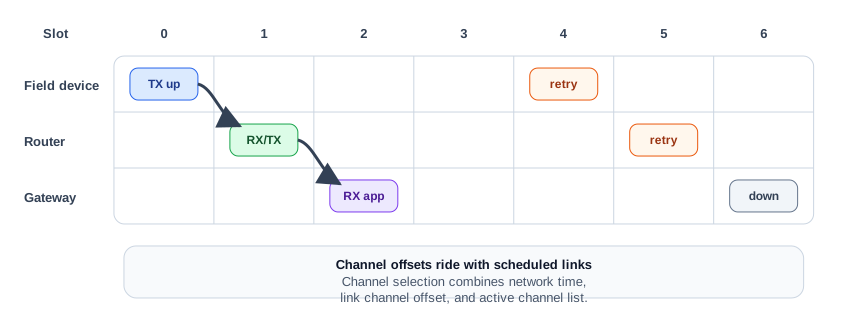
Follow Figure 21.2 across one repeat frame. The device sends while its router listens in one 10 ms slot. The router needs a second slot to send to the gateway. Thus, two ideal hops use at least before queue time or retries. Each link also has a channel offset. It works with the shared slot clock and the list of active channels. Planned retry slots make link strength a visible cost in the schedule instead of an unseen delay.
21.9 Slots, Superframes, And Channels
This section: Slots, Superframes, And Channels — Because the schedule is fixed and known, latency is bounded and predictable.
| Term | Review meaning |
|---|---|
| Slot | A fixed 10 ms window holding one transmit-plus-acknowledge transaction between two devices. |
| Superframe | A repeating cycle of slots; different superframe periods can coexist for fast and slow data. |
| Channel | The actual radio channel for a slot comes from the slot position plus a channel offset across the active IEEE 802.15.4 channels. |
| Link | A scheduled slot and channel-offset pair assigned by the Network Manager for a sender, receiver, and purpose. |
Because the schedule is fixed and known, latency is bounded and predictable. You can say when a reading should arrive, which contention-based radios cannot promise in the same way. A practitioner review starts by mapping the process requirement to links. Suppose a temperature transmitter must be fresh within 60 seconds. If it reports every 30 seconds and the host marks it stale after two missed reports, the operator has about one minute of tolerance, but the schedule still needs enough normal and retry opportunities to avoid routine misses.
With a two-hop path, one report may need a device-to-router link and a router-to-gateway link, plus retry opportunities on one or both edges. The review should identify those links explicitly, not just confirm that the tag exists. Channel planning should be recorded the same way. If diagnostics show retries on channels 15 and 20, but not on the rest of the active set, the smallest defensible change may be a temporary blacklist for those channels with a review date. If retries cluster on Router B across several channels, the issue is more likely route health, antenna placement, shielding, or schedule pressure.
21.10 Channel Hopping
This section: Channel Hopping — Channel hopping prevents a link from depending on one RF channel for every attempt.
Channel hopping prevents a link from depending on one RF channel for every attempt. WirelessHART computes the actual channel from synchronized slot timing and the assigned channel offset, then maps that result into the active channel list. The active list excludes blacklisted channels.
This matters because industrial interference is rarely uniform. A strong local interferer may damage one part of the band while other channels remain usable. Hopping spreads attempts across the usable set, so a single poor channel does not dominate every scheduled transmission. It also gives the Network Manager per-channel evidence: which channels produce retries, weak acknowledgements, or repeated delivery failures.
Channel hopping is not magic. Broadband noise, poor antenna placement, shielding by plant structures, or an overloaded schedule can still cause failures. The mechanism works best when paired with measured channel quality and a schedule that leaves retry capacity.
21.11 Blacklisting and Coexistence Evidence
This section: Blacklisting and Coexistence Evidence — Blacklisting is a controlled response to persistent channel-specific interference.
Blacklisting is a controlled response to persistent channel-specific interference. It should be based on evidence, not on a permanent assumption from installation day. A useful review record includes:
- Channel quality observations from the Network Manager.
- Retry and acknowledgement trends grouped by channel.
- Time-of-day patterns that align with nearby systems or plant operations.
- Spectrum observations from a site survey when available.
- Before-and-after health checks after a blacklist change.
A blacklist is too small if known-bad channels remain active and keep consuming retries. A blacklist is too large if it removes usable diversity and forces too much traffic onto the remaining channels. The operational goal is a defensible active channel set, reviewed when the RF environment changes.
Figure 21.3 keeps channel exclusions tied to retry and schedule evidence.

The worked WirelessHART view in Figure 21.3 first fixes a one-second superframe of 100 ten-millisecond slot positions. A scheduled transmission uses its slot, channel offset, and active channel list to choose an RF channel. In the diagnostic example, retries cluster on channels 15 and 20 while the rest of the active set has no such cluster. A temporary blacklist removes only those channels, with a review date. Check retry rates and delivery after the change, including any new pressure on the remaining channels. The example supports a bounded test, not a permanent blacklist from one observed retry.
21.12 Time Synchronization And Blacklist Validation
This section: Time Synchronization And Blacklist Validation — The 2.4 GHz band is shared with Wi-Fi and other systems, so WirelessHART adds channel blacklisting: an administrator can remove specific channels from the hopping pattern when persistent evidence supports it.
The 2.4 GHz band is shared with Wi-Fi and other systems, so WirelessHART adds channel blacklisting: an administrator can remove specific channels from the hopping pattern when persistent evidence supports it. Combined with hopping, this means a recurring interferer on one channel does not have to damage every future report, because scheduled attempts continue across the remaining active channels. The tradeoff is diversity: every channel removed also shrinks the set available for later hops.
All of this depends on tight time synchronization. Every device must agree on slot boundaries to sub-millisecond accuracy, or TDMA collapses into collisions and missed acknowledgements. Devices maintain sync by carrying timing information in acknowledgements and management traffic, continually correcting clocks against the network. The schedule tells a device when to act, the hopping pattern tells it which channel to use, and the blacklist removes frequencies that evidence says are persistently poor.
Under the hood, the channel for a transmission is derived from network time, the assigned channel offset, and the active channel list. A useful mental model is: scheduled link first, channel selection second, radio transmission third, diagnostic evidence last. If a channel is removed from the active list, the mapping changes for later slots, so the operations record should capture the old active set, new active set, reason, and validation window.
Consider a gateway area with 15 active channels and evidence that 2 channels are persistently poor during a packaging-line shift. A temporary blacklist leaves 15 - 2 = 13 active channels. If retry counts fall but queue age rises, the network may have traded RF errors for schedule pressure or route concentration. The correct follow-up is not “blacklist more”; it is to compare channel-specific retries, per-route retries, queue age, and stale-value behavior against the baseline.
21.13 Quick Check: TDMA, Hopping, And Blacklisting
This section: Quick Check: TDMA, Hopping, And Blacklisting
21.14 Graph Routing Interaction
This section: Graph Routing Interaction — Graph routing and TDMA scheduling are inseparable.
Graph routing and TDMA scheduling are inseparable. A graph can name alternate next hops, but those paths only help if transmit and receive opportunities exist at the right time. Likewise, a schedule can reserve slots, but those slots must align with route ownership and expected traffic direction.
When a device sends upstream data, the schedule should give the device a transmit slot to at least one neighbor, then give the next hop a later slot toward the gateway. For resilience, the graph may provide another parent and the schedule may reserve alternate or retry links. The Network Manager uses link evidence to adjust both the route graph and the slot plan.
Good review questions include:
- Does each important graph edge have matching transmit and receive links?
- Are retries scheduled on a different slot and channel opportunity?
- Are alternate parents actually reachable in the schedule, or only present in the route model?
- Does downstream traffic have scheduled capacity, not just upstream reporting capacity?
- Do diagnostics show one parent carrying all traffic while alternates remain unused or stale?
Figure 21.4 asks whether both graph parents have usable scheduled links.
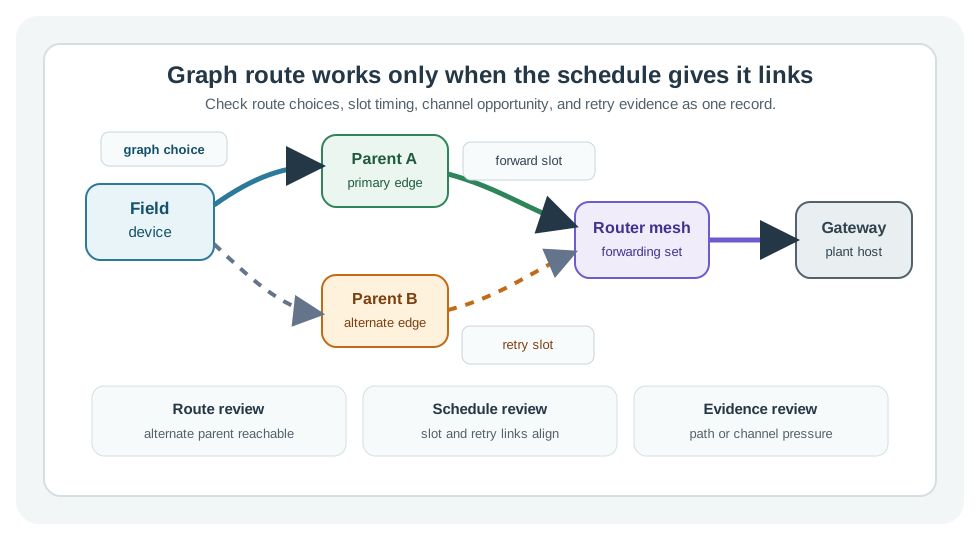
The graph record in Figure 21.4 shows a field device with primary Parent A and alternate Parent B paths toward the gateway. The route choice is usable only if the TDMA schedule includes forwarding and retry slots for the chosen parent and neighbors. Review the alternate parent’s reachability, assigned links, channel opportunity, and gateway report before accepting failover. A graph edge without a matching slot cannot carry the packet when the primary path fails. Keep route, schedule, retries, and delivery evidence in one change record so a later fault can be traced to path or channel pressure.
21.15 Troubleshooting Patterns
This section: Troubleshooting Patterns — Retries cluster on one channel.
Retries cluster on one channel. Check channel-quality evidence and recent site changes. A blacklist may be justified if the problem is persistent and localized to a channel.
Retries cluster on one path. Review graph health, parent selection, antenna placement, and scheduled retry opportunities. The issue may be topology rather than channel quality.
Missed slots appear across many devices. Check time synchronization health, gateway time source status, and whether a schedule update propagated cleanly.
Healthy links still show late data. Look for schedule bottlenecks. A route with several hops needs enough upstream, downstream, and retry opportunities in the right order.
A blacklist helped at first but later reduced headroom. Revisit the coexistence evidence. Channels removed during commissioning should be rechecked when nearby radios, equipment, or operating patterns change.
A new device joins but reports slowly. Shared or join-related access may be working while dedicated links are not yet sufficient. Confirm that the Network Manager assigned production links after the join.
21.16 Focused Practice
This section: Focused Practice
21.17 Knowledge Check: Evidence Before Blacklisting
This section: Knowledge Check: Evidence Before Blacklisting
21.18 Matching Quiz: Schedule Terms
This section: Matching Quiz: Schedule Terms
21.19 Ordering Quiz: Troubleshooting a Hopping Problem
This section: Ordering Quiz: Troubleshooting a Hopping Problem
21.21 TDMA Superframe Workbench
This section: TDMA Superframe Workbench
WirelessHART TDMA and channel hopping narrated tour
Narrated audio tour. The full transcript is below.
Play the tour to open the workbench. Pause, replay a beat, or read the full transcript below. Some situations cannot be shown by this teaching model; those beats keep the existing frame and provide captions only.
Full transcript — WirelessHART TDMA and channel hopping (8 beats)
B1 — Pressure reports
You are the engineer keeping a refinery's valve pressure reports available. A sensor reports once each cycle, but nearby welding makes a radio channel noisy. A missing reading can hide the process state. How can a planned send time and a changing channel help?
Model caption: A refinery pressure report needs planned communication despite a noisy channel.
B2 — Assigned slot
Time Division Multiple Access, or TDMA, assigns communication to time slots. Each slot lasts ten milliseconds and holds a message plus its acknowledgement, the receiver's confirmation. The network manager assigns the sender and receiver, so scheduled neighbors avoid talking over each other.
Model caption: One assigned sender and receiver use a ten millisecond message-and-acknowledgement slot.
B3 — Shared clock
A superframe is a repeating schedule of slots. The devices need a shared clock so they agree when each slot begins. Timing information in acknowledgements and management traffic helps correct their clocks. Without agreement on slot timing, transmissions can collide and acknowledgements can be missed.
Model caption: Devices must agree on slot boundaries. Acknowledgements and management traffic carry timing corrections; correction is not simulated.
B4 — Two scheduled hops
Follow your pressure reading through two scheduled hops. First, the sensor sends while a router listens. The first hop uses one ten millisecond slot. Next, the router forwards the reading to the gateway in another ten millisecond slot. The reading needs both communication opportunities.
Model caption: Sensor to router: ten milliseconds. Router to gateway: ten milliseconds. Two scheduled hops.
B5 — Ideal hop time
Ten plus ten gives twenty milliseconds for the two ideal hops, before queue time or retries. Twenty milliseconds is the scheduled hop time, rather than a guaranteed arrival deadline. Forwarding uses another slot because reaching the router is only part of the path to the gateway.
Model caption: Ten plus ten equals twenty milliseconds of ideal scheduled hop time, before queues or retries.
B6 — Channel exclusion
The schedule also assigns a number called a channel offset to each communication opportunity. That number shifts the radio channel choice. Devices combine it with shared slot timing to choose a channel from the active list. Hopping spreads attempts across the active list. In the teaching model's routine preset, channel twenty is excluded, leaving fourteen active channels. Excluding channel fifteen as well leaves thirteen; hopping continues within the smaller set.
Model caption: Excluding channel fifteen reduces fourteen choices to thirteen; the active table still supplies a channel.
B7 — Delivery misconception
A common mistake is to assume blacklisting a noisy channel fixes losses from poor antenna placement, but excluding a noisy channel reduces one source of trouble. A blacklist removes a channel from consideration; it cannot remove every cause of failure. Poor antenna placement or an overloaded schedule can still lose reports. Persistent interference on a channel supports an exclusion, while each exclusion also reduces the choices for later hops.
Model caption: Channel exclusion changes the choices, not every cause of failure. Persistent evidence supports a blacklist; delivery is not guaranteed.
B8 — Schedule takeaway
For your pressure reports, the schedule reserves communication time, shared timing aligns the devices, and the active channel list guides hopping. Reserve the time, share the clock, and spread attempts across the usable channels.
Model caption: Reserve the time, share the clock, and spread attempts across the usable channels.
21.22 Checkpoint: Summary
This section: Checkpoint: Summary — WirelessHART TDMA is a managed schedule, not just a time slot counter.
WirelessHART TDMA is a managed schedule, not just a time slot counter. Each useful communication opportunity combines slot timing, sender and receiver roles, channel offset, graph purpose, and retry behavior. Channel hopping spreads attempts across the active set, blacklisting removes persistently poor channels when evidence supports it, and graph routing provides path diversity only when the schedule gives those paths real transmit and receive opportunities.
21.23 Key Takeaway
This section: Key Takeaway — WirelessHART TDMA and channel hopping provide predictable radio behavior only when schedules, retries, route health, and coexistence evidence are monitored.
WirelessHART TDMA and channel hopping provide predictable radio behavior only when schedules, retries, route health, and coexistence evidence are monitored.
Find help
3 reviewed answers.
Where should I start in a module?
Open the module page from the sidebar to see its chapters in order. Use the module map to return to a topic you need.
Modules and pathsReviewed
What can I try when a project does not work?
Check the symptom, then work through the diagnostic steps. Keep the error message and the smallest example that reproduces it.
When you are stuckReviewed
How do interactive examples work?
Use the interactive guide to check how examples and simulations work before changing your project.
Interactive examples guideReviewed