2 How RFID Identifies Objects
More
Depth: Practitioner
Progress saves as you read. Mark sections complete as you go; your progress appears in the sidebar.
A tagged carton passes a loading door and the RFID reader tries to identify it among many nearby objects. The object tag needs energy or a battery, the radio link needs coupling, and the application must connect the received identifier to the correct asset event. RFID identifies through a system, not through a magic sticker.
RFID means radio-frequency identification, the method used by this reader and tag system.
2.1 Trace Identity From RFID reader Field to Asset Record
This section: Trace Identity From RFID reader Field to Asset Record — Begin with Figure 2.1.
Begin with Figure 2.1. Follow the inductive path between RFID reader and coil-coupled object tag, then compare the propagating or backscatter path used by many UHF systems. The labels show why orientation, distance, material, and antenna design affect the two regimes differently.
Figure 2.2 then expands from physics to information. The RFID reader energizes or queries tags, anti-collision separates replies, reader middleware filters observations, and the application binds an object tag identifier to an object and event. Read the final association carefully: receiving an EPC does not prove which doorway action occurred unless time, RFID reader zone, and business rule are present.
Passive tags draw operating energy from the RFID reader field and modulate a response. Battery-assisted tags can power their chip or sensors while still using a RFID reader interaction. Active tags transmit using their own battery. These names affect range, lifetime, cost, maintenance, and what the object tag can measure; they should not be reduced to “weak, medium, strong.”
Suppose a portal observes object tag T91 seven times during a two-second crossing. Reader middleware can combine those reads into one candidate passage event, but it must keep enough detail to handle direction and stray reads. If the upstream antenna sees T91 before the downstream antenna, the system may infer entry. Simultaneous or reversed observations need an explicit uncertain or exit rule.
Anti-collision allows several tags to share the read zone, but dense populations still need measured performance. Place 100 target tags on real cartons, include nearby non-target tags, and record unique identities, missed targets, and stray reads. A total of 100 messages is not the same as 100 correctly identified cartons because duplicates can hide misses.
If the reader identifies 100 distinct cartons in 2 s, its observed identification rate is . That RFID reader rate belongs to this object set, orientation, power, and doorway; repeat the calculation with the worst approved packing arrangement.
Predict the portal evidence. Move one known carton through and expect one application event tied to several raw observations. Reverse direction and expect the opposite event. Hold an object tag at the zone edge and verify whether the reader system rejects or marks it uncertain. Then run the 100-carton load and compare unique expected identifiers with observed ones.
RFID reader power, object tag sensitivity, material, orientation, local rules, and reader middleware vary. Test RFID reads with the real tags, objects, antennas, and traffic.
Protect the tag-to-asset binding. Commissioning should scan the object tag, confirm the physical object, and store who made the association. Replacing a damaged label must retire the old identifier before the new one is accepted.
2.2 Start With the Story
This section: Start With the Story — Picture a tool cabinet that must report which wrench was returned.
Turn a Radio Read Into a Bounded Claim
Picture a tool cabinet that must report which wrench was returned. Radio Frequency Identification, or RFID, uses radio energy to observe an identity stored on a tag. Radio frequency means energy carried by radio waves. A raw read says that a reader noticed a tag; it does not yet prove where the tool was or what action occurred.
Write the claim before placing equipment. Name the object, tag, reader, antenna, intended read zone, nearby zone, event rule, time, privacy limit, and owner. State how repeated raw reads become one business event.
Test every tag shape and position. Include metal, liquid, a crowded cabinet, two tags replying together, a tool just outside the zone, a damaged tag, and a restart. Count expected objects, missed objects, extra objects, and repeated reads. A bench read is not proof of the installed workflow.
Keep any urgent safety check independent of a weak read. The inventory system can guide staff, but uncertainty should remain visible rather than becoming a false present or absent result.
This opening does not promise one range or frequency fit. Practitioner builds the reader, zone, and event record. Under the Hood examines power, coupling, reply timing, collisions, materials, filtering, security, and the limits of each observation.
Imagine a tagged tool cabinet that says a wrench is present. The useful question is not whether RFID can read a tag on the bench. The useful question is whether the reader, antenna, tag, read zone, and middleware can turn messy radio observations into one trustworthy inventory event.
Use this chapter from that claim outward. Follow the energy path, the tag response, the anti-collision round, the filtering step, and the business event so the final record says what was observed and what could still fool the system.
The word “range” hides two different physical links, so inspect Figure 2.1 before using a distance claim. Its labelled INDUCTIVE COUPLING and RADIATIVE COUPLING AND BACKSCATTER panels put the energy and return paths side by side.
In the near-field panel of Figure 2.1, Reader field powers the tag is paired with Load modulation returns data; coil size, alignment, and detuning therefore shape the read zone. Across the divide, RF wave powers the tag and Backscatter returns data describe the UHF path, where antenna angle, liquids, metal, and multipath matter. The comparison restores the chapter’s running evidence rule: specify the coupling regime and environment before treating any observed range as transferable.
2.3 Overview: What an RFID Claim Means
This section: Overview: What an RFID Claim Means — Radio Frequency Identification, or RFID, is a way to observe object identity with a tag, a reader, an antenna, and software that turns radio observations into events.
Radio Frequency Identification, or RFID, is a way to observe object identity with a tag, a reader, an antenna, and software that turns radio observations into events. The useful claim is not "RFID works." The useful claim is that a named object, credential, animal, tool, carton, or asset can be observed in a defined read zone with enough reliability for a specific workflow.
That boundary matters because RFID systems can produce both missing reads and extra reads. A tag may be present but unreadable because of orientation, material, distance, collision, shielding, or damaged attachment. A tag may also be read outside the intended business event if the reader zone is too broad or the middleware accepts every raw observation.
Make the claim measurable before approving the system. For a tool cabinet, the bounded claim might be: "when the cabinet closes, the reader should identify the 18 tagged tools inside this cabinet, ignore tools on the bench beside it, and create one inventory event per physical tool." If the raw trace contains 63 observations, that is not 63 tools. The evidence should reduce those observations to the expected identities, such as 18 / 18 tools accepted, 0 / 3 nearby bench tools accepted, and duplicate observations suppressed by the cabinet-close event rule.
A moving portal has a different denominator. If 32 tagged cartons pass through a 2.4 m read zone at 1.6 m/s, the reader has about 2.4 / 1.6 = 1.5 s of dwell time. With an observed inventory round time of 200 ms, that is about 1.5 / 0.2 = 7.5 rounds before the cartons leave the zone. A pilot that reads 29 of 32 expected cartons is an evidence record, not a full release: the review still needs to explain whether the three misses came from tag orientation, material shielding, anti-collision timing, antenna aim, or middleware timeout. This is why RFID fundamentals are really about the whole identification chain, not only the tag chip.
Figure 2.2 follows a cabinet tag from radio observation to inventory event.
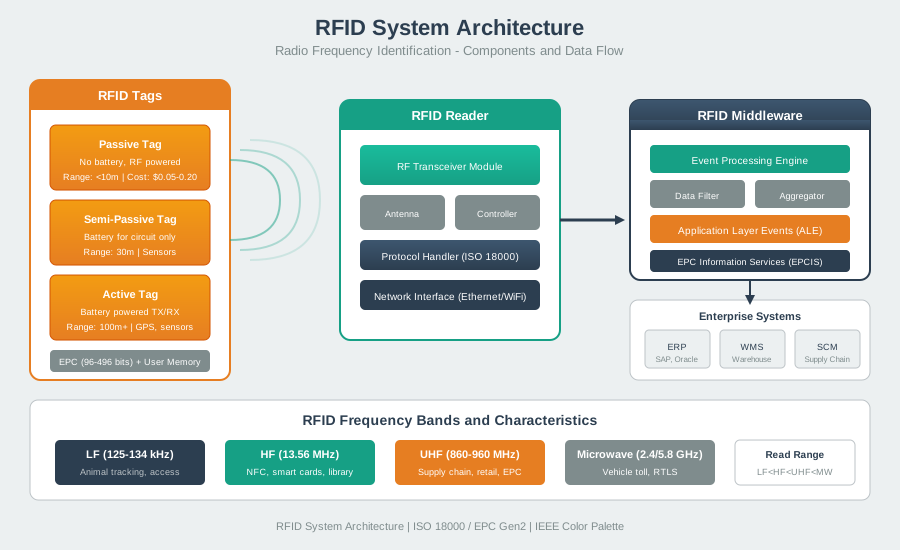
The tag links an identifier to a tool, while the reader and antenna collect replies and add reader identity and time. Anti-collision and repeated inventory rounds can produce more observations than there are tools. Middleware filters those reads before the application decides which tools are present or missing under a business rule. In the worked cabinet, 18 tagged tools and 63 observations are different quantities; the event must explain how repeats were handled. Keep the raw trace and filtered list together. A decoded EPC alone does not prove a cabinet return or a doorway crossing.
If you only need the intuition, this layer is enough: approve RFID from observed read-zone evidence, not from the technology label. Name the object identity, tag type, frequency family, reader zone, filtering rule, application event, privacy boundary, owner, and retest trigger.
The Five Evidence Boundaries
Identity
The tag identifier must map to the right object, credential, animal, container, or process state, with a rule for unknown, duplicate, damaged, or retired tags.
Physics
Tag power model, frequency family, coupling, antenna pattern, object material, orientation, and read distance define whether a radio observation is plausible.
Read-zone behavior
Reader placement, power, shielding, anti-collision, dwell time, movement, and neighboring tags define what the reader can and cannot prove.
Event meaning
Middleware, filtering, application rules, security, privacy, exception handling, ownership, and retest triggers decide whether a read becomes an approved event.
Beginner Examples
- A successful bench read proves that this tag and reader can communicate under that condition. It does not prove the installed read zone.
- A portal read proves an observation near the portal only when placement, antenna settings, object flow, and filtering rules are part of the evidence.
- A tag identifier is not the business event. The application still has to decide whether the observation means received, returned, released, counted, or rejected.
- Longer read range is not automatically better. A wider zone can create false events when nearby tags are observed unintentionally.
Overview Knowledge Check
2.4 Practitioner: Build the RFID Review Record
This section: Practitioner: Build the RFID Review Record — A practical RFID review record should let another engineer repeat the decision.
A practical RFID review record should let another engineer repeat the decision. It names the business event, the physical read zone, the tag and reader choices, the observed evidence, the filter that turns raw reads into events, and the operational change that reopens the decision.
Early design may record assumptions and required tests. A release review should replace assumptions with observations from representative tags, objects, mounting positions, reader placements, motion patterns, neighboring tags, privacy boundaries, and exception workflows.
Worked Review: Dock-Door Inventory
A dock-door workflow reads tagged cartons as they pass through a portal. The review should approve only the observed flow: the carton population, tag placement, reader antennas, power settings, movement speed, nearby tags, duplicate filter, missed-read rule, manual exception path, and retest trigger for new packaging, reader relocation, firmware, or operating procedure changes.
The safe approval statement is narrow: under the reviewed conditions, this portal can turn observed tag reads into this inventory event. It does not prove every product material, stacking pattern, doorway, antenna, or future warehouse layout.
Worked Review: Tool Checkout Cabinet
A cabinet reads tagged tools when a technician opens and closes the door. The evidence boundary is different from a portal. Review shielding, reader timing, tool overlap, tag attachment durability, unknown tools, duplicate reads, access identity, privacy, audit trail, and the exception process when a tool is missing or unreadable.
The approval should not say that RFID generally solves tool custody. It should say which cabinet, tag set, timing rule, and application mapping were observed.
Practitioner Knowledge Check
2.5 Under the Hood: Layer Handoffs and Failure Boundaries
This section: Under the Hood: Layer Handoffs and Failure Boundaries — RFID systems fail when radio observations are treated as complete application proof.
RFID systems fail when radio observations are treated as complete application proof. A tag can harvest enough energy and still collide with other tags. A reader can decode a tag and still observe the wrong zone. Middleware can filter duplicates and still map the event to the wrong object state. A privacy or cloning issue can exist even when reads are technically reliable.
The review should preserve enough handoff evidence to diagnose where the claim stopped being proven: tag physics, air-interface behavior, read-zone control, event filtering, application state, or operations. That separation makes later troubleshooting faster and keeps approvals from expanding beyond the evidence.
Diagnosis Pattern
- Name the failing boundary. Separate missed read, extra read, collision, duplicate event, object mapping, privacy issue, and application-state error.
- Check the closest lower proof. If an application event is wrong, inspect filtering and mapping before changing antenna placement. If the tag is unreadable, inspect object material and orientation before rewriting middleware.
- Change one variable at a time. Reader power, antenna position, tag model, attachment, firmware, object flow, and duplicate window can each change the evidence trail.
- Write the unsupported claim. If the pilot covered one doorway, one object type, or one tag population, keep the approval limited to that boundary.
Under-the-Hood Knowledge Check
2.6 Summary
This section: Summary
- RFID approval starts with a bounded identification claim, not with a successful read in isolation.
- Tags, readers, antennas, coupling, anti-collision, reader zones, filtering, and applications each prove different parts of the workflow.
- Passive, battery-assisted passive, and active tags support different power and evidence models.
- LF and HF systems use magnetic coupling; UHF passive systems use backscatter and are more sensitive to placement, materials, reflections, and region rules.
- A reliable RFID event requires a controlled read zone plus middleware that filters duplicates, misses, extra reads, and exception cases.
- Operations evidence names the owner, privacy boundary, replacement rule, monitoring signal, and retest trigger.
2.7 Key Takeaway
This section: Key Takeaway
Approve RFID only when the reviewed behavior is tied to object identity, tag physics, read-zone evidence, event filtering, application meaning, owner, and retest boundary.
2.8 See Also
This section: See Also
RFID Tag Types
Choose passive, battery-assisted passive, and active tags from power, form factor, lifecycle, and workflow evidence.
RFID Frequency Bands
Compare LF, HF, UHF, and specialized RFID behavior by coupling, materials, standards, and read-zone fit.
RFID System Components
Connect readers, antennas, tags, middleware, and applications to a reviewable system boundary.
RFID Design and Deployment
Plan pilots, read zones, antenna placement, exception paths, and evidence records for field deployment.
Find help
3 reviewed answers.
Where should I start in a module?
Open the module page from the sidebar to see its chapters in order. Use the module map to return to a topic you need.
Modules and pathsReviewed
What can I try when a project does not work?
Check the symptom, then work through the diagnostic steps. Keep the error message and the smallest example that reproduces it.
When you are stuckReviewed
How do interactive examples work?
Use the interactive guide to check how examples and simulations work before changing your project.
Interactive examples guideReviewed