38 NFC: Comprehensive Review
Sammy the Sensor was ready for a challenge: “We have learned so much about NFC. Now it is time to put it all together!” Max the Microcontroller agreed: “This review covers three big projects. First, we build a door lock with an ESP32 that reads NFC badges. Second, we create a smart home server with a Raspberry Pi that responds to NFC taps. Third, we learn why NFC payments are incredibly safe!” Bella the Battery reminded everyone: “Remember, NFC has three modes – reading tags, phone-to-phone sharing, and pretending to be a card. Each mode powers different real-world applications.” Lila the LED summarized: “And the short range is not a weakness – it is the superpower! Being close means being safe and intentional.”
Work through this chapter after:
- NFC Fundamentals - operating modes, tag types, and NDEF basics.
- NFC Architecture - broader NFC context and design considerations.
Here you will focus on end-to-end systems (e.g. access control, payments), not definitions:
- How readers, tags, locks, and applications fit together.
- Where security pitfalls appear in real deployments.
If terms like NDEF, tag type 2/4, or peer-to-peer mode are unfamiliar, revisit the fundamentals first, then return here to tackle the labs and questions.
Deep Dives:
- NFC Fundamentals - Core NFC concepts and operating modes
- NFC Architecture - Protocol stack and tag types
- NFC Hands-On - Practical implementations
Comparisons:
- RFID Comprehensive Review - Related wireless identification technology
- Bluetooth Fundamentals - Alternative short-range protocol
Learning:
- Quizzes Hub - Test your NFC knowledge
- Videos Hub - Visual learning resources
38.1 Learning Objectives
By the end of this review, you will be able to:
- Construct NFC Access Control Systems: Assemble and program ESP32-based door locks using PN532 readers with UID authorization logic
- Configure I2C Tag Communication: Set up and verify I2C wiring between ESP32 and PN532 for reliable NFC tag detection
- Design Security Architectures: Architect authorized tag databases, evaluate SE vs HCE trade-offs, and select appropriate encryption for access control
- Integrate Hardware Subsystems: Wire NFC readers, servo motors, LEDs, and buzzers into a cohesive embedded feedback system
- Evaluate Tag Type Suitability: Compare NTAG213, NTAG424 DNA, and DESFire EV2 capabilities against deployment requirements
- Diagnose NFC Deployment Failures: Troubleshoot I2C communication errors, metal interference, range anomalies, and NDEF parsing failures
38.2 Chapter Overview
This comprehensive review covers NFC system implementation across three focused chapters:
38.2.1 Chapter Structure
| Chapter | Focus | Key Topics |
|---|---|---|
| NFC Access Control | ESP32 Implementation | Hardware wiring, I2C communication, UID authorization, servo control |
| NFC Smart Home | Python Automation | Raspberry Pi, nfcpy, MQTT integration, scene management |
| NFC Security & Comparisons | Security Analysis | Payment security, SE vs HCE, technology selection |
38.3 Prerequisites
Required Chapters:
- NFC Fundamentals - Core NFC concepts
- NFC Architecture - Protocol stack and modes
- RFID Fundamentals - Related technology background
Recommended Reading:
- Bluetooth Fundamentals - Comparison context
- Mobile Phone as Sensor - NFC in smartphones
Technical Background:
- Understanding of RF communication basics
- Familiarity with ISO standards concepts
- Basic security/encryption knowledge
NFC Mode Summary:
| Mode | Initiator | Target | Example |
|---|---|---|---|
| Reader/Writer | Phone | Tag | Reading smart poster |
| Peer-to-Peer | Phone | Phone | Android Beam |
| Card Emulation | Terminal | Phone | Mobile payments |
NFC’s intentionally short range (4-10 cm) provides security through physics. Signal strength falls with distance:
\[ P_{\text{received}} = P_{\text{transmit}} \times \left(\frac{\lambda}{4\pi d}\right)^2 \]
At 13.56 MHz, wavelength λ = 22.1 m. For phone transmit power 200 mW at 5 cm working distance: \[ P_{\text{received}} = 0.2 \times \left(\frac{22.1}{4\pi \times 0.05}\right)^2 = 31 \text{ mW (sufficient)} \]
At 50 cm (10× distance), power drops to 0.31 mW (100× reduction). Commercial NFC readers need >1 mW for reliable operation, making eavesdropping from 50 cm+ impractical without specialized directional antennas costing $10k+. This “security by proximity” is why contactless cards work—physics prevents distant attacks, not just encryption.
Estimated Time: 2 hours (all three chapters)
This comprehensive review connects to learning resources across the module:
Interactive Practice:
- Quizzes Hub - Test your NFC security and protocol knowledge
- Simulations Hub - Explore interactive NFC scenarios
Visual Learning:
- Videos Hub - Watch NFC payment and access control demos
- Knowledge Map - See how NFC fits in the IoT ecosystem
Identify Gaps:
- Knowledge Gaps Hub - Common NFC misconceptions addressed
Related Technologies:
- RFID Comprehensive Review - Compare NFC vs RFID implementations
- Bluetooth Comprehensive Review - Alternative short-range wireless
The Myth: Many users believe that because NFC transmits data wirelessly, attackers can easily intercept payments by standing nearby with special equipment.
The Reality: NFC mobile payments are significantly more secure than physical credit cards. Here’s why intercepted NFC data is worthless:
Real-World Data:
- NFC payment fraud rate: 0.002% ($2 per $100,000 transacted)
- Physical card fraud rate: 0.5-1% ($500-$1,000 per $100,000) - 250-500x higher!
- Successful NFC relay attacks: Extremely rare in practice (requires $10k+ equipment, millisecond timing, and physical proximity to both phone and terminal simultaneously)
Why NFC is More Secure:
Tokenization: Real card number
4532 1234 5678 9012never transmitted. Only device-specific token4012 8888 8888 1881sent (useless outside this phone)Dynamic Cryptograms: Each transaction generates unique one-time code. Captured cryptogram from Coffee Shop #1 cannot be reused at Coffee Shop #2 (bank detects replay attack and declines)
Secure Element: Cryptographic keys locked in tamper-resistant hardware chip, physically isolated from main processor. Even malware with root access cannot extract keys
Biometric Requirement: Payment requires fingerprint/face scan. Stolen phone cannot make payments without biometric match
Bottom Line: Worry more about phishing emails stealing your password than someone intercepting your NFC payment. The wireless part is the most secure link in the payment chain!
Learn more in NFC Security and Comparisons.
38.4 Detailed Chapter Contents
38.4.1 1. NFC Access Control Systems
Read the full chapter: NFC Access Control
Build an ESP32-based door lock system using NFC:
- Hardware Integration: ESP32 + PN532 NFC reader + servo motor
- I2C Communication: Configure reliable tag reading
- Authorization Logic: UID-based access control with authorized tag database
- Access Logging: Circular buffer for security auditing
- User Feedback: LED and buzzer indicators
Key Skills:
- Arduino/ESP32 programming for NFC
- Hardware wiring and I2C protocol
- Real-time embedded systems
38.4.2 2. NFC Smart Home Automation
Read the full chapter: NFC Smart Home
Create a Raspberry Pi-based smart home controller:
- Python NFC Server: Using nfcpy for tag detection
- Scene Management: Tag-to-scene mappings for multi-device control
- MQTT Integration: Connect to smart home devices
- Web Dashboard: Flask-based control interface
- Technology Comparison: NFC vs BLE vs QR for museum guides
Key Skills:
- Python programming with nfcpy
- MQTT publish/subscribe patterns
- Web application development
38.4.3 3. NFC Security and Technology Comparisons
Read the full chapter: NFC Security and Comparisons
Understand NFC security and technology selection:
- Payment Security: Tokenization, cryptograms, secure elements
- SE vs HCE: Hardware vs software card emulation
- Technology Selection: When to use NFC, QR, BLE, or RFID
- Security Myths: Why NFC eavesdropping is ineffective
- Decision Framework: Flowcharts for technology selection
Key Skills:
- Security architecture analysis
- Technology evaluation
- System design decisions
38.5 Key Concepts
- NFC Modes: Three operating modes - Peer-to-peer (P2P), Read/Write, and Card Emulation (CE)
- NDEF (NFC Data Exchange Format): Standard for interoperable data representation on NFC tags
- Touch-to-Connect: Intentional, proximity-based interaction model (4-10 cm)
- Passive Tags: Powered by initiator device’s electromagnetic field
- Mobile Payment: Secure NFC-based contactless payment systems (Apple Pay, Google Pay)
- Device Pairing: Fast, secure connection setup between NFC-enabled devices
- Tokenization: Securing payment data by substituting sensitive information with encrypted tokens
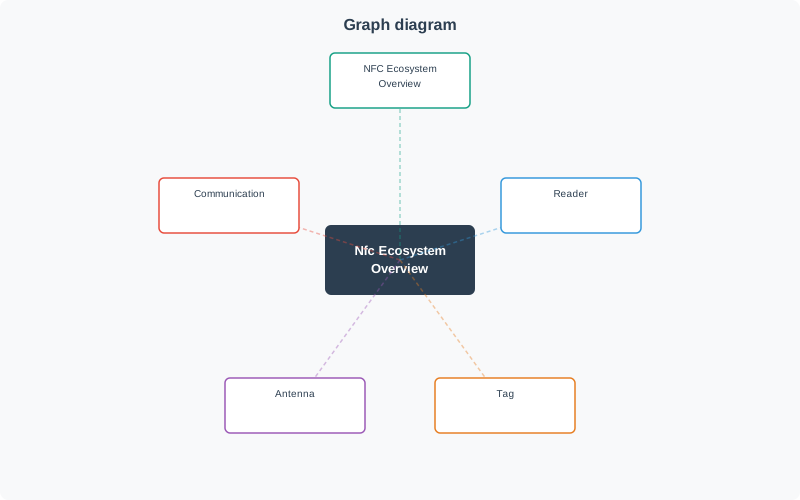
38.6 NFC Ecosystem Overview
38.7 NFC vs Alternative Technologies
38.8 Knowledge Check
The Problem: Developers assume NTAG213, NTAG215, NTAG216, and DESFire tags are functionally equivalent and choose based solely on price, leading to security vulnerabilities and failed deployments.
Why This Happens: All tags use 13.56 MHz and are “NFC Forum compliant,” creating the false impression they’re interchangeable. Teams prioritize cost over security requirements without understanding capability differences.
Real-World Impact:
Case 1: Hotel Key Card System (2021)
- Hotel deployed NTAG213 tags ($0.12 each) for room keys
- Saved $4,800 vs DESFire EV2 ($1.50 each) on 4,000 cards
- Within 3 months: Guests discovered cards could be cloned using $20 NFC copier
- Root cause: NTAG213 has no cryptographic authentication - UID is read-only but clonable
- Fix cost: $6,000 to replace entire system + reputation damage
- Lesson: $4,800 “savings” cost them $10,000+
Case 2: Luxury Product Authentication (2022)
- Brand used NTAG215 ($0.18 each) for anti-counterfeiting
- Tags stored product serial number in plaintext
- Counterfeiters cloned legitimate tags to fake products
- Root cause: NTAG215 lacks cryptographic signatures - anyone can copy UID and NDEF data
- Should have used: NTAG424 DNA ($0.80) with Secure Dynamic Messaging (unforgeable signed URLs)
- Cost of error: Millions in counterfeit merchandise undermining brand
Tag Security Comparison (Access Control Use Case):
| Tag Type | Security Level | Cloning Risk | Use Case Match |
|---|---|---|---|
| NTAG213 | None | HIGH - UID easily cloned | ❌ Access control |
| NTAG215 | Password (32-bit) | HIGH - Password brute-forceable | ❌ Access control |
| NTAG424 DNA | AES-128 + SUN | LOW - Cryptographic signatures | ⚠️ Online verification only |
| DESFire EV2 | AES-128 mutual auth | VERY LOW - Crypto chip | ✅ Offline access control |
Decision Matrix:
Choose NTAG213/215 ($0.12-0.18) when:
- ✅ Smart posters (public information)
- ✅ Marketing campaigns (non-sensitive)
- ✅ Quick device pairing (no security requirement)
- ❌ Never for access control, payments, or authentication
Choose NTAG424 DNA ($0.70-0.95) when:
- ✅ Product authentication (needs unforgeable proof)
- ✅ Luxury goods (high counterfeit risk)
- ✅ Online verification available (server validates each tap)
- ❌ Not for offline access control (needs network)
Choose DESFire EV2 ($1.20-1.80) when:
- ✅ Building access (offline operation required)
- ✅ Payment cards (PCI-DSS compliance)
- ✅ Transit ticketing (sub-200ms transactions)
- ⚠️ Requires certified readers (higher deployment cost)
Cost-Benefit Example (1,000 employee access badges):
Wrong choice (NTAG215): - Tag cost: $180 (1,000 × $0.18) - Security breach year 1: 15% probability - Average breach cost: $25,000 (investigation + reissuance) - Expected total cost: $180 + ($25,000 × 0.15) = $3,930
Right choice (DESFire EV2): - Tag cost: $1,500 (1,000 × $1.50) - Security breach year 1: 0.5% probability - Expected total cost: $1,500 + ($25,000 × 0.005) = $1,625
The $1,320 “expensive” solution actually saves $2,305 in expected costs.
How to Choose Correctly:
Step 1: Security Requirements
- Public information only? → NTAG21x acceptable
- Access control / authentication? → DESFire or NTAG424
Step 2: Operational Model
- Offline validation needed? → DESFire (mutual auth)
- Online validation acceptable? → NTAG424 DNA (server-side)
Step 3: Cost Analysis
- Calculate: (tag cost) + (breach probability × breach cost)
- Choose the option with lowest expected total cost
Red Flags That Signal Wrong Tag Choice:
- 🚩 “We chose the cheapest NFC tag” (without security analysis)
- 🚩 “All NFC tags are basically the same” (ignoring crypto capabilities)
- 🚩 “UID verification is secure enough” (UID is clonable)
- 🚩 “We’ll add security in software” (can’t fix hardware limitations)
Bottom Line: Tag selection is a security decision, not just a purchasing decision. The cost difference between weak and strong tags ($0.12 vs $1.50) is trivial compared to breach costs ($10,000-$1M+). Choose based on threat model, not just price.
38.9 Concept Relationships
This review synthesizes three NFC implementation layers: hardware (ESP32/PN532 wiring, I2C communication), middleware (MQTT gateways, NDEF parsing), and application (access control logic, payment tokenization). Real systems combine all three—the ESP32 lab demonstrates hardware + firmware, the Python server adds middleware, and security analysis addresses application-layer threats.
Tag type selection permeates every decision: NTAG213 for basic read/write, NTAG424 DNA for cryptographic auth, DESFire for high-security access. The choice cascades through cost ($0.20 vs $1.50), security (password vs AES-128), and implementation complexity (simple UID check vs CMAC verification).
Technology comparison tables guide selection: NFC for deliberate taps, BLE for continuous sensing, QR for visual simplicity. But real deployments often combine technologies—NFC for initial pairing, BLE for data streaming (handover pattern).
38.10 See Also
Common Pitfalls
Reader/Writer, Peer-to-Peer, and Card Emulation each have different use cases, protocol layers, and security considerations. Conflating them leads to wrong answers in scenario questions. Fix: for each mode, write one concrete real-world example application before the review assessment.
Tag Types (1–5) are different from Operating Modes. Tag types describe the physical memory organisation and command set; operating modes describe the communication role of the NFC device. Fix: create a two-dimensional table separating tag types (rows) from operating modes (columns) with examples in each cell.
NFC security questions frequently appear in assessments, covering eavesdropping protection, relay attacks, and tag authentication. Fix: ensure you can explain the security properties (and limitations) of at least two NFC tag types and both HCE and Secure Element card emulation.
38.11 Summary
This comprehensive review provides end-to-end coverage of NFC system implementation:
- Access Control: ESP32-based systems with hardware integration and authorization logic
- Smart Home Automation: Python-based scene control with MQTT and web interfaces
- Security Analysis: Understanding why NFC payments are secure and when to choose NFC
- Technology Selection: Decision frameworks for NFC vs QR vs BLE vs RFID
Key Takeaways:
- NFC is specialized HF RFID (13.56 MHz) with peer-to-peer capability
- Three modes: Peer-to-peer, Read/Write, Card Emulation
- Built into 2+ billion smartphones worldwide
- NDEF standard ensures interoperability
- Security requires encryption, authentication, tokenization
- Perfect for payments, access control, device pairing, smart marketing
- Short range (4-10 cm) provides inherent security and intentionality
38.12 Additional Resources
Books:
- “Beginning NFC” by Tom Igoe
- “NFC Essentials” by Ali Koudri
Videos:
- See the course-wide Video Gallery: Video Hub
Tools:
- NFC Tools (Android/iOS): Tag reading/writing app
- TagWriter (NXP): Program NFC tags
- NFC TagInfo: Detailed tag analysis
Standards:
- NFC Forum Specifications
- ISO 14443 - Proximity Cards
- ISO 18092 - NFC Interface and Protocol (NFCIP-1)
Organizations:
- NFC Forum: Industry consortium for NFC standards
- EMVCo: Payment card specifications
38.13 What’s Next
| Chapter | Focus | Link |
|---|---|---|
| NFC Access Control | Build an ESP32-based door lock with PN532 and UID authorization | Read chapter |
| NFC Smart Home | Create Python-based smart home automation with MQTT and Flask | Read chapter |
| NFC Security and Comparisons | Analyze payment tokenization, SE vs HCE, and technology selection | Read chapter |
| NFC Hands-On and Applications | Practice NFC programming with real-world implementation projects | Read chapter |
| IEEE 802.15.4 Fundamentals | Explore the low-power wireless standard enabling IoT mesh networking | Read chapter |