29 How UWB Measures Distance
More
Depth: Practitioner
Progress saves as you read. Mark sections complete as you go; your progress appears in the sidebar.
A forklift and a worker badge exchange precisely timed UWB packets so the system can estimate separation. The radio does not measure position directly; it measures timing evidence that an algorithm turns into distance and then location. Reflections and blocked first paths can make a precise timestamp wrong in the physical world.
UWB means ultra-wideband radio. Bandwidth means the span of frequencies occupied by its signal.
29.1 Follow the First Path Into a Range Estimate
This section: Follow the First Path Into a Range Estimate — Read Figure 29.1 from wide occupied bandwidth to short time features.
Read Figure 29.1 from wide occupied bandwidth to short time features. A broad signal supports finer separation of closely spaced arrivals, helping the receiver distinguish an early direct path from later reflections. The figure links bandwidth to timing resolution, not to extra transmit power.
In Figure 29.2, follow packets and timestamps into time-of-flight, distance, and then position; note the evidence recorded at each layer. The stack matters because a plausible coordinate can hide a weak first-path decision or unsynchronized anchor.
Figure 29.3 exposes the channel impulse response. Read the noise floor, first detected path, stronger later peak, and review boundary in order. A metal obstruction may weaken the direct arrival until a reflected path looks dominant; choosing that later peak inflates range.
Distance from one-way time of flight is . A measured 10 ns flight gives . A 1 ns timing error corresponds to about 0.30 m in this one-way example. Two-way ranging uses several timestamps to reduce clock-offset effects, so its exact formula must match the packet exchange.
One UWB distance range places the tag on a sphere around an anchor. Multiple well-positioned anchors provide intersecting constraints for location. Poor geometry can amplify small range errors, especially when anchors lie nearly on one line or one side of the tag. Record anchor coordinates and the ranges used for each position.
Predict a ranging trial. At a surveyed 3.0 m line-of-sight point, expect a stable first path near the calculated flight time. Add a metal obstruction and expect the impulse response and bias to change. Move the tag outside the anchor polygon and expect worse location geometry even if individual ranges still arrive. Compare raw timestamps, first-path metrics, ranges, and final coordinates before blaming the map.
UWB accuracy depends on radio, antenna delay calibration, anchor geometry, firmware, environment, and line of sight. Verify performance across the real work area and safety distances.
29.2 Start With the Story
This section: Start With the Story — Bandwidth is the span of radio frequencies used by a signal.
Bandwidth is the span of radio frequencies used by a signal. Picture a tagged tool near two doors. The system must decide which door it passed, not just report that some radio energy was heard.
Follow the tagged tool through a door decision that needs distance evidence.
-
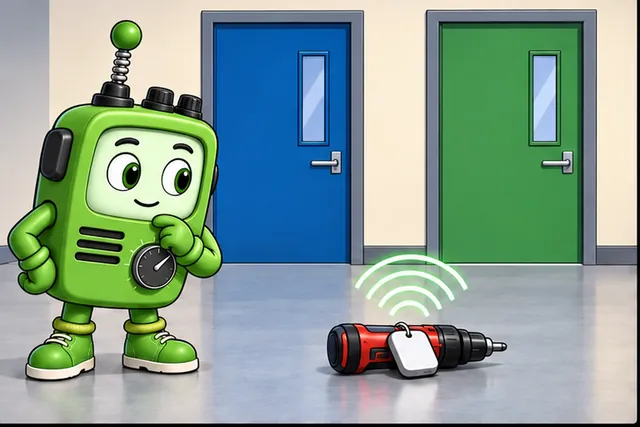
A tagged tool sits near two doors and the system must choose the right one.
-
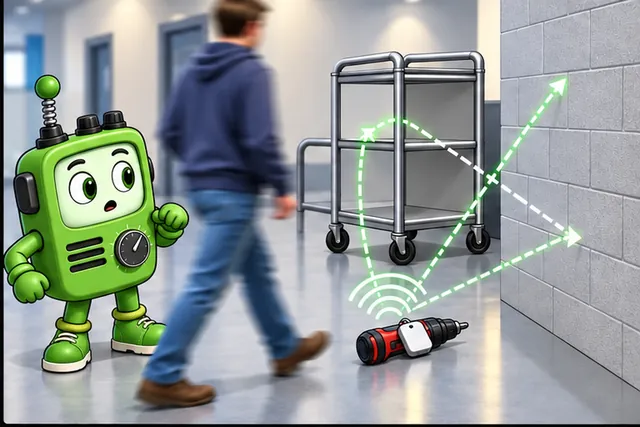
A body, metal cart, wall, or reflected path can shift the timing result.
-
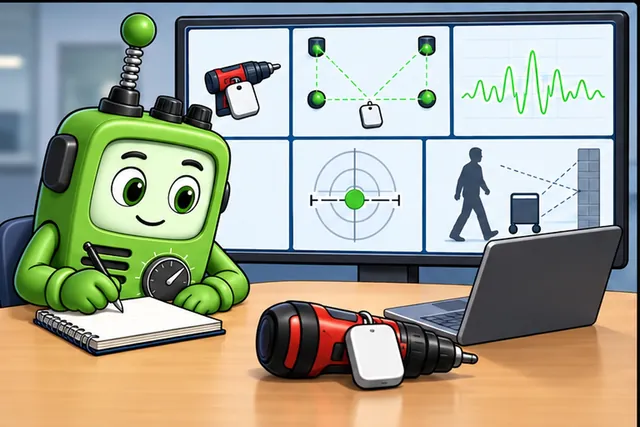
Record the tag, fixed points, timing quality, allowed error, and hard scenes.
-
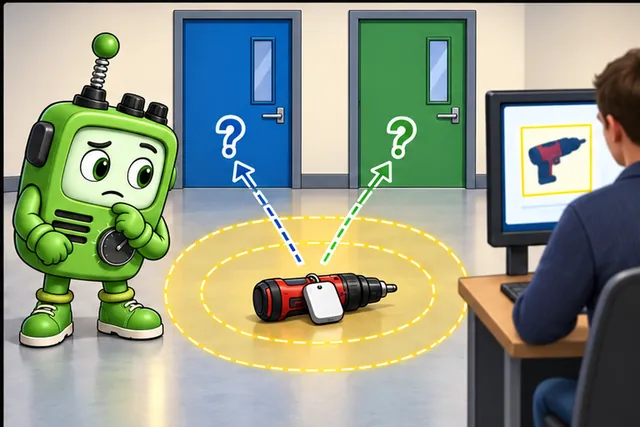
A safe doubt zone sends uncertain door choices to review.
Read the story panels from the ambiguous two-door observation to the safe doubt zone. The first scene defines the decision the range must support, while the obstruction scene shows how a body, metal cart, wall, or reflected path can bias timing. Recording tag identity, anchor positions, timing quality, allowed error, and difficult scenes makes uncertainty visible. The final review route prevents a weak door estimate from becoming a confident business event.
Start with the distance claim. Name the tag, the fixed points, the timing method, and the error that the door decision can allow. Then record the quality of each exchange before turning times into a place.
Check the hard scene. A body, metal shelf, wall, poor clock, or reflected path can shift the result. More fixed points can improve shape, yet they add cost, setup work, and more places for bad data.
This door story cannot make location automatic. It does not prove safe ranging, block relay attacks, or set a universal error. The installed scene needs calibration and known failure rules.
Use the Practitioner sections to build the ranging and decision record. Use Under the Hood for pulse timing, channel evidence, geometry, and attack limits. The deeper work explains the distance claim; it does not turn radio timing into magic.
Run a simple door test. Mark both doors. Fix each radio point. Measure its place. Move the tag slowly. Save each time. Save each quality sign. Try a clear path. Add a person. Add a metal cart. Turn the tag. Hide one fixed point. Compare the door result. Mark each wrong choice. Set a safe doubt zone. Send doubt to review. Test a relay attack. Keep access closed on doubt. Repeat after the room changes.
UWB is useful when distance evidence matters. A tag near a door, tool, forklift, phone, or robot is not just “near”; the system needs timing, channel quality, geometry, confidence, and security boundaries to make that claim meaningful.
Read this chapter by following one ranging exchange. Wide bandwidth helps measure time precisely, but the deployment still has to prove line of sight, calibration, interference, policy, and relay resistance for the decision it wants to make.
Wide bandwidth is useful here because it changes time resolution, not because it promises a stronger transmitter. The narrow-band and UWB signals in Figure 29.1 demonstrate the change in time resolution that wider bandwidth permits.
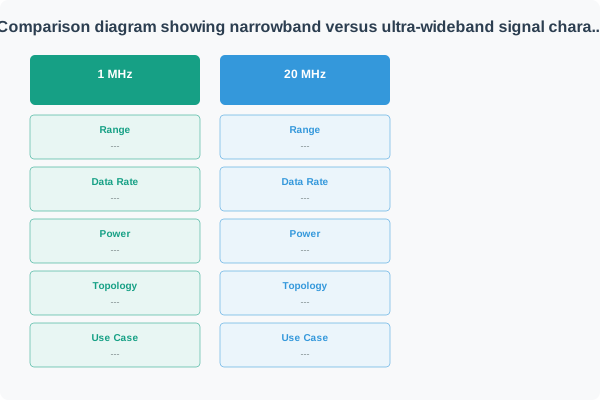
Read Figure 29.1 from the narrow case’s Broad correlation peak, where arrival time is less distinct, to the UWB case’s Sharp correlation peak and Smaller timing uncertainty. The one-way and round-trip equations then convert that timing uncertainty into different range uncertainties. This closes the chapter’s argument carefully: bandwidth can sharpen timestamp evidence, but link budget, multipath, calibration, and path selection still determine whether the timestamp is trustworthy.
29.3 Overview: UWB Is Timing Evidence, Not Magic Location
This section: Overview: UWB Is Timing Evidence, Not Magic Location — Ultra-Wideband, or UWB, spreads radio energy across a very wide signal bandwidth.
Ultra-Wideband, or UWB, spreads radio energy across a very wide signal bandwidth. That wide signal can expose short timing features, which makes time-of-flight ranging useful for indoor proximity and positioning systems. The radio does not directly prove "where an object is." It first creates timestamp, range, and channel-quality evidence.
A useful UWB review keeps the evidence chain visible. Wide bandwidth supports timing evidence. Timing evidence supports a range or arrival-time claim. Range evidence becomes position only after geometry, calibration, filtering, confidence checks, and policy decide how the application should act.
Figure 29.2 follows a UWB signal from timing evidence to a usable location claim.
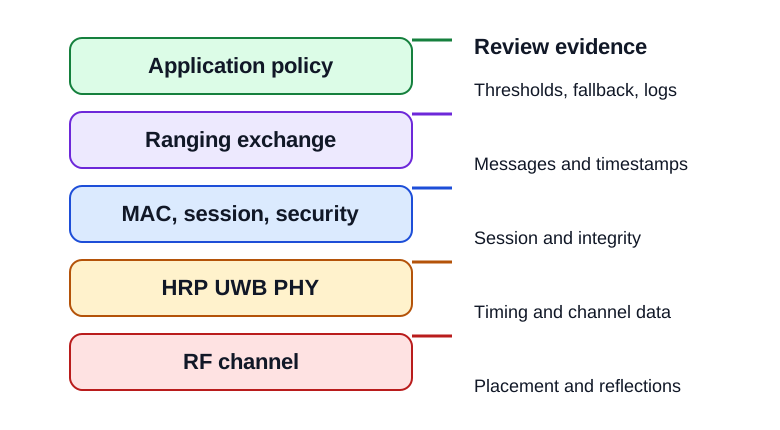
The wideband signal exposes fine timing features, but placement, obstruction, and antenna delay affect what is measured. Time-of-flight and timestamp checks turn those features into range evidence; calibration and clock state determine whether that range can be trusted. Several usable ranges then support a position estimate only when anchor geometry is sufficient. The final application decision needs freshness and confidence rather than a raw coordinate. Keep the signal, timing, range, and geometry checks separate in the record so a bad location can be traced to its earliest weak link.
The arithmetic is small enough to audit by hand. Radio waves travel at roughly 300,000,000 m/s, so 1 ns of one-way timing error is about 0.30 m. In a two-way ranging exchange, the range estimate divides the round-trip timing by two, so a 2 ns round-trip timing error becomes about 300,000,000 x 2 ns / 2 = 0.30 m of range error. That is why antenna delay calibration, timestamp quality, first-path selection, and clock behavior matter. A display that says "42 cm" may look precise, but the review still has to ask whether the timing evidence, channel quality, and installed geometry justify consuming that number.
Use this mental model for every UWB claim. A phone-to-lock proximity check may only need "inside 1.2 m with fresh confidence." A warehouse map may need several anchors, known positions, tag mounting rules, and stale-data filtering. A safety workflow may need independent guarding and a deny state even when UWB looks good. UWB fundamentals are strongest when the team can state what the measured timing proves, what it does not prove, and which change forces a retest.
If you only need the intuition, this layer is enough: approve UWB only for the bounded range, position, proximity, or access decision that has observed timing, channel, geometry, confidence, owner, and retest evidence.
29.4 Core Evidence Boundaries
This section: Core Evidence Boundaries
Wideband signal
The physical layer can expose fine timing features, but placement, antenna delay, obstruction, and receiver behavior still affect the evidence.
Range evidence
Two-way ranging, arrival-time methods, and channel review create distance or timing observations with confidence, not unconditional truth.
Position evidence
Anchors, geometry, calibration, synchronization, filtering, and quality rules turn several observations into a position estimate.
Application policy
Access, safety, asset tracking, navigation, and privacy workflows decide what to do when confidence is high, weak, stale, or missing.
29.5 Beginner Examples
This section: Beginner Examples
- A single distance estimate can support a narrow proximity claim, but it does not prove a full indoor positioning system.
- A coordinate estimate is strongest when the anchor geometry and channel quality were reviewed where the tag actually moves.
- Secure-ranging language matters only when key handling, freshness, relay resistance, policy, logs, and fallback behavior are part of the design.
- A weak or obstructed channel should lead to recheck, lower confidence, or fallback instead of automatic action.
29.6 Overview Knowledge Check
This section: Overview Knowledge Check
29.7 Practitioner: Build the UWB Review Record
This section: Practitioner: Build the UWB Review Record — A practical UWB review record starts with the decision being made.
A practical UWB review record starts with the decision being made. The decision might be distance between two devices, a room-level zone, a tracked asset position, a nearby-device unlock, or a safety stop. Each decision needs a different evidence boundary, so the record should avoid approving a broad "UWB location" claim when only a narrow range behavior was tested.
The record should name the ranging method, anchor or peer roles, device mounting, clock or synchronization assumptions, channel evidence, geometry, confidence handling, security boundary, privacy boundary, and retest trigger. That makes it clear whether later failures belong to radio placement, calibration, geometry, filtering, policy, or operations.
29.8 Worked Review: Tool Positioning in a Workshop
This section: Worked Review: Tool Positioning in a Workshop — A workshop wants UWB tags on mobile tools and anchors near work cells.
A workshop wants UWB tags on mobile tools and anchors near work cells. The review should approve only the installed positioning behavior that was observed: anchor locations, tag orientation, body and metal blockage, channel quality, confidence thresholds, stale-position handling, and the application rule that decides whether a tool is present, missing, or in transit.
The safe approval statement is narrow. It can say that under the reviewed geometry and movement paths, the system produces position evidence strong enough for inventory awareness. It should not say the same evidence is ready for safety interlocks, access control, or every future anchor layout.
29.9 Worked Review: Secure Proximity Unlock
This section: Worked Review: Secure Proximity Unlock — A lock workflow may need UWB because it wants physical proximity evidence, not just radio reachability.
A lock workflow may need UWB because it wants physical proximity evidence, not just radio reachability. The review should record the ranging exchange, freshness requirement, secure session context, confidence threshold, relay-risk handling, denied-state behavior, logs, fallback, and what happens when the path is obstructed or confidence is weak.
29.10 Practitioner Knowledge Check
This section: Practitioner Knowledge Check
29.11 Under the Hood: Timing, Multipath, Confidence, and Drift
This section: Under the Hood: Timing, Multipath, Confidence, and Drift — Under the hood, UWB measurements are useful because timing evidence can be very fine, not because every received waveform is clean.
Under the hood, UWB measurements are useful because timing evidence can be very fine, not because every received waveform is clean. A receiver may see a weak first path and a stronger reflection. A tag may be blocked by a body. An anchor may be moved without updating the geometry record. A confidence score may become stale while the application still displays the last position.
The review should preserve handoff evidence between the radio layer and the application layer. Timestamp quality, channel impulse response, first-path selection, calibration, anchor geometry, filtering, and policy all need owners. Without that handoff evidence, later troubleshooting turns into guessing.
Inspect Figure 29.3 and ask whether the earliest detected path or the strongest later reflection is driving the reported range.
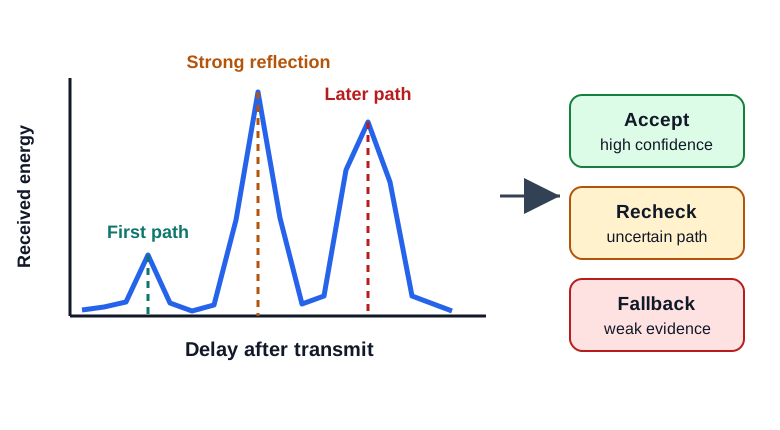
Read Figure 29.3 from the noise floor to the weak first detected path, then the stronger reflected peak. Choosing the later peak adds propagation delay and inflates range. At approximately , a 10 ns one-way flight time gives , while a 1 ns timing error contributes about 0.30 m. First-path selection, channel response, antenna-delay calibration, mounting, obstruction, and line of sight jointly determine whether the estimate is accepted, rechecked, or replaced by fallback.
29.12 Diagnosis Pattern
This section: Diagnosis Pattern
- Name the failing claim. Separate bad range, bad position, stale coordinate, weak confidence, relay risk, privacy issue, and application policy error.
- Check channel evidence before policy guesses. If values drift near a rack, inspect first-path quality, reflections, mounting, and obstruction before changing the workflow rule.
- Retest the changed boundary. A moved anchor, new tag enclosure, changed firmware, new floorplan, or revised confidence threshold invalidates different evidence.
- Write the unsupported claim. If validation covered inventory awareness, do not silently reuse it for access control or safety interlocks.
29.13 Under-the-Hood Knowledge Check
This section: Under-the-Hood Knowledge Check
29.14 Checkpoint: Summary
This section: Checkpoint: Summary
- UWB fundamentals review starts with the claim being made: range, position, proximity, access, safety, tracking, or privacy-sensitive decision.
- Wide bandwidth supports fine timing evidence, but channel quality, antenna delay, mounting, obstruction, and firmware still shape the result.
- Range evidence becomes position only through geometry, calibration, synchronization or peer exchange, filtering, confidence handling, and retest discipline.
- Security-sensitive UWB decisions need secure-ranging context, freshness, confidence thresholds, fallback, logs, and ownership.
- A useful review record names the evidence boundary and the changes that reopen the decision.
29.15 Key Takeaway
This section: Key Takeaway
Approve UWB only when timing, range, channel quality, geometry, confidence, policy, owner, and retest evidence support the exact IoT decision being released.
29.16 Related Chapters: See Also
This section: Related Chapters: See Also
UWB Ranging Techniques
Compare two-way ranging, time-difference methods, angle evidence, synchronization, and quality constraints.
UWB Indoor Positioning Systems
Turn range evidence into deployed location behavior with anchors, geometry, calibration, confidence, and operations.
UWB Applications and Security
Apply UWB evidence to access, assets, safety, privacy, relay-risk handling, and release controls.
NFC Security and Comparisons
Compare nearby technologies while keeping proximity, evidence quality, relay risk, and fallback boundaries explicit.
Find help
3 reviewed answers.
Where should I start in a module?
Open the module page from the sidebar to see its chapters in order. Use the module map to return to a topic you need.
Modules and pathsReviewed
What can I try when a project does not work?
Check the symptom, then work through the diagnostic steps. Keep the error message and the smallest example that reproduces it.
When you are stuckReviewed
How do interactive examples work?
Use the interactive guide to check how examples and simulations work before changing your project.
Interactive examples guideReviewed