4 RFID Frequency Bands
More
Depth: Practitioner
Progress saves as you read. Mark sections complete as you go; your progress appears in the sidebar.
A livestock ear tag, library book, and warehouse pallet all use RFID, yet their coils, antennas, range, and response to water or metal differ. Frequency affects whether energy couples through a near magnetic field or propagates as a radio wave. Band choice begins with the object and read zone.
RFID means radio-frequency identification. A protocol is the rule its reader and tag use to exchange commands and replies.
4.1 Cross From Coupling to Propagation
This section: Cross From Coupling to Propagation — Read Figure 4.1 from lower to higher frequency.
Read Figure 4.1 from lower to higher frequency. Follow the labelled LF, HF, and UHF regions with their typical coupling, antenna, range, and environmental trade-offs. The figures compare regimes; they do not promise one exact read distance.
Next use Figure 4.2. The reader coil creates a changing magnetic field for inductive coupling, and a nearby tag coil receives energy and exchanges data. In the UHF view, the reader antenna launches an electromagnetic wave and the tag changes its reflection through backscatter. Read the arrows both ways because tag power and returned information use related but distinct paths.
The approximate near-field boundary is , where (lambda=c/f). At 13.56 MHz, wavelength is about , giving . This boundary separates field behavior; it is not an HF tag read-range prediction. Coil size, tuning, protocol, power, orientation, and losses usually constrain a practical tap much more tightly.
At 915 MHz, wavelength is about 0.328 m and . Warehouse UHF systems therefore work mainly in a propagating regime beyond a few centimetres, where antenna polarization, multipath, absorption by water, and detuning near metal matter. A livestock tag near tissue presents a different environment from a label on dry cardboard.
Build a band record with region, permitted channel plan, reader power, antenna, tag design, object material, orientation, read-zone boundary, collision load, and observed missed or stray reads. Regulations and allowed power vary by country, so a successful warehouse setting cannot simply travel worldwide.
Predict the site trial. Rotate tags through the worst orientations and expect a measured coverage map. Add the target liquid or metal and predict which read zones may shrink or move. Place an unwanted tag just outside the boundary and expect it not to enter inventory. Compare those results across the candidate band and antenna arrangements.
Measure frequency-band coexistence with the equipment that will run nearby. Motors, readers, metalwork, liquids, and other radio systems can change noise or field shape. Record missed and unintended reads by tag identity rather than only total count.
Repeat the frequency-band map after changing tag placement or packaging, because a few centimetres and a new material can alter coupling.
4.2 Start With the Story
This section: Start With the Story — Picture a hospital checking tagged supply trays through a doorway.
Choose the Read Zone Before the Frequency
Picture a hospital checking tagged supply trays through a doorway. Radio frequency means energy carried by radio waves. Radio Frequency Identification, or RFID, uses that energy to observe an identity stored on a tag. The team does not need the greatest possible distance. It needs every tray inside the doorway, no tray in the next room, and a clear result around metal carts and people.
Write the installed read claim. Name the tag and object, intended zone, nearby exclusion zone, material, speed, antenna place, allowed power, local rules, privacy limit, event rule, and owner.
Test front, back, edge, stacked, moving, wet, metal, crowded, and damaged cases. Include an object just outside the zone and nearby radio use. Count missed, extra, repeated, and late reads. A catalog range or one open-room trial is not proof of the installed zone.
Keep any urgent safety check independent of an uncertain radio read. Show unknown as unknown rather than forcing it into present or absent.
This opening does not say that one band is always best. Practitioner compares the zone, tag, reader, rules, and evidence. Under the Hood examines near and far fields, coupling, wake power, reply strength, detuning, orientation, and why range changes after installation.
Use a plain zone check. Put one tag in, one tag out, and one tag on each hard material. Move them at the real speed. Count each miss and extra read. Change one thing at a time. Keep the weak case in the test set.
Picture the same tagged item near metal, liquid, cardboard, and open air. LF, HF, UHF, and microwave RFID do not fail in the same way, because coupling, wavelength, antenna shape, and regulation change the read zone.
Read the frequency band as an installed-environment decision. The best band is the one whose evidence survives the material, range, speed, and standards constraints of the actual workflow, not the one with the longest headline range.
4.3 Overview: Frequency Choice Is a Read-Zone Decision
This section: Overview: Frequency Choice Is a Read-Zone Decision — RFID frequency bands are useful because they shape how a tag couples to the reader field.
RFID frequency bands are useful because they shape how a tag couples to the reader field. LF and HF systems are usually near-field magnetic systems, so they fit deliberate, close, controlled reads. UHF systems use far-field backscatter, so they can support larger passive inventory zones when tags, antennas, materials, and reader settings are engineered together.
The review question is not "which band reads farthest?" The useful question is which frequency family can produce the required evidence for the object, material, read zone, workflow speed, regional setting, and exception path.
Use a concrete read decision to make the choice testable. A medicine cabinet that should identify one item only when a nurse places it on a reader pad has a deliberate close-read boundary. HF or NFC is usually the first candidate because the intended action is proximity, not bulk inventory. The acceptance evidence can be simple: the correct tagged item reads when placed on the pad, nearby shelf items remain absent, and a failed read leaves the medication workflow in a manual-review state.
A receiving doorway is a different problem. Suppose a pallet crosses a 2.4 m read zone at 1.2 m/s, giving 2.4 / 1.2 = 2.0 s of dwell time. If the pallet carries 48 tagged cases, UHF may fit because the system needs passive bulk inventory during motion. The evidence now changes: tag orientation, pallet wrap, liquid or metal content, antenna polarization, reader profile, duplicate suppression, and boundary tags in the neighboring lane all matter. A band is acceptable only if the pilot shows the expected case population can be observed and converted into the right business event inside that dwell window.
The same object can even lead to different answers when the workflow changes. A single reusable metal tool checked in at a bench may favor close controlled presentation or an on-metal tag with a short read zone. A tool crib inventory sweep may favor UHF if the tag type, shelf material, antenna aim, and exception workflow are tested together. The frequency selection is therefore not a label on the tag; it is a claim about a bounded read zone that another engineer can retest.
Figure 4.1 compares RFID frequency families by coupling and the read zone they need.
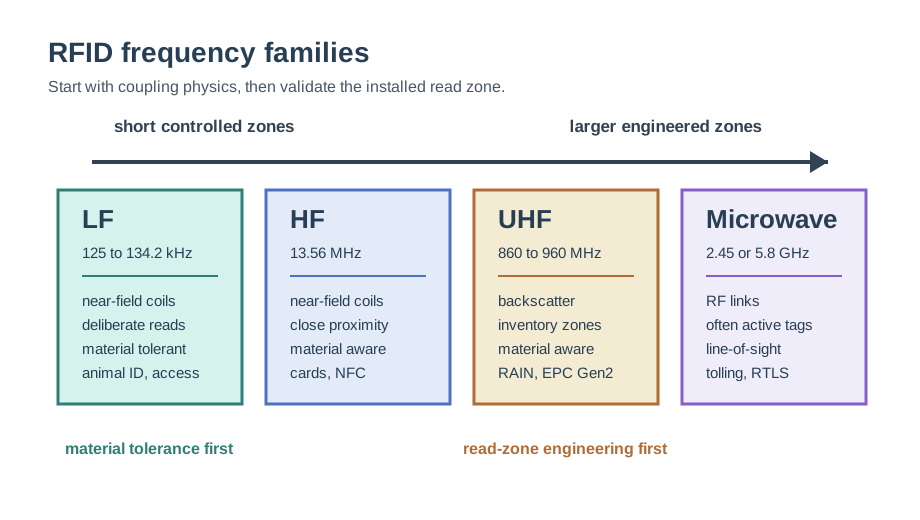
LF and HF use close near-field coupling and suit controlled individual reads, with the shown examples including animal identification and cards or NFC. UHF uses a radiated backscatter path for a larger engineered zone and is more sensitive to the installed environment. These bands suggest a starting design, not a guaranteed range: tag orientation, materials, antennas, and power can change the result. Choose from the required item movement and zone, then test the final material and placement. A frequency label cannot substitute for measured target reads and neighboring exclusions.
If you only need the intuition, this layer is enough: choose the RFID band from the workflow and material evidence, not from a generic range promise.
Frequency Families
LF
Best for close, deliberate reads where coil coupling and tolerance of difficult material conditions matter more than fast bulk inventory.
HF and NFC
Best for controlled proximity workflows such as cards, documents, library assets, deliberate taps, and phone-adjacent NFC interactions.
UHF
Best for engineered passive inventory zones where tag selection, mounting, antenna geometry, regional settings, and filtering are validated.
Microwave or active
Best treated as specialized system families with explicit battery, protocol, enclosure, maintenance, ranging, or telemetry evidence.
Beginner Examples
- An animal ID or embedded-access workflow usually cares more about controlled close reads than warehouse throughput.
- A tap-to-commission workflow should be reviewed as an HF or NFC trust boundary, not as a bulk inventory system.
- A dock-door inventory workflow may fit UHF only when read zones, tag placement, duplicate filtering, and nearby-pallet behavior are tested.
- An active tag or microwave design can solve a different problem, but it adds power, maintenance, protocol, and support evidence.
Overview Knowledge Check
4.4 Practitioner: Build the Frequency Selection Record
This section: Practitioner: Build the Frequency Selection Record — A practical RFID frequency record starts with the business event and works backward to the physics.
A practical RFID frequency record starts with the business event and works backward to the physics. It should say what the reader must decide, what object and material are in scope, what tag family is proposed, which region settings apply, where reads are accepted, and what pilot evidence closes the decision.
The record should also say what is not proven. A bench read does not prove motion, stacked items, liquid-filled packaging, metal shelving, neighboring portals, handheld use, reader firmware changes, or region changes.
Worked Review: Tool Bench
A maintenance bench needs to identify reusable metal tools one at a time. Operators can present each tool close to a reader, and coolant may be nearby. The frequency review should prefer a controlled close-read pattern first, then validate the real tag attachment, material effects, read confirmation, missed-read fallback, and privacy boundary. It should not approve a wide UHF zone unless the workflow actually needs bulk reads and the on-metal tag behavior is proven.
Worked Review: Receiving Portal
A dock-door portal needs case or pallet evidence while goods move through a doorway. UHF may fit, but only after the pilot captures tag orientation, pallet wrap, antenna placement, reader settings, duplicate filtering, nearby-door behavior, partial reads, and manual exception handling. The approval should say which doorway, packaging, and product set were tested.
Practitioner Knowledge Check
4.5 Under the Hood: Coupling, Detuning, and Evidence Drift
This section: Under the Hood: Coupling, Detuning, and Evidence Drift — Under the hood, RFID frequency selection changes the field shape and the failure modes.
Under the hood, RFID frequency selection changes the field shape and the failure modes. LF and HF rely on magnetic coupling, so coil alignment and distance dominate. UHF relies on radiated energy and backscatter, so antenna polarization, tag sensitivity, reflections, absorption, and local region settings dominate. Active systems add their own battery, sleep, wake, protocol, and maintenance states.
Figure 4.2 shows why coil coupling and backscatter need different tests.
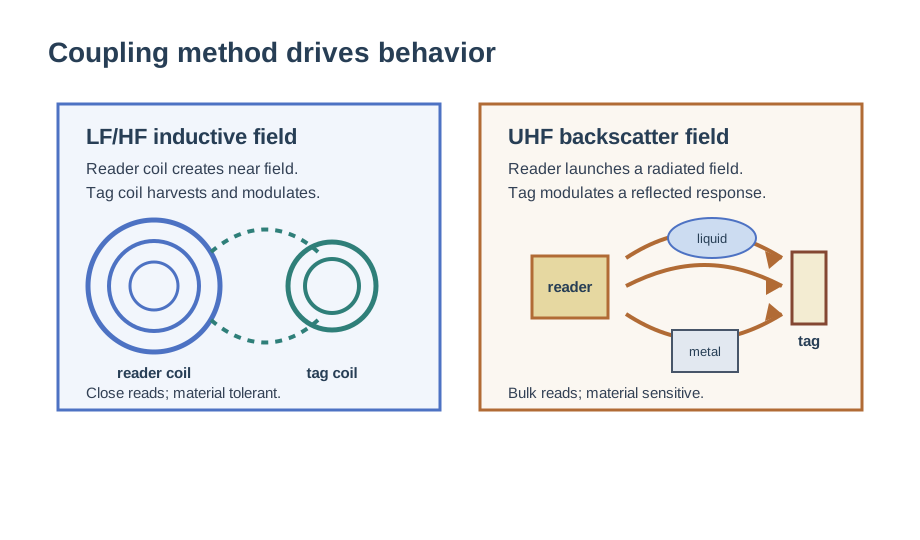
In LF and HF, the reader coil creates a near field and the tag coil harvests and modulates it. That supports a close, deliberate read zone. In UHF, the reader launches a radiated field and the tag changes the reflected response, which can cover more items but interacts strongly with metal, liquid, orientation, and placement. The method does not decide the application by itself. Test a tag on the real object and in the intended zone, then check misses and stray reads. That measured behavior determines whether the coupling choice fits the workflow.
The installed evidence can drift. A new product package, metal shelf, liquid container, reader firmware, antenna angle, region setting, tag supplier, or middleware rule can invalidate a frequency decision that was correct during the pilot.
Diagnosis Pattern
- Name the symptom. Separate missed reads, extra reads, orientation sensitivity, material detuning, region mismatch, battery failure, and wrong business events.
- Check the closest physics boundary. For unread tags, inspect tag choice, attachment, material, antenna geometry, reader settings, and region before changing the application.
- Keep event evidence separate. A tag observation is not a received, returned, opened, counted, or located event until filtering and application rules accept it.
- Retest after drift. Packaging, placement, reader firmware, tag supplier, antenna angle, region setting, and middleware changes can all reopen the frequency decision.
Under-the-Hood Knowledge Check
4.6 Summary
This section: Summary
- RFID frequency selection is a coupling and read-zone decision, not a simple range contest.
- LF and HF are strongest for close, controlled reads where material tolerance, deliberate presentation, or NFC behavior matters.
- UHF is strongest for engineered passive inventory zones when tags, materials, antennas, region settings, and filtering are validated together.
- Microwave and active systems need explicit power, maintenance, protocol, privacy, and support evidence.
- Frequency approvals should name the workflow, object material, tag mounting, read zone, regional setting, event filtering, fallback, and retest trigger.
4.7 Key Takeaway
This section: Key Takeaway
Choose an RFID frequency band only when its coupling behavior, material fit, read-zone evidence, standards ecosystem, operational owner, and retest triggers support the same bounded workflow.
4.8 See Also
This section: See Also
RFID Fundamentals and Operation
Review the core RFID evidence boundary across tags, readers, antennas, anti-collision, and event meaning.
RFID System Components
Connect frequency choice to tag fit, antenna placement, reader settings, middleware, and business-event handoff.
RFID Tag Types
Match passive, battery-assisted, and active tags to power, mounting, memory, lifecycle, and workflow evidence.
RFID Design and Deployment
Turn band selection into pilot design, read-zone acceptance, exception handling, and rollout evidence.
Find help
3 reviewed answers.
Where should I start in a module?
Open the module page from the sidebar to see its chapters in order. Use the module map to return to a topic you need.
Modules and pathsReviewed
What can I try when a project does not work?
Check the symptom, then work through the diagnostic steps. Keep the error message and the smallest example that reproduces it.
When you are stuckReviewed
How do interactive examples work?
Use the interactive guide to check how examples and simulations work before changing your project.
Interactive examples guideReviewed