24 NFC Introduction and Basics
24.2 Learning Objectives
By the end of this chapter, you will be able to:
- Differentiate NFC from Related Technologies: Compare NFC with RFID and Bluetooth based on range, frequency, and coupling mechanism
- Classify NFC Operating Modes: Categorize peer-to-peer, read/write, and card emulation modes and match each to appropriate IoT use cases
- Evaluate NFC for IoT Scenarios: Justify why NFC is or is not the right technology choice for a given short-range communication requirement
- Analyze Range as a Security Feature: Explain how NFC’s 4 cm near-field inductive coupling provides physical-layer security against remote eavesdropping
24.3 Prerequisites
Before diving into this chapter, you should be familiar with:
- Networking Basics: Understanding wireless communication principles, data rates, and protocol basics helps contextualize how NFC fits within the broader IoT communication landscape
- Basic wireless concepts: Familiarity with frequency bands, data encoding, and wireless range concepts will help you understand NFC’s 13.56 MHz operation and short-range characteristics
By this point you may have already studied:
- Wi-Fi Fundamentals and Standards - local-area networking for homes and offices
- Bluetooth Fundamentals and Architecture - short-range personal area networking
- RFID Fundamentals and Standards - identification and tagging across a range of frequencies
You can think of NFC as the ultra-short-range, user-intent corner of this family: - very short range (a few centimetres) - usually one-to-one interactions initiated by a tap - often used as a trigger for other links (for example, NFC tap to start Bluetooth pairing)
As you read this chapter, keep comparing NFC to what you know from Bluetooth and RFID: what stays the same (radio waves, tags, readers) and what changes (range, power, and how people interact with the system).
In one sentence: NFC enables instant, secure communication within 4 cm range without pairing, making it ideal for payments, access control, and triggering other wireless connections.
Remember this rule: Use NFC when you need intentional “tap to interact” user experience with zero setup time; use Bluetooth when you need continuous streaming or longer range.
NFC is like a secret handshake between your phone and special stickers!
24.3.1 The Sensor Squad Adventure: The Magic Tap
One day, the Sensor Squad discovered something mysterious at the bus stop. There was a colorful poster for a new movie, and when Sammy the Temperature Sensor’s owner tapped their phone against a small circle on the poster - WHOOSH! - the movie trailer started playing on their phone!
“How did that happen?!” Lila the Light Sensor gasped. “There’s no wire, no button, nothing!”
Bella the Button knew the answer. “That’s NFC - Near Field Communication! It’s like a super-secret whisper between devices. But here’s the cool part: they have to be REALLY close to talk - like almost touching, within about the width of your thumb!”
Max the Motion Detector zoomed in for a closer look at the poster. “See that tiny circle? That’s an NFC tag. It’s thinner than a sticker, has NO battery, and can store information like a tiny invisible treasure chest. When you bring your phone super close, the phone’s energy wakes up the tag, and they share secrets!”
“It’s like a magic handshake!” Sammy said excitedly. “You know how you and your best friend might have a special handshake that only you two know? NFC is like that - your phone and the tag have a special language, but they can only use it when they’re touching!”
The Sensor Squad learned that NFC is used everywhere - paying for things at stores (tap to pay!), getting on buses with a card, sharing photos between phones, and even unlocking doors. All with just a tap!
24.3.2 Key Words for Kids
| Word | What It Means |
|---|---|
| NFC (Near Field Communication) | A way for devices to talk by almost touching - like whispering a secret into someone’s ear |
| Tap to Pay | Using your phone like a magic wallet - tap it on the store’s machine and it pays for things |
| NFC Tag | A tiny sticker with a hidden antenna that can store information and share it when you tap it |
24.3.3 Try This at Home!
The Whispering Game: Play a game to understand why NFC’s short range is actually its superpower! Stand in a room with family members. First, SHOUT a message (this is like Wi-Fi - everyone can hear from far away). Then TALK normally across a table (this is like Bluetooth - medium distance). Finally, WHISPER directly into someone’s ear (this is like NFC - super private, only the person right next to you hears). Which way is most private? That’s why banks love NFC for payments - no one can “hear” your credit card number because devices must almost touch!
24.4 Getting Started (For Beginners)
24.4.1 What is NFC? (Simple Explanation)
NFC = Near Field Communication
It’s the technology that lets two devices communicate when they’re almost touching (within ~4 cm).
You use NFC for:
- Contactless payments (Apple Pay, Google Pay)
- Transit cards (tap to enter subway)
- Quick pairing (tap phone to speaker)
- Smart tags (tap poster for info)
- Access cards (tap to unlock door)
24.4.2 How NFC Works: A Simple Analogy
Analogy: Whispered Conversation
Think of wireless technologies like different ways of talking:
| Technology | Range | Analogy | Use Case |
|---|---|---|---|
| Wi-Fi | 50m | Shouting across a field | Home internet |
| Bluetooth | 10m | Normal conversation | Headphones |
| NFC | 4cm | Whisper in someone’s ear | Payments |
NFC is like whispering:
- Private - Only the person right next to you can hear
- Instant - No pairing needed, just get close
- Effortless - Tags don’t even need batteries!
24.4.3 NFC vs. RFID vs. Bluetooth
24.4.4 The Three NFC Modes
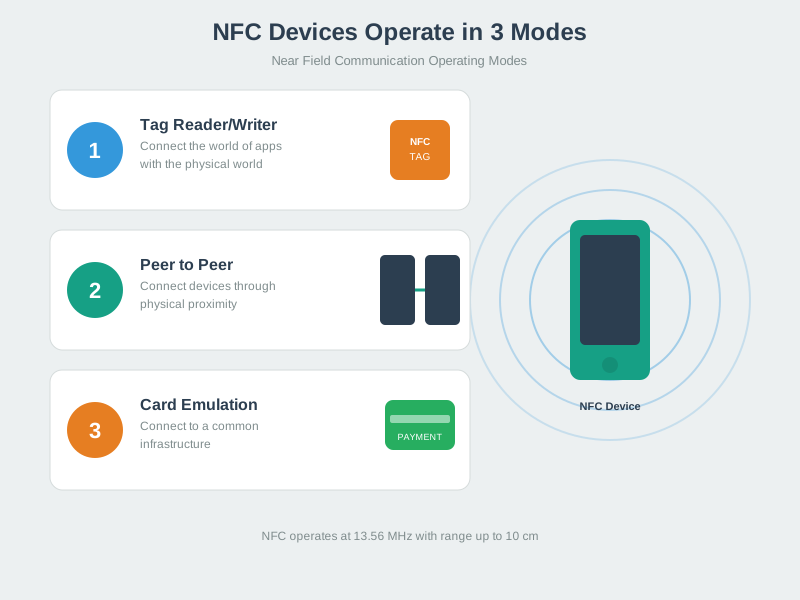
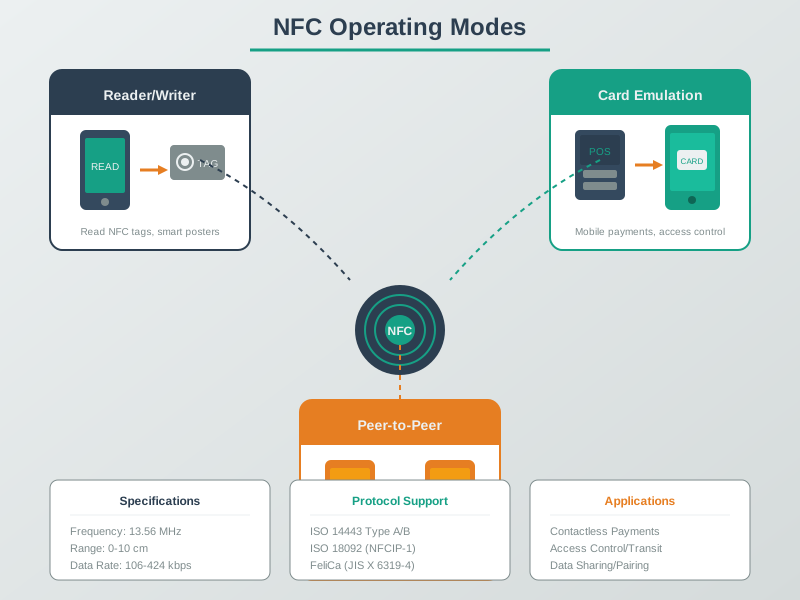
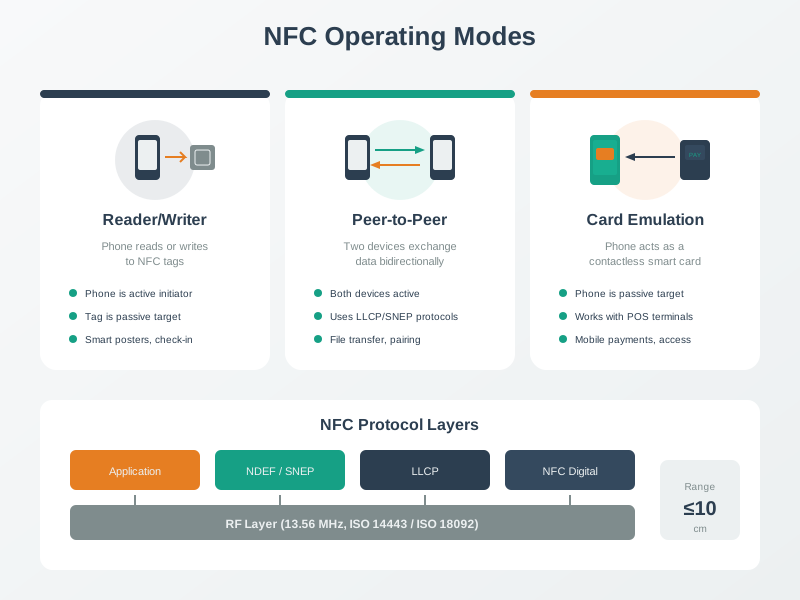
NFC devices can operate in three different modes:
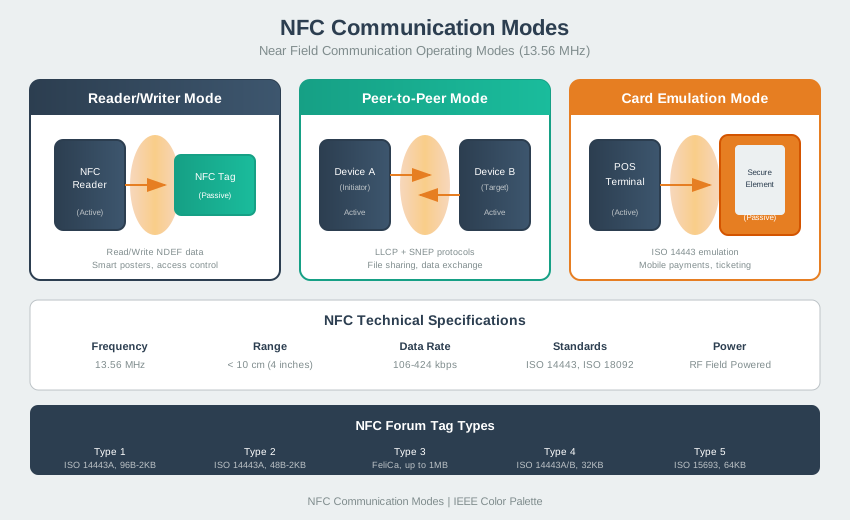
24.5 Alternative View: Interactive Modes Diagram
This variant helps you decide when to use NFC vs other technologies:
NFC is ideal when users must deliberately tap, and it is often used to trigger Bluetooth pairing for ongoing connections.
24.5.1 Real-World NFC Examples
1. Contactless Payments (Apple Pay/Google Pay)
You tap phone -> Phone acts as credit card -> Terminal reads
                card number (encrypted) -> Payment approved
2. Smart Posters
Movie poster has NFC tag -> Tap phone -> Opens trailer in browser3. Quick Device Pairing
New Bluetooth speaker -> Tap phone to speaker -> Automatically pairs!4. Smart Home
NFC tag on nightstand -> Tap phone -> Turns off lights,
                                    sets alarm, enables Do Not Disturb
24.5.2 Why NFC for IoT?
| Advantage | How It Helps IoT |
|---|---|
| No batteries in tags | Passive tags can be long-lived and maintenance-free (though they can still be damaged or removed) |
| Intent required | User must physically tap (secure) |
| Instant connection | No pairing, no passwords |
| Low cost | Many tag types are inexpensive (varies by type and volume) |
| Broad support | Many smartphones support NFC, but availability varies by device and region |
This variant shows the three NFC operating modes and their typical use cases:
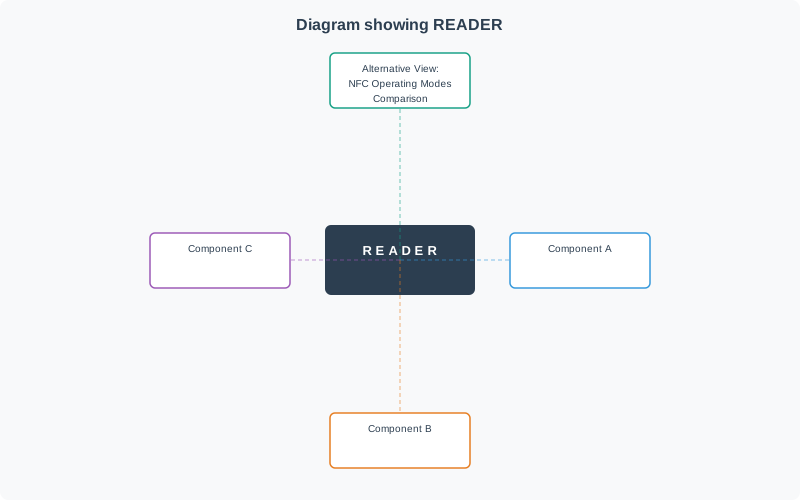
NFC operates in three modes: Reader/Writer (phone reads passive tags), Peer-to-Peer (two phones exchange data), and Card Emulation (phone becomes a contactless card for payments). Card Emulation is most critical for secure applications.
This variant compares NFC with related short-range technologies:
NFC excels at intentional, instant interactions. BLE provides continuous connections at longer range. HF RFID (NFC’s parent technology) suits high-volume access/inventory. Common pattern: NFC initiates, BLE sustains.
This variant shows the detailed message flow during contactless payment:
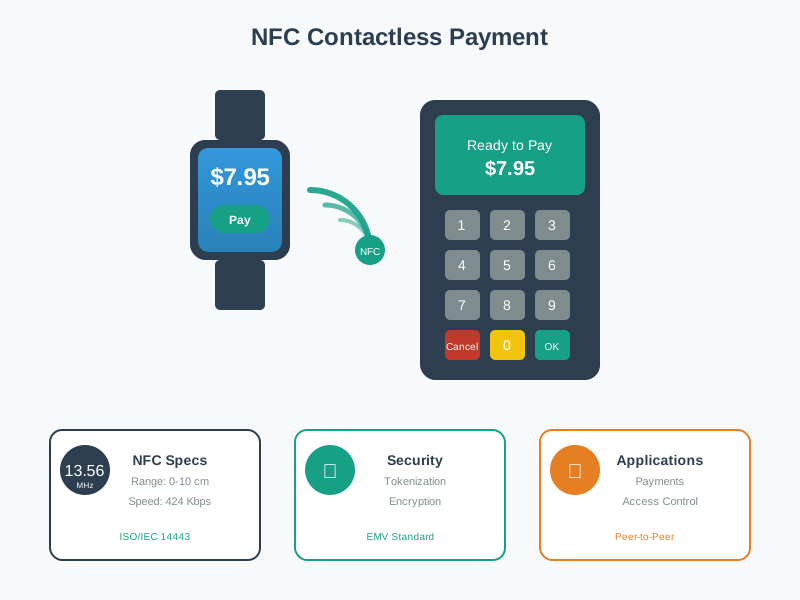
Contactless payment uses Card Emulation mode. The Secure Element generates a one-time cryptographic token that cannot be reused, protecting against skimming. The entire process completes in under 500ms.
24.5.3 Self-Check: Understanding the Basics
Before continuing, make sure you can answer:
- What range does NFC operate at? - About 4 cm (you need to almost touch devices)
- What’s the main advantage over Bluetooth? - Instant connection without pairing; tags need no batteries
- What are the three NFC modes? - Reader/Writer, Peer-to-Peer, Card Emulation
- How does contactless payment work? - Phone emulates a credit card; terminal reads encrypted card data
NFC’s 4 cm maximum range is enforced by physics, not just regulation. The magnetic field strength in near-field inductive coupling drops as \(H \propto \frac{1}{r^3}\). Worked example: If signal strength at 4 cm = 100%, then at 5 meters the signal is \((4/500)^3 = 0.000000064\%\) of baseline — 1.5 billion times weaker. The thermal noise floor at room temperature is \(-174 \text{ dBm/Hz}\). An NFC signal at 4 cm is roughly \(-20 \text{ dBm}\). At 5 m, it drops to \(-182 \text{ dBm}\), which is below the noise floor of the universe — physically undetectable without the signal being within centimeters.
24.6 In Plain English: NFC is Like a Secret Handshake
24.7 Real-World Example: Contactless Payment in Action
24.8 What Would Happen If: Distance Attack Scenario
The Misconception: Many developers new to NFC assume it works like Bluetooth with a “short range” of 1-3 meters, planning applications where users can interact with devices from across a room.
Why This Happens: Both technologies are marketed as “short-range wireless,” leading to assumptions they work similarly. Developers often discover the 4 cm limitation only after building prototypes that fail in real-world testing.
Real-World Impact:
Case Study 1: Museum Audio Tour Failure (2020)
- Museum deployed NFC tags at exhibit entrances
- App design assumed visitors could stand 1 meter away while reading plaques
- Reality: Users had to press phone directly against wall-mounted tags
- Result: Poor user experience, elderly visitors struggled with awkward positioning
- Fix cost: $15,000 to redesign exhibit layout and add QR code fallbacks
Case Study 2: Smart Home “Tap to Control” (2021)
- Company designed smart light switches with NFC for guest control
- Marketing promised “wave your phone near the switch to control”
- Reality: Phone must be within 2-3 cm of tiny switch face
- Users complained about “broken” switches that “don’t detect my phone”
- Root cause: Expected Bluetooth-like range (10-100 cm), got NFC reality (< 4 cm)
The Physics Behind the 4 cm Limit:
NFC uses near-field inductive coupling, not radio wave propagation:
| Technology | Principle | Range Formula | Practical Limit |
|---|---|---|---|
| Wi-Fi | Radio waves | Power × antenna gain ÷ path loss | 50-200 m |
| Bluetooth | Radio waves | Similar to Wi-Fi | 10-100 m |
| NFC | Magnetic coupling | 1/r³ (inverse cube) | 4-10 cm |
Field Strength at Distance:
At 4 cm:  100% signal strength (baseline)
At 10 cm: (4/10)³ = 6.4% of baseline
At 50 cm: (4/50)³ = 0.05% of baseline (unusable)
At 1 m:   (4/100)³ = 0.006% of baseline (noise floor)
At 1 meter, NFC signal is 16,000× weaker than at 4 cm!
Design Implications:
Don’t Design for:
- ❌ “Approach the door and unlock” (needs > 50 cm range)
- ❌ “Scan product by pointing at shelf” (needs > 10 cm range)
- ❌ “Automatic check-in when entering room” (needs presence detection)
Do Design for:
- ✅ “Tap phone on door handle NFC sticker to unlock”
- ✅ “Hold product close to phone to see details”
- ✅ “Tap badge on reader to check in” (deliberate physical action)
When 4 cm Range is Actually a Feature:
Security Benefits:
- Prevents drive-by attacks: Attacker must physically touch device
- User awareness: Clear moment when transaction occurs
- Intentional interaction: No accidental connections from pocket
Mobile Payment Example:
- NFC (< 4 cm): User must deliberately tap phone at terminal
- Hypothetical “10m range NFC”: Could charge users walking past store
The 4 cm range isn’t a bug - it’s the entire security model!
How to Design NFC UX Correctly:
Bad UX (assumes Bluetooth-like range):
"Hold your phone near the poster to download the app"
└─ User stands 30 cm away, nothing happens
└─ User moves to 10 cm, still nothing
└─ User gives up: "My phone doesn't support NFC"
Good UX (embraces 4 cm reality):
"Tap your phone on the NFC symbol"
+ Visual indicator: Large "TAP HERE" with NFC logo
+ Physical design: Raised circular target to guide placement
+ Instructions: "Hold phone steady for 1-2 seconds"
+ Feedback: Haptic vibration when tag detected
└─ User taps, immediate response
└─ Success rate: 95%+
Material Matters:
Even within 4 cm, materials affect range:
| Material Between Tag and Phone | Effective Range | Notes |
|---|---|---|
| Air | 4-10 cm | Best case |
| Plastic (3mm) | 3-8 cm | Minimal loss |
| Glass (5mm) | 2-6 cm | Some attenuation |
| Wood (10mm) | 1-4 cm | Moderate loss |
| Metal (any thickness) | 0 cm | Complete block |
Metal Kills NFC:
- Tag behind aluminum poster frame? Won’t work
- Phone with metal case? Greatly reduced range
- Tag on metal shelf? Must use special ferrite-backed tags
Technology Selection Based on Range Needs:
< 4 cm: NFC - Mobile payments - Access badges - Product authentication - Smart posters
10 cm - 1 m: QR Codes - Marketing posters - Menu ordering - Ticketing
1-10 m: Bluetooth/BLE - Proximity beacons - Asset tracking - Smart home presence detection
10-100 m: Wi-Fi - Internet connectivity - High-bandwidth streaming
How to Explain to Stakeholders:
Bad explanation: “NFC has limited range due to technical constraints”
Good explanation: “NFC uses magnetic coupling, like a transformer. Just as a phone charger only works when placed directly on the charging pad, NFC requires near-contact. This isn’t a limitation - it’s the security feature that makes NFC safe for payments. If NFC had 1-meter range, your credit card could be charged from across the room!”
Diagnostic Questions for Developers:
Before building NFC solution, ask: 1. Can users physically touch/tap the NFC point? 2. Is the tap location easily accessible? 3. Does UX guide users to tap, not wave? 4. Have you tested with thick phone cases? 5. Is there metal between tag and phone?
If any answer is “no” or “unsure,” reconsider NFC vs alternatives.
Bottom Line: NFC’s 4 cm range is non-negotiable physics. Design for deliberate taps, not waving from distance. If your use case needs > 10 cm range, NFC is the wrong technology - use QR codes or Bluetooth instead.
24.9 Concept Relationships
NFC’s 4 cm range is the defining constraint that shapes all other design choices. This short range enforces intentional interaction (no accidental payments), provides physical security (prevents remote eavesdropping), and enables simple UX (tap = explicit consent). The three operating modes build on this foundation: Reader/Writer for accessing passive tags, Peer-to-Peer for device-to-device exchange, Card Emulation for payment/access.
The relationship to RFID is hierarchical: NFC is specialized HF RFID (13.56 MHz only) with added bidirectional communication and smartphone integration. All NFC is RFID; not all RFID is NFC. This distinction matters for technology selection—use NFC for phone-based interactions, standard RFID for long-range inventory scanning.
Security relies on physics, not just cryptography. The inverse-cube field strength (1/r³) makes signal 1.5 billion times weaker at 5m vs 4cm—physically impossible to intercept from distance. Relay attacks remain possible (forward signal in real-time) but require physical proximity to victim device, raising the attack bar significantly.
24.10 See Also
This NFC Series:
- NFC Modes and Protocols - Technical deep dive
- NFC Security and Best Practices - Security implementation
- NFC Hands-On Lab - Wokwi simulation
Related Technologies:
- RFID Fundamentals - Parent technology comparison
- Bluetooth Fundamentals - Short-range alternative
- QR Codes - Visual option
Learning Resources:
- Quizzes Hub - Test your NFC knowledge
- Videos Hub - Watch NFC demonstrations
Common Pitfalls
NFC and BLE both operate at short range but differ fundamentally: NFC requires no pairing, works with passive tags that have no battery, and has 100-byte/s throughput. BLE requires pairing, needs batteries, but offers 2 Mbps throughput. Fix: choose NFC for tap-and-go interactions with passive objects; choose BLE for ongoing data exchange between powered devices.
NFC tags ship as writable but can be permanently locked. MIFARE Classic tags use a proprietary security layer incompatible with standard NDEF libraries. Fix: verify the tag’s format compatibility and write status before attempting to write in the field.
NFC interoperability requires matching ISO/IEC standards (14443 Type A/B, 15693, 18092). Not all “NFC” devices support all tag types. Fix: check which NFC Forum tag types your reader hardware and software support before selecting tags for a deployment.
24.11 Summary
This chapter introduced NFC fundamentals:
- What NFC Is: Short-range wireless technology operating at 13.56 MHz with intentionally limited 4 cm range
- Three Operating Modes: Reader/Writer, Peer-to-Peer, and Card Emulation
- Common Applications: Contactless payments, transit cards, smart posters, device pairing
- Security Through Physics: Range limitation is a deliberate security feature, not a technical constraint
- Comparison to Other Technologies: NFC for instant tap-to-interact, Bluetooth for continuous connections, RFID for bulk scanning
24.12 Knowledge Check
24.13 What’s Next
| Chapter | Focus |
|---|---|
| NFC Modes and Protocols | Technical deep dive into operating modes, tag types, and NDEF data format |
| NFC Tags and NDEF Format | Tag memory layout, NDEF record structure, and cross-platform data exchange |
| NFC Security and Best Practices | Threat models, relay attacks, and secure implementation patterns |
| NFC Hands-On Lab | Wokwi ESP32 simulation for reading and writing NFC tags |
| RFID Fundamentals and Standards | Parent technology comparison – understanding NFC’s roots in HF RFID |