30 UWB Ranging Techniques
More
Depth: Practitioner
Progress saves as you read. Mark sections complete as you go; your progress appears in the sidebar.
30.1 Start With the Story
This section: Start With the Story — Picture a cart moving between two marked points while four systems report different distances.
Measure the Same Walk Four Times
Picture a cart moving between two marked points while four systems report different distances. Ultra-wideband (UWB) means a radio method that uses very short timing events across a wide range of frequencies.
Name the tag, anchors, clocks, timestamps, geometry, and chosen ranging method. Test a clear path, a blocked path, poor anchor placement, and a moving tag over the same route.
Keep raw times, calculated range, reference distance, confidence, and error. This proves one method and layout, not exact position everywhere; the deeper sections compare two-way timing, synchronized anchors, direction estimates, and failure sources.
A UWB range is the result of a timing method, not a magic number. Two-way ranging, double-sided two-way ranging, TDoA, and AoA all answer the distance question with different assumptions about clocks, anchors, tags, geometry, and traffic.
Use this chapter as a technique selection story. Start with the movement and infrastructure the system can support, then choose the ranging method whose timing evidence and failure modes can be explained.
30.2 In 60 Seconds
This section: In 60 Seconds — UWB ranging estimates distance or relative timing from very precise radio timestamps.
UWB ranging estimates distance or relative timing from very precise radio timestamps. Two-way ranging (TWR) measures a round trip between two devices and subtracts responder delay. Double-sided TWR adds a reverse exchange so clock-rate error has less influence. Time difference of arrival (TDoA) lets a tag transmit one blink that synchronized anchors timestamp, which can scale well but depends on anchor time quality. Angle of arrival (AoA) uses antenna arrays to estimate direction and is usually combined with range or TDoA evidence. In every case, the output should be treated as measurement evidence with confidence, not as an automatically exact location.
30.4 Learning Objectives
This section: Learning Objectives
By the end of this chapter, you will be able to:
- Calculate a basic TWR distance from four timestamps.
- Explain why DS-TWR reduces sensitivity to clock-rate mismatch.
- Compare TWR, TDoA, and AoA by synchronization, airtime, geometry, and evidence quality.
- Identify non-line-of-sight, multipath, calibration, and clock-quality risks in UWB measurements.
- Select a ranging technique for a deployment without overclaiming accuracy, secure-ranging behavior, energy use, or scale.
30.5 Quick Check: UWB Ranging
This section: Quick Check: UWB Ranging
30.6 Ranging Is Evidence
This section: Ranging Is Evidence — UWB does not directly output truth.
UWB does not directly output truth. It produces timestamp, channel, and geometry evidence that a positioning engine or application policy may use. A strong design records how that evidence was produced and how much confidence the system should place in it.
Figure 30.1 compares TWR, DS-TWR, TDoA, and angle evidence by their timing duties.
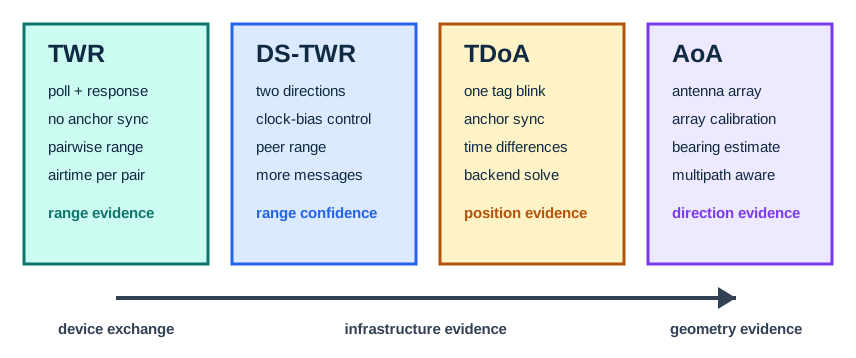
TWR uses a poll and response for pairwise range without synchronizing all anchors, but each pair consumes airtime. Double-sided TWR adds another direction of timing information to control clock bias at the cost of more messages. TDoA relies on synchronized anchors observing a tag blink and a backend solver. Angle of arrival adds direction where antenna hardware supports it. Each path produces a different record, from peer timestamps to anchor clock state. Choose a technique from the site’s tag count, power, geometry, and confidence need, then test it under obstruction.
30.7 Method Choice Is a Clock and Airtime Budget
This section: Method Choice Is a Clock and Airtime Budget — UWB measures distance by timing radio pulses, and the named methods trade accuracy, airtime, and clock requirements differently.
UWB measures distance by timing radio pulses, and the named methods trade accuracy, airtime, and clock requirements differently. Single-sided two-way ranging (SS-TWR), double-sided two-way ranging (DS-TWR), and time difference of arrival (TDoA) all exploit UWB’s sub-nanosecond pulses. The design tension is that fine time resolution turns tiny clock errors into real distance errors, so each method is a different answer to “whose clock do we trust?”
Start with the conversion: light travels about 0.30 m/ns. In a two-way exchange, a timing error in the round-trip estimate is divided by two when it becomes one-way distance. A 2 ns round-trip error is therefore about 0.30 m of one-way range error: 0.30 m/ns x 2 ns / 2 = 0.30 m.
That number explains why UWB ranging is powerful but not automatic truth. If a tool cabinet only needs to decide whether a device is within about 1.5 m, a well-calibrated DS-TWR exchange with confidence fields may be enough. If a robot cell needs a 0.25 m exclusion boundary, the same raw range is not enough unless the system also proves antenna-delay calibration, first-path quality, line-of-sight evidence, freshness, and geometry. The method name says how evidence was collected; it does not say the evidence is safe to act on.
A useful range record carries more than distance. It should include method, anchors or peer, raw timing age, calibration version, channel quality, confidence class, and the policy action that consumed it. A log entry such as “DS-TWR, 3.2 m, high confidence, 45 ms old, calibration v4, accepted” is operational evidence. A bare “3.2 m” is a number with hidden assumptions.
30.8 Two-Way Ranging
This section: Two-Way Ranging — Figure 30.2 marks the timestamps used for a two-way range estimate.
Single-sided TWR uses four timestamps:
- The initiator transmits a poll at .
- The responder receives it at .
- The responder transmits a response at .
- The initiator receives the response at .
The responder delay is . The initiator’s elapsed time is . The round-trip flight time estimate is:
Distance is:
where is the speed of light in air for the required engineering precision.
Figure 30.2 marks the timestamps used for a two-way range estimate.
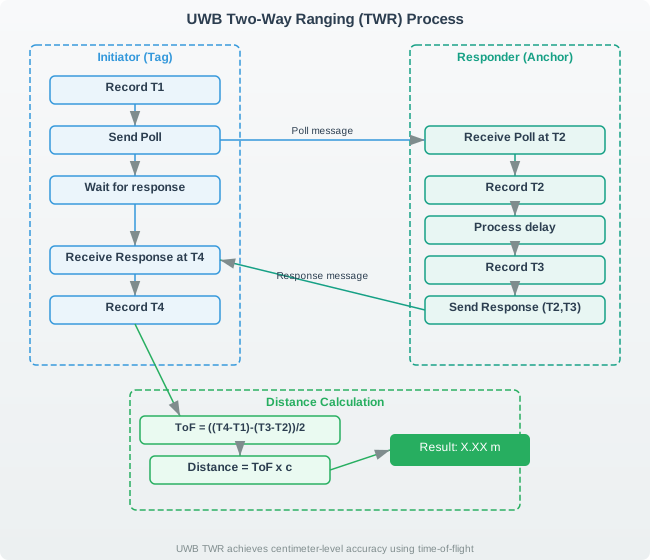
The initiator sends a poll at T1 and receives the response at T4. The responder records receipt at T2 and reply at T3, so the calculation removes its processing delay from the round trip before estimating time of flight. Multiplying that time by signal speed yields a distance estimate. Keep the four timestamps and calibration context together, then compare the result with a known separation. A mathematically consistent exchange can still be biased by antenna delay or an obstructed path, so the application should use the range with a quality check.
-

Remi sends a poll and marks the first local time.
-

The far radio marks arrival and reply times.
-

The first radio marks when the reply returns.
-

Subtract the far radio wait, then halve the trip.
-

Convert that bounded flight time to distance.
The worked exchange in Figure 30.2 records the initiator’s T1 poll and T4 response times, plus the responder’s T2 arrival and T3 reply times. In the figure, T4 minus T1 is 220 ns and T3 minus T2 is a 200 ns responder wait. Subtracting leaves 20 ns for the round trip; halving gives 10 ns of one-way flight time, or about 3.0 m at 0.3 m per ns. This is a teaching estimate. Antenna delay, clock behavior, calibration, and channel quality must be checked before an application trusts the distance for access or safety.
30.9 Worked TWR Example
This section: Worked TWR Example — This calculation is useful only if timestamp calibration, antenna delay, clock behavior, and channel quality are good enough for the decision that will use the result.
Suppose a tag sends a poll at ns and receives the response at ns. The responder records ns and ns.
- Initiator elapsed time: ns.
- Responder delay: ns.
- Round-trip flight time: ns.
- One-way flight time: ns.
- Distance using m/ns: m.
This calculation is useful only if timestamp calibration, antenna delay, clock behavior, and channel quality are good enough for the decision that will use the result.
30.10 Try Two-Way Ranging in the Workbench
This section: Try Two-Way Ranging in the Workbench
UWB two-way ranging narrated tour
Play silently with captions on provisional storyboard timing; narration audio is pending. Production pacing is not protocol time. Choose Reduced motion for a complete still at each beat.
Play the tour to open the workbench. Pause, replay a beat, or read the full transcript below. Some situations cannot be shown by this teaching model; those beats keep the existing frame and provide captions only.
Full transcript — UWB two-way ranging (8 beats)
B1 — Cabinet decision
You are the engineer setting up a connected tool cabinet. It must decide whether a tagged device is within about one point five metres. A distance error could change that decision. How can a radio exchange give your cabinet a distance it can use?
Model caption: Your tool cabinet must decide whether a tagged device is within about 1.5 m; distance error can change that decision.
B2 — Poll and response
Ultra-wideband, or UWB, uses very short radio timing events across a wide range of frequencies. Two-way ranging measures a round trip between two devices. The device starting the exchange sends a poll. The responder receives it, waits, and sends a response back.
Model caption: Ultra-wideband uses short radio timing events. Two-way ranging times a poll-and-response round trip, including the responder's wait.
B3 — Subtract the wait
Single-sided two-way ranging measures the whole exchange on the starting device's clock. Subtract the responder's reported waiting time, then halve the remaining time to get the flight time in one direction. Multiply by the speed of light to turn that flight time into distance.
Model caption: Subtract reported responder wait from the whole exchange, halve the remainder, then multiply by light speed to calculate distance.
B4 — Clock mismatch
The waiting time comes from the responder's clock, while the whole exchange is timed by the starting device's clock. Their clocks can run at slightly different rates. That mismatch turns some of the reply delay into a distance error, even after the subtraction.
Model caption: Round trip and reply delay come from different clocks. A clock-rate mismatch leaves distance error after subtraction.
B5 — Thirty centimetres
Suppose your responder waits one hundred microseconds, and its clock differs by twenty parts per million. Multiply one hundred microseconds by twenty, then divide by one million. The apparent waiting-time error is about two nanoseconds. At about zero point three metres per nanosecond, multiply by two nanoseconds and divide by two for the round trip. The distance bias has a magnitude of about thirty centimetres.
Model caption: 100 microseconds × 20 / 1,000,000 ≈ 2 ns. 0.30 m/ns × 2 ns / 2 ≈ 0.30 m bias magnitude. The model's +20 ppm setting reads about 7.70 m for a true 8 m.
B6 — Third message
Double-sided two-way ranging adds a third message so each device measures a round trip. Combining those measurements cancels much of the error caused by the different clock rates. Your cabinet gets less clock-sensitive timing, at the cost of another message and more energy per range.
Model caption: A third message supplies a round trip on each device. Double-sided timing reduces clock-rate error; another message costs energy. With unchanged example settings, the model estimates about 8.00 m.
B7 — Remaining path bias
The misconception is that the extra message removes every source of distance error. It reduces clock mismatch, but a reflected radio path can still arrive later than the direct path. That extra travel time can make the measured distance too long, even with double-sided ranging.
Model caption: One misconception: the extra message removes every distance error. A late reflected path can still lengthen the range. The model's fixed 30 cm bias remains after clock correction.
B8 — Ranging takeaway
Two-way ranging subtracts the wait; double-sided ranging reduces clock error; neither straightens a reflected path.
Model caption: Two-way ranging subtracts the wait; double-sided ranging reduces clock error; neither straightens a reflected path.
30.11 Double-Sided TWR
This section: Double-Sided TWR — Single-sided TWR assumes the responder delay measured on one device’s clock is directly comparable with the elapsed time measured on the other device’s clock.
Single-sided TWR assumes the responder delay measured on one device’s clock is directly comparable with the elapsed time measured on the other device’s clock. Small clock-rate differences can matter when reply delays are long or timing quality is weak. DS-TWR adds a reverse exchange or a final message so the ranging engine has timing measurements from both sides.
DS-TWR does not make measurements perfect. It reduces one error source: clock-rate mismatch between the devices. The result still needs antenna-delay calibration, first-path review, and quality checks.
Use DS-TWR when:
- The exchange is peer-to-peer or small-scale.
- A single-sided exchange may be biased by clock-rate mismatch.
- A bidirectional exchange is acceptable for latency and airtime.
- The application needs range confidence, not just a nearby/not-nearby signal.
30.12 Time Difference of Arrival
This section: Time Difference of Arrival — TDoA changes the architecture.
TDoA changes the architecture. The tag transmits a blink, and multiple anchors timestamp the arrival. The positioning engine compares arrival-time differences, so it can estimate a location from hyperbolic constraints. The tag does not need to range separately with every anchor, but the anchor network must maintain time alignment and good geometry.
For two anchors, the measured time difference gives a distance-difference constraint:
The positioning engine combines several such constraints with anchor coordinates, clock-quality estimates, and filtering. Poor synchronization directly becomes bad range-difference evidence. Poor geometry can amplify otherwise small timing errors.
Figure 30.3 contrasts active two-way exchanges with synchronized-anchor observations.
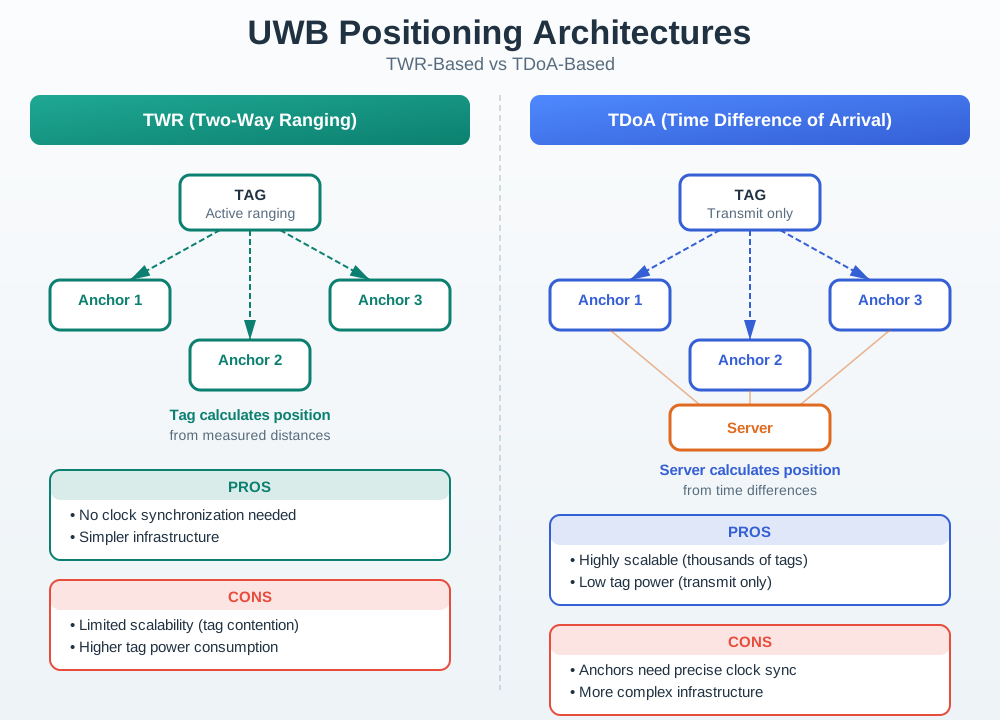
In TWR, the tag exchanges messages with anchors and can calculate ranges without a shared anchor clock, but many tags create contention and power cost. In TDoA, a tag blink is received by synchronized anchors; the backend uses arrival-time differences to solve a position. That changes the main risk from pairwise airtime to anchor timing and calibration. The diagram lists method strengths and limits, not a site accuracy result. Test a known point, an edge of the anchor geometry, and an obstructed path before choosing one for the deployment.
Use TDoA when:
- Many tags need periodic position evidence.
- The deployment can support synchronized anchor infrastructure.
- The system can monitor clock quality, anchor health, and geometry.
- A central engine can reject, down-weight, or flag weak measurements.
Avoid treating TDoA as simply “lower power” or “larger scale.” Those outcomes depend on update rates, channel planning, tag behavior, anchor density, synchronization quality, and application tolerance for stale or uncertain evidence.
30.13 Angle of Arrival
This section: Angle of Arrival — AoA estimates direction rather than distance.
AoA estimates direction rather than distance. A UWB receiver with an antenna array compares phase or timing evidence across known antenna positions. Direction evidence can reduce ambiguity or improve geometry, especially when combined with TWR or TDoA. It also creates new failure modes: array calibration, device orientation, polarization, body blockage, and reflections can bias the angle estimate.
Use AoA as a complement when:
- A direction estimate improves the application decision.
- The anchor can support calibrated antenna arrays.
- Multipath and mounting orientation are included in the test plan.
- The positioning engine can attach confidence to angle evidence.
30.14 Measurement Quality
This section: Measurement Quality — Every ranging technique needs a quality gate before an application acts.
Every ranging technique needs a quality gate before an application acts. Good systems do not only store a distance or coordinate; they store enough evidence to explain why the measurement was accepted, down-weighted, retried, or rejected.
Figure 30.4 asks whether a range is fresh and credible enough for an action.
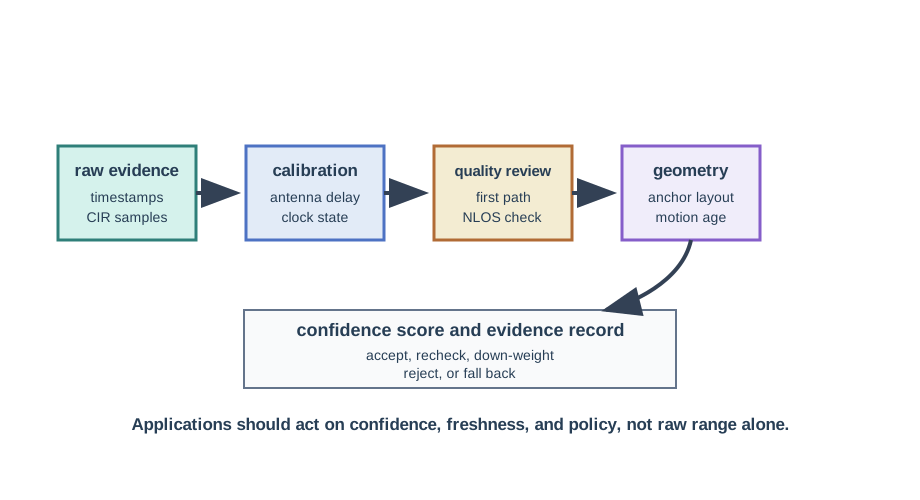
The quality path in Figure 30.4 starts with raw timestamps and channel impulse response samples. Calibration checks antenna delay and clock state before the first path and non-line-of-sight conditions are judged. Anchor geometry and motion age can further weaken a range that looks precise in isolation. Record a confidence score with the source evidence, then let application policy accept, recheck, down-weight, reject, or fall back. A raw distance alone cannot explain which path was detected or whether the measurement is fresh. Keep those quality fields beside the action so a later review can reproduce why the estimate was trusted.
Review these quality factors:
- Clock quality: TDoA depends on anchor synchronization; TWR depends on stable local timestamping and bounded reply behavior.
- Calibration: Antenna delay and device-specific offsets must be measured or controlled.
- First-path evidence: Channel impulse response helps separate the earliest useful path from stronger reflections.
- Geometry: Anchor layout can amplify timing errors into larger position errors.
- Motion and latency: A good range can still be stale when the tag or controlled object is moving.
- Policy fit: A measurement that is good enough for room-level context may not be good enough for access or safety behavior.
30.15 Technique Selection
This section: Technique Selection — Choose the method by the evidence requirement, not by a headline accuracy number.
Choose the method by the evidence requirement, not by a headline accuracy number.
30.16 Example Selection Reasoning
This section: Example Selection Reasoning — A tool cabinet only needs to know whether one authorized device is near the correct side of the cabinet at checkout time.
A tool cabinet only needs to know whether one authorized device is near the correct side of the cabinet at checkout time. DS-TWR can fit because the interaction is local, bidirectional, and low population. A factory-wide asset map with many tags may fit TDoA if the site can maintain synchronized anchors and confidence monitoring. A robot docking system might combine range with AoA if direction helps resolve approach angle. None of these choices is complete until the installed environment proves the evidence quality.
30.17 Capacity and Failure-Mode Review
This section: Capacity and Failure-Mode Review — The practical split is two-way versus one-way timing.
The practical split is two-way versus one-way timing. TWR needs a back-and-forth with each anchor, which costs airtime per tag but needs no synchronized infrastructure. TDoA reverses that model: the tag blinks once and the fixed anchors, sharing a common clock, compute position from arrival-time differences.
| Method | Exchange | Clock requirement | Trade |
|---|---|---|---|
| SS-TWR | Poll -> response; one side times the round trip | No shared clock, but sensitive to inter-device clock offset | Simple and fewer messages; usually least accurate |
| DS-TWR | Poll -> response -> final; both sides time a round trip | No shared clock; the math cancels much first-order clock offset | More accurate; one extra message and more energy |
| TDoA | Tag sends one blink; many anchors timestamp arrival | Anchors must be tightly synchronized | Tag transmits once, so it scales to many tags when infrastructure is healthy |
Do the capacity arithmetic before choosing. A small tool-checkout system with 12 active tags, 4 anchors per decision, and 2 Hz updates asks for about 12 x 4 x 2 = 96 tag-anchor ranging decisions per second. If DS-TWR uses three messages for each decision, the message pressure is roughly 96 x 3 = 288 ranging messages per second before retries and management traffic. The same population using TDoA at 2 Hz asks the tags for about 12 x 2 = 24 blinks per second, but the anchors must maintain synchronization and the backend must reject weak geometry.
Acceptance testing should mirror the decision. For TWR, test known distances with the installed antenna orientation and record responder delay, channel impulse response first-path quality, and rejected measurements. For TDoA, test known points inside and near the edge of the anchor hull, then record anchor time status and residual error. For AoA, include a bearing sanity check: a 10 degree angle error at 5 m is about 5 x tan(10 degrees) = 0.88 m sideways uncertainty. That is fine for “which aisle” and weak for a tight safety zone.
The practitioner rule is simple: choose the method whose failure mode you can monitor. TWR failure often appears as airtime pressure, reply timing, or non-line-of-sight bias. TDoA failure often appears as clock drift, bad geometry, or stale anchor coordinates. AoA failure often appears as array calibration, mounting, or reflections. A design review that names those checks is stronger than one that only cites an accuracy headline.
30.18 Clock Drift Error Budget
This section: Clock Drift Error Budget — In SS-TWR, device A sends a poll, device B replies after a known processing delay, and A computes distance from the round-trip time minus B’s reply delay.
In SS-TWR, device A sends a poll, device B replies after a known processing delay, and A computes distance from the round-trip time minus B’s reply delay. The catch is that the reply delay is measured on B’s clock while the round trip is measured on A’s clock. Those crystals never run at exactly the same frequency. That frequency offset multiplies the reply delay into a ranging error, and reply delays are long enough that small parts-per-million offsets become centimeters.
DS-TWR reduces this by adding a third message so each device measures a round trip. Combining the two round-trip measurements cancels much of the first-order clock-offset error. The cost is one more message and more energy per range. The choice is concrete: SS-TWR when the fewest messages matter and more error is acceptable; DS-TWR when accuracy must hold despite clock drift; TDoA when tag scale and battery life matter more than avoiding anchor synchronization.
Put numbers on the drift. Suppose the responder waits 100 microseconds before sending its reply and its clock differs by 20 ppm from the initiator. The apparent reply-delay error is about 100 microseconds x 20 / 1,000,000 = 2 ns. In a single-sided range, that becomes about 0.30 m/ns x 2 ns / 2 = 0.30 m of distance bias. If the reply delay stretches to 1 ms, the same 20 ppm offset becomes 20 ns, or roughly 3 m of distance bias before multipath, antenna-delay, or timestamp-noise effects.
DS-TWR still leaves the rest of the error budget. Antenna delay can shift timestamps, non-line-of-sight paths can arrive late, and filtering can publish a fresh-looking range from stale evidence. TDoA has a different budget: if anchor synchronization is off by 0.5 ns, the distance-difference evidence is biased by about 0.15 m. With a geometry factor of 2, that can become about 0.30 m of position uncertainty before environment bias.
Engineering review should attach method, timing age, calibration, channel evidence, geometry, and confidence to every accepted range or coordinate. The distance is only trustworthy when the evidence trail matches the application consequence.
30.19 Common Pitfalls
This section: Common Pitfalls
- Claiming automatic centimeter accuracy. UWB can support fine timing evidence, but installed accuracy depends on line of sight, calibration, geometry, clock quality, antenna placement, and filtering.
- Using TDoA without clock evidence. Time-difference systems are only as good as anchor synchronization, timestamping, and drift monitoring.
- Ignoring non-line-of-sight bias. A reflected path can arrive later than the direct path and make the range look too long. Use channel evidence and consistency checks.
- Optimizing update rate before airtime. More ranges per second can increase collisions, stale processing, and energy use. Check packet timing and channel load.
- Turning range into authorization. Secure ranging can strengthen proximity evidence, but authorization, freshness, confidence, boundary policy, and fallback still decide the action.
30.20 Knowledge Check
This section: Knowledge Check
30.21 Quick Check: TWR Timing
This section: Quick Check: TWR Timing
30.22 Matching Quiz: Ranging Evidence
This section: Matching Quiz: Ranging Evidence
30.23 Ordering Quiz: TDoA Measurement Review
This section: Ordering Quiz: TDoA Measurement Review
30.24 Quick Check: Clock Offset
This section: Quick Check: Clock Offset
30.25 Summary
This section: Summary
- TWR estimates distance from a bidirectional exchange and does not require synchronized anchors.
- DS-TWR reduces sensitivity to clock-rate mismatch but still needs channel, calibration, and confidence review.
- TDoA can support managed multi-tag systems when synchronized anchors and backend quality monitoring are available.
- AoA adds direction evidence, usually as a complement to range or time-difference measurements.
- UWB ranging results should be handled as evidence with confidence, freshness, geometry, and fallback rules.
30.26 Key Takeaway
This section: Key Takeaway — UWB ranging quality depends on timing method, anchor geometry, line of sight, multipath, calibration, and validation against the required accuracy.
UWB ranging quality depends on timing method, anchor geometry, line of sight, multipath, calibration, and validation against the required accuracy.
30.27 Concept Relationships
This section: Concept Relationships
- Wide bandwidth supports precise timestamp evidence.
- TWR and DS-TWR turn round-trip timing into range evidence.
- TDoA turns synchronized arrival-time differences into position constraints.
- AoA adds direction evidence through antenna geometry.
- CIR review helps distinguish first-path evidence from reflections.
- Application policy decides whether evidence is strong enough to accept, retry, down-weight, or fall back.
30.28 References
This section: References
- IEEE 802.15.4z-2020: enhanced UWB ranging amendment.
- IEEE 802.15.4: low-rate wireless networks and UWB PHY history.
- FiRa Consortium technical resources: UWB ranging, MAC, and interoperability guidance.
- Decawave application notes: UWB two-way ranging, channel impulse response, and antenna delay calibration.
- ETSI EN 302 065 and FCC UWB operation rules: regional spectrum constraints for UWB devices.
30.29 What’s Next
This section: What’s Next
Find help
3 reviewed answers.
Where should I start in a module?
Open the module page from the sidebar to see its chapters in order. Use the module map to return to a topic you need.
Modules and pathsReviewed
What can I try when a project does not work?
Check the symptom, then work through the diagnostic steps. Keep the error message and the smallest example that reproduces it.
When you are stuckReviewed
How do interactive examples work?
Use the interactive guide to check how examples and simulations work before changing your project.
Interactive examples guideReviewed