34 NFC Hands-on and Applications
34.1 Learning Objectives
By the end of this chapter, you will be able to:
- Construct NFC tag programs across Android, Python (PN532), and Arduino platforms using NDEF message formats
- Evaluate and select the appropriate NFC tag type (Type 1–5) based on application requirements for memory, security, and cost
- Architect NFC application systems for payments, access control, smart home, and product authentication
- Apply security best practices including tokenization, encrypted tags, and relay-attack countermeasures
- Diagnose NFC implementation failures using systematic troubleshooting for tag detection, NDEF parsing, and communication errors
If you take away only three things from this chapter:
- NFC applications span three operating modes – Reader/Writer mode (reading smart posters, programming tags), Peer-to-Peer mode (device pairing, data exchange), and Card Emulation mode (mobile payments, access control) – and selecting the correct mode determines your entire implementation approach.
- Tag type selection drives application feasibility – Type 2 tags (NTAG213/215) suit low-cost read-only applications like smart posters, while Type 4 tags (DESFire/NTAG424) with crypto coprocessors enable high-security applications like payments and anti-counterfeiting, at 5–10x the cost per tag.
- Security is layered, not optional – production NFC systems combine tag-level encryption (AES-128 on DESFire), transport-level tokenization (EMV payment tokens replacing real card numbers), and application-level validation (server-side signature verification) because NFC’s short range alone does NOT prevent relay and replay attacks.
Hey Sensor Squad! Have you ever tapped a card on a bus reader or held your phone near something to make it do something cool? That is NFC – Near Field Communication!
Sammy explains: “NFC is like a magic handshake! When I hold my phone REALLY close to a special sticker – like, closer than your thumb is long – they can talk to each other. But ONLY when they are super close. It is like whispering a secret – you have to be right next to someone’s ear!”
Lila’s Tap Adventures:
- “I tap my library card on the door and it opens – that is Access Control!”
- “Mom taps her phone at the store to pay for groceries – that is Mobile Payments!”
- “I tap my phone on a poster at the zoo and a video of penguins starts playing – that is a Smart Poster!”
Max’s Cool Trick – Three Modes!
Max figured out NFC can work in THREE different ways:
- Reader Mode: “My phone READS a tag, like scanning a treasure map clue!”
- Sharing Mode: “Two phones touch and SHARE a photo – like a high-five that sends pictures!”
- Pretend Mode: “My phone PRETENDS to be a card, so I can pay without a real wallet!”
Bella’s Warning: “The magic only works when things are SUPER close – less than 4 centimeters. That is shorter than a crayon! This keeps it safe because a sneaky person cannot read your card from far away. But you still need passwords and encryption to be truly safe!”
Real-world version: Every time you tap to pay at a store, your phone creates a one-time secret code (called a token) instead of sending your real card number. Even if someone could somehow intercept it, that token only works once and is useless afterward!
34.2 Overview
This section provides comprehensive hands-on guidance for NFC implementation and real-world applications. NFC operates at 13.56 MHz with a typical range of less than 4 cm, making it uniquely suited for intentional, secure interactions. The content has been organized into focused chapters covering tag programming, simulation labs, and production deployment.
NFC’s 13.56 MHz frequency corresponds to a wavelength of \(\lambda = \frac{c}{f} = \frac{3 \times 10^8 \text{ m/s}}{13.56 \times 10^6 \text{ Hz}} = 22.1 \text{ m}\). The near-field boundary occurs at \(\frac{\lambda}{2\pi} \approx 3.5 \text{ m}\), but NFC intentionally operates in the reactive near-field region where magnetic coupling dominates and field strength drops as \(\frac{1}{r^3}\). Worked example: At 4 cm range, relative signal strength = 100%. At 10 cm, it drops to \((4/10)^3 = 6.4\%\). At 5 m, it’s \((4/500)^3 = 0.000000064\%\) — effectively zero, making remote interception physically impossible.
What is NFC in practice? NFC (Near Field Communication) is the technology behind contactless payments, smart transit cards, and phone-to-phone data sharing. Unlike Bluetooth or Wi-Fi, NFC requires devices to be within about 4 cm of each other, which provides a natural layer of physical security.
Why learn NFC development? NFC is one of the fastest-growing IoT technologies – over 2 billion NFC-enabled smartphones are in use worldwide. Understanding NFC development opens doors to building payment systems, access control, smart retail, healthcare tracking, and product authentication solutions.
Key concepts you need first:
| Term | Meaning |
|---|---|
| NDEF | NFC Data Exchange Format – the standard message structure for NFC data |
| Tag Types 1–5 | NFC Forum tag categories with different memory, speed, and security capabilities |
| Reader/Writer Mode | Phone reads from or writes to a passive NFC tag |
| Card Emulation | Phone pretends to be an NFC card (used for mobile payments) |
| Peer-to-Peer | Two active NFC devices exchange data bidirectionally |
| Tokenization | Replacing sensitive data (card numbers) with one-time-use tokens |
Prerequisites:
- NFC Fundamentals – Understanding NDEF format and operating modes
- Basic programming knowledge (Java, Python, or C++)
Learning Path:
- Start with Tag Programming for hands-on coding experience
- Use the Simulation Lab to practice without hardware
- Explore Real-World Applications for production implementations
34.2.1 NFC Application Architecture
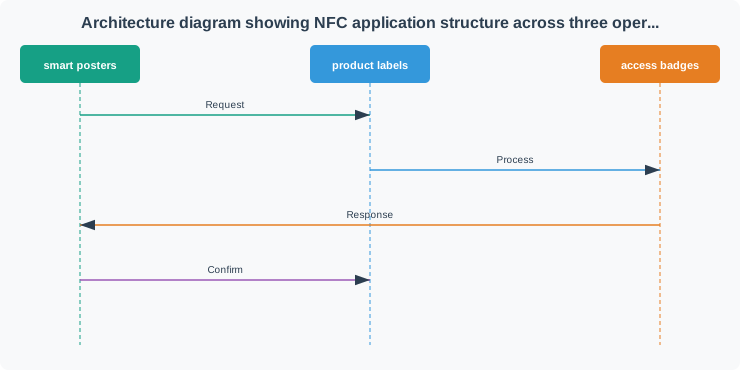
The following diagram shows how NFC applications are structured across the three operating modes, from physical tags through middleware to cloud backends.
34.3 Chapter Guide
34.3.1 NFC Tag Programming
Hands-on exercises for programming NFC tags across multiple platforms:
- Android Development: Java/Kotlin NFC programming with NdefMessage and NfcAdapter
- Python with PN532: Raspberry Pi implementations using nfcpy library
- Arduino Integration: I2C-based PN532 communication with NfcAdapter library
- Tag Type Selection: Choosing between Type 1-5 tags for different applications
- Debugging Strategies: Troubleshooting tag detection and NDEF parsing issues
34.3.2 NFC Simulation Lab
Interactive Wokwi-based simulation for learning NFC concepts:
- NDEF Message Parsing: TLV containers, record headers, payload decoding
- URI Prefix Compression: Space-saving techniques for small tags
- Tag Type Characteristics: Memory, security, and use cases for Types 1-5
- Anti-Collision Protocol: Multi-tag handling and UID resolution
- Security Demonstrations: Relay attacks and countermeasures
- Challenge Exercises: Hands-on coding challenges to extend the simulation
34.3.3 NFC Real-World Applications
Production implementations and use cases:
- Mobile Payments: Apple Pay/Google Pay tokenization and EMV standards
- Smart Home Automation: NFC triggers for Home Assistant and MQTT
- Product Authentication: Anti-counterfeiting with encrypted tags
- Smart Posters: Dynamic marketing with analytics integration
- Access Control: Hotel keys, office badges, and audit logging
- Python Security Tools: Vulnerability assessment and security scoring
34.4 NFC Tag Type Decision Framework
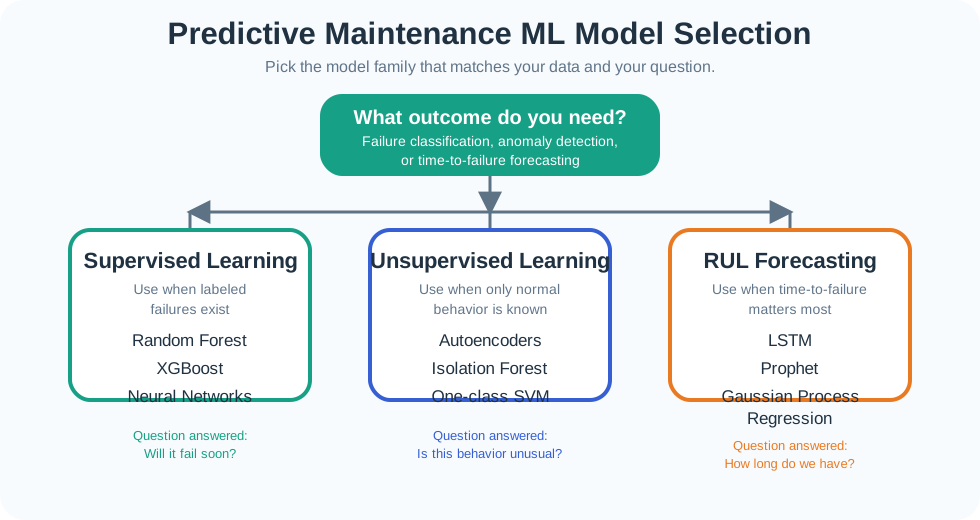
Selecting the right NFC tag type is one of the most consequential decisions in an NFC project. The following diagram maps application requirements to recommended tag types.
34.5 NFC Communication Sequence
The following sequence diagram illustrates the complete NFC interaction flow for a mobile payment transaction, showing the layers of security involved.
34.6 NFC Implementation Workflow
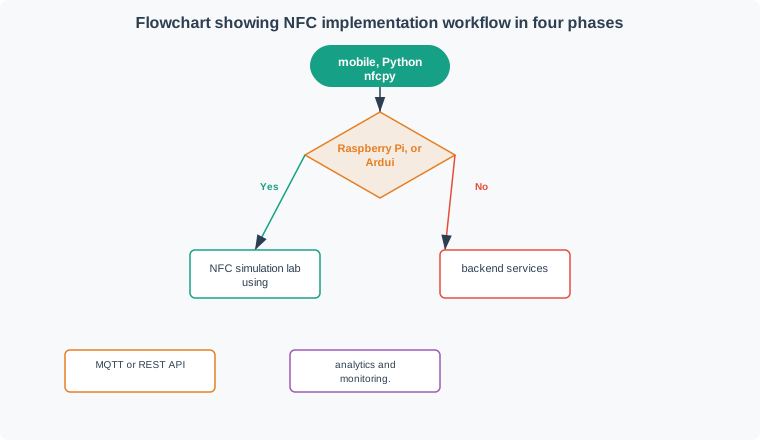
This diagram shows the development workflow from choosing an NFC application type through implementation to deployment, highlighting the key decisions and tools at each stage.
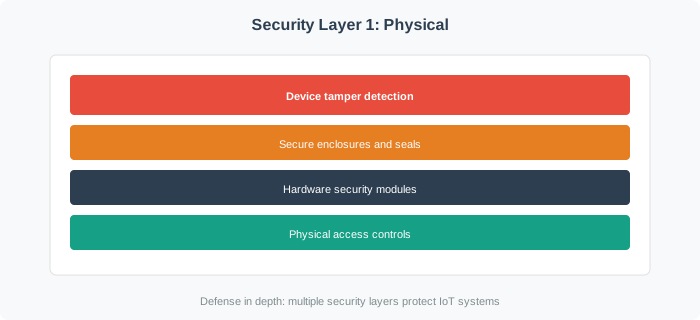
34.7 NFC Security Layer Model
NFC security is not a single mechanism but a stack of complementary layers. The following diagram shows how these layers combine to protect different application types.
34.8 Quick Reference
| Application | Tag Type | Operating Mode | Security Level | Typical Cost/Tag |
|---|---|---|---|---|
| Smart Posters | Type 2 (NTAG213) | Reader/Writer | Low | ~$0.10 |
| Device Pairing | Type 2 (NTAG215) | Peer-to-Peer | Medium | ~$0.25 |
| Loyalty Cards | Type 2 (NTAG216) | Reader/Writer | Medium | ~$0.35 |
| Access Control | Type 4 (DESFire EV2) | Card Emulation | High | ~$1.50 |
| Mobile Payments | Type 4 (SE) | Card Emulation | Critical | N/A (phone SE) |
| Product Auth | Type 4 (NTAG424 DNA) | Reader/Writer | High | ~$0.80 |
34.9 Common Pitfalls
1. Relying on proximity as the sole security mechanism. NFC’s 4 cm range provides physical-layer protection, but relay attacks can extend this range using two colluding devices. A 2013 research demonstration showed NFC relay over Bluetooth at 100+ meters. Always implement cryptographic authentication (AES-128 on DESFire or SDM on NTAG424) for any security-sensitive application.
2. Using NTAG213/215 for access control or authentication. Type 2 tags lack cryptographic coprocessors – their “password” protection is a simple 32-bit value transmitted in plaintext and trivially sniffed. For access control, use DESFire EV2/EV3 with mutual authentication; for product authentication, use NTAG424 DNA with Secure Dynamic Messaging.
3. Hardcoding sensitive data on tags without server-side validation. Writing access tokens, API keys, or credentials directly to NFC tags means anyone with an NFC reader (every modern smartphone) can clone them. Instead, store only a unique identifier on the tag and resolve it server-side against a secure database.
4. Ignoring NDEF message size limits. NTAG213 has only 144 bytes of user memory. After NDEF TLV overhead (typically 4–7 bytes), you have roughly 137 bytes for payload. A URL record with a long domain name can easily exceed this. Always calculate total NDEF message size including record headers (3+ bytes per record) and TLV containers before selecting a tag.
5. Not handling the “tag removed during write” scenario. NFC writes are not atomic – if a user pulls their phone away mid-write, the tag can be left in a partially-written state with corrupted NDEF data. Implement a write-verify cycle: write the NDEF message, immediately read it back, and compare checksums. For critical applications, use tags with transaction-commit support (DESFire Transaction MAC).
34.10 Worked Example: Smart Office NFC Access System
Scenario: A company wants to deploy NFC-based access control for a 50-person office with 4 secured doors. Each employee gets an NFC badge, and the system must log all entry attempts with timestamps.
Step 1: Tag Type Selection
Requirements analysis:
- Security: Must prevent badge cloning (rules out Type 2 tags)
- Capacity: Need to store employee ID + department code (~32 bytes)
- Durability: Badges used 10+ times daily for 3+ years
- Budget: Up to $3/badge for 50 employees
Decision: DESFire EV2 (Type 4) – AES-128 mutual authentication, 2 KB memory, rated for 500,000+ read cycles. Cost: ~$1.50/badge, well within budget.
Step 2: System Architecture
[DESFire Badge] <--NFC--> [Door Reader (PN532)] <--I2C--> [ESP32]
                                                            |
                                                        [Wi-Fi]
                                                            |
                                                    [MQTT Broker]
                                                            |
                                                [Access Control Server]
                                                            |
                                                    [PostgreSQL DB]
Step 3: Badge Provisioning (Python with nfcpy)
import nfc
import json
from datetime import datetime

def provision_badge(clf, employee_id, department, auth_key):
    """Provision a DESFire EV2 badge with employee credentials."""
    tag = clf.connect(rdwr={'on-connect': lambda tag: False})

    if not tag or tag.type != "Type4Tag":
        raise ValueError("DESFire EV2 tag required")

    # Authenticate with master key (AES-128)
    tag.authenticate(key_number=0, key=auth_key)

    # Create application with AES authentication
    app_id = bytes([0x01, 0x00, 0x00])  # Application ID
    tag.create_application(app_id, key_settings=0x0B, num_keys=2)

    # Write employee record
    employee_record = json.dumps({
        "id": employee_id,
        "dept": department,
        "issued": datetime.now().isoformat(),
        "version": 1
    }).encode('utf-8')

    tag.select_application(app_id)
    tag.create_file(file_id=0x01, file_type='standard',
                    access_rights=0xE000, size=len(employee_record))
    tag.write_data(file_id=0x01, data=employee_record)

    print(f"Badge provisioned for {employee_id} ({department})")
Step 4: Door Reader Logic (ESP32 + PN532)
1. PN532 detects badge in RF field
2. ESP32 sends DESFire SELECT command
3. Mutual AES-128 authentication (3-pass challenge-response)
4. Read employee record from badge file
5. Publish to MQTT: office/door/{door_id}/access
   Payload: {"employee_id": "E042", "timestamp": "...", "door": "D3"}
6. Server validates: employee active? department authorized for this door?
7. Server responds: office/door/{door_id}/unlock or /deny
8. ESP32 triggers door lock relay (or flashes red LED)
Step 5: Security Measures
| Layer | Implementation |
|---|---|
| Physical | NFC read range limited to 3 cm by reader antenna design |
| Tag | AES-128 mutual authentication; unique key per badge |
| Transport | TLS-encrypted MQTT (port 8883) |
| Application | Server validates employee status, door permissions, time windows |
| Audit | All access attempts logged with timestamp, door ID, result |
Step 6: Cost Analysis
| Item | Unit Cost | Quantity | Total |
|---|---|---|---|
| DESFire EV2 badges | $1.50 | 55 (50 + 5 spare) | $82.50 |
| PN532 readers | $12.00 | 4 doors | $48.00 |
| ESP32 controllers | $5.00 | 4 doors | $20.00 |
| Door lock relays | $8.00 | 4 doors | $32.00 |
| MQTT broker (Mosquitto) | $0 | 1 (self-hosted) | $0 |
| Total hardware | $182.50 |
Result: A secure, auditable NFC access control system for under $200 in hardware, with per-badge cost of $1.50 compared to $5–15 for commercial access cards with equivalent security.
34.11 Knowledge Checks
Test your understanding of NFC hands-on implementation and application design.
34.12
34.14 Concept Relationships
NFC application architecture spans three layers: physical tags (passive NTAG, active DESFire), middleware (NDEF parsers, NFC readers), and cloud backends (authentication servers, analytics). Reader/Writer mode connects these layers for smart posters and inventory. Peer-to-Peer enables direct phone-to-phone exchange bypassing cloud. Card Emulation integrates Secure Elements with payment networks.
Tag type selection drives feasibility: Type 2 (NTAG213/215) for low-cost smart posters ($0.10-0.25), Type 4 (DESFire EV2) for cryptographic access control ($1.50), NTAG424 DNA for product authentication with unforgeable signatures ($0.80). The 5-10x cost difference buys AES-128 coprocessors and anti-cloning features—essential for high-value applications.
Security layers stack: tag-level encryption (DESFire AES), transport tokenization (EMV payments), application validation (server CMAC checks). No single layer suffices—relay attacks bypass proximity, cloned tags fake authentication, replay attacks reuse captured tokens. Production systems combine all three layers.
34.15 See Also
Implementation Guides:
- NFC Tag Programming - Android/Python/Arduino code
- NFC Simulation Lab - Wokwi interactive exercises
- NFC Real-World Applications - Production deployments
Security:
- NFC Security - EMV payment security, SE vs HCE
- IoT Device Security - Secure Element architecture
Comparisons:
- RFID Applications - Related contactless tech
- Bluetooth Applications - BLE pairing patterns
34.16 Summary
NFC hands-on development spans three distinct operating modes, each demanding different implementation strategies, tag types, and security architectures.
Key takeaways:
- Tag type selection is the first critical decision: Type 2 tags (NTAG213/215/216) are cost-effective for read-only applications like smart posters and device pairing at $0.10–0.35/tag, while Type 4 tags (DESFire EV2, NTAG424 DNA) provide cryptographic security essential for access control and product authentication at $0.80–1.50/tag.
- Three operating modes serve different use cases: Reader/Writer mode handles smart posters and product labels; Peer-to-Peer mode supports device pairing and data exchange; Card Emulation mode enables mobile payments and transit cards. The mode determines the hardware requirements, software architecture, and security mechanisms needed.
- Security must be layered: Physical proximity (< 4 cm) provides a baseline, but production systems require tag-level encryption (AES-128), transport-level tokenization (EMV), and application-level validation (server-side verification) to defend against relay attacks, cloning, and replay attacks.
- NDEF message sizing requires careful calculation: Tag memory must accommodate TLV wrappers, record headers, type fields, and terminators in addition to payload data – a 128-byte payload may need 140+ bytes of total tag storage.
- Development follows a predictable workflow: Choose application type and tag, develop with Android/Python/Arduino, test first in simulation (Wokwi) then with physical hardware, and deploy with batch provisioning and backend integration.
Platform support is wide: Android (Java/Kotlin with NfcAdapter), Python (nfcpy library on Raspberry Pi), and Arduino (Adafruit PN532 library) all provide mature NFC development frameworks. Start with the simulation lab to build confidence before investing in physical hardware.
34.17 What’s Next
| Topic | Chapter | Focus |
|---|---|---|
| Tag programming | NFC Tag Programming | Android, Python, and Arduino NFC coding |
| Simulation practice | NFC Simulation Lab | Wokwi-based tag reading and NDEF parsing |
| Production systems | NFC Real-World Applications | Payments, smart home, product authentication |
| Security deep dive | NFC Security and Comparisons | EMV security, SE vs HCE, threat models |
| Hands-on lab | NFC Hands-On Lab | ESP32 NFC simulation with security demos |