6 RFID Design and Deployment
More
Depth: Practitioner
Progress saves as you read. Mark sections complete as you go; your progress appears in the sidebar.
6.1 Start With the Story
This section: Start With the Story — Picture a tagged medicine tray moving through a doorway.
Pilot One Read Zone With the Real Materials
Picture a tagged medicine tray moving through a doorway. A bench reader sees it every time, but metal carts and liquid packs change the path and may create misses or reads from the next lane.
Near field communication, or NFC, is a short-range radio method for nearby exchanges. Radio frequency means the rate of a radio wave. Radio frequency identification, or RFID, uses radio to identify a tag. The right family depends on range, material, motion, and workflow.
Move known tags through one marked zone at real speed and orientation. Change the load, spacing, power, and nearby material. Record expected reads, misses, extra reads, signal, time, filters, and business event.
This runway does not prove every site or tag placement. The deeper sections explain frequency choice, antenna shape, dwell time, mounting, middleware rules, pilot limits, and retest triggers.
A deployment plan begins when a prototype leaves the bench and enters a real doorway, shelf, cabinet, dock, or production line. Orientation, speed, metal, liquids, reader power, antenna pattern, and middleware rules all become part of the result.
Use this chapter as a rollout story. Define the event, model the read zone, pilot it under representative conditions, explain misses and extra reads, then decide what evidence is strong enough for release.
6.2 In 60 Seconds
This section: In 60 Seconds — RFID deployment succeeds when the RF behavior, physical workflow, reader configuration, middleware event contract, and acceptance evidence are designed together.
RFID deployment succeeds when the RF behavior, physical workflow, reader configuration, middleware event contract, and acceptance evidence are designed together. Choose the frequency family from the use case, validate tag placement in the real environment, model read-zone dwell time, and treat pilot measurements as release evidence rather than a one-time demo.
6.3 Learning Objectives
This section: Learning Objectives
By the end of this chapter, you should be able to:
- Choose LF, HF/NFC, UHF, semi-passive, or active RFID from workflow constraints rather than range claims alone.
- Plan a site survey that separates intended read zones, no-read zones, materials, tag orientation, reader power, and antenna placement.
- Use a first-pass link budget to explain why practical read distance differs from ideal free-space behavior.
- Tune dense-tag portal designs with dwell time, antenna geometry, and EPC Gen2 Q-algorithm settings.
- Define pilot acceptance evidence that covers missed reads, duplicate reads, cross reads, middleware filtering, and rollout retest triggers.
6.4 Quick Check: RFID Deployment
This section: Quick Check: RFID Deployment
6.5 Prerequisites
This section: Prerequisites
Before working through this chapter, review:
- RFID Introduction for basic RFID terms and read concepts.
- RFID Frequency Bands for LF, HF, UHF, and active RFID behavior.
- RFID Standards and Protocols for EPC Gen2 inventory rounds and anti-collision.
- RFID Hardware Integration for reader interfaces, mounting, power, and event contracts.
6.6 Design Boundary
This section: Design Boundary — A deployment plan should make every approval dependency visible before hardware is ordered.
A deployment plan should make every approval dependency visible before hardware is ordered. Inspect the loop diagram Figure 6.1 from the business requirement through frequency fit, installed geometry, pilot evidence, the middleware contract, and the changes that force a retest.
Figure 6.1 keeps deployment approval tied to read-zone and event evidence.
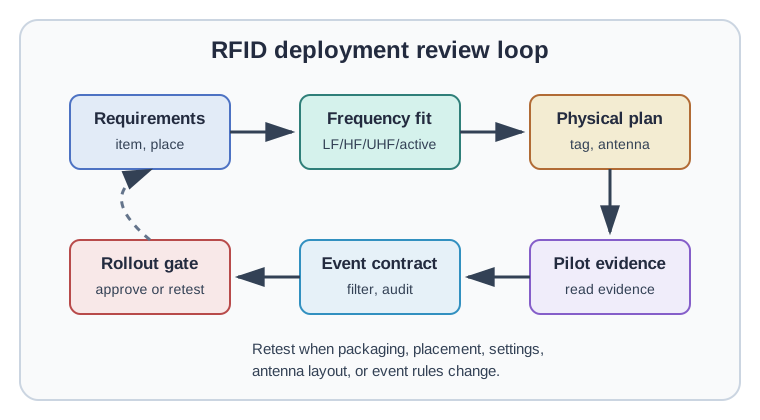
The loop in Figure 6.1 gives each deployment decision an input and a later test. Requirements state the item and place; frequency fit narrows the radio choice, while tag and antenna placement define the intended field. A site survey tests that field before a pilot records missed, duplicate, and cross reads. Middleware then turns raw observations into a named event contract, which the rollout gate can approve or send back for retest. Packaging, antenna layout, reader settings, or event rules can change the result. Preserve the requirement, setup, pilot trace, and event rule together so a changed design cannot inherit an old pass.
Read Figure 6.1 clockwise from requirements. Frequency and tag fit constrain the possible field behaviour; placement and site survey turn that choice into an installed zone; pilot traces then test intended reads, misses, duplicates, and cross reads. Middleware converts those observations into a named event contract before rollout is approved. The return path through retest triggers is essential: packaging, layout, power, antennas, software, or tag changes send the design back through the relevant evidence steps instead of inheriting an obsolete pass.
Use the loop this way:
- Requirements: Define what must be identified, where the item moves, how fast it moves, who acts on the read, and what happens when a read is missing.
- Frequency fit: Match the field behavior to the material and workflow constraints before choosing readers or tags.
- Physical design: Place the tag, antenna, cable, shield, and reader as one system. A good bench result does not prove the installed geometry.
- Pilot evidence: Measure intended reads, missed reads, duplicate reads, cross reads, and recovery behavior in the real workflow.
- Middleware contract: Decide how raw observations become business events. Deduplication, filtering, timing, and rejected events must be reviewable.
- Retest trigger: Reopen the evidence when item packaging, shelf layout, reader power, antennas, middleware rules, or tag model changes.
Taken together, those stages form one approval argument rather than a menu of independent checks. Requirements establish the promised event and failure response; the frequency and physical design create a candidate read zone; the pilot tests that zone with realistic target and boundary populations; and middleware proves that repeated radio observations become the intended application event. Rollout is justified only while that linked evidence remains current. A change at any stage must therefore return to the loop at the point where its assumptions entered, then carry new results forward to the release decision.
6.7 Deployment Is RF Engineering, Not Just Mounting
This section: Deployment Is RF Engineering, Not Just Mounting — A UHF RFID install succeeds or fails on three coupled choices: the antenna polarization, the shape of the read zone, and the event rule that decides when raw reads become an accepted workflow event.
A UHF RFID install succeeds or fails on three coupled choices: the antenna polarization, the shape of the read zone, and the event rule that decides when raw reads become an accepted workflow event. None of these are visible in a data sheet’s “read range” number, which is measured under controlled conditions with a tag orientation and environment that may not match the site.
Consider a dock-door portal. The tagged pallet is about 1.2 m long, the intended read zone is 2.4 m deep, and the forklift crosses at 1.2 m/s. The dwell time is therefore 2.4 m / 1.2 m/s = 2.0 s. If the pallet carries 48 tagged cases, the deployment question is not just “can one case tag read at 3 m?” It is whether the reader and middleware can inventory enough of those 48 tags during the 2.0 s window while rejecting tags in the neighboring lane. Figure 6.2 shows why that timing question cannot be separated from geometry, inventory behaviour, and event filtering.
Figure 6.2 moves from a physical read boundary to an application event.
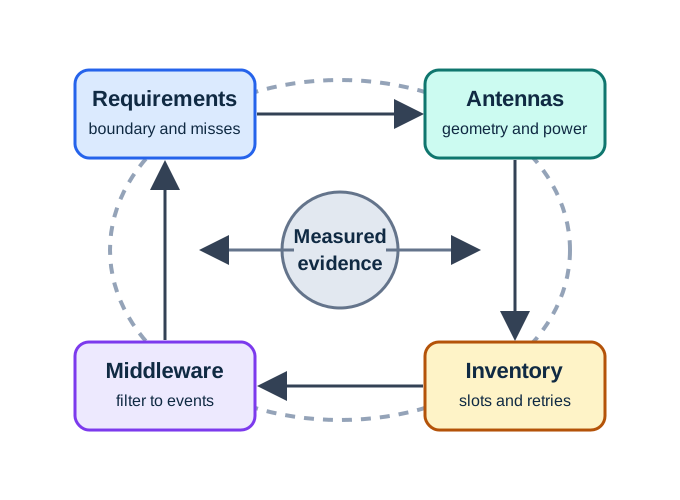
Requirements identify the intended item path and acceptable misses. Antenna geometry and power shape the field, while inventory slots and retries affect which tags the reader observes. Middleware then filters those observations into events for the application. A measured walk test must show target reads and neighboring exclusions under the installed conditions. If a tag is missed, inspect the physical path and reader settings before changing the event rule; if a neighboring tag appears, test isolation before filtering it away. Keep the raw read trace and resulting event side by side.
In Figure 6.2, begin with requirements and the no-read boundary, then follow the loop through antenna geometry and power. Inventory slots and retries determine how much evidence can be collected during the dwell window; middleware filtering then decides whether repeated observations support one accepted event. Measured evidence sits at the centre because every outer choice must be tested against the same target and boundary populations. This framing prevents two release mistakes: accepting every nearby tag, or trusting a bench read when installed timing permits too few useful inventory rounds.
When RF design, dwell time, and event rules align, tags read reliably as they pass. When one is wrong, the symptoms differ: intermittent reads from weak tag coupling, cross reads from an oversized field, duplicate events from middleware that treats every observation as a new action, or reader rows whose performance collapses when they all transmit together.
6.8 Frequency and Tag Fit
This section: Frequency and Tag Fit — Frequency selection is a fit decision, not a ranking.
Frequency selection is a fit decision, not a ranking. The useful question is: “Which field behavior supports this workflow with the fewest unresolved assumptions?”
Use LF when:
- Identification is close and deliberate.
- The installation must tolerate tissue, water, dirt, or rugged mounting better than it needs high throughput.
- The workflow can accept short read distance and lower data rate.
Use HF or NFC when:
- A deliberate tap or close pass is desirable.
- The system needs compatibility with NFC-capable phones or established HF card/tag workflows.
- Read precision matters more than bulk inventory speed.
Use passive UHF when:
- The workflow needs bulk reads, dock-door portals, handheld inventory, or item-level scanning across a larger read zone.
- The environment can be engineered for tag orientation, packaging, spacing, and antenna placement.
- The design can tolerate RF sensitivity to metal, liquid, multipath, and neighboring read zones.
Use semi-passive tags when:
- The tag must run a sensor or keep local state but still depends on a reader interaction for the workflow.
- Battery service is acceptable and is part of the maintenance plan.
Use active RFID when:
- The workflow needs beaconing, coarse location, or wider-area tracking that passive tags cannot support.
- Battery life, replacement process, device identity, and monitoring are managed as operational requirements.
6.9 Site Survey and Read-Zone Planning
This section: Site Survey and Read-Zone Planning — The site survey turns a conceptual RFID plan into installed evidence.
The site survey turns a conceptual RFID plan into installed evidence. Before walking the site, inspect the portal diagram Figure 6.3 in this order: antenna geometry, intended and excluded zones, item movement and dwell, reader settings, then the retained middleware evidence.
Figure 6.3 defines the intended portal zone and its neighboring no-read areas.
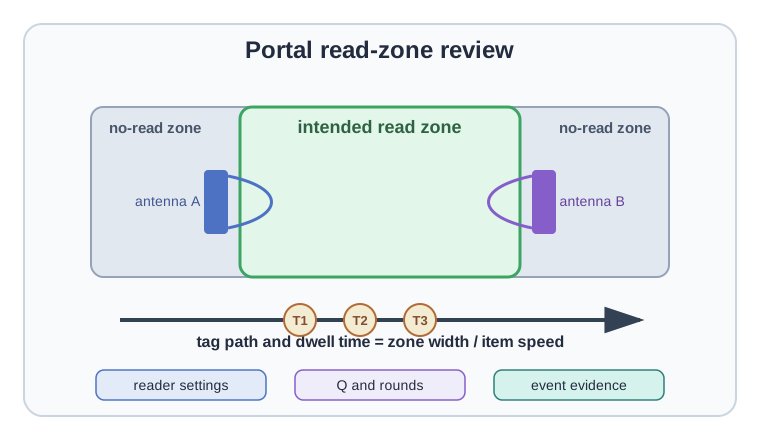
Two antennas face the doorway while tagged items pass along a known path. Height, angle, power, reader Q, and inventory rounds affect the time a tag spends in the useful field. The zone-width and item-speed relation gives a dwell-time estimate, but the actual passage test must measure target reads and stray observations. Walk several tagged items through the intended path and neighboring lanes at realistic speed. Preserve the raw reads, filtered event, and settings. A high target-read count is not enough if the portal also claims items that never crossed.
Read Figure 6.3 from the two antenna faces into the intended zone. Their height, aim, and polarization shape which tag orientations receive energy; the marked no-read areas test whether that field spills into neighbouring workflows. Next follow the movement arrow and dwell interval to the reader profile, because a correct zone still fails if too few inventory opportunities occur. Finally trace raw and filtered observations into the evidence record. The survey checklist below captures each of those dependencies so the installed test can be repeated.
A useful survey includes:
- Workflow path: Mark how tagged items enter, pause, rotate, stack, and leave the read area.
- Materials: Record nearby metal, liquid, dense products, shelving, carts, doors, people, and packaging that can detune or block tags.
- Tag placement: Test tag position, orientation, spacing, and attachment method on real items, not only on loose sample tags.
- Antenna geometry: Confirm height, angle, polarization, beam direction, cable route, and whether neighboring lanes or shelves are visible.
- Reader settings: Capture reader identity, antenna port map, transmit setting, region profile, inventory mode, session, and Q behavior.
- No-read zones: Verify that tags outside the intended lane, shelf, doorway, or workcell do not create accepted events.
- Evidence trace: Save raw reads, filtered reads, accepted events, rejected events, timestamps, item state, and test notes together.
After reviewing the planned geometry, inspect Figure 6.4 to see the physical constraints that the survey must record rather than assume.
The installed portal in Figure 6.4 shows the geometry that a read-zone test must record.

Reader antennas are mounted on the doorway frame, with cables routed toward nearby equipment. Antenna height, angle, beam direction, mounting, and cable condition can all change which moving tags are observed. The photograph gives a real installation form but no measured read rate or exclusion result. Record the mounted positions and reader settings, then walk target items and neighboring tags through the site. Compare the raw observations with the intended crossing event and repeat after a mount or cable change. This ties the physical installation to the business event that depends on it.
In Figure 6.4, locate the antenna panels on the doorway first, then follow the brackets and cable route toward the associated equipment. Door structure, mounting height, antenna angle, cable strain, and service access can all alter or disturb the approved field. The photograph therefore closes the survey narrative: translate the planned zone in Figure 6.3 into measured installation details, and treat any later physical change as a retest trigger.
Photo: Geirvevle, CC BY-SA 3.0.

6.10 Link Budget and Practical Read Distance
This section: Link Budget and Practical Read Distance — A link budget is a screening tool.
A link budget is a screening tool. It explains why a design might work, but it does not replace an installed pilot.
For a first-pass forward-link estimate:
P_tag = P_reader + G_reader + G_tag - FSPL - installation_losses
FSPL(dB) = 20 log10(4 pi d / lambda)
Where:
P_readeris the configured reader transmit power.G_readeris the antenna gain in the tag direction.G_tagis the tag antenna gain in the tested orientation.dis the read distance.lambdais the wavelength at the operating frequency.installation_lossesinclude cable loss, detuning, polarization mismatch, body or liquid absorption, multipath fading, and shielding.
For passive UHF systems, also remember that the reader must hear the tag backscatter. A forward-link estimate can look acceptable while the return path or anti-collision timing still fails in production.
6.11 Polarization, Link Margin, And Zone Shape
This section: Polarization, Link Margin, And Zone Shape — The first design pass should put numbers beside the physical choices.
The first design pass should put numbers beside the physical choices. Start with antenna polarization, because it trades range against orientation tolerance. Linear polarization can deliver stronger coupling when the tag orientation is known; circular polarization usually gives up some peak coupling to tolerate random tag angles. The right choice depends on how the object actually moves through the read zone.
| Antenna | Range | Tag orientation | Use when |
|---|---|---|---|
| Linear-polarized | Longer, with energy concentrated in one plane | Tag must be aligned to that plane | Tags pass in a known, fixed orientation, such as a conveyor |
| Circular-polarized | Shorter, often around 3 dB less peak coupling | More tolerant of tag angle | Tags arrive at random angles, such as a dock door or bin |
Then make a conservative link-budget screen. At 915 MHz, wavelength is about 0.328 m. At 3 m, free-space path loss is 20 log10(4 pi d / lambda), or about 41.2 dB. If the reader is configured at 30 dBm, the antenna contributes 6 dBi in the tag direction, the tag orientation contributes roughly -2 dBi, and installation effects cost 4 dB, the forward-link estimate at the tag is 30 + 6 - 2 - 41.2 - 4 = -11.2 dBm. Compare that value against the specific tag sensitivity; do not treat it as guaranteed distance. If the chosen tag threshold is -18 dBm, this example has about 6.8 dB of forward-link margin before real-site variation.
The second screen is dwell time. With the 2.0 s portal example and an observed inventory round time of 250 ms, the portal has about 2.0 / 0.25 = 8 rounds while the pallet is inside the zone. If the pilot log shows most expected tags appear in the first three rounds but the same two case positions are missed until round seven, the fix may be tag placement or antenna angle, not a middleware change. If the log shows all expected tags quickly but the application creates repeated arrivals, the fix is deduplication and idempotency.
The third screen is the read zone: the 3D volume where a tag both harvests enough power to wake and returns a signal the reader can hear. Shape it with antenna gain and pattern, transmit setting, mounting angle, shielding, and physical workflow. The target is not the largest possible zone; it is the smallest zone that covers the intended path with margin. Bounding the zone is as important as filling it.
Use link budgets conservatively:
- Compare configurations instead of treating the result as a guaranteed read distance.
- Keep margins visible. A design that barely clears the tag threshold in calculation has little room for orientation or material variation.
- Replace generic loss assumptions with measurements from the pilot site.
- Recalculate when antenna placement, tag model, item material, reader settings, or cable length changes.
6.12 Dense-Tag Portals and Anti-Collision
This section: Dense-Tag Portals and Anti-Collision — Warehouse, laboratory, and retail portals fail when the read zone is physically correct but the tags do not remain in the field long enough to complete inventory rounds.
Warehouse, laboratory, and retail portals fail when the read zone is physically correct but the tags do not remain in the field long enough to complete inventory rounds.
Review three numbers together:
dwell_time = read_zone_width / item_speed
slot_count = 2^Q
inventory_rounds_available = dwell_time / observed_round_time
Then tune the system:
- Estimate the number of tags that may be in the field at once.
- Start Q near
ceil(log2(expected_tags)), then verify with reader logs and measured read completeness. - Use multiple antenna angles when tag orientation changes during motion.
- Narrow the read zone or reduce transmit setting when cross reads are accepted from neighboring lanes.
- Slow the workflow, widen the intended zone, or add antenna coverage when the item leaves before enough inventory rounds complete.
- Keep the middleware dedupe window separate from the reader inventory behavior. Hiding duplicates is not the same as reading all expected tags.
6.13 Dense-Reader Planning
This section: Dense-Reader Planning — When several readers run near each other, the core problem is a power mismatch: a reader transmits watts of carrier, while a tag answers with a faint backscattered reflection.
When several readers run near each other, the core problem is a power mismatch: a reader transmits watts of carrier, while a tag answers with a faint backscattered reflection. One reader’s transmission can drown a neighbor’s tag replies, which is reader-to-reader interference. EPC Gen2 addresses this with dense-reader mode and spectral planning: readers transmit on assigned channels while tags backscatter using a Miller-modulated subcarrier that shifts tag responses into gaps between reader channels.
Dense portals also have a tag-population problem. If a pallet has 48 case tags, the starting Q value should be near ceil(log2(48)) = 6, giving 2^6 = 64 slots. Starting at Q=4 gives only 16 slots, or 48 / 16 = 3 tags per slot on average, so the log should show many collisions. Starting much larger than needed wastes time in empty slots. The deployment record should preserve singleton, collision, and empty-slot counts because they explain whether a missed read is a physical coverage issue, an anti-collision tuning issue, or a dwell-time issue.
Regulations add the other half. In the US UHF band, readers frequency-hop across permitted channels; in European deployments, fewer UHF channels and listen-before-talk behavior are part of channel access planning. The operational lesson is the same without relying on one regulatory clause number: dense deployments are planned in frequency and time, not only in space. Antenna spacing helps, but it is incomplete unless reader profiles, channel behavior, transmit timing, and no-read zones are validated together.
| Observed pilot symptom | Likely mechanism | Evidence to collect before changing design |
|---|---|---|
| One portal works alone, several collapse together | Reader-to-reader interference | Reader channel and timing log, dense-reader profile, and trace with readers enabled one at a time and together |
| Many collision slots with expected tags still missing | Frame too small or tag population too dense for dwell time | Q history, singleton/collision/empty counts, expected tag count, and pallet dwell time |
| Accepted events from a neighboring lane | Oversized read zone or missing zone ownership rule | No-read-zone trace, antenna aim record, transmit setting, and middleware rejection evidence |
This is why “turn up the power” is rarely a complete deployment fix. More power may improve a weak tag at the center of the lane, but it can also enlarge the zone, increase stray reads, and worsen the carrier environment for neighboring readers. A defensible pilot changes one variable at a time, reruns the same tag population and movement path, and records whether the improvement came from RF coverage, anti-collision tuning, channel planning, or middleware filtering.
6.14 Deployment Failure Patterns
This section: Deployment Failure Patterns — Assuming every pass will be complete: RFID reads are probabilistic in real environments.
Assuming every pass will be complete: RFID reads are probabilistic in real environments. Design reconciliation, retry, and exception handling before rollout.
Selecting frequency by distance alone: UHF can be the right choice for bulk inventory, but metal, liquid, orientation, and neighboring lanes can dominate the design. HF or LF may be better when proximity and material tolerance matter more than bulk speed.
Treating middleware as a pass-through: Readers can report repeated observations, stale observations, and cross reads. Middleware must deduplicate, reject, timestamp, map, and audit events without hiding the raw evidence needed for debugging.
Leaving tag placement flexible: A tag moved a few centimeters can change coupling, polarization, and shielding. The approved placement should be part of the deployment specification.
Maximizing reader power by default: More power can enlarge unwanted read zones. Tune power with antenna direction, shielding, and no-read tests.
Skipping retest after physical changes: New packaging, shelf material, cart geometry, reader firmware, antenna cable length, or middleware rules can invalidate the original pilot evidence.
6.15 Knowledge Check
This section: Knowledge Check
6.16 Quick Check: Dense-Reader Interference
This section: Quick Check: Dense-Reader Interference
6.17 Pilot Acceptance Record
This section: Pilot Acceptance Record — Write the acceptance record so another engineer can reproduce the approved design.
Write the acceptance record so another engineer can reproduce the approved design.
Include:
- Use case and acceptance criteria.
- Tag model or tag family, placement drawing, and item material notes.
- Reader model, antenna port map, antenna position, cable length class, and reader settings.
- Intended read zones and no-read zones.
- Test item count, tag density, motion path, speed, and dwell time.
- Raw read trace, filtered event trace, rejected event trace, and application action trace.
- Missed-read, duplicate-read, cross-read, offline, restart, and fallback tests.
- Middleware dedupe window, business event mapping, timestamp source, and audit fields.
- Retest triggers and owner.
The record should distinguish “the reader observed a tag” from “the application accepted an event.” Deployment bugs often happen when those two statements are treated as the same thing.
6.18 Matching Review
This section: Matching Review
6.19 Deployment Sequence Review
This section: Deployment Sequence Review
6.20 Summary
This section: Summary — RFID design is a systems problem.
RFID design is a systems problem. The frequency choice matters, but so do item material, tag placement, antenna geometry, dwell time, reader settings, middleware filtering, and acceptance evidence. A reliable deployment defines where reads should happen, proves where reads should not happen, and keeps enough raw and filtered evidence to debug changes after rollout.
Key takeaways:
- Select frequency and tag type from workflow constraints, not from headline distance.
- Treat a site survey as installed evidence for both read zones and no-read zones.
- Use link budgets to compare designs, then replace assumptions with pilot measurements.
- For dense-tag portals, review dwell time, Q behavior, antenna angles, and workflow speed together.
- Make middleware and application acceptance explicit so raw observations do not become unreviewed actions.
6.21 See Also
This section: See Also
- RFID Frequency Bands for detailed frequency trade-offs.
- RFID Tag Types for passive, semi-passive, and active tag selection.
- RFID Standards and Protocols for anti-collision and protocol behavior.
- RFID Hardware Integration for reader interfaces, mounting, power, and event evidence.
- Wireless Channel Characteristics for multipath, fading, and path loss concepts.
- Link Budget Analysis for RF propagation models.
6.22 What’s Next
This section: What’s Next
- RFID Comprehensive Review - End-to-end design validation and scenario review.
- RFID Security and Privacy - Authentication, anti-cloning, and privacy controls for RFID systems.
- RFID Hands-on and Applications - Pilot implementation and application labs.
- NFC Fundamentals - Smartphone-based HF RFID concepts for tap workflows.
Find help
3 reviewed answers.
Where should I start in a module?
Open the module page from the sidebar to see its chapters in order. Use the module map to return to a topic you need.
Modules and pathsReviewed
What can I try when a project does not work?
Check the symptom, then work through the diagnostic steps. Keep the error message and the smallest example that reproduces it.
When you are stuckReviewed
How do interactive examples work?
Use the interactive guide to check how examples and simulations work before changing your project.
Interactive examples guideReviewed