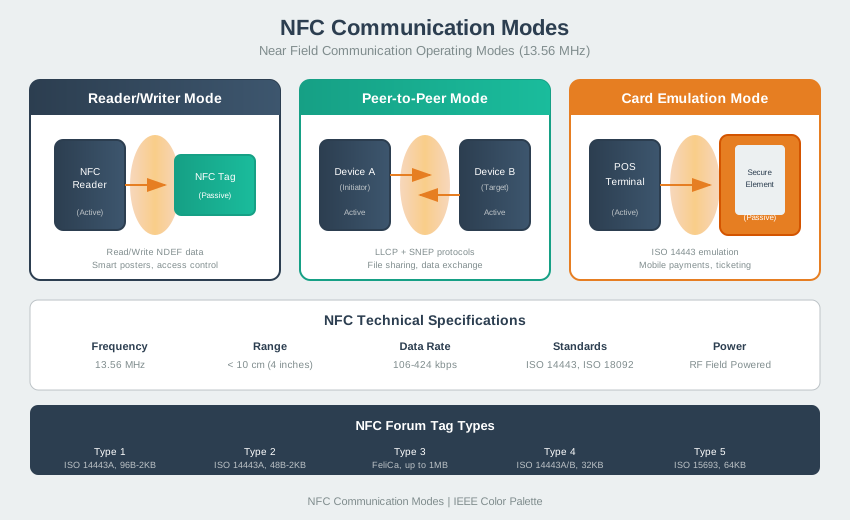
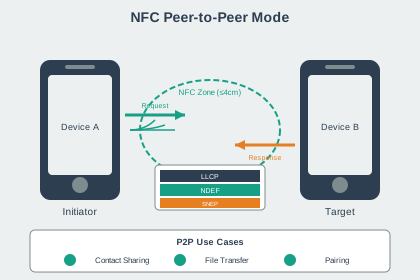
What they got wrong: A retailer promoted contactless credit cards as “just as secure as Apple Pay” because both use NFC and tokenization. They encouraged customers to use either method interchangeably, claiming identical security.
Why physical NFC cards are less secure than mobile wallets:
Physical NFC contactless card:
- ✅ Tokenization: YES (token, not PAN transmitted)
- ✅ Dynamic cryptogram: YES (EMV cryptogram per transaction)
- ❌ Authentication: NO (anyone holding card can tap)
- ❌ Biometric: NO
- ❌ Stolen card protection: None (works until reported stolen)
- ❌ Transaction limits: Often capped at $50-100 without PIN
Mobile wallet (Apple Pay/Google Pay):
- ✅ Tokenization: YES (device-specific token)
- ✅ Dynamic cryptogram: YES
- ✅ Biometric authentication: YES (Face ID / Touch ID required)
- ✅ Device lock: YES (phone must be unlocked)
- ✅ Stolen device protection: Remote wipe capability
- ✅ Transaction limits: None (biometric authorizes any amount)
Real-world fraud comparison:
| Card/phone stolen |
100% until reported (no auth) |
0.001% (biometric bypass near-impossible) |
| Lost in public |
Anyone can use for small purchases (<$50) |
Locked, requires Face ID/Touch ID |
| Skimming attempt |
Card transmits token when tapped by any reader (including rogue) |
Phone requires intentional unlock + authentication |
| Relay attack |
Possible (card always responsive) |
Harder (phone must be unlocked first) |
The mistake in practice:
Customer A (uses physical NFC card):
- Loses wallet in coffee shop
- Thief immediately makes 8 purchases under $50 each = $400 fraud
- Customer reports card stolen 3 hours later
- Bank reverses charges, but inconvenience + card replacement delay
Customer B (uses Apple Pay):
- Loses phone in coffee shop
- Thief cannot unlock phone (Face ID requires owner’s face)
- Customer uses “Find My iPhone” to remotely lock + wipe device
- $0 fraud (Apple Pay unusable on locked device)
Why the claim “just as secure” is misleading:
Technically, the transmission security (tokenization + cryptogram) is identical. But overall system security includes:
Possession factor: Card = anyone possesses it can use it. Mobile = possession + biometric required.
Transaction limits: Cards often have “no-PIN” limits ($50-250 depending on region). Mobile wallets have no limit because biometric is required for all transactions.
Lost/stolen protection: Cards rely on user reporting theft quickly. Phones have remote kill switches and biometric locks that activate immediately.
Statistics (Visa 2023 fraud report):
Physical contactless card fraud rate: 3.1 basis points (bp) - $31 fraud per $1,000,000 in transactions
Mobile wallet fraud rate: 0.5 basis points (bp) - $5 fraud per $1,000,000 in transactions
Mobile wallets are 6.2× more secure than physical contactless cards, despite using the same NFC transmission technology.
Correct messaging:
“Both NFC contactless cards and mobile wallets use tokenization and dynamic cryptograms for transmission security. However, mobile wallets add biometric authentication and device locking, making them 6× more secure overall against lost/stolen fraud—the most common attack vector.”
Lesson: Transmission security (tokenization, cryptograms) is only ONE layer. Authentication (biometric) and device security (remote lock/wipe) are equally important. Mobile wallets combine all three layers; physical cards lack the latter two. They are NOT equally secure in practice, even if technically similar in how they transmit data.