5 RFID Standards and Protocols
More
Depth: Practitioner
Progress saves as you read. Mark sections complete as you go; your progress appears in the sidebar.
5.1 Start With the Story
This section: Start With the Story — Picture a warehouse tag that one reader sees but another cannot decode.
Choose the Standard at the Boundary That Must Work
Picture a warehouse tag that one reader sees but another cannot decode. Both boxes say they support tags, yet the air link, reader control, and event record may follow different contracts.
Near field communication, or NFC, is a short-range radio method for nearby exchanges. Radio frequency means the rate of a radio wave. Radio frequency identification, or RFID, uses radio to identify a tag. Standards divide that work into layers that must not be confused.
Read one known tag with two approved readers. Record tag family, band, air contract, reader settings, identifier, event fields, filters, time, and result. Swap one reader and reject any event whose meaning changes.
This runway does not make one standards family fit every workflow. The deeper sections separate air interfaces, reader control, identifiers, business events, pilots, and retest evidence.
A working RFID system has several contracts at once. The tag and reader need an air-interface contract, the reader and software need a control contract, and the application needs event data that still means the same thing after filtering.
This chapter separates those contracts so design reviews do not mix them together. Start with the boundary that must interoperate, then choose the standard evidence that proves the right layer is doing the right job.
5.2 In 60 Seconds
This section: In 60 Seconds — RFID standards are easier to use when you keep the layers separate.
RFID standards are easier to use when you keep the layers separate. ISO 14443, ISO 15693, ISO/IEC 18000, EPC Gen2, and NFC Forum specifications describe tag-to-reader behavior. LLRP describes a reader-control interface. EPC, EPCIS, and CBV describe identifiers and business events. Start with the workflow, choose the standard family that fits the read pattern, pilot it with real tags and materials, and record the settings and retest triggers.
5.3 Learning Objectives
This section: Learning Objectives
By the end of this chapter, you will be able to:
- Separate air-interface standards from reader-control protocols and event-data standards.
- Choose between ISO 14443, ISO 15693, EPC Gen2, NFC Forum, and active RFID families based on workflow evidence.
- Explain why EPC Gen2 anti-collision needs a tuned inventory round instead of only higher reader power.
- Describe how EPC identifiers become useful business events through middleware, EPCIS, and common vocabularies.
- Review a proposed RFID standards choice for interoperability, operations, privacy, and retest risk.
5.4 Quick Check: RFID Standards
This section: Quick Check: RFID Standards
5.5 Why Standards Matter
This section: Why Standards Matter — Standards reduce those risks, but they do not all solve the same problem.
An RFID project usually fails at one of three boundaries:
- The tag and reader cannot communicate reliably.
- The reader cannot be managed consistently across sites or vendors.
- The raw tag reads do not become shared, auditable business events.
Standards reduce those risks, but they do not all solve the same problem. ISO 14443, ISO 15693, ISO/IEC 18000, EPC Gen2, and NFC Forum specifications describe how devices communicate over the air. LLRP describes a network interface for controlling compatible readers. EPC, EPCIS, and the GS1 Core Business Vocabulary describe how identifiers and read events are represented for supply-chain visibility.
Figure 5.1 separates radio, NFC data, reader control, and shared event duties.
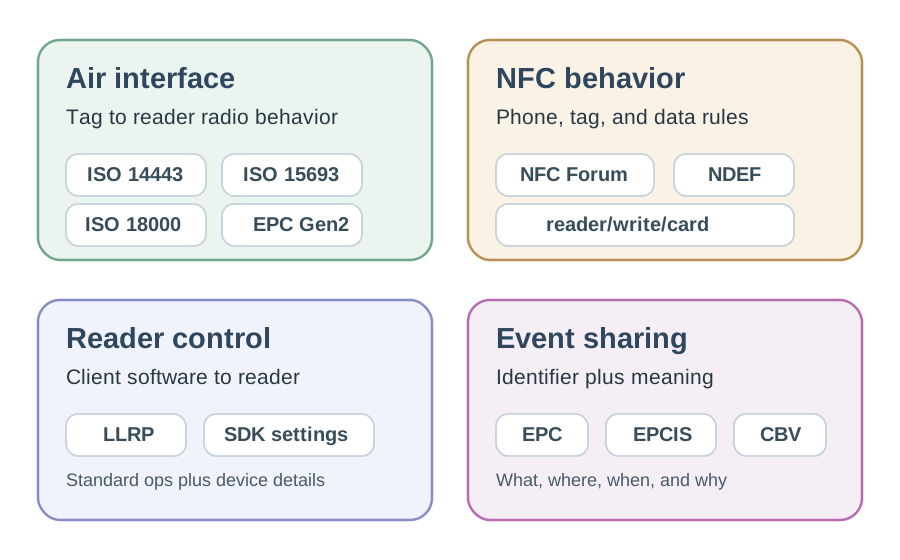
The map in Figure 5.1 separates four interfaces that are often called simply RFID. ISO and EPC air-interface rules govern tag-to-reader radio behavior. NFC Forum modes and NDEF describe phone, tag, and data exchanges. LLRP or an SDK controls reader operations and device settings. EPCIS with CBV shares events with business meaning: what moved, where, when, and why. A tag ID read at the air interface does not yet supply that event context. When choosing a standard, name which boundary the design must cross and preserve the lower-layer evidence that supports the higher-layer event.
5.6 Standards By Responsibility
This section: Standards By Responsibility
5.7 Selection Workflow: Air-Interface Standards
This section: Selection Workflow: Air-Interface Standards — Air-interface standards define how the reader and tag communicate: frequency family, modulation, command sequence, timing, and anti-collision behavior.
Air-interface standards define how the reader and tag communicate: frequency family, modulation, command sequence, timing, and anti-collision behavior.
- ISO 14443: HF proximity cards and devices at 13.56 MHz. Use it when intentional close-range interaction matters, such as tap access, identity cards, and contactless card workflows.
- ISO 15693: HF vicinity cards at 13.56 MHz. Use it when the item can be read farther than a tap but still benefits from HF behavior, such as library, document, and item-level asset workflows.
- ISO/IEC 18000 family: RFID air interfaces across frequency families for item management. The UHF branch is the relevant family for many passive supply-chain and inventory systems.
- EPC Gen2 / ISO 18000-63: The common UHF passive item-identification air interface used in many supply-chain RFID deployments. Older material may describe this lineage as ISO 18000-6C; current procurement and compliance language should be checked against the exact specification and region.
5.8 NFC Forum Specifications
This section: NFC Forum Specifications — NFC builds on HF proximity technology and defines predictable behavior for phones, tags, and readers.
NFC builds on HF proximity technology and defines predictable behavior for phones, tags, and readers. In practice, NFC decisions often combine two questions:
- Which RF technology does the tag use, such as NFC-A, NFC-B, NFC-F, or NFC-V?
- Which data behavior is required, such as NDEF records, reader/writer mode, card emulation, or peer interaction?
Do not treat every 13.56 MHz tag as an NFC tag. A phone-compatible workflow needs both compatible RF behavior and the right NFC data format.
5.9 Reader-Control Protocols
This section: Reader-Control Protocols — Reader-control protocols sit above the air interface.
Reader-control protocols sit above the air interface. LLRP is used to control compatible RFID readers from client software. It can standardize inventory operations, reporting, and reader-client communication, but it does not erase every vendor-specific configuration detail.
In a review, ask which layer the team is standardizing:
- Air interface between tag and reader.
- Reader control between middleware and reader.
- Event schema between business systems.
- Operational process for commissioning, monitoring, and retesting.
5.10 Event-Data Standards
This section: Event-Data Standards — The Electronic Product Code gives physical things a structured identifier.
The Electronic Product Code gives physical things a structured identifier. EPCIS and the Core Business Vocabulary help turn observations into shareable events such as what was observed, where it was observed, when it happened, and why it matters to the business process.
This distinction is important. Reading a tag is not the same as proving that a shipment was received, a medicine was dispensed, or an asset changed custody. The event layer needs business context and reviewable evidence.
5.11 EPC Gen2 Dominates UHF Supply-Chain RFID
This section: EPC Gen2 Dominates UHF Supply-Chain RFID — The other standards fill in the interaction patterns Gen2 does not cover.
When people say “RFID” in supply-chain and retail contexts, they often mean EPC Gen2: the EPCglobal UHF Class-1 Generation-2 air interface, standardized internationally as ISO/IEC 18000-63 and operating in the UHF 860-960 MHz band. It defines radio behavior between reader and tag plus the tag data conventions that let a Gen2 reader from one vendor inventory Gen2 tags from another.
The other standards fill in the interaction patterns Gen2 does not cover. ISO/IEC 14443 supports proximity behavior at 13.56 MHz HF, ISO/IEC 15693 supports vicinity behavior at 13.56 MHz HF, and ISO 11784/11785 covers LF animal identification at 134.2 kHz. Picking a standard is really picking a band, range class, interaction pattern, and evidence model together.
The important design habit is to keep the standards family tied to the interaction that must be proven. A medicine cabinet badge tap is not the same problem as a dock-door carton portal. In the cabinet case, the review evidence may say: staff presents a badge within a few centimeters, the cabinet logs one deliberate access event, and a missed read sends the nurse to a manual identity check. That points toward ISO 14443 or NFC-style proximity behavior because short range is part of the control.
In the dock-door case, the evidence may say: a pallet spends 1.6 seconds in a 2.4 m read zone, cartons can be stacked, and the system must identify many passive labels without line of sight. That points toward EPC Gen2 UHF because bulk inventory and anti-collision are the central mechanisms. If a pilot reads 47 of 50 tagged cartons on dry cardboard but only 39 of 50 when foil packaging is added, the standards decision is not “Gen2 failed.” It is that Gen2 remains only a candidate until tag placement, antenna geometry, shielding, or exception handling closes the evidence gap.
Standards make interoperability possible; they do not remove the need to test the actual workflow. A reviewable standards packet records the object class, range expectation, material exposure, tag family, reader-control method, event-data owner, privacy exposure, and retest trigger.
5.12 Choosing A Standards Family
This section: Choosing A Standards Family — Start with the workflow, not with the technology name.
Start with the workflow, not with the technology name.
Figure 5.2 starts standard choice with the object and interaction.
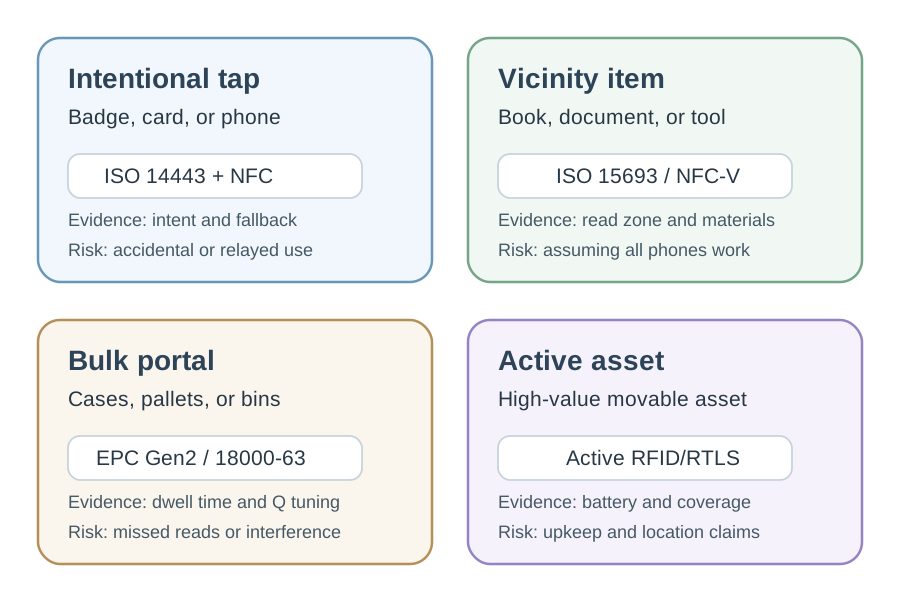
A deliberate phone or card tap suggests a close HF workflow, while a portal or bulk inventory needs a different zone and tag motion test. The route then checks environment, candidate family, pilot result, and the final record. ISO air-interface or EPC family names describe parts of the technology, but the installed object, read pattern, and application event determine whether a candidate fits. Pilot the chosen tag and reader on the real material, including misses and neighboring reads. Record the scope, owner, and retest trigger before a standard choice becomes a deployment claim.
Use this sequence during design review:
- State the object being identified: person token, consumable, case, pallet, reusable asset, tool, document, animal, vehicle, or container.
- State the interaction pattern: deliberate tap, short vicinity read, portal pass, handheld inventory sweep, gate crossing, or periodic active beacon.
- Check the environment: metal, liquids, body proximity, stacked items, speed through the read zone, neighboring readers, privacy exposure, and expected exceptions.
- Select the candidate standards family.
- Pilot with representative tags, readers, mounting positions, and process events.
- Record the standard, regional settings, reader-control method, data schema, and retest trigger.
5.13 Selection Workflow: Common Patterns
This section: Selection Workflow: Common Patterns
- Use ISO 14443 and NFC Forum behavior when the user must intentionally present a card, phone, or tag at close range.
- Use ISO 15693 or NFC-V behavior when HF vicinity reads are useful and phone or specialized-reader support is part of the workflow.
- Use EPC Gen2 UHF when many passive items must be identified without line of sight and the environment supports reliable UHF reads.
- Use active RFID or RTLS-specific systems when the asset must announce itself over a larger area or when battery-powered location behavior is required.
5.14 Folded Standards Selection Record
This section: Folded Standards Selection Record — Inspect the story panels and ask which standard owns each boundary between the tagged object and the business event.
Inspect the story panels and ask which standard owns each boundary between the tagged object and the business event.
-

Start with the object, event, and what a read must prove.
-

Link the air path, tag, reader, and event record without merging their jobs.
-

Pilot real objects and save false reads, missed reads, and the retest rule.
Read the panels from the object and proof question into the separate air-interface, tag, reader-control, and event-record contracts. Keeping an owner on each boundary prevents one compatibility claim from standing in for the whole system. The pilot then moves representative mounted objects through real paths and records successful, false, duplicate, and missed reads. Its retest trigger makes later material, reader, tag, or workflow changes reopen the evidence instead of inheriting an outdated standards decision.
A standards decision should link the air interface to the workflow, data model, and pilot evidence:
| Review field | What to write down |
|---|---|
| Object and event | Person token, animal, document, tool, case, pallet, vehicle, or container, plus what a read should prove. |
| Frequency and coupling | LF/HF inductive coupling, UHF radiative backscatter, active beaconing, or NFC tap behavior. |
| Standards family | ISO 11784/11785, ISO/IEC 14443, ISO/IEC 15693, ISO/IEC 18000 family, EPC Gen2, NFC Forum, or event-data standards such as EPCIS. |
| Reader and tag construction | Reader placement, antenna geometry, tag package, on-metal behavior, durability, and regional settings. |
| Backend event handling | Duplicate filtering, missed-read exceptions, wrong-read handling, event schema, and business-system ownership. |
| Pilot evidence | Representative objects, mounting, motion path, read rate, false reads, duplicate reads, and retest trigger. |
Do not collapse all of this into “RFID standard selected.” The radio standard, reader-control protocol, and event-data standard solve different problems and usually have different owners.
5.15 EPC Gen2 Anti-Collision
This section: EPC Gen2 Anti-Collision — Bulk UHF RFID works because the reader manages an inventory round.
Bulk UHF RFID works because the reader manages an inventory round. When many passive tags are energized at the same time, they cannot all answer at once. EPC Gen2 uses a slotted process where the reader announces a Q value, tags choose slots, and collided tags retry in later rounds.
Figure 5.3 shows how Q and random slots affect an EPC Gen2 inventory.
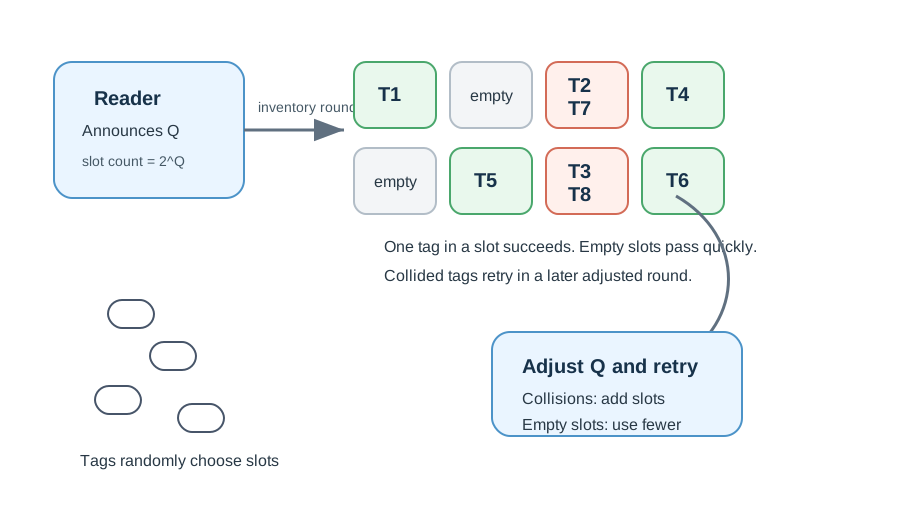
The reader opens a frame from Q, and tags choose slots randomly. A singleton can yield one tag reply, a collision needs another opportunity, and an empty slot carries no tag. The reader may adjust Q after observing the slot mix, which changes how quickly a crowded read zone is inventoried. Keep Q, slot outcomes, and the repeated-round trace with the tag count and placement. A tag not seen in one frame may still be present; a release test should show whether the complete inventory process meets the application’s miss and dwell limits.
The practical review question is not “what is the maximum read rate?” It is:
- How many tags are expected in the field at the same time?
- How long does the object stay inside the useful read zone?
- How many antennas are switching during the inventory cycle?
- How much tag orientation and material variation exists?
- Does the reader adjust Q automatically, or is a fixed setting being forced?
- What read evidence proves the process works on the real package mix?
5.16 Q Value As A Planning Heuristic
This section: Q Value As A Planning Heuristic — The slot count is 2^Q.
The slot count is 2^Q. A useful starting estimate is:
That estimate is only a starting point. A larger Q reduces collisions but lengthens a round. A smaller Q shortens a round but increases collisions. The best setting depends on dwell time, tag count, antenna sequence, reader firmware, and the materials in the read zone.
Use these review statements instead of brittle promises:
- “The reader configuration was piloted with the real tag population and dwell time.”
- “The system records missed-read exceptions and retests after package, antenna, or reader changes.”
- “Dense reader behavior was reviewed when neighboring readers could interfere.”
- “The event layer does not assume that a single read is proof of business custody.”
5.17 The Select, Query, And ACK Handshake
This section: The Select, Query, And ACK Handshake — A Gen2 reader does not just scan.
A Gen2 reader does not just scan. It runs a defined command sequence to single out one tag at a time from a crowd:
- Select narrows the population to tags matching a filter, such as a company prefix, so the reader does not inventory the whole warehouse.
- Query opens an inventory round and sets a slot count from the parameter Q; each tag picks a random slot in
0..2^Q-1. - When a tag’s slot counter reaches zero, it backscatters a 16-bit random number called RN16.
- The reader echoes that RN16 in an ACK; only the tag that sent it replies with its PC bits and EPC. Echoing the RN16 is how the reader proves it is talking to that one tag.
- For reading or writing memory, Req_RN returns a handle used by the Read, Write, Lock, and Kill access commands.
This is the anti-collision mechanism: random slotting plus the RN16 handshake lets many tags share the channel and be read one by one. Getting Q close to the population size is what separates a fast inventory from a stalled one.
RFID EPC inventory narrated tour
Play silently with captions on provisional storyboard timing; narration audio is pending. Production pacing is not protocol time. Choose Reduced motion for a complete still at each beat.
Play the tour to open the workbench. Pause, replay a beat, or read the full transcript below. Some situations cannot be shown by this teaching model; those beats keep the existing frame and provide captions only.
The workbench uses an illustrative 12-tag frame, then a separate 7-tag frame. The chapter’s 48-tag calculations and Q=9 comparison are caption-only. Slot outcomes are random; an ACK is shown only after a real successful reply. If preparation finds no success, the tour holds RN16 with the explanation in captions.
Full transcript — RFID EPC inventory (8 beats)
B1 — Dock-door inventory
You are the engineer setting up a radio frequency identification reader, or RFID reader, at a warehouse dock door. A tagged pallet is moving through the reading area. Your job is to identify its items before they leave; wasted time can mean missed reads.
Model caption: You configure a radio frequency identification reader at a warehouse dock door. A moving pallet gives limited time to identify its tags; wasted time can mean missed reads.
B2 — Query and slot choice
The electronic product code, or EPC, is an item's structured identifier. To collect those identifiers, the reader opens an inventory round with a Query command. It announces a parameter called Q, which sets how many time slots are available. Tags choose slots randomly, spreading their replies across the round.
Model caption: Illustrative asset population: 12 tags, Q=4, 16 slots.
B3 — RN16 reply
The slot count is two raised to the power of Q. Each tag chooses a counter from zero through the slot count minus one. When that counter reaches zero, the tag replies with a sixteen bit random number, known as R N sixteen.
Model caption: Slots = 2^Q; counters range from 0 to 2^Q − 1. At counter zero, a tag replies with a sixteen-bit random number, RN16. More than one eligible tag can collide.
B4 — Conditional ACK
If the reader decodes a single reply, it echoes that random number in an acknowledgement, called an ACK. The selected tag then returns its EPC. A command called QueryRep advances to the next slot, and the remaining active tags decrease their counters. Random slot choice and acknowledgement let tags be read individually.
Model caption: ACK means acknowledgement. The reader echoes a decoded single tag's RN16; that selected tag returns its EPC. QueryRep advances to the next slot and remaining tags decrease their counters.
B5 — 48-tag estimate
For your dock door, take the chapter's example of forty-eight tags. The starting estimate rounds the base two logarithm of the tag count upward. That gives Q equal to six. Two raised to the power of six gives sixty-four slots, providing room for the forty-eight tags to spread out.
Model caption: Chapter example: 48 tags. Starting estimate Q = ceil(log₂(48)) = 6. Frame size = 2^6 = 64 slots. This gives tags room to spread out.
B6 — Frame size comparison
Compare two other settings for the same population. Q equal to four gives sixteen slots, so many of the forty-eight tags choose the same slots and collide. Q equal to nine gives five hundred twelve slots, so the reader can spend time advancing through mostly empty slots.
Model caption: Same 48 tags: Q=4 gives 16 slots and many collisions. Q=9 gives 512 slots and mostly empty slots.
B7 — Empty slot tradeoff
The misconception is that increasing Q always makes inventory faster. A larger Q reduces collisions, but it also lengthens the round. Empty slots use time without returning a tag identifier. For your moving pallet, both an overcrowded frame and an oversized frame can mean missed reads.
Model caption: Separate illustration: 7 tags, 64 slots.
B8 — Inventory takeaway
Give tags room to take turns, without making the reader spend the round waiting through empty turns.
Model caption: Give tags room to take turns, without making the reader spend the round waiting through empty turns.
Use the Q value as a planning estimate before the pilot. If a dock-door reader expects about 48 tags in the field, ceil(log2(48)) = 6, so Q = 6 gives 2^6 = 64 slots. That is a plausible starting point because it gives the population room to spread out. If the reader starts at Q = 4, there are only 2^4 = 16 slots, so many of the 48 tags will choose the same slots and collide. If it starts at Q = 9, there are 512 slots, so the round can waste time stepping through mostly empty slots. Both extremes can lose reads when the pallet is moving.
Now add dwell time. A pallet moving through a 2.4 m useful read zone at 1.2 m/s is available for 2.4 / 1.2 = 2.0 seconds. If the reader cycles four antennas evenly, each antenna has roughly 2.0 / 4 = 0.5 seconds of dwell time before the package geometry changes. That does not produce a universal maximum tag count because real timing depends on modulation settings, tag sensitivity, reader firmware, collisions, retries, and materials. It does give the design review a concrete question: did the pilot prove that the selected Q behavior, antenna sequence, and filter rules complete enough inventory rounds inside the actual dwell time?
5.18 From Identifier To Business Event
This section: From Identifier To Business Event — A standards-compliant read is still just an observation.
A standards-compliant read is still just an observation. The system becomes useful when the observation is filtered, associated with business context, and shared in a form that other systems can interpret.
Inspect Figure 5.4 and ask where a tag identifier acquires the context needed to become a business event.
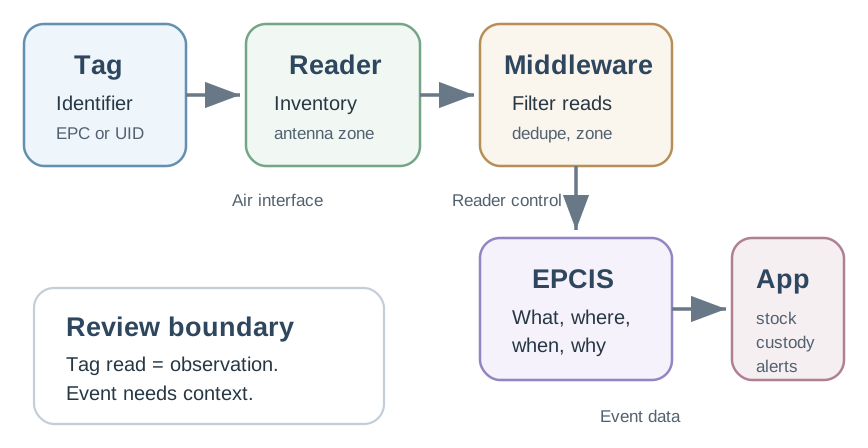
Follow Figure 5.4 from the EPC or UID to the final event. The tag ID crosses the air link to the reader. A filter then turns raw reads into a useful event. The ID says which tag replied. Reader, antenna, time, zone, and filter fields state where and how it was seen. An EPCIS-style event adds terms for stock, custody, or trace work. Keep these layers apart. A raw read alone does not prove a handoff of custody, and the split shows which standard or part owns a disputed result.
Review each layer separately:
- Tag memory and identifier: Is the identifier encoded consistently? Who owns the numbering scheme? How are duplicates prevented?
- Air-interface behavior: Which standard family is used? Which regional settings, channels, power constraints, and tag classes apply?
- Reader control: How are readers configured, monitored, and updated? Which settings are standardized and which remain vendor-specific?
- Read filtering: How are duplicate reads, ghost reads, missed reads, and antenna zones handled?
- Event representation: What business step, location, disposition, and timestamp are recorded?
- Sharing boundary: Which partners or systems can query events, and what privacy or access rules apply?
5.19 Gen2 Memory Banks Are Separate Evidence Fields
This section: Gen2 Memory Banks Are Separate Evidence Fields — Reading a Gen2 tag well means knowing where its data lives.
Reading a Gen2 tag well means knowing where its data lives. The standard defines four memory banks that are addressed independently:
| Bank | Name | Contents |
|---|---|---|
00 | Reserved | 32-bit kill password and 32-bit access password. |
01 | EPC | CRC-16, Protocol-Control bits, and the EPC identifier itself. |
10 | TID | Tag identifier: chip maker and model; many tags add a permanent unique serial. |
11 | User | Optional application data, not present on the cheapest tags. |
Figure 5.5 distinguishes identifier, control, and optional tag data.
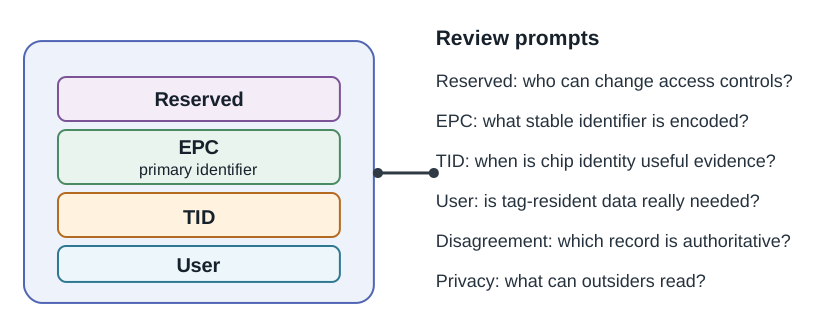
The map in Figure 5.5 keeps four Gen2 banks distinct. Reserved holds access controls. EPC is the main writable identifier, TID may help identify the chip, and User memory holds optional data. An EPC can be copied. A mismatch with a locked TID may flag a problem, but it does not prove a tag is genuine. Use stronger tag checks when proof of origin matters. Review who can change access controls, which ID is trusted, whether User data is needed, and what outsiders can read. Keep each bank’s value and trust claim separate in the event record.
Two practical consequences follow. First, the EPC in Bank 01 is writable and clonable. For a tag model with a factory-locked unique TID serial, compare that serial with the EPC to detect inconsistent identities; use cryptographic tag authentication when authenticity must be proved. Second, the passwords in Bank 00 are only 32 bits and are sent with light cover-coding, so classic Gen2 security is weak by design. The security chapter builds on that point.
Use memory banks to write acceptance tests, not just documentation. Suppose a reusable tool is issued with a 96-bit EPC. That is 96 / 8 = 12 bytes of identifier payload; PC bits and CRC may appear separately in a reader report when the reporting interface is configured to include them. The business system should parse the EPC payload according to the encoding scheme the organization actually owns, then store the reader, antenna, timestamp, and event reason beside the observation.
A stronger commissioning test reads both EPC and TID. The record might say: expected EPC prefix matched, TID manufacturer and model matched the approved inlay, 48 of 48 pilot labels produced the same EPC/TID pair across three inventory passes, and 0 duplicate EPCs appeared with different TIDs. That catches a common weak design: accepting only the writable EPC as truth. If an operator finds two tags that both report the same EPC but different factory-locked TIDs, the event layer should flag a clone or encoding error rather than silently merging the observations.
5.20 Check TID Versus EPC Evidence
This section: Check TID Versus EPC Evidence
5.21 Matching Standards To Roles
This section: Matching Standards To Roles
5.22 Worked Review: Receiving Doorway
This section: Worked Review: Receiving Doorway — A manufacturer wants to scan incoming cartons as pallets pass through a dock doorway.
A manufacturer wants to scan incoming cartons as pallets pass through a dock doorway. Each pallet may contain a mixed number of tagged cartons, and neighboring dock doors may have their own readers.
5.23 Candidate Choice
This section: Candidate Choice — EPC Gen2 UHF is a reasonable candidate because the workflow needs passive, non-line-of-sight, bulk identification.
EPC Gen2 UHF is a reasonable candidate because the workflow needs passive, non-line-of-sight, bulk identification. The review should not stop there.
5.24 Checkpoint: Evidence to Collect
This section: Checkpoint: Evidence to Collect
- Use ISO 14443 and NFC Forum behavior when the user must intentionally present a card, phone, or tag at close range.
- Use ISO 15693 or NFC-V behavior when HF vicinity reads are useful and phone or specialized-reader support is part of the workflow.
- Use EPC Gen2 UHF when many passive items must be identified without line of sight and the environment supports reliable UHF reads.
- Use active RFID or RTLS-specific systems when the asset must announce itself over a larger area or when battery-powered location behavior is required.
5.25 Checkpoint: Acceptance Record
This section: Checkpoint: Acceptance Record
A defensible record should include:
- Candidate standards and exact product conformance claims from vendors.
- Regional RF settings and deployment constraints.
- Pilot evidence with representative cartons and pallet speeds.
- Missed-read handling and manual exception path.
- Retest trigger after tag, packaging, reader firmware, antenna layout, or process changes.
5.26 Checkpoint: Common Mistakes
This section: Checkpoint: Common Mistakes
5.27 Treating Frequency As The Standard
This section: Treating Frequency As The Standard — “13.56 MHz” and “UHF” are not enough.
“13.56 MHz” and “UHF” are not enough. The review needs the actual standard family, tag behavior, data format, and reader-control assumptions.
5.28 Using One Standard For Every Workflow
This section: Using One Standard For Every Workflow — A hospital, warehouse, or campus can legitimately use several RFID families.
A hospital, warehouse, or campus can legitimately use several RFID families. Force-fitting every workflow into one standard often creates either privacy risk, missed reads, or poor user intent.
5.29 Confusing Tag Reads With Business Events
This section: Confusing Tag Reads With Business Events — An antenna read does not automatically mean receiving, shipping, dispensing, or custody transfer.
An antenna read does not automatically mean receiving, shipping, dispensing, or custody transfer. EPCIS-style events require context and business vocabulary.
5.30 Assuming LLRP Removes All Vendor Differences
This section: Assuming LLRP Removes All Vendor Differences — LLRP can standardize an important reader-control interface, but antenna mapping, diagnostic data, firmware features, and device management may still differ.
LLRP can standardize an important reader-control interface, but antenna mapping, diagnostic data, firmware features, and device management may still differ.
5.31 Ignoring Retest Triggers
This section: Ignoring Retest Triggers — Standards conformance is not a one-time proof.
Standards conformance is not a one-time proof. Packaging, mounting, regional settings, reader firmware, tag supplier, neighboring readers, and workflow speed can all require retesting.
5.32 Checkpoint: Review Checklist
This section: Checkpoint: Review Checklist
Before approving an RFID standards choice, confirm that the team can answer these questions:
- Which workflow is being supported, and what evidence shows the read pattern is correct?
- Which standards layer is being selected: air interface, NFC behavior, reader control, identifier syntax, or event sharing?
- Which exact tag class, memory behavior, and regional radio settings apply?
- How are multiple tags, collisions, missed reads, and duplicate reads handled?
- What event data is produced, and which business meaning does it carry?
- How will privacy, access control, and partner sharing be governed?
- What changes require the pilot evidence to be repeated?
5.34 Checkpoint: Summary
This section: Checkpoint: Summary — RFID standards are most useful when they are assigned to the right layer.
RFID standards are most useful when they are assigned to the right layer. ISO 14443, ISO 15693, ISO/IEC 18000, EPC Gen2, and NFC Forum specifications shape tag-to-reader behavior. LLRP helps control compatible readers. EPC, EPCIS, and CBV help transform observations into shared business events. Good design review starts with the workflow, chooses the candidate standards family, pilots the real environment, and records the retest triggers.
5.35 Key Takeaway
This section: Key Takeaway — RFID standards choices should document the air interface, data model, reader integration, certification need, and interoperability boundary.
RFID standards choices should document the air interface, data model, reader integration, certification need, and interoperability boundary.
5.36 Checkpoint: Concept Relationships
This section: Checkpoint: Concept Relationships
- Frequency-band knowledge explains why LF, HF, UHF, and active systems behave differently.
- Tag-type knowledge explains why passive, battery-assisted, and active tags fit different workflows.
- RFID security knowledge explains why range, identity, and event sharing create privacy and misuse risks.
- Deployment knowledge explains how antenna placement, reader scheduling, and exception handling affect the final outcome.
5.38 Sequence Review
This section: Sequence Review
Find help
3 reviewed answers.
Where should I start in a module?
Open the module page from the sidebar to see its chapters in order. Use the module map to return to a topic you need.
Modules and pathsReviewed
What can I try when a project does not work?
Check the symptom, then work through the diagnostic steps. Keep the error message and the smallest example that reproduces it.
When you are stuckReviewed
How do interactive examples work?
Use the interactive guide to check how examples and simulations work before changing your project.
Interactive examples guideReviewed