Start with devices that have to pass useful data before any fixed network is guaranteed. In DTN Social Routing, the first question is not the protocol name; it is which neighbors, routes, failure signals, and degraded behaviors you would trust in the field.
14.2 Start With the Node That Usually Meets the Right People
Social routing starts from an observation: in many mobile systems, contacts are not random. Some devices, vehicles, people, or gateways regularly meet the communities that need the message.
For IoT deployments, that pattern can make forwarding more selective than flooding. Start with one carrier and one destination group. The routing question becomes whether past contact evidence is strong enough to trust the carrier with the next copy.
Chapter Roadmap
This chapter has four stops:
First identify what social evidence means in a DTN: contact history, community structure, centrality, and resource state.
Then turn that evidence into a forwarding record so a team can review why one carrier is trusted over another.
Next calculate CAR and SocialCast utility scores, including the 0.405 versus 0.334 vehicle example and bounded gamma copies.
Finally test the privacy, drift, and resource trade-offs before treating social routing as production-ready.
Checkpoints recap the route. Deep-dive sections and calculation panels are there for verification when you need the working.
In 60 Seconds
Context-aware routing (CAR) uses utility functions combining encounter probability, mobility patterns, and device resources to select optimal message carriers, reducing overhead to 200-350% while maintaining 88-93% delivery. SocialCast creates bounded replicas (gamma=5-10) that climb to higher-utility carriers over time. Social routing sacrifices ~7% delivery ratio compared to epidemic but uses 3-5x fewer resources – ideal for battery-constrained IoT with predictable mobility patterns.
Minimum Viable Understanding
Context-aware routing (CAR) uses utility functions combining encounter probability, mobility patterns, and resources to select the best message carriers, reducing overhead to 200-350% while maintaining 88-93% delivery
SocialCast creates a bounded number of message replicas (gamma=5-10) that “climb” to higher-utility carriers over time, exploiting social network structures for efficient publish-subscribe in DTN
The key trade-off: Social routing sacrifices ~7% delivery ratio compared to epidemic routing but uses 3-5x fewer resources, making it ideal for battery-constrained IoT devices with predictable mobility
Smart Messenger Service
“Instead of telling EVERYONE my message like in epidemic routing,” said Sammy the Sensor, “what if I only tell people who are LIKELY to meet the person I’m trying to reach?”
Max the Microcontroller snapped his fingers. “Like if you need to send a message to the school librarian, don’t give copies to random strangers – give it to kids who go to that school every day!”
“Exactly!” said Bella the Battery. “That’s social routing! Each person gets a ‘usefulness score.’ The kid who visits the library every day scores 0.9 out of 1.0. A random tourist scores 0.1. You only hand your message to high-scoring people!”
Lila the LED added, “And the best part is: you only make 5-10 copies instead of hundreds. Each copy finds its way to a better and better messenger until someone delivers it. It’s like your message ‘climbs’ toward the destination!”
The Squad’s math: Epidemic routing = 95% delivery but 1000% overhead (expensive!). Social routing = 88% delivery but only 200% overhead (5x cheaper!). For battery-powered sensors, that savings means years more battery life!
14.3 Learning Objectives
By the end of this chapter, you will be able to:
Apply Context-Aware Routing: Use utility functions based on mobility, colocation, and resources
Design SocialCast Protocols: Implement social network-based forwarding with bounded replication
Optimize Forwarding Decisions: Select carriers based on delivery likelihood rather than flooding
Evaluate Trade-offs: Balance delivery ratio, latency, and resource consumption
14.4 Overview: Choose Carriers With Evidence
If you only need the intuition, this layer is enough: social DTN routing avoids copying every bundle to every contact. It forwards toward carriers that have measured evidence of reaching the destination, community, or subscriber group.
The word "social" does not mean the protocol guesses from labels such as friend, worker, or student. It means the forwarding decision uses observed contact structure: who meets whom, how recently, how often, for how long, and with what spare storage or battery. A campus shuttle, clinic nurse, field technician, or market bus can become a better carrier because the contact record shows repeated access to the destination group.
The practical benefit is selectivity. Epidemic routing asks whether another node lacks the bundle. Social routing asks whether that node is a better future carrier than the current one, or whether an extra copy is justified by the replica budget. If the peer has weaker evidence, the correct action may be to keep the bundle and wait. That restraint is what saves energy and buffer space.
A useful overview therefore names the destination context as well as the carrier. Forwarding to "a central node" is incomplete; forwarding to a node that reliably reaches the clinic community, the maintenance team, or the bus depot is a measurable claim. The routing record should make that claim visible.
Social DTN forwarding should choose the carrier with better measured utility, not the next random contact or every contact.
Mobile summary: score candidate carriers by contact history, mobility, and resource state, then forward only when the peer has stronger evidence of reaching the destination.
Contact history
Past encounters estimate whether a carrier is likely to meet the destination again.
Community structure
Nodes that regularly meet the same group can carry messages into that group more efficiently.
Bounded copies
Protocols such as SocialCast keep the replica count limited so energy and buffer use remain controlled.
14.5 Forwarding Record
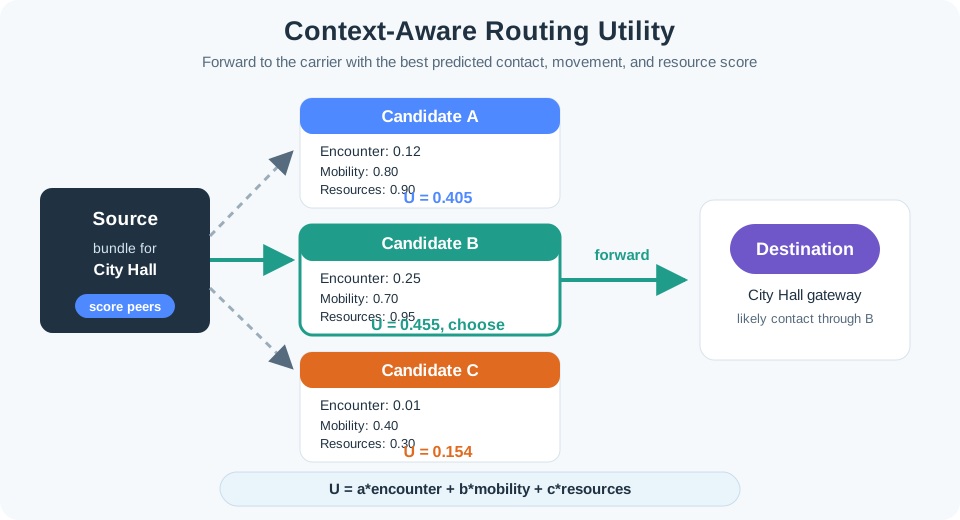
A social-routing design should record why one carrier is better than another. A utility score is useful only when the team can explain the measurement window, weighting, privacy limits, and resource constraints behind it.
Start by writing the score as a reviewable equation or decision table. Each input needs a unit, a sampling window, a decay rule, and a tie-breaker. For example, recent encounters with the destination may outrank older encounters, but a node with a nearly full buffer may still refuse the transfer. The record should state whether the protocol uses destination-specific utility, community membership, centrality, subscriber interest, or a combination of those signals.
Then test the rule with counterexamples. A highly central carrier may be useful for many destinations but overloaded; a familiar carrier may meet the destination often but have a weak battery; a privacy policy may forbid sharing raw encounter histories. The field acceptance run should replay at least one normal contact pattern, one schedule change, one full-buffer event, and one privacy-restricted contact trace before the score is trusted.
The forwarding record also needs a minimum-improvement rule. Transferring to a peer whose utility is only slightly higher can waste the contact window and create duplicate storage pressure. Many deployments require a threshold, such as "forward only when the peer score is higher by a configured margin" or "forward only when the peer reaches a community the current node rarely reaches." The exact number is local, but the rule must be explicit.
Utility inputs
Name the contact-history, mobility, centrality, similarity, battery, and buffer signals used by the score.
Forwarding rule
State when to transfer, keep, duplicate, expire, or refuse a bundle during a contact.
Replica budget
Record the gamma or copy limit, why it is acceptable, and what traffic gets priority when storage is tight.
Privacy boundary
Define what contact history can be stored, shared, anonymized, aggregated, or deleted.
Checkpoint: Evidence Before Forwarding
You now know:
Social routing does not forward to every contact; it forwards only when measured evidence says the peer is a better carrier.
A useful record names the sampling window, decay rule, resource limits, tie-breaker, and privacy boundary behind the score.
Old contact evidence can drift, so history decay and minimum-evidence rules matter as much as the utility formula.
14.6 Why Social Evidence Drifts
Social routing depends on patterns that can change. A strong carrier this month can become weak after a schedule change, event season, battery limit, buffer pressure, privacy policy, or community split.
Many social DTN protocols can be understood as local graph estimators. SimBet-style forwarding combines similarity to the destination's neighborhood with betweenness-like bridge value. Bubble Rap-style forwarding separates global centrality from community membership. CAR-style forwarding combines contact probability, mobility, and resource context. In constrained IoT nodes, these values are often approximated from encounter tables rather than computed from a complete graph.
That approximation creates drift. A node may look central because it used to meet everyone during a shift pattern that no longer exists. A community detector may lag after people move teams or a transport route changes. A resource score may be stale if battery and buffer readings are not refreshed before contact. Under the hood, the routing stack needs aging, confidence, and minimum-evidence rules so old social evidence cannot dominate new observations indefinitely.
Privacy controls also affect the algorithm. Raw contact graphs can reveal routines and relationships even when payloads are encrypted, so deployments may hash identifiers, aggregate counts, keep only local scores, or shorten retention windows. Those protections are useful, but they reduce what the routing layer can know. A defensible design records the resulting accuracy trade-off instead of pretending the privacy-preserving score is identical to an unrestricted encounter graph.
Failure handling closes the loop. When delivery drops, the investigation should compare the old score distribution with recent contact logs, not simply increase the replica budget. More copies can hide a stale utility model temporarily while draining the same resources social routing was chosen to protect.
History decay: recent contacts should usually matter more than old contacts.
Local approximation: practical nodes often estimate centrality from local or two-hop evidence, not a perfect global graph.
Replica discipline: bounded replication works only when transfer, expiry, and priority rules are enforced.
Privacy exposure: contact graphs can reveal movement and relationship patterns even when payloads are encrypted.
14.7 Prerequisites
Before diving into this chapter, you should be familiar with:
DTN Fundamentals: Understanding store-carry-forward is essential for social routing
DTN Epidemic Routing: Knowledge of flooding-based routing helps appreciate why social routing is more efficient
Social Routing: DTN routing exploiting human social patterns (community membership, centrality, contact frequency) for efficient message delivery
Social Centrality: Node’s position in a social network graph; highly central nodes (hubs) interact with many others and make better message carriers
Community Detection: Identifying groups of nodes that frequently contact each other; used in bubble routing and community-based routing
SimBet Routing: Combines social similarity (common contacts) and betweenness centrality to select next-hop carriers
Bubble Routing: Messages stay in source community until a node with higher global centrality can carry them to the destination community
Contact History: Past encounter records used to predict future contacts; stored in encounter tables indexed by node ID and time
Betweenness Centrality: Fraction of shortest paths in the social graph passing through a node; high-betweenness nodes are good message relays
Homophily: Tendency for people to contact socially similar others; enables community-based routing to outperform random routing
14.8 For Beginners: Social Routing
Social Routing - The Smart Strategy:
Instead of telling everyone (epidemic routing), tell people who are likely to meet the destination. Like asking “Can you deliver this message?” only to people who work near the recipient’s office.
SocialCast uses social patterns:
If Node A frequently encounters Node B, A has high “utility” for delivering to B.
Forward messages only to higher-utility carriers.
Bounded replication creates only 5-10 copies, not unlimited copies.
Result: high delivery with much lower overhead than epidemic flooding when contact patterns are predictable.
Key terms:
PRoPHET: forwards to nodes with stronger encounter history, like asking someone who often sees the recipient.
Utility function: scores delivery likelihood, like estimating which courier is most likely to reach an address.
Context-aware routing: uses location, mobility, relationships, and resources instead of forwarding blindly.
Where: - \(U(X, D)\) = Utility of node X for delivering to destination D - \(P_{colocation}(X, D)\) = Probability X will encounter D - \(Mobility(X)\) = Mobility score (higher = visits more locations) - \(Resources(X)\) = Battery level, buffer space - \(\alpha, \beta, \gamma\) = Weighting parameters
Putting Numbers to It
For a delivery vehicle passing city hall 3 times/day versus once/week, the encounter probability scales linearly: \(P_{daily} = 3/24 = 0.125\) per hour versus \(P_{weekly} = 1/168 = 0.006\) per hour. With \(\alpha=0.6\), \(\beta=0.3\), \(\gamma=0.1\) and typical freshness/battery values of 0.8/0.9:
The 21% utility advantage (\(0.405 / 0.334 = 1.21\)) means messages preferentially climb to vehicle carriers, reducing delivery time from 7 days to ~8 hours despite only 21% better utility.
Checkpoint: CAR Utility
You now know:
CAR combines colocation probability, mobility, and resources into one reviewable utility score.
With weights alpha=0.6, beta=0.3, gamma=0.1, the delivery vehicle scores 0.405 while the pedestrian scores 0.334.
A higher score justifies forwarding only when the rule and improvement threshold are explicit enough to audit.
Colocation Prediction (Kalman Filter):
CAR can use a Kalman filter or another time-series predictor to estimate future encounters from past history:
def predict_colocation(node_x, node_d, history):""" Predict probability node_x will encounter node_d based on past encounter history using Kalman filter """# Historical encounter frequency encounters =sum(1for t in history if met(node_x, node_d, t)) total_windows =len(history)# Kalman filter state# (Simplified - real implementation more complex) predicted_rate = encounters / total_windows# Adjust for time since last encounter time_since_last = time_now() - last_encounter_time(node_x, node_d) decay_factor = exp(-time_since_last / DECAY_CONSTANT)return predicted_rate * decay_factor
14.9.3 CAR vs Epidemic Routing
Example Scenario:
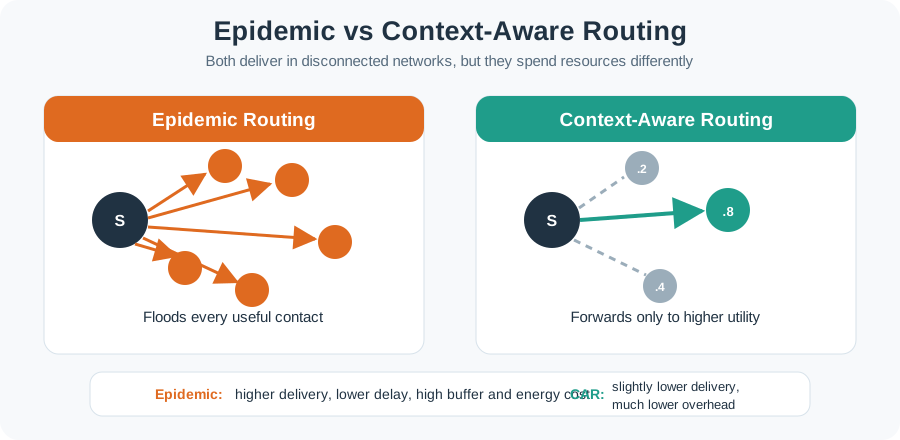
Figure 14.1: CAR versus epidemic routing trade-off for disconnected IoT networks
Performance comparison in the example trace:
Delivery ratio: epidemic reaches about 95%; CAR reaches about 88%.
Copy overhead: epidemic creates about 15 copies per delivered message; CAR creates about 3.
Average latency: epidemic is faster in this trace, about 450 seconds versus 520 seconds.
Energy per delivery: epidemic is high because many nodes carry copies; CAR is medium because it forwards selectively.
Trade-off:
CAR: Slightly lower delivery ratio, much lower overhead
Best when: Resources constrained, predictable mobility
Quick Check: Context-Aware Routing
14.10 SocialCast: Social-Based DTN Routing
Time: ~15 min | Difficulty: Advanced | Unit: P04.C01.U04
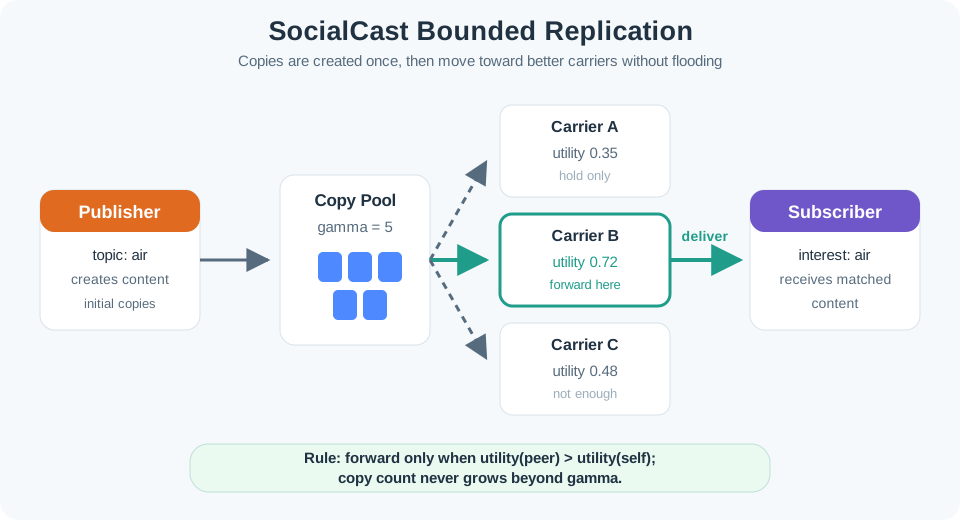
Figure 14.2: SocialCast bounded-replication workflow for DTN publish-subscribe delivery
SocialCast extends CAR by exploiting social network structures for packet dissemination.
14.10.1 SocialCast Concepts
Key Insight: People with similar interests tend to be colocated periodically.
Application: Publish-subscribe in DTN - Publishers: Generate content - Subscribers: Want to receive content matching interests - Carriers: Mobile nodes with high utility transport messages
Figure Summary: SocialCast Workflow
SocialCast creates a fixed number of replicas at publication time. Each replica moves only when the encountered node has higher delivery utility, so the copy count stays bounded while messages drift toward likely subscribers.
14.10.2 SocialCast Protocol
Message Replication Strategy:
Create gamma replicas at publisher
Forward only to “better” carriers:
Better = utility(neighbor) > utility(self)
Carriers hold messages until:
Finding even better carrier, OR
Encountering subscriber
Replicas never increase (bounded replication)
TTL prevents infinite lifetime
Key Properties:
Bounded replicas: Only gamma copies exist (doesn’t grow like epidemic)
Selective forwarding: Only to higher-utility nodes
Upgrade path: Replicas “climb” to better carriers over time
Subscriber participation: Subscribers with high utility can act as carriers
14.10.3 SocialCast Performance
Delivery and overhead vs replicas:
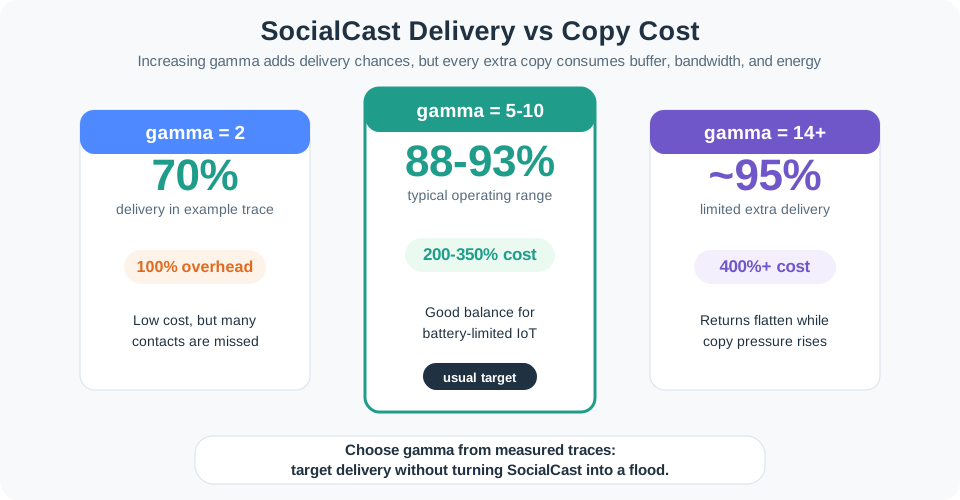
Figure 14.3: SocialCast delivery and overhead trade-off as gamma increases
Figure Summary: Gamma Trade-off
More replicas improve delivery because more carriers can discover useful contacts. The benefit flattens after roughly 5-10 replicas, while storage, bandwidth, and energy cost continue to rise.
Optimal Configuration:
gamma = 5-10 for most scenarios
Balance: 88-93% delivery with 200-350% overhead
Compare to epidemic: 95% delivery with 800-1200% overhead
TTL Impact:
Longer TTL values usually improve delivery in sparse networks because a copy has more time to encounter a better carrier or subscriber. The trade-off is buffer pressure: every extra hour of TTL keeps stale data in constrained devices longer.
SocialCast Utility Calculation
Scenario: A smart city deploys sensors on delivery vehicles for air quality monitoring. Calculate which vehicle should carry pollution alerts to city hall.
Given:
Vehicle A: Delivers to suburbs, encounters city hall area 1x/week
Vehicle B: Downtown route, passes city hall 3x/day
Vehicle C: Mixed route, passes city hall 1x/day
Current carrier: Vehicle A (utility U_A = 0.43 after calculation)
Message: PM2.5 alert for city hall environmental office
Steps:
Calculate utility for each vehicle:
Utility formula: U(X, Dest) = alpha x P_encounter + beta x Freshness + gamma x Battery
Vehicle A encounters B: U_B (0.90) > U_A (0.43): Forward to B
Vehicle A encounters C: U_C (0.91) > U_A (0.43): Forward to C
Both B and C are “better carriers” - forward to whichever encountered first
Result: Message forwarded from Vehicle A to Vehicle B (or C), moving the alert from a weekly contact opportunity to a daily route past the destination.
Key Insight: SocialCast’s “utility climbing” ensures messages naturally flow toward nodes with better access to the destination. The delivery vehicle example shows how urban mobility patterns create predictable utility scores that SocialCast can exploit.
Checkpoint: SocialCast Discipline
You now know:
SocialCast creates gamma replicas once, then moves existing copies toward higher-utility carriers instead of growing the copy count like epidemic routing.
The usual 5-10 replica range aims for 88-93% delivery with 200-350% overhead, not epidemic-style 800-1200% overhead.
The forwarding rule is simple to state but strict to operate: transfer only when the neighbor’s utility is higher than the current carrier’s utility.
Test Your Understanding
Question 1: In context-aware routing, what is the primary purpose of the utility function U(X, D)?
To encrypt messages for secure delivery
To calculate the probability that node X will successfully deliver a message to destination D
To measure the physical distance between two nodes
To compress data for efficient transmission
Answer
b) To calculate the probability that node X will successfully deliver a message to destination D. The utility function combines colocation probability (how often X encounters D), mobility patterns, and available resources (battery, buffer) into a single score. Messages are forwarded only to nodes with higher utility scores, ensuring they “climb” toward better carriers over time.
Question 2: Why does SocialCast use bounded replication (gamma copies) instead of unlimited replication like epidemic routing?
Bounded replication limits resource consumption while maintaining good delivery (88-93%)
SocialCast cannot create more than one copy
Unlimited replication is impossible in mobile networks
Answer
b) Bounded replication limits resource consumption while maintaining good delivery. SocialCast creates only gamma copies (typically 5-10), which is sufficient for 88-93% delivery but uses 3-5x fewer resources than epidemic routing’s unlimited copies. For battery-constrained IoT devices, this resource efficiency is critical. The slight reduction in delivery ratio (from 95% to 88%) is an acceptable trade-off.
Question 3: A delivery vehicle (Vehicle B) passes city hall 3 times per day. Another vehicle (Vehicle A) passes it once per week. Using SocialCast’s forwarding rule, what happens when Vehicle A carrying a message for city hall encounters Vehicle B?
Vehicle A keeps the message since it was the original carrier
Vehicle A forwards the message to Vehicle B because B has higher utility for city hall
Both vehicles keep a copy of the message
The message is dropped because neither vehicle is at city hall
Answer
b) Vehicle A forwards the message to Vehicle B because B has higher utility. SocialCast’s core rule is: forward only to nodes with utility(neighbor) > utility(self). Vehicle B’s encounter rate with city hall (3/day) is much higher than Vehicle A’s (1/week), giving B a higher utility score. The message “climbs” to the better carrier, dramatically increasing delivery probability from 14% to nearly 100% per day.
14.11 SocialCast Utility Function Explorer
Adjust the weights and node parameters to see how the utility score changes:
Scalability: Local utility decisions scale better than global knowledge
Example IoT Applications:
Smart city: Traffic sensors publish updates, delivered to vehicles in area
Wildlife monitoring: tracking collars exchange data via high-mobility carriers
Wearable health: Health data from many users aggregated via mobile phone carriers
14.13 Knowledge Check
Quiz: SocialCast Protocol
14.14 Community Mesh Routing
Case Study: Community-Managed Mesh Links
Community Wi-Fi mesh networks are not automatically DTNs, and they are not formal SocialCast deployments. They are still useful design analogies because administrators often route content through people and links they trust to be available at predictable times.
How the analogy maps to social routing:
Utility function: local operators know which rooftop links, relays, or users are reliable.
Encounter probability: evening usage windows and scheduled maintenance create predictable contact opportunities.
Bounded replication: popular files are cached on a small number of reliable mirrors instead of copied everywhere.
Utility climbing: content moves from peripheral nodes toward better-connected local hubs before crossing weak links.
Design lesson: social routing should be treated as an engineering trade-off, not a magic replacement for connectivity. It works best when contact patterns are predictable, resources are scarce, and forwarding decisions can be made from recent local evidence. Before using SocialCast-like logic in production, collect trace data from the target environment and validate delivery, latency, energy, and privacy impact.
14.15 Concept Relationships
Utility functions select carriers by combining encounter probability, mobility patterns, and resource state.
Social routing relies on contact history as a predictor of future contacts. Work schedules, commuting patterns, and social behavior change over weeks and months. Routing decisions based on stale contact history (months old) may be less accurate than routing based on current network state. Implement contact history decay to weight recent contacts more heavily.
Social Centrality Without Full Map
Betweenness centrality requires global network graph knowledge – knowing all nodes and their interconnections. In a distributed DTN, this information is unavailable. Practical social routing uses local approximations (encounter counts, two-hop neighbor counts) that underestimate true centrality.
Social Routing Beyond Humans
Social routing exploits human mobility patterns (workplace, home, social events). Animal tracking, vehicle networks, or robot swarms have different mobility patterns that may not exhibit the community structure social routing exploits. Always validate that the target environment exhibits social-like contact patterns before applying social routing.
Contact Tracking Privacy Risks
Social routing requires nodes to share and track contact history. This creates detailed records of who met whom and when – personal location data. Deployments must consider privacy implications and anonymization techniques. Publishing contact graphs can reveal sensitive information about individuals’ movements.
Label the Diagram
Code Challenge
14.17 Summary
This chapter covered context-aware and social-based DTN routing:
Context-Aware Routing (CAR): Uses utility functions combining colocation probability, mobility patterns, social relationships, and resources to make intelligent forwarding decisions, reducing overhead to 200-350% while maintaining 88-93% delivery
Utility Function Design: The formula U(X, D) = alpha * P_colocation + beta * Mobility + gamma * Resources provides a mathematical framework for carrier selection
Colocation Prediction: Kalman filters use past encounter history to predict future contact probabilities, enabling “smart” forwarding
SocialCast Protocol: Creates bounded gamma replicas that “climb” to higher-utility carriers over time, exploiting social network structures for publish-subscribe in DTN
Performance Optimization: gamma = 5-10 replicas typically achieves 88-93% delivery with 200-350% overhead, compared to epidemic’s 95% delivery with 800-1200% overhead
IoT Suitability: SocialCast works well for IoT due to natural device clustering, predictable mobility patterns, resource efficiency, and local decision scalability
Social routing uses repeated contact patterns, communities, or central nodes to improve DTN forwarding. It only works when those patterns are real, measured, and acceptable from a privacy and governance standpoint.
 Checkpoint: Evidence Before Forwarding
14.10.1 SocialCast Concepts
Key Insight: People with similar interests tend to be colocated periodically.
Application: Publish-subscribe in DTN - Publishers: Generate content - Subscribers: Want to receive content matching interests - Carriers: Mobile nodes with high utility transport messages
SocialCast creates a fixed number of replicas at publication time. Each replica moves only when the encountered node has higher delivery utility, so the copy count stays bounded while messages drift toward likely subscribers.