31 Real-World DTN Deployments
emerging-paradigms
adhoc
dtn
31.1 Start Simple
Start with devices that have to pass useful data before any fixed network is guaranteed. In Real-World DTN Deployments, the first question is not the protocol name; it is which neighbors, routes, failure signals, and degraded behaviors you would trust in the field.
31.2 Start With the Delay the User Can Live With
A DTN application succeeds only when the delay matches the job. Wildlife data, rural health records, ferry telemetry, and disaster reports can tolerate different waiting times and different risks of loss.
Start with the user’s patience and the value of the message. Then choose custody, replication, priority, storage, and delivery evidence that match the real deployment rather than an always-connected network ideal.
Chapter Roadmap
This chapter moves from fit to field proof:
- First decide whether the mission can accept delayed delivery and which traffic must bypass DTN.
- Then compare rural, tactical, wildlife, hybrid, space, and disaster deployments.
- Next size buffers and contact windows with the ZebraNet-style collar example.
- Finally turn those examples into a deployment record, failure-mode checklist, and application selection rule.
Checkpoints recap the path as you go. Deep-dive sections and interactives give extra practice after the main idea is clear.
Minimum Viable Understanding
- DTN applications excel in scenarios with no continuous connectivity: wildlife tracking (ZebraNet), rural connectivity (DakNet), military tactical, disaster recovery, and space communications
- The key decision factor is latency tolerance: DTN suits applications accepting minutes-to-days delay; real-time streaming and voice calls are unsuitable
- Hybrid architectures combine traditional infrastructure (where available) with DTN (for coverage gaps and fallback), using mobile collectors to bridge disconnected areas
Message in a Bottle Network
“Imagine you live on an island with no phone service,” Sammy the Sensor said, sitting on a beach. “How would you send a message to another island?”
“Easy!” said Max the Microcontroller. “Write a message, put it in a bottle, and toss it in the ocean. Someone on a passing boat might pick it up and carry it closer to your friend’s island!”
Bella the Battery nodded. “That’s exactly how DTN applications work! In Kenya, zebras with GPS collars pass messages to each other when they meet at watering holes. It might take days, but the data eventually reaches the scientists!”
Lila the LED lit up green. “And in rural India, buses carry internet messages between villages that have no phone towers. The bus is like the bottle floating between islands – slow, but it works when nothing else can!”
Real examples the Squad loves:
- ZebraNet: Zebras share GPS data when they bump into each other – takes 3-7 days but scientists get their migration data!
- DakNet: Buses carry emails between villages in India – 24-hour delivery is fine for crop price questions!
- Space mail: Mars rovers use DTN to send photos to Earth – even 24-minute delays are handled!
31.3 Learning Objectives
By the end of this chapter, you will be able to:
- Classify DTN Use Cases: Distinguish scenarios where DTN provides unique value over traditional networking
- Design Rural Connectivity: Apply DTN architectures for developing region connectivity solutions
- Configure Wildlife Tracking: Implement opportunistic forwarding for animal monitoring deployments
- Plan Hybrid Architectures: Combine infrastructure and DTN for robust fault-tolerant systems
- Evaluate Deployment Trade-offs: Assess latency tolerance against infrastructure costs quantitatively
31.4 Prerequisites
Before diving into this chapter, you should be familiar with:
- DTN Fundamentals: Understanding store-carry-forward is essential for application design
- DTN Epidemic Routing: Knowledge of flooding-based routing helps understand when it’s appropriate
- DTN Social Routing: Context-aware routing provides efficient alternatives for many applications
Key Concepts
- DTN Application Domains: Disaster response networks, wildlife tracking, underwater sensor networks, deep space communication, rural connectivity
- Delay-Tolerant E-mail: Messaging that accommodates hours-to-days of delivery delay; uses store-and-forward with eventual delivery
- Data Mule: A mobile node (vehicle, animal, robot) that physically carries data between disconnected network islands
- Interplanetary Internet: NASA-developed application of DTN principles for Mars-Earth communication with 4-24 minute one-way delays
- Epidemic Routing in Practice: Uncontrolled message replication that floods available storage; tradeoff between delivery probability and resource consumption
- Social-Aware Routing: Routing decisions based on contact history, social centrality, and community detection rather than network topology
- Application Buffer Management: Prioritizing which messages to keep when storage is full; drop-oldest, drop-least-used, or priority-based policies
- Bundle Protocol: IETF standardized DTN protocol (RFC 9171) providing end-to-end delivery over intermittent connections
31.5 For Beginners: DTN Applications
When to Use DTN:
- Wildlife tracking (animals rarely meet)
- Disaster recovery (infrastructure down)
- Space networks (extreme delays)
- Rural connectivity (intermittent access)
When NOT to Use DTN:
- Video streaming (requires continuous connection)
- Real-time gaming (cannot tolerate delays)
- Emergency alerts (need immediate delivery)
Real Examples:
- DakNet (India): Buses carry internet data to villages - 24h latency acceptable for email/queries
- ZebraNet (Kenya): GPS collars on zebras exchange data when animals meet - 3-7 day latency acceptable for migration studies
Related Chapters
DTN Series:
- DTN Fundamentals - Store-carry-forward basics
- DTN Epidemic Routing - Flooding-based protocols
- DTN Social Routing - Context-aware and social-based routing
Applications:
- IoT Application Domains - DTN use cases
- Wildlife Tracking Examples - Real-world DTN
Architecture:
- Wireless Sensor Networks - WSN in sparse deployments
- FANET Fundamentals - Aerial DTN applications
- Mobile Phone Gateway Fundamentals - Mobile DTN carriers
Learning:
- Simulations Hub - DTN simulators
31.6 Applications of DTN Routing
Start with deployment shape, not routing jargon. Each example below asks the same question: which moving carrier can bridge the gap, and what delay can the application honestly tolerate?
31.6.1 Remote and Developing Regions
Scenario: Rural Agricultural Extension Service
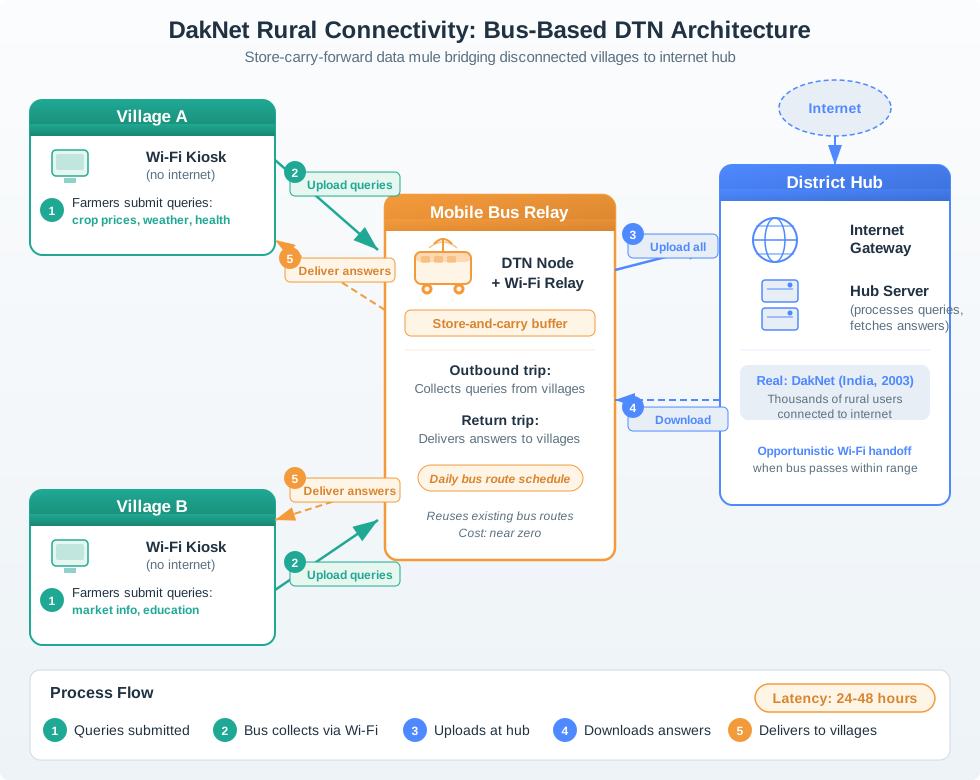
Mobile summary: A village kiosk stores farmer queries, a scheduled bus collects them over Wi-Fi, the bus syncs at the district hub, and answers return on a later village pass. The latency is hours to a day, but the service works without continuous backhaul.
Operation:
- Villages have Wi-Fi kiosks but no internet
- Farmers submit queries (crop prices, weather, health questions)
- Bus with Wi-Fi node drives daily route
- Bus collects queries from villages
- At hub, bus uploads queries to internet gateway
- Responses downloaded to bus
- Bus delivers responses on return route
Real Implementation: DakNet (2003), India - Latency: 24-48 hours (acceptable for non-urgent queries) - Cost: Extremely low (reuses existing bus routes) - Impact: Thousands of rural users connected
31.6.2 Military Tactical Networks
Challenged Environment:
- No infrastructure
- Jamming and interference
- High mobility
- Intermittent connectivity
- Hostile territory
DTN Solution:
- Soldiers carry handheld DTN nodes
- Vehicles act as mobile relays
- UAVs provide aerial data mules
- Opportunistic forwarding when in range
- Store-and-forward tolerates disconnections
31.6.3 Sensor Systems
Wildlife Tracking Example:
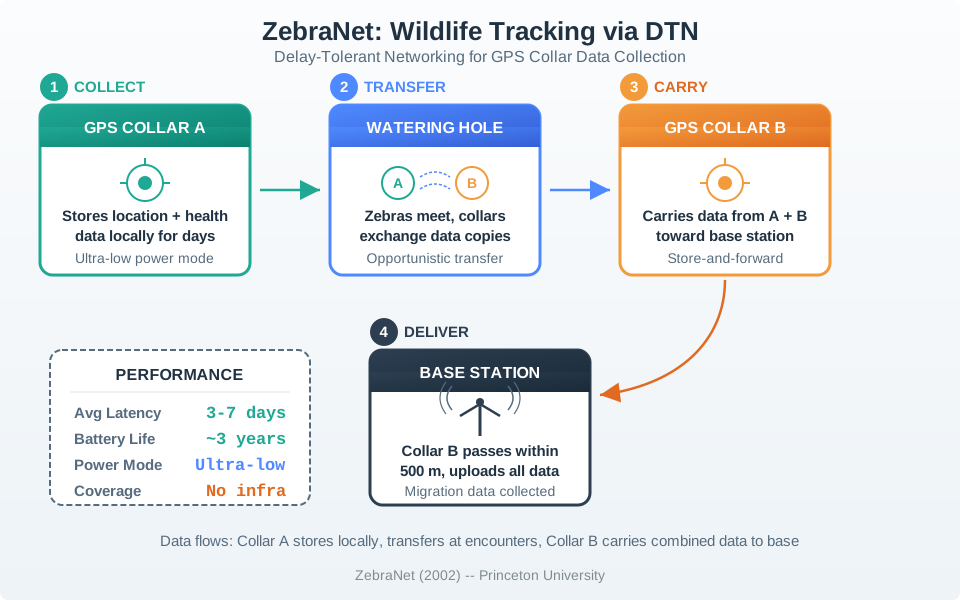
Mobile summary: Each collar stores its own readings, exchanges copies during animal encounters, and uploads the combined backlog when any carrier reaches a base station. This trades immediate visibility for low-power multi-day collection.
ZebraNet (2002):
- GPS collars on zebras
- Collect location/movement data
- Store locally for weeks
- Transfer opportunistically when zebras encounter each other
- Download to base station when animals visit watering hole
- Battery budget: ~3 years
DTN Benefits:
- No need to track every animal continuously
- Data eventually reaches base station
- Ultra-low power (mostly storage, rare transmissions)
31.6.4 Hybrid Models
Modern IoT deployments often combine infrastructure and DTN:
Smart City Hybrid:
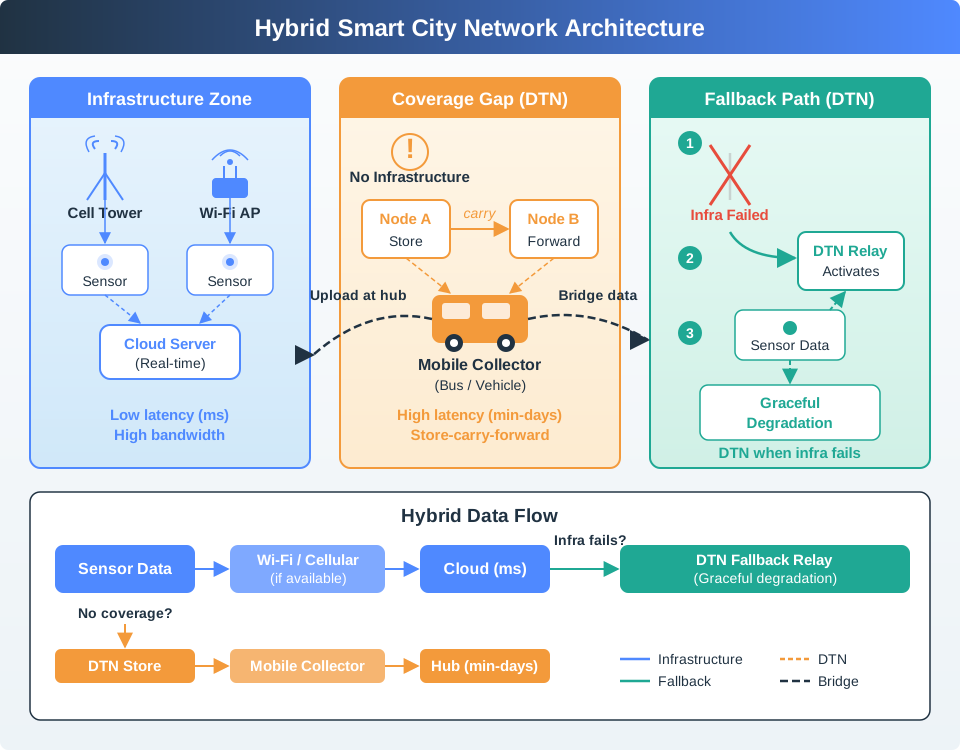
Mobile summary: A hybrid deployment uses Wi-Fi or cellular where coverage exists, DTN mobile collectors where it does not, and fallback DTN paths when the primary infrastructure fails.
Why Hybrid?
- Infrastructure where available (low latency, high bandwidth)
- DTN for coverage gaps (no infrastructure cost)
- Mobile nodes bridge gaps
- Graceful degradation (DTN fallback if infrastructure fails)
31.6.5 Space Networks
Interplanetary Communication:
- Light-speed delays: Mars is 4-24 minutes away
- Planetary occlusion: No line-of-sight during planet rotation
- Relay satellite handoffs
- Bundle Protocol (RFC 9171) standardizes modern DTN bundle delivery
NASA Deep Space Network:
- Uses DTN principles for Mars rovers
- Store data during blackouts
- Forward when Earth visible
- Tolerates hours of disconnection
31.6.6 Disaster Recovery
Post-Disaster Scenarios:
- Cell towers destroyed
- Power grid down
- Roads blocked
- First responders need communication
DTN for Disaster Response:
- Responders carry DTN nodes
- Drones provide aerial relay
- Survivor phones act as DTN nodes
- Messages eventually reach command center
- Better than no communication
 Checkpoint: Application Fit
You now know:
- Rural connectivity can accept 24-48 hour delivery when the payload is a non-urgent query or response.
- Wildlife tracking can accept 3-7 day average delivery when collars keep local records and upload opportunistically.
- Disaster and tactical systems need DTN for degraded communication, but urgent alerts still need a direct or higher-priority path.
31.7 Knowledge Check
Test Your Understanding
Question 1: A rural health clinic needs to deliver non-urgent medical test results to village patients. The only transport is a bus that visits twice daily. What is the expected average delivery latency?
- Under 1 hour – bus arrives frequently enough
- 4-8 hours – average wait for bus plus travel time
- 24-48 hours – must wait for full round trip
- 1 week – DTN always has very long delays
Answer
b) 4-8 hours. The average wait for the next bus is half the cycle time (4 hours if buses run every 8 hours), plus the travel time from hub to village (typically 4 hours). This 8-hour average is acceptable for non-urgent test results, which is exactly why DTN is suitable for this use case.
Question 2: Which of the following applications is LEAST suitable for DTN?
- Wildlife migration tracking with GPS collars
- Real-time video surveillance for security
- Environmental sensor data collection in remote forests
- Delivering educational content to rural schools
Answer
b) Real-time video surveillance. DTN tolerates delays of minutes to days, making it unsuitable for real-time applications requiring continuous streaming. Video surveillance needs millisecond-level latency and sustained bandwidth – both impossible with store-carry-forward. The other three applications all tolerate hours-to-days delays.
Question 3: In a hybrid DTN/infrastructure architecture for a smart city, what is the primary purpose of DTN components?
- To replace all cellular infrastructure for cost savings
- To provide faster data delivery than Wi-Fi
- To cover connectivity gaps and provide fallback when infrastructure fails
- To encrypt data more securely than traditional networks
Answer
c) To cover connectivity gaps and provide fallback. Hybrid architectures use traditional infrastructure (Wi-Fi, cellular) where available for low-latency communication, and DTN for areas without coverage or as a fallback when infrastructure fails (e.g., during power outages or disasters). DTN complements infrastructure rather than replacing it.
31.8 DTN Buffer Sizing for Tracking
ZebraNet GPS Collar Design
Scenario: A conservation project tracks 50 elephants in Kruger National Park (19,485 km2). Each collar records GPS position, accelerometer activity, and ambient temperature every 5 minutes. Collars exchange data opportunistically when elephants meet at watering holes (average 2 encounters/day, 30-second contact window each). A base station at park headquarters downloads data when collared elephants pass within 500m (average once per 5 days).
Given:
- Sensors per reading: GPS (20 bytes), accelerometer (8 bytes), temperature (2 bytes), timestamp (4 bytes), and collar ID (2 bytes), for 36 bytes total.
- Reading interval: every 5 minutes, or 288 readings/day.
- Data generated per day: 288 x 36 bytes = 10,368 bytes, about 10 KB/day.
- Worst-case base-station gap: 15 days.
- Collar-to-collar contacts: about 2/day, with a 30-second contact window each.
- Radio data rate: 250 Kbps using an 802.15.4-class radio.
- Relay load to budget for: up to 49 other collars x 10 KB/day x 5 days average backlog, or about 2.45 MB before applying forwarding limits.
Step 1: Own data buffer requirement
- Worst case: 15 days without base station contact
- Own data: 15 days x 10 KB/day = 150 KB
Step 2: Relay buffer for forwarding others’ data
- Each collar may carry data from multiple elephants
- Practical limit: carry data from 10 other collars at most
- Relay buffer: 10 collars x 15 days x 10 KB = 1.5 MB
Step 3: Total buffer
- Own data: 150 KB
- Relay data: 1.5 MB
- Protocol overhead (headers, routing tables): ~100 KB
- Total: ~1.75 MB, which fits comfortably in a small flash part.
Step 4: Contact window analysis
- Data transferable in 30-second contact: 250 Kbps x 30s = 7,500 Kb = 937 KB
- Typical transfer per contact: own 5-day backlog (50 KB) + relay messages (200 KB) = 250 KB
- Transfer time: 250 KB x 8 / 250 Kbps = 8 seconds (well within 30s window)
Putting Numbers to It
DTN contact windows limit data transfer during brief encounters. Use the capacity formula \(C = R \times t\):
- Maximum transfer: elephants meet for 30 seconds and the radio runs at 250 kbps, so
250,000 x 30 / 8 = 937.5 KB. - Payload needed: 5 days of own data is
10 KB/day x 5 = 50 KB, plus about200 KBof relay data, for 250 KB total. - Transfer time:
250 KB x 8 / 250 kbps = 8 seconds. - Margin: a 30-second contact leaves about 22 seconds for setup, handshakes, and retries.
- Short-contact check: even a 10-second contact can move about
250,000 x 10 / 8 = 312 KB, which still fits the 250 KB payload.
Step 5: Expected delivery latency
- Average path: Elephant A -> meets Elephant B (day 1-2) -> B visits base station (day 3-5)
- Expected delivery: 3-7 days (acceptable for migration studies)
- 95th percentile: 12 days (worst case: remote elephant, few contacts)
Result: A small flash buffer, an 802.15.4-class radio, and simple DTN forwarding can support reliable data delivery with 3-7 day average latency. The communication subsystem stays small relative to the GPS, battery, and enclosure budget, so buffer over-provisioning is usually worth the small hardware cost.
Key Insight: DTN buffer sizing depends on two factors: data generation rate (own data) and network relay load (others’ data). Over-provisioning buffer by 2x costs pennies but prevents data loss during extended isolation periods.
Checkpoint: Buffer Proof
You now know:
- A collar producing about 10 KB/day needs about 150 KB for a 15-day own-data gap.
- Relay storage dominates the budget: 10 other collars over 15 days adds about 1.5 MB before overhead.
- Contact capacity is not the bottleneck in the worked case: a 30-second, 250 Kbps link can move about 937 KB, while the typical payload is about 250 KB.
31.9 DTN Contact Window Calculator
Use this calculator to determine whether enough data can be transferred during a DTN opportunistic contact and estimate buffer requirements for your deployment.
31.10 Application Selection Guide
Use DTN When:
- Good DTN fits:
- Wildlife tracking: days to weeks of tolerance.
- Rural health records: hours to days of tolerance.
- Disaster messaging: minutes to hours of tolerance when direct infrastructure is unavailable.
- Environmental monitoring: hours of tolerance for batch data collection.
- Poor DTN fits:
- Video streaming: millisecond latency and continuous bandwidth are required.
- Real-time control: commands must arrive immediately and predictably.
- Financial transactions: seconds matter and consistency guarantees are strict.
- Voice calls: interactive audio cannot tolerate store-carry-forward delay.
Decision Framework:
Is continuous connectivity available?
├── Yes → Use traditional networking
└── No → Can application tolerate delay?
    ├── No → Invest in infrastructure or satellite
    └── Yes → How much delay?
        ├── Minutes → Epidemic routing (high delivery)
        ├── Hours → Context-aware routing (balanced)
        └── Days → Social routing (efficient)
31.11 Concept Relationships
- Rural connectivity uses scheduled buses or other vehicles as data mules to provide village internet access without continuous backhaul.
- Wildlife tracking uses animal encounters and base-station visits for opportunistic data collection.
- Hybrid architectures combine infrastructure where available with DTN coverage for gaps and fallback.
- Latency tolerance determines whether minutes-to-days delivery delay is acceptable.
- Mobile collectors bridge disconnected network regions through physical transportation.
31.12 See Also
- DTN Fundamentals - Store-carry-forward concepts
- DTN Epidemic Routing - Flooding strategies for high delivery
- DTN Social Routing - Efficient context-aware forwarding
- Wireless Sensor Networks - WSN deployments in harsh environments
- FANET Fundamentals - Aerial DTN applications
Common Pitfalls
Design DTN Apps Around Buffers
DTN applications hold messages in storage until a delivery opportunity. Without analyzing expected buffer requirements (arrival rate × average delay), storage exhaustion causes message drops. Determine buffer requirements from traffic patterns and expected contact intervals before deployment.
2. Assuming DTN Delivery Is Guaranteed
DTN’s store-carry-forward provides best-effort delivery, not guaranteed delivery. In extreme partition scenarios with rare contacts, messages may expire before delivery. Applications must define maximum tolerable delay (time-to-live) and design for graceful degradation when messages expire undelivered.
3. Using DTN for Time-Sensitive Alerts
DTN is inherently high-latency. Disaster alerts, medical emergencies, or any time-critical information should not rely on DTN’s potentially multi-hour delivery delay. DTN is appropriate for non-time-sensitive data collection, not real-time alerting. Combine DTN with direct emergency channels for critical alerts.
4. Ignoring Security in DTN Applications
DTN’s store-carry-forward model means messages traverse many intermediate nodes. Without end-to-end encryption and authentication, intermediate nodes can read or modify messages. Apply DTN security (Bundle Security Protocol) from the start of application design, not as an afterthought.
31.13 Overview: Match Delay to Mission
The examples and quizzes identified the fit. The next layer turns that fit into a field rule: name the carrier, bound the delay, and keep time-critical traffic out of the delayed queue.
If you only need the decision rule, this layer is enough: a DTN application is viable when the mission can wait for a carrier, tolerate stale data, and still act usefully when some bundles expire.
The common pattern is not "bad network, use DTN." It is a mission where delay is part of the operating model: a bus reaches a village twice per day, a wildlife collar comes near a gateway during patrol, a UAV returns from survey work, or a spacecraft has scheduled contact windows. The application works only if the data remains valuable when that carrier finally appears.
That means the first design question is about consequence, not protocol. A weather summary, crop advisory, animal track, inspection image, or science observation can often wait if it is timestamped and bounded by an expiry time. An emergency alarm, actuator command, or clinical alert cannot simply be placed in the same delayed queue. DTN is a fit when the delayed path is explicit and the urgent path is kept separate.
A useful overview therefore names the carrier, the maximum acceptable delay, the payload that still has value after that delay, and the traffic that must bypass DTN.
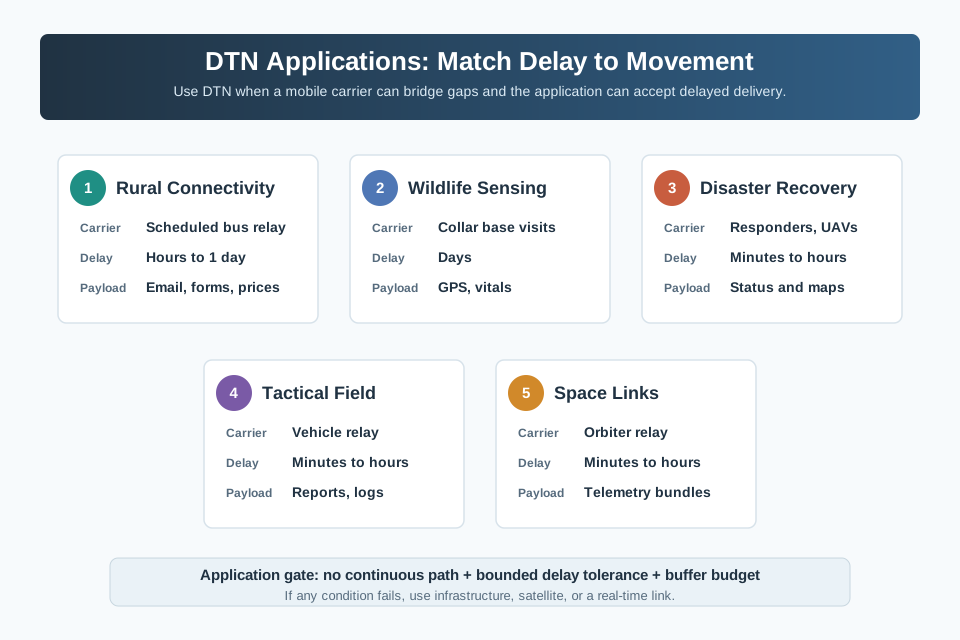
Mobile summary: DTN applications all share the same design shape: no continuous path, a mobile carrier that can physically bridge gaps, buffered payloads, and an application that accepts delayed delivery.
Carrier path
Name the bus, collar, responder, UAV, spacecraft relay, or other mobile system that physically bridges disconnected islands.
Delay budget
State the acceptable delivery window in minutes, hours, or days before choosing a routing pattern.
Payload value
Confirm that delayed delivery is still useful for the farmer query, wildlife record, survey file, or science observation.
31.14 Deployment Record
A deployable DTN use case needs more than a story about intermittent links. Record the movement schedule, storage plan, priority policy, and fallback path so the team can retest the design when conditions change.
Start with a contact budget. For each expected carrier encounter, record the earliest and latest arrival time, expected contact duration, conservative link rate, setup overhead, and the backlog that must move during that window. If a route provides 300 seconds at 80 kbps, the theoretical payload budget is about 3 MB before protocol overhead, retransmissions, and link margin. The deployable budget should be lower than the arithmetic maximum.
Then make the application policy visible. Each bundle class should have a lifetime, priority, maximum local storage share, and behavior when the contact window is shorter than planned. A clinic might send appointment reminders and inventory updates by bus-carried DTN, but reserve cellular, satellite, or radio voice for emergency alerts. A wildlife study might prioritize low-rate collar summaries before large image files so the smallest useful data moves first.
The review artifact should also name the owner of the buffer. A sensor node, handheld gateway, vehicle computer, or base station may be responsible for holding bundles for hours or days. That device needs power budget, storage health monitoring, clock quality for expiry decisions, and a way to report dropped or expired payloads. Without that record, a field failure looks like "the network lost data" even when the real cause was a full flash partition or expired queue.
Contact model
Document expected carrier visits, contact duration, link rate, and worst-case gap between upload opportunities.
Buffer plan
Size local storage for own data, relay data, protocol overhead, retries, and the longest credible isolation period.
Priority rule
Define which messages transfer first, which expire, and which can be dropped when the contact window is shorter than expected.
Fallback boundary
Separate non-urgent DTN traffic from emergency, safety, medical, or control traffic that needs a direct channel.
31.15 Under the Hood: Why Good Fits Still Fail
Most DTN application failures are not caused by the store-carry-forward idea itself. They come from weak assumptions about movement, value decay, storage pressure, security, and operational ownership.
Bundle Protocol version 7, standardized in RFC 9171, makes those assumptions concrete by carrying endpoint identifiers, creation time, lifetime, destination, source, and forwarding metadata in a stored bundle. The lifetime field matters because a late bundle can be worse than no bundle: it can update a dashboard with obsolete state or trigger a workflow after the useful window has passed. Application logic should therefore treat expiry as a normal outcome, not an exceptional crash.
Forwarding policy is another failure surface. Scheduled contacts, such as spacecraft ground passes, can use a known contact plan. Opportunistic contacts, such as field vehicles or animal-borne relays, need measured encounter probabilities and conservative replication rules. Epidemic forwarding can improve delivery probability, but it also multiplies buffer pressure and energy use. A production design should state when to replicate, when to keep one copy, and when to delete a stale or low-priority bundle.
Security also changes shape because bundles rest on intermediate carriers. Payload confidentiality and integrity should be designed with Bundle Protocol Security, RFC 9172, or an equivalent end-to-end protection model, not left to the assumption that every relay is trusted. Operators also need audit evidence: which node accepted the bundle, which contact forwarded it, when it expired, and whether any payload was dropped under pressure.
- Movement drift: a bus route, animal migration, patrol pattern, or satellite window can change after deployment.
- Value decay: a payload that was useful after one hour may be useless after one day.
- Storage pressure: relay buffers fill first when every node carries other nodes' backlog.
- Security exposure: bundles spend time at intermediate carriers, so payload protection and custody records matter.
Checkpoint: Deployment Record
You now know:
- A usable DTN record names the carrier path, delay budget, payload value, buffer plan, priority rule, and fallback boundary.
- Bundle lifetime and expiry are application decisions, not cleanup details, because stale data can be worse than missing data.
- Security must cover stored bundles at intermediate carriers with end-to-end protection and audit evidence.
31.16 Summary
This chapter covered real-world DTN applications and deployment scenarios:
- Rural Connectivity: DakNet-style systems use buses or vehicles as data mules to connect villages without infrastructure, accepting 24-48 hour latency for email and information queries
- Wildlife Tracking: ZebraNet demonstrates opportunistic data collection from animals using GPS collars that exchange data when animals encounter each other, with 3-7 day acceptable latency
- Military Tactical: Soldiers, vehicles, and UAVs form DTN networks in infrastructure-free hostile environments with jamming and high mobility
- Space Networks: NASA’s Deep Space Network uses DTN principles (Bundle Protocol) to handle light-speed delays and planetary occlusion for Mars communication
- Disaster Recovery: Post-disaster scenarios leverage responder nodes, drones, and survivor phones for communication when infrastructure is destroyed
- Hybrid Architectures: Modern deployments combine infrastructure (low latency) with DTN (coverage gaps and fallback), using mobile collectors to bridge disconnected areas
- Application Selection: DTN is suitable when applications can tolerate minutes-to-days latency; unsuitable for real-time streaming, voice, or financial transactions
31.17 What’s Next
- To learn DTN fundamentals and store-carry-forward, read DTN Store-Carry-Forward.
- To study epidemic routing algorithms, read DTN Epidemic Routing.
- To explore social routing for DTN, read DTN Social Routing.
- To compare with ad hoc routing protocols, read Ad-Hoc Multi-Hop Routing.
- To revisit ad hoc production readiness, read Ad-Hoc Production Readiness.
31.18 Key Takeaway
DTN applications should be designed around delayed delivery, local storage, custody decisions, and priority. If the mission can tolerate delay, intermittent connectivity becomes a design condition instead of a failure.