2 Infrastructure-Free Networking
2.1 Start Simple
Start with devices that have to pass useful data before any fixed network is guaranteed. In Infrastructure-Free Networking, the first question is not the protocol name; it is which neighbors, routes, failure signals, and degraded behaviors you would trust in the field.
2.2 Start With No Infrastructure
An ad-hoc network starts with devices that cannot assume an access point, gateway, or fixed route is waiting for them. They have to discover neighbors, exchange state, and build enough local agreement to move useful data.
That is the field story behind emergency sensors, temporary worksites, mobile robots, and pop-up monitoring. Start with two devices meeting in the field, then decide what they must learn before trusting each other to forward traffic.
2.3 Ad-Hoc Without Infrastructure
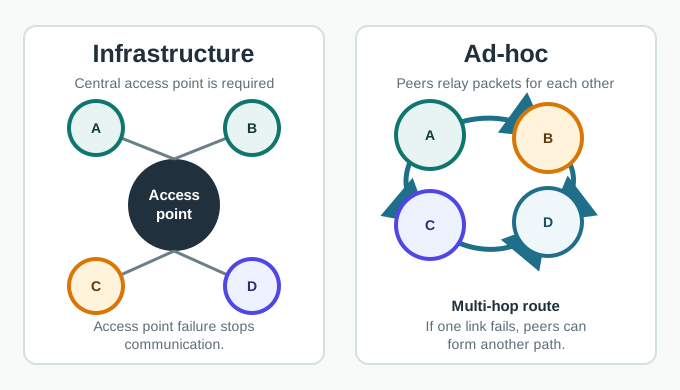
An ad-hoc network is a wireless network that can form without a pre-installed access point, base station, or fixed router. Nodes discover nearby peers, exchange messages directly when they can, and may forward traffic for other nodes when the destination is out of direct radio range.
The concept is useful in IoT because many field systems cannot assume stable infrastructure at the moment data is produced. Emergency teams may arrive before communications are restored. Sensors may be deployed in remote terrain. Vehicles, robots, or UAVs may move faster than a fixed coverage plan can follow. In those cases, the network has to be treated as a temporary, local, changing system instead of a static service.
The gateway question is separate from the local-formation question. A mesh may eventually hand data to Ethernet, Wi-Fi, LTE, satellite, or a vehicle gateway, but the ad-hoc claim is about what happens before that exit path is reachable: neighbor discovery, relay choice, local buffering, and repair.
No fixed anchor
The network can start from the devices that are present. A gateway may still exist, but the local network is not defined by one permanent access point.
Peer forwarding
A node can be both an endpoint and a relay. That forwarding role is what lets the network reach beyond one radio hop.
Changing paths
Routes may change when nodes move, batteries fail, interference appears, or an operator places a relay in a better location.
Shared wireless cost
Every relay hop consumes airtime, energy, and buffer space. More paths do not automatically mean more usable capacity.
2.4 Ad-Hoc Design Before Protocol
A practical ad-hoc design starts with the operating record: who is moving, what must be delivered, what infrastructure cannot be assumed, and what the gateway exit looks like when a gateway is available. Only then should the team choose between proactive, reactive, hybrid, geographic, or delay-tolerant approaches.
The record should be small enough for a design review but specific enough to test. It should separate the local mesh claim from the end-to-end service claim. A packet reaching a nearby relay does not prove that the message reaches the operator, cloud system, or actuator in time.
2.5 Discovery, State, Airtime, Repair
Under the hood, an ad-hoc network is a set of local control loops. Nodes discover neighbors, decide which links are usable, maintain or discover paths, forward packets, and repair routes when the topology changes. The exact protocol may differ, but the evidence questions are similar across the family.
Proactive routing keeps path state ready before data arrives, which reduces first-packet delay but spends control traffic even when the application is quiet. Reactive routing discovers a path when data needs one, which can reduce idle overhead but adds discovery delay and can flood the local network. Hybrid and geographic methods try to contain that overhead by limiting what must be maintained or discovered. Delay-tolerant designs go further: they accept that no continuous path may exist and use store-carry-forward behavior instead.
Stale state is the common failure mode behind many confusing field bugs. A node can keep forwarding into a route that no longer exists, retry a neighbor that is asleep, or deliver a message after its decision window has expired. Repair policy therefore needs timers, sequence or freshness evidence, and an application rule for when to stop retrying.
Discovery
Nodes learn which peers are reachable now. Link quality, movement, interference, and duty cycling all affect whether a neighbor is useful.
Path state
The protocol either maintains paths ahead of time, discovers them on demand, limits state to a zone, uses location hints, or stores data until contact.
Forwarding cost
Each hop shares the same wireless medium, consumes energy, and can add loss or delay. Shorter radio hops are not free if they create too many relays.
Repair
When a link breaks, the system must detect the break, avoid stale paths, and either reroute, buffer, retry, or declare the message undeliverable.
For IoT, the hardest part is often not route discovery itself. It is proving that the chosen repair behavior fits the application. A wildlife tracker can tolerate long delay if eventual delivery is enough. A safety alert, actuator command, or operator alarm may need a different architecture because stale delivery can be worse than no delivery.
2.6 Summary
Ad-hoc networking is a design choice for local communication when fixed infrastructure cannot be assumed. It lets nodes form peer relationships, relay traffic, and adapt to movement or failure, but it also shifts responsibility to the device mix, routing protocol, forwarding load, gateway exit, and repair behavior. A defensible IoT design records those facts before it claims that an ad-hoc approach is appropriate.
2.7 Key Takeaway
Ad-hoc networks are valuable when local formation and peer forwarding fit the operating problem, but they are proven by evidence of discovery, relay cost, route repair, gateway handoff, and degraded behavior, not by the wireless label alone.
2.8 See Also
Compare proactive, reactive, and hybrid routing choices after the operating record is clear.
Map ad-hoc networking to emergency response, sensing, vehicles, and mobile systems.
Use delay-tolerant networking when no continuous end-to-end path can be assumed.
See how mobility and aerial relays change ad-hoc assumptions in FANET-style systems.