16 DTN Applications: Missions and Deployment Patterns
More
Depth: Practitioner
Progress saves as you read. Mark sections complete as you go; your progress appears in the sidebar.
16.1 Overview
This section: Overview — This first route compares real disrupted-network missions and decides when delayed delivery is useful rather than a failure.
This first route compares real disrupted-network missions and decides when delayed delivery is useful rather than a failure.
This is part 1 of 2. Continue with DTN Applications: Buffers, Contacts, and Field Operations for the second focused route.
16.2 Start Simple
This section: Start Simple — Picture wildlife collars that meet only when two animals pass, then reach a ranger’s truck once a day.
Match Delay to the Mission Before Choosing the Route
Picture wildlife collars that meet only when two animals pass, then reach a ranger’s truck once a day. A location record can wait, while a snare alarm may need the first trusted contact. The field lead must decide how long each message may live and how many copies the network may carry.
Write one mission record per message class. Name the source, value, priority, expiry time, store limit, allowed copies, and person who needs it. State whether an intermediate device may hold it and what receipt proves that custody or final delivery changed hands.
Test long gaps, short meetings, full stores, dead batteries, repeated copies, false clocks, a lost carrier, and a late base visit. Check that high-value messages move first, expired data stops moving, duplicates do not create false events, and the ranger can see what was delayed or lost.
Do not send an urgent safety need through a path whose normal delay is longer than the safe response. Use a local fallback, another link, or a clear human plan for that case. A delayed path is useful only when its limits match the job.
This opening does not predict every contact or prove a field schedule. Practitioner turns the mission into a store, carry, and delivery trial. Under the Hood examines contact plans, queues, copies, custody, energy, and the math behind delivery chance.
Use this field delay check:
- Name the field task.
- Name the end user.
- Name each message class.
- Rank the message worth.
- Set each wait limit.
- Set each life limit.
- Set the store limit.
- Set the copy limit.
- Mark the first holder.
- Mark each next holder.
- Mark the final reader.
- Keep the source name.
- Keep the event time.
- Keep the last hop.
- Keep the hand-off time.
- Keep the receipt state.
- Fill the local store.
- Lose the next meet.
- Shorten the next meet.
- Move the base visit.
- Stop one field node.
- Drain one field cell.
- Repeat one old item.
- Send one late item.
- Send one false time.
- Send two like copies.
- Check which moves first.
- Check which waits next.
- Check which must stop.
- Check what gets dropped.
- Check what gets kept.
- Check the user view.
- Keep urgent work apart.
- Keep a local plan.
- State each route limit.
- State each proof gap.
- Name the retest event.
- Reopen when waits change.
- Reopen when worth changes.
- Reopen when routes change.
- Reopen when sites change.
16.3 Start With the Delay the User Can Live With
This section: Start With the Delay the User Can Live With — A DTN application succeeds only when the delay matches the job.
A DTN application succeeds only when the delay matches the job. Wildlife data, rural health records, ferry telemetry, and disaster reports can tolerate different waiting times and different risks of loss.
Start with the user’s patience and the value of the message. Then choose custody, replication, priority, storage, and delivery evidence that match the real deployment rather than an always-connected network ideal.
This chapter moves from fit to field proof:
- First decide whether the mission can accept delayed delivery and which traffic must bypass DTN.
- Then compare rural, tactical, wildlife, hybrid, space, and disaster deployments.
- Next size buffers and contact windows with the ZebraNet-style collar example.
- Finally turn those examples into a deployment record, failure-mode checklist, and application selection rule.
Checkpoints recap the path as you go. Deep-dive sections and interactives give extra practice after the main idea is clear.
- DTN applications excel where no continuous path exists but a scheduled or opportunistic carrier can eventually bridge the gap: spacecraft relays, rural buses, animal collars, response teams, underwater vehicles, and road fleets
- The key decision factor is latency tolerance: DTN suits applications accepting minutes-to-days delay; real-time streaming and voice calls are unsuitable
- Hybrid architectures combine traditional infrastructure (where available) with DTN (for coverage gaps and fallback), using mobile collectors to bridge disconnected areas
“Imagine you live on an island with no phone service,” Temperature Terry said, sitting on a beach. “How would you send a message to another island?”
“Easy!” said the microcontroller. “Write a message, put it in a bottle, and toss it in the ocean. Someone on a passing boat might pick it up and carry it closer to your friend’s island!”
the battery nodded. “That’s exactly how DTN applications work! In Kenya, zebras with GPS collars pass messages to each other when they meet at watering holes. It might take days, but the data eventually reaches the scientists!”
the LED lit up green. “And in rural India, buses carry internet messages between villages that have no phone towers. The bus is like the bottle floating between islands — slow, but it works when nothing else can!”
Real examples the Squad loves:
- ZebraNet: Zebras share GPS data when they bump into each other — takes 3-7 days but scientists get their migration data!
- DakNet: Buses carry emails between villages in India — 24-hour delivery is fine for crop price questions!
- Space mail: Mars rovers use DTN to send photos to Earth — even 24-minute delays are handled!
16.4 Learning Objectives
This section: Learning Objectives
By the end of this chapter, you will be able to:
- Classify DTN Use Cases: Distinguish scenarios where DTN provides unique value over traditional networking
- Design Rural Connectivity: Apply DTN architectures for developing region connectivity solutions
- Configure Wildlife Tracking: Implement opportunistic forwarding for animal monitoring deployments
- Plan Hybrid Architectures: Combine infrastructure and DTN for robust fault-tolerant systems
- Evaluate Deployment Trade-offs: Assess latency tolerance against infrastructure costs quantitatively
16.5 Prerequisites
This section: Prerequisites
Before diving into this chapter, you should be familiar with:
- DTN Fundamentals: Understanding store-carry-forward is essential for application design
- DTN Epidemic Routing: Knowledge of flooding-based routing helps understand when it’s appropriate
- DTN Social Routing: Context-aware routing provides efficient alternatives for many applications
- DTN Application Domains: Space communication, rural and remote connectivity, wildlife tracking, disaster response, underwater sensing, and vehicular opportunistic networks
- Delay-Tolerant E-mail: Messaging that accommodates hours-to-days of delivery delay; uses store-and-forward with eventual delivery
- Data Mule: A mobile node (vehicle, animal, robot) that physically carries data between disconnected network islands
- Interplanetary Internet: NASA-developed application of DTN principles for Mars-Earth communication with 4-24 minute one-way delays
- Epidemic Routing in Practice: Uncontrolled message replication that floods available storage; tradeoff between delivery probability and resource consumption
- Social-Aware Routing: Routing decisions based on contact history, social centrality, and community detection rather than network topology
- Application Buffer Management: Prioritizing which messages to keep when storage is full; drop-oldest, drop-least-used, or priority-based policies
- Bundle Protocol: IETF standardized DTN protocol (RFC 9171) providing end-to-end delivery over intermittent connections
16.6 Selection Workflow: For Beginners: DTN Applications
When to Use DTN:
- Wildlife tracking (animals rarely meet)
- Disaster recovery (infrastructure down)
- Space networks (extreme delays)
- Rural connectivity (intermittent access)
When NOT to Use DTN:
- Video streaming (requires continuous connection)
- Real-time gaming (cannot tolerate delays)
- Emergency alerts (need immediate delivery)
Real Examples:
- DakNet (India): Buses carry internet data to villages - 24h latency acceptable for email/queries
- ZebraNet (Kenya): GPS collars on zebras exchange data when animals meet - 3-7 day latency acceptable for migration studies
DTN Series:
Store-carry-forward concepts.
Flooding strategies for high delivery.
Efficient context-aware forwarding.
WSN deployments in harsh environments.
Aerial DTN applications.
Applications:
- IoT Application Domains - DTN use cases
- Wildlife Tracking Examples - Real-world DTN
Architecture:
- Wireless Sensor Networks - WSN in sparse deployments
- FANET Fundamentals - Aerial DTN applications
- Mobile Phone Gateway Fundamentals - Mobile DTN carriers
Learning:
- Simulations Hub - DTN simulators
16.7 Applications of DTN Routing
This section: Applications of DTN Routing — Start with deployment shape, not routing jargon.
Start with deployment shape, not routing jargon. Each example below asks the same question: which moving carrier can bridge the gap, and what delay can the application honestly tolerate?
16.7.1 Remote and Developing Regions
Scenario: Rural Agricultural Extension Service
The rural relay figure turns a daily bus route into a network path. Read it from a village kiosk on the left, through the bus in the centre, to the connected district hub on the right, and then follow the return journey. The important feature is that request and response travel in different contact windows; there is never a continuous village-to-internet session.
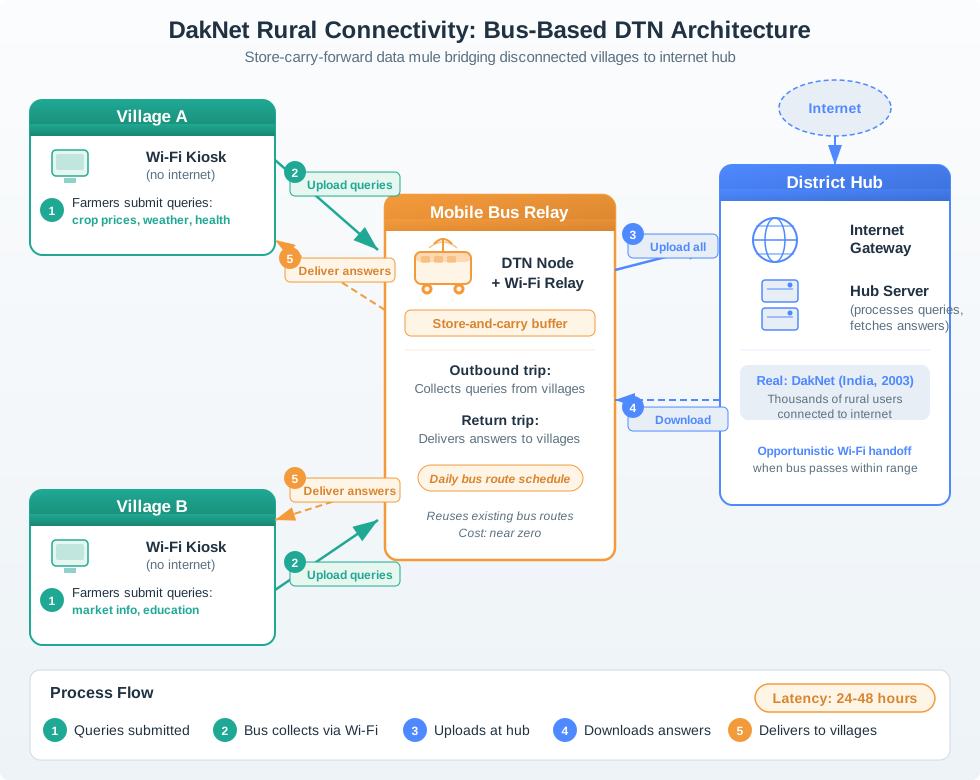
Mobile summary: A village kiosk stores farmer queries, a scheduled bus collects them over Wi-Fi, the bus syncs at the district hub, and answers return on a later village pass. The latency is hours to a day, but the service works without continuous backhaul.
At the first village contact, the kiosk transfers a backlog rather than opening an end-to-end connection. The bus then becomes the custodian while physically moving toward the hub. Internet processing happens only after the hub sync, and the reply waits for another bus pass. This makes the 24–48 hour service target an application property tied to the timetable, not a packet-level latency claim.
Operation:
- Villages have Wi-Fi kiosks but no internet
- Farmers submit queries (crop prices, weather, health questions)
- Bus with Wi-Fi node drives daily route
- Bus collects queries from villages
- At hub, bus uploads queries to internet gateway
- Responses downloaded to bus
- Bus delivers responses on return route
Real Implementation: DakNet (2003), India
- Latency: 24-48 hours (acceptable for non-urgent queries)
- Cost: Extremely low (reuses existing bus routes)
- Impact: Thousands of rural users connected
16.7.2 Selection Workflow: Military Tactical Networks
Challenged Environment:
- No infrastructure
- Jamming and interference
- High mobility
- Intermittent connectivity
- Hostile territory
DTN Solution:
- Soldiers carry handheld DTN nodes
- Vehicles act as mobile relays
- UAVs provide aerial data mules
- Opportunistic forwarding when in range
- Store-and-forward tolerates disconnections
16.7.3 Sensor Systems
Wildlife Tracking Example:
The wildlife figure shows a path assembled from animal encounters. Begin with collar A storing its own readings, follow the peer exchange at a watering-hole encounter, and finish where collar B later enters base-station range. Ask which device holds the only useful copy at each step and what happens if the second encounter occurs after the bundle expires.
Inspect Figure 16.2 and look for how an animal encounter substitutes for a continuous network path.
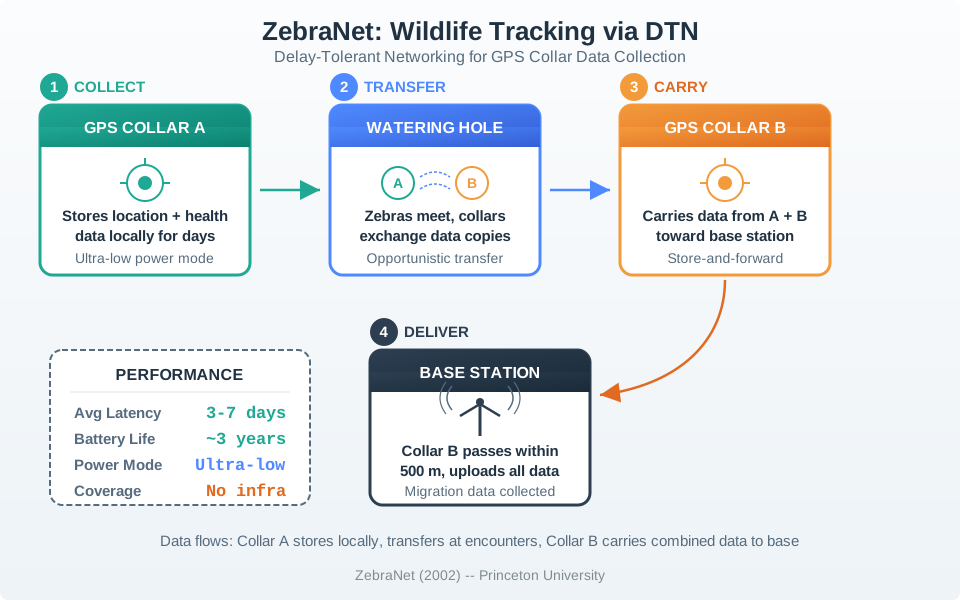
Follow Figure 16.2 from collar A to collar B and the base station. A stores place and health data because no full path exists. At the water hole, A gives B a copy. B carries it until the animal comes within 500 m of the station. A delay of three to seven days may suit a migration record, but it cannot support urgent control. Long storage and rare sends also protect the battery. Set copy, expiry, and contact rules from the data’s delay limit, then save which carrier held the useful copy at each step.
Mobile summary: Each collar stores its own readings, exchanges copies during animal encounters, and uploads the combined backlog when any carrier reaches a base station. This trades immediate visibility for low-power multi-day collection.
The diagram’s arrows are separated in time. The first contact does not deliver the record; it changes which animal can carry it toward a sink. The later base-station contact completes data homing. Replication improves the chance that some carrier reaches the sink, while copy limits and expiry prevent old observations from consuming every collar’s flash and radio budget.
ZebraNet (2002):
- GPS collars on zebras
- Collect location/movement data
- Store locally for weeks
- Transfer opportunistically when zebras encounter each other
- Download to base station when animals visit watering hole
- Battery budget: ~3 years
DTN Benefits:
- No need to track every animal continuously
- Data eventually reaches base station
- Ultra-low power (mostly storage, rare transmissions)
The routing lesson is broader than the zebra example. Encounters are created by animal movement rather than by a network operator, so a collar cannot assume which peer will next reach a sink. Replication can raise delivery probability, but every extra copy consumes flash, airtime, and battery. A field design therefore measures encounter traces, caps replicas, expires stale observations, and gives compact health or location summaries priority over bulky payloads.
16.7.4 Underwater Sensing
Seafloor instruments, drifting sensors, autonomous underwater vehicles (AUVs), and surface gateways rarely form a stable end-to-end path. Acoustic links propagate slowly, offer limited throughput, and vary with range and water conditions; surfacing or close-range optical and radio contacts provide faster but brief transfer opportunities. A DTN node can keep timestamped observations in persistent storage until an AUV visits, the instrument surfaces, or a gateway contact becomes usable.
DTN earns its keep here because waiting is part of the sampling mission. A temperature or salinity time series may remain valuable after hours or days, while a closed-loop safety command may not. Routing must distinguish scheduled AUV tours from uncertain drift encounters, reserve storage for the longest credible collection gap, and move small status summaries before raw sonar or imagery when a contact window closes early. Underwater DTN is therefore a data-retrieval architecture, not a promise that an intermittent acoustic link can support real-time control.
16.7.5 Vehicular Opportunistic Networks
Vehicles can be both data sources and mobile carriers. Buses, service fleets, delivery vehicles, and roadside units meet along partly predictable routes, allowing traffic observations, road-condition reports, map updates, or remote-site telemetry to move between otherwise disconnected islands. A bundle may travel in a vehicle for part of a route, transfer during a short roadside contact, and reach a fixed gateway through a later vehicle encounter.
The useful routing evidence is route regularity, direction of travel, destination progress, contact duration, and buffer pressure—not simply that two vehicles are close now. Epidemic copying can overwhelm crowded urban fleets; single-copy forwarding can strand a bundle on a vehicle leaving the useful corridor. Bounded-copy or context-aware forwarding is often the practical middle ground, while collision warnings and coordinated driving remain outside the DTN delay budget and require a direct low-latency path.
16.7.6 Hybrid Models
Modern IoT deployments often combine infrastructure and DTN:
Smart City Hybrid:
The hybrid figure separates three operating states. Read the left zone as ordinary connected service, the centre as a coverage gap crossed by mobile storage, and the lower path as degraded-mode behavior when infrastructure fails. The same payload may change forwarding mode at a zone boundary, so policy must preserve its identity, priority, lifetime, and security across both stacks.
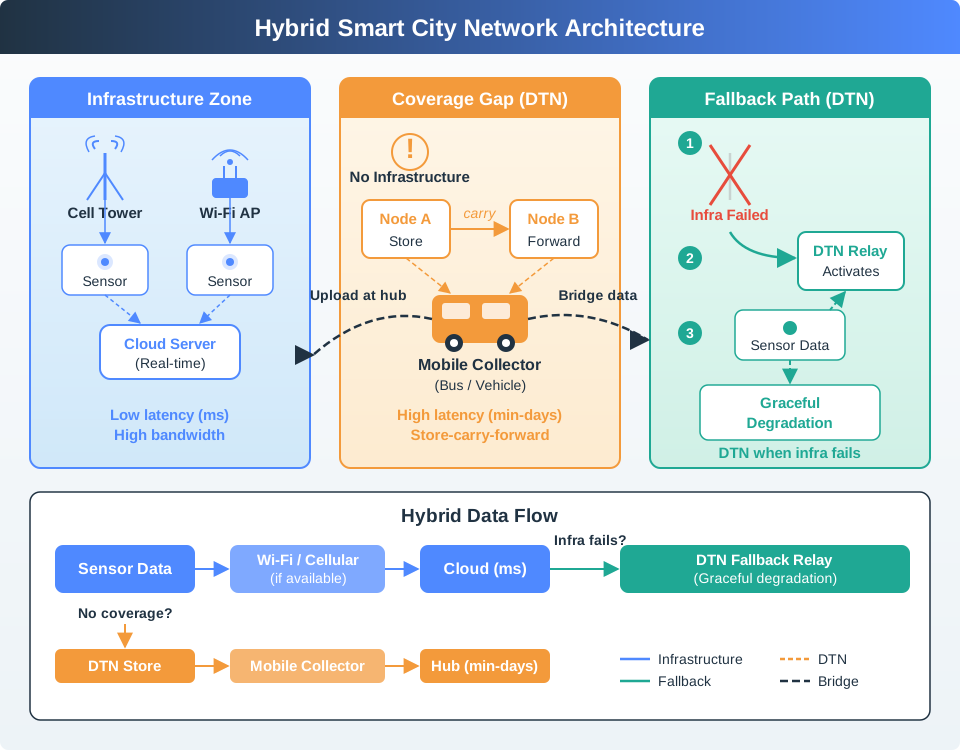
Mobile summary: A hybrid deployment uses Wi-Fi or cellular where coverage exists, DTN mobile collectors where it does not, and fallback DTN paths when the primary infrastructure fails.
The central carrier is not a slower router on a continuous path; it is persistent storage in motion. The fallback arrow likewise represents a deliberate service downgrade, not instant failover with unchanged latency. A sound hybrid design tells the application when it has entered delayed mode and keeps commands that cannot wait off that path.
Why Hybrid?
- Infrastructure where available (low latency, high bandwidth)
- DTN for coverage gaps (no infrastructure cost)
- Mobile nodes bridge gaps
- Graceful degradation (DTN fallback if infrastructure fails)
16.7.7 Space Networks
Interplanetary Communication:
- Light-speed delays: Mars is 4-24 minutes away
- Planetary occlusion: No line-of-sight during planet rotation
- Relay satellite handoffs
- Bundle Protocol (RFC 9171) standardizes modern DTN bundle delivery
NASA Deep Space Network:
- Uses DTN principles for Mars rovers
- Store data during blackouts
- Forward when Earth visible
- Tolerates hours of disconnection
Space DTN differs from most terrestrial opportunistic networks because many contacts are predicted. Orbiter passes, ground-station visibility, occultation, and link-rate changes can be represented as a contact plan, so routing can select a path that exists over time rather than flooding copies in hope of an encounter. Persistent storage and bundle lifetime still matter: a missed pass can shift delivery to the next opportunity, and an observation must remain useful when it arrives.
16.7.8 Disaster Recovery
Post-Disaster Scenarios:
- Cell towers destroyed
- Power grid down
- Roads blocked
- First responders need communication
DTN for Disaster Response:
- Responders carry DTN nodes
- Drones provide aerial relay
- Survivor phones act as DTN nodes
- Messages eventually reach command center
- Better than no communication
The application boundary must be explicit. Situation reports, shelter inventories, photographs, and family-welfare messages may tolerate delayed carriage by responders or UAVs. Mayday traffic, evacuation commands, and live medical coordination cannot inherit the same assumptions. Disaster DTN should therefore expose message age, expiry, custody, and delivery state to operators rather than presenting eventual delivery as if it were an ordinary connected chat service.
 Checkpoint: Application Fit
You now know:
- Rural connectivity can accept 24-48 hour delivery when the payload is a non-urgent query or response.
- Wildlife tracking can accept 3-7 day average delivery when collars keep local records and upload opportunistically.
- Disaster and tactical systems need DTN for degraded communication, but urgent alerts still need a direct or higher-priority path.
- Underwater and vehicular systems must separate delay-tolerant observations from real-time control or safety traffic.
16.8 Knowledge Check
This section: Knowledge Check
16.9 Continue to Part 2
This section: Continue to Part 2 — Continue with DTN Applications: Buffers, Contacts, and Field Operations.
Continue with DTN Applications: Buffers, Contacts, and Field Operations.
Find help
3 reviewed answers.
Where should I start in a module?
Open the module page from the sidebar to see its chapters in order. Use the module map to return to a topic you need.
Modules and pathsReviewed
What can I try when a project does not work?
Check the symptom, then work through the diagnostic steps. Keep the error message and the smallest example that reproduces it.
When you are stuckReviewed
How do interactive examples work?
Use the interactive guide to check how examples and simulations work before changing your project.
Interactive examples guideReviewed