15 DTN Social Routing: Community and Forwarding Decisions
More
Depth: Practitioner
Progress saves as you read. Mark sections complete as you go; your progress appears in the sidebar.
15.1 Start With the Decision
This section: Start With the Decision — A popular node is not always the best carrier for a given community.
A popular node is not always the best carrier for a given community. Social routing must balance group relevance, spread, and delivery cost.
15.2 Route Overview
This section: Route Overview — This is part 2 of 2.
This is part 2 of 2. Review DTN Social Routing: Contact and Utility Models for the preceding evidence.
15.3 Learning Objectives
This section: Learning Objectives
- Explain community-aware SocialCast forwarding.
- Evaluate social metrics and replication trade-offs.
15.4 Chapter Roadmap
This section: Chapter Roadmap
- SocialCast: Social-Based DTN Routing
- Figure Summary: SocialCast Workflow
- Figure Summary: Gamma Trade-off
- Resource-Aware Teaching Score Calculation
- Checkpoint: SocialCast Discipline
- Test Your Understanding
- Resource-Aware Teaching Score Explorer
- SocialCast Advantages for IoT
- Knowledge Check
- Quiz: SocialCast Protocol
- Community Mesh Routing
- Case Study: Community-Managed Mesh Links
- Concept Relationships
- See Also
- Interactive Quiz: Match Concepts
- Interactive Quiz: Sequence the Steps
- Common Pitfalls
- Social Contacts Are Not Stable
- Social Centrality Without Full Map
- Social Routing Beyond Humans
- Contact Tracking Privacy Risks
- Label the Diagram
- Code Challenge
- Summary
- What’s Next
- Key Takeaway
15.5 SocialCast: Social-Based DTN Routing
This section: SocialCast: Social-Based DTN Routing — SocialCast extends CAR by exploiting social network structures for packet dissemination.
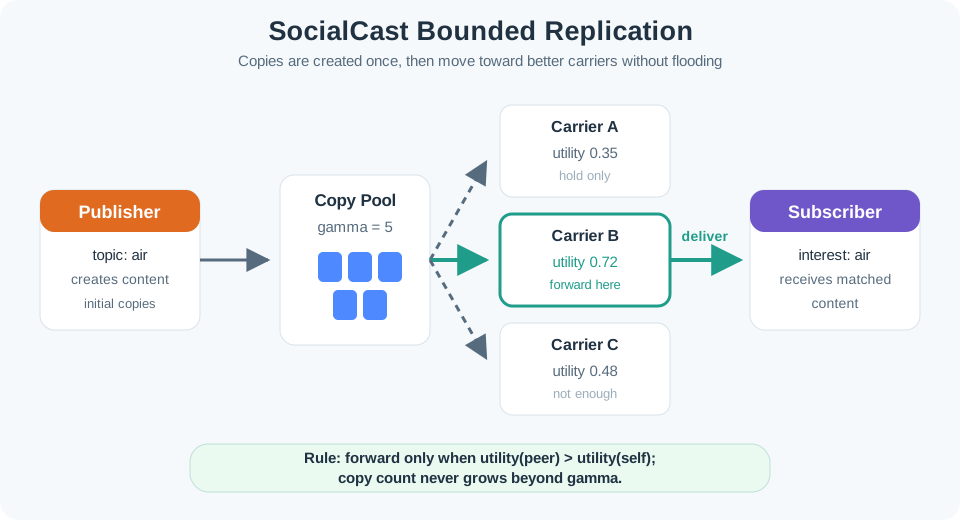
SocialCast extends CAR by exploiting social network structures for packet dissemination.
This section:
15.5.3 SocialCast Performance
Delivery and overhead vs replicas:
Inspect Figure 15.2 and look for the range where delivery gain begins to flatten while copy costs continue rising.
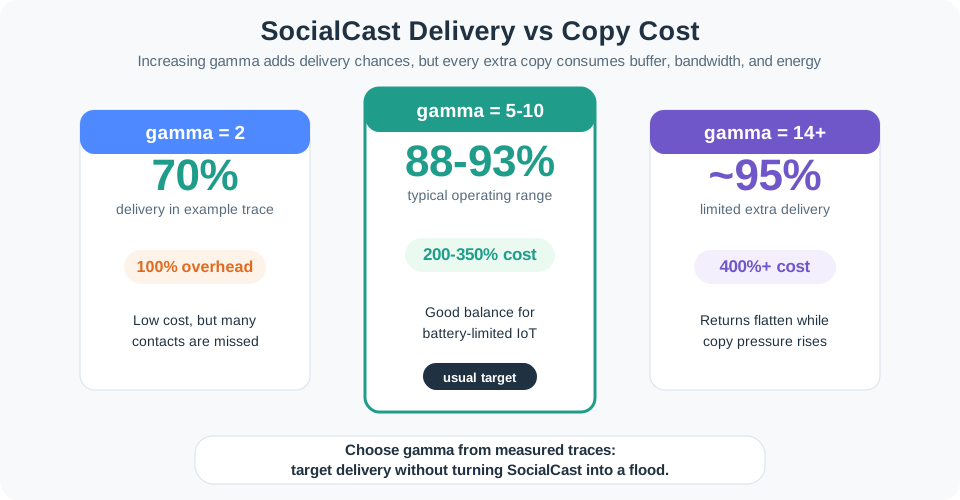
Read Figure 15.2 from the first added copy to the marked gamma range. Delivery rises at first, then the gain starts to flatten near five to ten copies. Storage, contact time, and energy still rise after that point. In the illustrative trace, bounded copies give 88% to 93% delivery with 200% to 350% overhead. In that illustrative trace, epidemic spread gives 95% delivery with 800% to 1,200% overhead. Those values describe one case, not a default. Choose gamma from the delivery need and resource limits, then test whether each later copy adds a new contact path worth its cost.
This section:
 Checkpoint: SocialCast Discipline
You now know:
- SocialCast creates gamma replicas once, then moves existing copies only when a neighbor’s interest-specific utility exceeds the current carrier’s by the configured hysteresis margin ; it does not grow the copy count like epidemic routing.
- The illustrated 5–10 replica setting aims for 88–93% delivery with 200–350% overhead in this trace, versus the illustrated epidemic 800–1,200% overhead.
- Transfer a copy when the neighbor’s utility for the message’s interest exceeds the current carrier’s utility by the configured hysteresis margin ; deliver directly to interested subscribers when encountered.
15.6 Resource-Aware Teaching Score Explorer
This section: Resource-Aware Teaching Score Explorer
Adjust the weights and node parameters to see how the utility score changes:
15.8 Knowledge Check
This section: Knowledge Check
15.11 See Also
This section: See Also
Common Pitfalls
This section: Common Pitfalls
Social routing relies on contact history as a predictor of future contacts. Work schedules, commuting patterns, and social behavior change over weeks and months. Routing decisions based on stale contact history (months old) may be less accurate than routing based on current network state. Implement contact history decay to weight recent contacts more heavily.
Betweenness centrality requires global network graph knowledge — knowing all nodes and their interconnections. In a distributed DTN, this information is unavailable. Practical social routing uses local approximations (encounter counts, two-hop neighbor counts) that underestimate true centrality.
Social routing exploits human mobility patterns (workplace, home, social events). Animal tracking, vehicle networks, or robot swarms have different mobility patterns that may not exhibit the community structure social routing exploits. Always validate that the target environment exhibits social-like contact patterns before applying social routing.
Social routing requires nodes to share and track contact history. This creates detailed records of who met whom and when — personal location data. Deployments must consider privacy implications and anonymization techniques. Publishing contact graphs can reveal sensitive information about individuals’ movements.
15.12 Checkpoint: Summary
This section: Checkpoint: Summary
This chapter covered context-aware and social-based DTN routing:
- Context-Aware Routing (CAR) uses utility functions combining colocation, mobility, social, and resource evidence to choose carriers; in the chapter’s illustrative trace, it gives 88–93% delivery with 200–350% overhead.
- Resource-Aware Teaching Score: This separate example ranks carriers using normalized encounter-frequency, mobility, and resource inputs; it is not a calibrated delivery probability
- Colocation Prediction: Kalman filters use past encounter history to predict future contact probabilities, enabling “smart” forwarding
- SocialCast Protocol: Creates bounded gamma replicas and transfers copies when interest-specific utility exceeds the current carrier’s by hysteresis margin , delivering directly to interested subscribers
- Performance Optimization: In the illustrative trace, gamma = 5–10 copies gives 88–93% delivery with 200–350% overhead, versus 95% delivery and 800–1,200% overhead for epidemic replication.
- IoT Suitability: SocialCast works well for IoT due to natural device clustering, predictable mobility patterns, resource efficiency, and local decision scalability
15.14 Key Takeaway
This section: Key Takeaway — Social routing uses repeated contact patterns, communities, or central nodes to improve DTN forwarding.
Social routing uses repeated contact patterns, communities, or central nodes to improve DTN forwarding. It only works when those patterns are real, measured, and acceptable from a privacy and governance standpoint.
15.15 Continue Your Route
This section: Continue Your Route — This is the last part of this chapter.
This is the last part of this chapter. Return to DTN Social Routing: Contact and Utility Models or continue from the emerging-paradigms module index.
Find help
3 reviewed answers.
Where should I start in a module?
Open the module page from the sidebar to see its chapters in order. Use the module map to return to a topic you need.
Modules and pathsReviewed
What can I try when a project does not work?
Check the symptom, then work through the diagnostic steps. Keep the error message and the smallest example that reproduces it.
When you are stuckReviewed
How do interactive examples work?
Use the interactive guide to check how examples and simulations work before changing your project.
Interactive examples guideReviewed
15.5.1 SocialCast Concepts
Key Insight: People with similar interests tend to be colocated periodically.
Application: Publish-subscribe in DTN