14 DTN Social Routing: Contact and Utility Models
More
Depth: Practitioner
Progress saves as you read. Mark sections complete as you go; your progress appears in the sidebar.
14.1 Start With the Decision
This section: Start With the Decision — A delay-tolerant node must choose a carrier before an end-to-end path exists.
A delay-tolerant node must choose a carrier before an end-to-end path exists. Contact history and utility scores guide that choice.
14.2 Route Overview
This section: Route Overview — This is part 1 of 2.
This is part 1 of 2. Continue with DTN Social Routing: Community and Forwarding Decisions.
14.3 Part Objectives
This section: Part Objectives
- Compute forwarding utility from contact evidence.
- Compare prediction and context-aware DTN routing.
14.4 Begin With a Better Carrier
This section: Begin With a Better Carrier — A protocol means an agreed set of rules for passing data.
A protocol means an agreed set of rules for passing data. Picture a health team whose staff carry phones between villages. One phone has a report for the clinic. Copying it to every phone may waste space and power. A better first choice may be a person who often reaches the clinic or meets people who do.
Start with a small contact record. Count who met whom, when, and for how long. Name the goal and the useful life of the report. Score two possible carriers with the same facts. Then check the result against a later set of meetings. Record copies, delivery, delay, energy, and any person or group that the rule leaves out.
Past contact can guide a choice, but people change shifts, routes, and habits. A popular carrier can become busy or reveal private patterns. Fewer copies save resources but may miss a rare path. This simple story does not prove that social ties stay stable or that the score is fair. For a social-contact forwarding rule, build a forwarding record and compare choices; check drift, utility maths, privacy, and resource bounds before accepting the result.
Walk the first choice with names on paper. Sam meets Lee each day. Lee visits the clinic twice a week. Jo has more contacts but rarely goes near the clinic. The report expires tomorrow. Lee may be the best next carrier. Now change one fact. Lee starts a new shift. The old score may fail at once. Check age before each use. Check free space. Check power. Check whether the person agreed to this use. Keep a copy count. Keep a stop time. Keep a direct-send choice for rare urgent work.
The field record should stay easy to read. It should say why one carrier won. It should show the facts used that day. It should show who did not get a fair chance. It should show what happened after the copy left. If the report arrives, count the cost as well as the win. If it fails, keep the contact path that was tried. A useful rule learns from both results. It never treats a social score as a fixed fact about a person.
Run a small shadow test before the rule sends real work. Let the old route make the live choice. Let the new rule write only a suggested choice. Compare both with what later happened. Do this across work days, rest days, rain, and shift change. Look for one person who gets too much work. Look for one group that gets poor service. Change the rule or its limits before release.
Give people a clear way to leave the scheme. Remove old contact facts on time. Keep names out where a short device label will do. Limit who can read the contact map. A route plan can expose a human routine. Treat that risk as part of the network cost.
Set a plain stop rule. Stop broad copy when the report arrives. Stop when time ends. Stop when the copy cap is met. Stop when the carrier lacks safe space or power. Log the reason. A stopped copy is not always a failure; it may be the rule protecting the rest of the service.
14.5 Start Simple
This section: Start Simple
14.6 Start With the Node That Usually Meets the Right People
This section: Start With the Node That Usually Meets the Right People — Social routing starts from an observation: in many mobile systems, contacts are not random.
Social routing starts from an observation: in many mobile systems, contacts are not random. Some devices, vehicles, people, or gateways regularly meet the communities that need the message.
For IoT deployments, that pattern can make forwarding more selective than flooding. Start with one carrier and one destination group. The routing question becomes whether past contact evidence is strong enough to trust the carrier with the next copy.
- Begin With a Better Carrier
- Start Simple
- Start With the Node That Usually Meets the Right People
- In 60 Seconds
- Minimum Viable Understanding
- Smart Messenger Service
- Overview: Choose Carriers With Evidence
- Forwarding Record
- Checkpoint: Evidence Before Forwarding
- Why Social Evidence Drifts
- Prerequisites
- Key Concepts
- For Beginners: Social Routing
- Related Chapters
- Context-Aware Routing
- Putting Numbers to It
- Checkpoint: CAR Utility
- Quick Check: Context-Aware Routing
“Instead of telling EVERYONE my message like in epidemic routing,” said Temperature Terry, “what if I only tell people who are LIKELY to meet the person I’m trying to reach?”
the microcontroller snapped his fingers. “Like if you need to send a message to the school librarian, don’t give copies to random strangers — give it to kids who go to that school every day!”
“Exactly!” said the battery. “That’s social routing! Each person gets a ‘usefulness score.’ The kid who visits the library every day scores 0.9 out of 1.0. A random tourist scores 0.1. You only hand your message to high-scoring people!”
the LED added, “And the best part is: you only make 5-10 copies instead of hundreds. Each copy finds its way to a better and better messenger until someone delivers it. It’s like your message ‘climbs’ toward the destination!”
The Squad’s illustrative math: Assume epidemic routing delivers 95% of messages with 1,000% overhead. Assume social routing delivers 88% (seven percentage points lower) with 200% overhead (one fifth of the epidemic example). For battery-powered sensors, that savings means years more battery life!
14.7 Learning Objectives
This section: Learning Objectives
By the end of this chapter, you will be able to:
- Apply Context-Aware Routing: Use utility functions based on mobility, colocation, and resources
- Design SocialCast Protocols: Implement social network-based forwarding with bounded replication
- Calculate Utility Functions: Combine colocation probability, mobility scores, and resource levels
- Optimize Forwarding Decisions: Select carriers based on delivery likelihood rather than flooding
- Evaluate Trade-offs: Balance delivery ratio, latency, and resource consumption
14.8 Overview: Choose Carriers With Evidence
This section: Overview: Choose Carriers With Evidence — If you only need the intuition, this layer is enough: social DTN routing avoids copying every bundle to every contact.
If you only need the intuition, this layer is enough: social DTN routing avoids copying every bundle to every contact. It forwards toward carriers that have measured evidence of reaching the destination, community, or subscriber group.
The word "social" does not mean the protocol guesses from labels such as friend, worker, or student. It means the forwarding decision uses observed contact structure: who meets whom, how recently, how often, for how long, and with what spare storage or battery. A campus shuttle, clinic nurse, field technician, or market bus can become a better carrier because the contact record shows repeated access to the destination group.
The humans behind those carriers usually play one of three overlapping roles in the wider sensing system: they can be the sensing target itself, as in personal health monitoring where the person's own body is what is measured; a sensor operator who carries and points a phone, wearable, or PDA at the surroundings; or a plain data source who shares an observation, such as a status update or a geotagged report, without carrying any dedicated sensor at all. Participatory sensing designs build on that last role deliberately: instead of only harvesting anonymous readings from a crowd, the goal is to let the same community access the aggregated data and act on it, treating the geotag and timestamp as context and checking report authenticity separately. That framing matters for social DTN routing because it explains why device energy, participant selection, and privacy of users are recurring design pressures rather than incidental ones -- the "carrier" scoring this chapter builds on is a person first and a radio second.
The practical benefit is selectivity. Epidemic routing asks whether another node lacks the bundle. Social routing asks whether that node is a better future carrier than the current one, or whether an extra copy is justified by the replica budget. If the peer has weaker evidence, the correct action may be to keep the bundle and wait. That restraint is what saves energy and buffer space.
A useful overview therefore names the destination context as well as the carrier. Forwarding to "a central node" is incomplete; forwarding to a node that reliably reaches the clinic community, the maintenance team, or the bus depot is a measurable claim. The routing record should make that claim visible.
Inspect Figure 14.2 and ask which candidate has the stronger evidence of reaching City Hall.
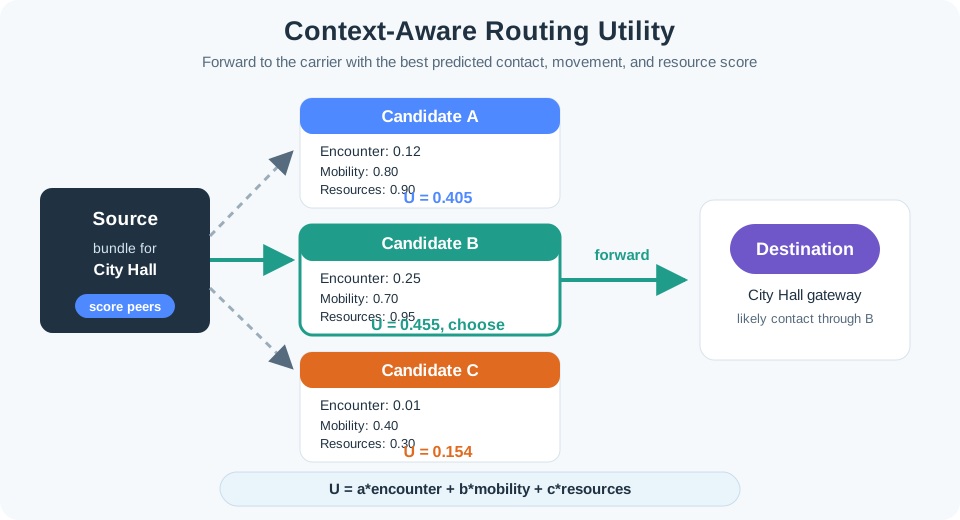
Work through Figure 14.2 from encounter history to the combined utility. Candidate B meets City Hall three times per day, an encounter rate of ; using as the reference rate gives a normalized frequency score of 0.125. The once-weekly rate is , or a normalized score of about 0.006. B's weighted encounter term is ; adding mobility and resources gives $U=0.405$. The pedestrian's rarer contact produces the lower total, 0.334. The source therefore forwards to B because its measured context better supports the destination, not because B is the next contact. This calculation anchors the chapter's caution: coefficients, observation window, and stale encounters must remain in the record, since a precise utility built from weak context is not reliable routing evidence.
This section:
 Checkpoint: Evidence Before Forwarding
You now know:
- Social routing does not forward to every contact; it forwards only when measured evidence says the peer is a better carrier.
- A useful record names the sampling window, decay rule, resource limits, tie-breaker, and privacy boundary behind the score.
- Old contact evidence can drift, so history decay and minimum-evidence rules matter as much as the utility formula.
14.11 Prerequisites
This section: Prerequisites
Before diving into this chapter, you should be familiar with:
- DTN Fundamentals: Understanding store-carry-forward is essential for social routing
- DTN Epidemic Routing: Knowledge of flooding-based routing helps appreciate why social routing is more efficient
- Multi-Hop Fundamentals: Multi-hop concepts provide background for forwarding decisions
- Social Routing: DTN routing exploiting human social patterns (community membership, centrality, contact frequency) for efficient message delivery
- Social Centrality: Node’s position in a social network graph; highly central nodes (hubs) interact with many others and make better message carriers
- Community Detection: Identifying groups of nodes that frequently contact each other; used in bubble routing and community-based routing
- SimBet Routing: Combines social similarity (common contacts) and betweenness centrality to select next-hop carriers
- Bubble Routing: Messages stay in source community until a node with higher global centrality can carry them to the destination community
- Contact History: Past encounter records used to predict future contacts; stored in encounter tables indexed by node ID and time
- Betweenness Centrality: Fraction of shortest paths in the social graph passing through a node; high-betweenness nodes are good message relays
- Homophily: Tendency for people to contact socially similar others; enables community-based routing to outperform random routing
DTN Series:
Background:
- Multi-Hop Fundamentals - Multi-hop communication
- Ad-hoc Fundamentals - Ad-hoc network basics
Learning:
- Simulations Hub - DTN simulators
14.13 Context-Aware Routing
This section: Context-Aware Routing — When node mobility is predictable or observable, smarter forwarding decisions can be made using context information.
When node mobility is predictable or observable, smarter forwarding decisions can be made using context information.
14.13.1 Selection Workflow: Context-Aware Routing (CAR) Concept
Rather than blindly replicating packets, CAR uses utility functions to select best carriers based on:
- Mobility patterns: Where do nodes typically move?
- Colocation history: Which nodes frequently encounter destination?
- Social relationships: Friend networks, interest groups
- Resources: Battery, buffer space
14.13.2 Selection Workflow: Utility Function Design
Basic Utility Function:
Where:
- = Utility of node X for delivering to destination D
- = Probability X will encounter D
- = Mobility score (higher = visits more locations)
- = Battery level, buffer space
- = Weighting parameters
This section:
Checkpoint: CAR Utility
You now know:
- CAR combines colocation probability, mobility, and resources into one reviewable utility score.
- With weights alpha=0.6, beta=0.3, gamma=0.1, the delivery vehicle scores 0.405 while the pedestrian scores 0.334.
- A higher score justifies forwarding only when the rule and improvement threshold are explicit enough to audit.
14.13.3 CAR vs Epidemic Routing
Example Scenario:
Inspect Figure 14.1 and look for the resource cost of the final seven percentage points of delivery in the example trace.
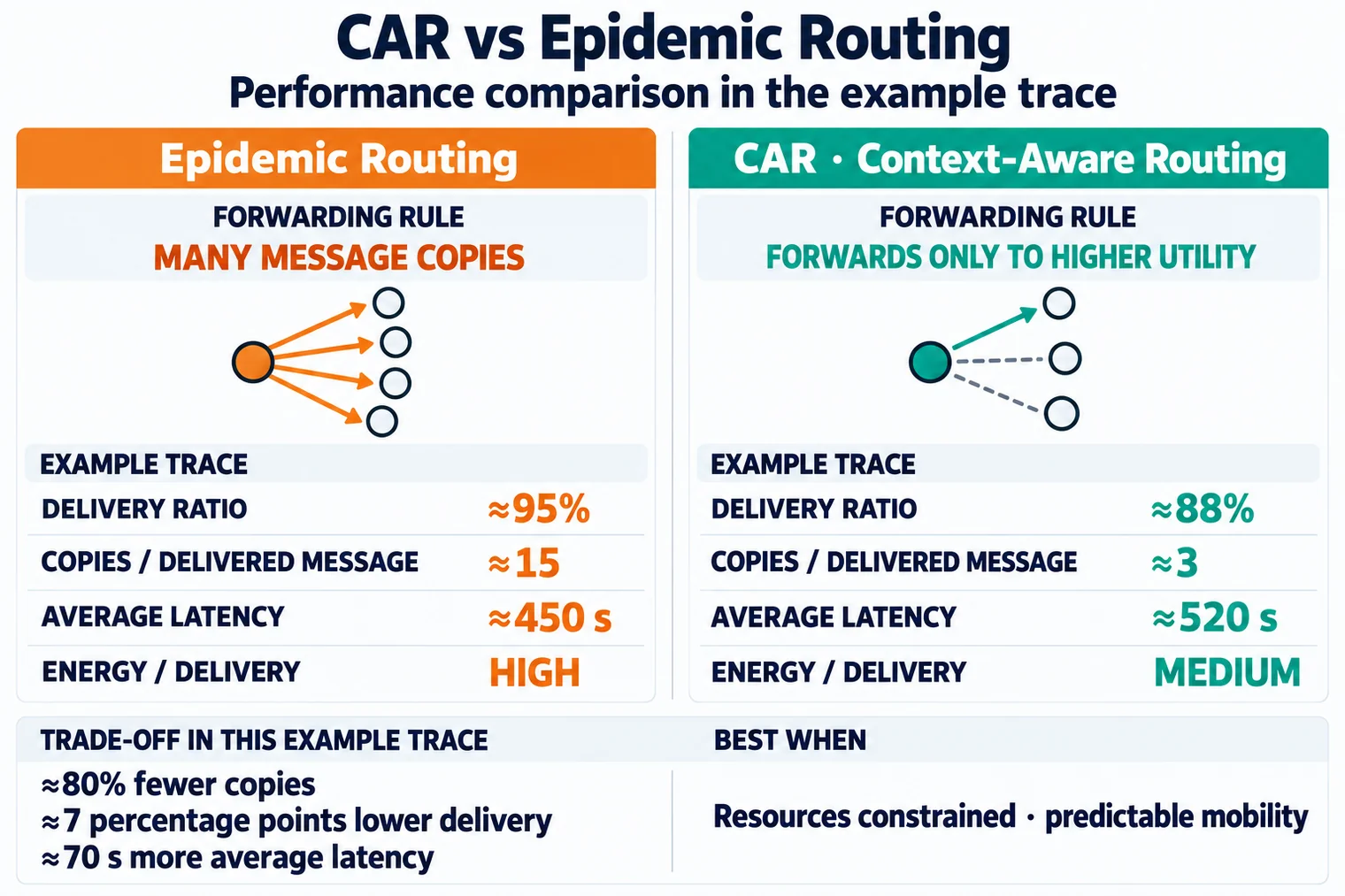
Compare Figure 14.1 by rule, copies, delivery, delay, and energy. Epidemic routing makes about fifteen copies and reaches 95% delivery in this illustrative trace. CAR sends only to a carrier with a higher score. It makes about three copies, reaches 88%, uses less energy, and raises mean delay from 450 to 520 seconds. The copy cut is , or 80%, for a seven-point delivery loss. These are illustrative values, not measured results or fixed promises. Use CAR only when known motion and tight resources justify that loss, then check it against the mission target.
Performance comparison in the example trace:
- Delivery ratio: epidemic reaches about 95%; CAR reaches about 88%.
- Copy overhead: epidemic creates about 15 copies per delivered message; CAR creates about 3.
- Average latency: epidemic is faster in this illustrative trace, about 450 seconds versus 520 seconds.
- Energy per delivery: epidemic is high because many nodes carry copies; CAR is medium because it forwards selectively.
Trade-off:
- CAR: Slightly lower delivery ratio, much lower overhead
- Best when: Resources constrained, predictable mobility
14.14 Continue to the Next Part
This section: Continue to the Next Part — Carry this evidence into DTN Social Routing: Community and Forwarding Decisions, which begins with SocialCast: Social-Based DTN Routing.
Carry this evidence into DTN Social Routing: Community and Forwarding Decisions, which begins with SocialCast: Social-Based DTN Routing.
Find help
3 reviewed answers.
Where should I start in a module?
Open the module page from the sidebar to see its chapters in order. Use the module map to return to a topic you need.
Modules and pathsReviewed
What can I try when a project does not work?
Check the symptom, then work through the diagnostic steps. Keep the error message and the smallest example that reproduces it.
When you are stuckReviewed
How do interactive examples work?
Use the interactive guide to check how examples and simulations work before changing your project.
Interactive examples guideReviewed