17 DTN Applications: Buffers, Contacts, and Field Operations
More
Depth: Practitioner
Progress saves as you read. Mark sections complete as you go; your progress appears in the sidebar.
17.1 Start With the Situation
This section: Start With the Situation — A mission fits delay-tolerant networking, but the device still has finite storage and only brief contact opportunities.
A mission fits delay-tolerant networking, but the device still has finite storage and only brief contact opportunities. The team must turn message rate, retention time, link speed, and encounter duration into a design that does not silently drop evidence.
17.2 Overview
This section: Overview — This route sizes buffers and contact windows, applies the calculations to tracking, and builds a field-ready deployment record.
This route sizes buffers and contact windows, applies the calculations to tracking, and builds a field-ready deployment record.
This is part 2 of 2. Review DTN Applications: Missions and Deployment Patterns when you need the first route.
17.3 Learning Objectives
This section: Learning Objectives
By the end of this chapter, you will be able to:
- size a DTN buffer from message rate and delay
- calculate whether a contact window can clear queued data
- build a tracking deployment record with explicit failure modes
17.4 DTN Buffer Sizing for Tracking
This section: DTN Buffer Sizing for Tracking
17.4.1 Application Buffer Management: Read the Tail, Not the Average
A DTN buffer is shared by locally generated bundles and replicas carried for other nodes. That makes fleet average occupancy a dangerous planning number: socially central carriers see more contacts, receive more replicas, and can overflow while quiet nodes remain almost empty.
A historical SocialCast experiment makes the imbalance concrete. Its buffer-size histogram groups nodes by occupied-buffer band. Read the bars as percentage of nodes in a band, not percentage of total bytes. Approximate values from the published plot are (Costa et al., Fig. 7):
| Occupied-buffer band | SocialCast nodes | No-prediction nodes | Operational reading |
|---|---|---|---|
| 0–5 | about 44% | about 72% | prediction leaves fewer carriers nearly empty |
| 6–10 | about 19% | about 17% | both policies have a substantial low-occupancy group |
| 11–15 | about 15% | about 7% | selected SocialCast carriers begin to carry noticeably more state |
| 16–20 | about 9% | about 3% | the distribution is no longer well represented by its median |
| 21–25 | about 7% | below 1% | a small carrier set bears disproportionate relay pressure |
| 26–30 | about 3% | about 1% | only a few nodes reach the high tail, but those are the first overflow candidates |
| 31–35 | below 1% | approximately 0% | the extreme tail still matters when loss at one central carrier affects many bundles |
These are plot readings, not a universal SocialCast law; buffer units and results depend on the experiment. The durable lesson is the shape. Prediction concentrates useful replicas on nodes expected to meet suitable destinations. That can improve forwarding opportunity while also shifting storage work into a longer tail. “Most nodes are below five” does not protect the carrier in the 26–30 band.
For node , write the instantaneous occupancy as
where is its queued bundle set and is each stored bundle’s size. Capacity is safe only if a chosen high-percentile bound—not merely —stays below usable storage after filesystem, wear-leveling, and reserved-space margins:
If an experiment reports only binned percentages, form the empirical tail by summing bins above a threshold. In the approximate SocialCast bars, roughly one fifth of nodes lie above 15 units, while the no-prediction tail above 15 is only a few percent. That difference tells the designer where to inject overload and eviction tests.
Turn the distribution into policy in four steps:
- Bound replication. Give each bundle a copy budget and decrement it on transfer. High delivery utility is not permission for unlimited copies.
- Set TTL from mission delay. Expire a bundle when its information is no longer actionable. A long TTL raises occupancy approximately with arrival rate by Little’s-law intuition, , even when capacity per contact is unchanged.
- Reserve local evidence. Protect space for the node’s own measurements and control records before accepting relay replicas; otherwise a popular carrier can lose its primary mission data.
- Evict by declared utility. Prefer delivered, expired, duplicated, or low-delivery-probability bundles over unique urgent records. A practical score can combine delivery probability, remaining lifetime, priority, and size, for example
Evict the lowest only after hard rules for safety, custody, and local-data reservation. The weights are product policy, not routing truth, so record them and test sensitivity.
Finally, monitor per-node percentiles, drops by reason, oldest-bundle age, replica count, and bytes accepted/refused during contacts. If the 99th percentile rises while the median stays flat, the routing policy is concentrating pressure. Reduce copy budgets, shorten TTL for low-value data, raise carrier capacity, or deliberately spread replicas before the tail becomes silent data loss.
A fleet mean can look safe while a few social carriers run out of storage. Figure 17.1 puts the median, P90, P99, and an 80% overflow gate on the same occupancy scale.

The median pair in Figure 17.1 is modest at 34 and 29, yet the P99 social-routing bar reaches 96 and crosses the 80% limit. Bounded forwarding pulls that tail to 73, demonstrating why buffer policy must be set from overloaded carriers rather than fleet-average comfort.
17.5 ZebraNet GPS Collar Design
Scenario: A conservation project tracks 50 elephants in Kruger National Park (19,485 km2). Each collar records GPS position, accelerometer activity, and ambient temperature every 5 minutes. Collars exchange data opportunistically when elephants meet at watering holes (average 2 encounters/day, 30-second contact window each). A base station at park headquarters downloads data when collared elephants pass within 500m (average once per 5 days).
Given:
- Sensors per reading: GPS (20 bytes), accelerometer (8 bytes), temperature (2 bytes), timestamp (4 bytes), and collar ID (2 bytes), for 36 bytes total.
- Reading interval: every 5 minutes, or 288 readings/day.
- Data generated per day: 288 x 36 bytes = 10,368 bytes, about 10 kB/day.
- Worst-case base-station gap: 15 days.
- Collar-to-collar contacts: about 2/day, with a 30-second contact window each.
- Radio data rate: 250 Kbps using an 802.15.4-class radio.
- Relay load to budget for: up to 49 other collars x 10 kB/day x 5 days average backlog, or about 2.45 MB before applying forwarding limits.
Step 1: Own data buffer requirement
- Worst case: 15 days without base station contact
- Own data: 15 days x 10 kB/day = 150 kB
Step 2: Relay buffer for forwarding others’ data
- Each collar may carry data from multiple elephants
- Practical limit: carry data from 10 other collars at most
- Relay buffer: 10 collars x 15 days x 10 kB = 1.5 MB
Step 3: Total buffer
- Own data: 150 kB
- Relay data: 1.5 MB
- Protocol overhead (headers, routing tables): ~100 kB
- Total: ~1.75 MB, which fits comfortably in a small flash part.
Step 4: Contact window analysis
- Raw radio ceiling in a 30-second contact: 250 Kbps x 30s = 7,500 Kb = 937 kB, before radio framing
- Typical transfer per contact: own 5-day backlog (50 kB) + relay messages (200 kB) = 250 kB
- Raw-airtime floor: 250 kB × 8 / 250 kbps = 8 seconds; allow setup, frame overhead and retries within the 30-second window.
DTN contact windows limit data transfer during brief encounters. Use the capacity formula :
- Raw radio ceiling: elephants meet for 30 seconds and the radio runs at 250 kbps, so
250,000 x 30 / 8 = 937.5 KBbefore radio framing. - Payload needed: 5 days of own data is
10 KB/day x 5 = 50 KB, plus about200 KBof relay data, for 250 kB total. - Raw-airtime floor:
250 kB × 8 / 250 kbps = 8 seconds, before setup and frame overhead. - Margin: a 30-second contact leaves about 22 seconds for setup, handshakes, and retries.
- Short-contact check: a 10-second contact has a raw 250 kbps ceiling of
250,000 x 10 / 8 = 312.5 kB, but the 250 kB payload needs about 8 seconds of raw transmission plus the calculator’s 5-second setup allowance, so it does not fit this contact.
Step 5: Expected delivery latency
- Average path: Elephant A -> meets Elephant B (day 1-2) -> B visits base station (day 3-5)
- Expected delivery: 3-7 days (acceptable for migration studies)
- 95th percentile: 12 days (worst case: remote elephant, few contacts)
Result: A small flash buffer, an 802.15.4-class radio, and simple DTN forwarding can support delayed data delivery in the assumed contact schedule, with an estimated 3–7 day average latency; measure delivery ratio separately. The communication subsystem stays small relative to the GPS, battery, and enclosure budget, so buffer over-provisioning is usually worth the small hardware cost.
Key Insight: DTN buffer sizing depends on two factors: data generation rate (own data) and network relay load (others’ data). Doubling buffer capacity gives room for longer isolation periods and can reduce drops when queued data exceeds the original capacity.
This section:
 Checkpoint: Buffer Proof
You now know:
- A collar producing about 10 kB/day needs about 150 kB for a 15-day own-data gap.
- Relay storage dominates the budget: 10 other collars over 15 days adds about 1.5 MB before overhead.
- The raw radio ceiling is about 937 kB for a 30-second, 250 Kbps contact; the typical payload is about 250 kB, before setup and radio framing.
This section:
17.6 DTN Contact Window Calculator
This section: DTN Contact Window Calculator — Use this calculator to determine whether enough data can be transferred during a DTN opportunistic contact and estimate buffer requirements for your deployment.
Use this calculator to determine whether enough data can be transferred during a DTN opportunistic contact and estimate buffer requirements for your deployment.
17.7 Application Selection Guide
This section: Application Selection Guide — Delay alone does not select a routing algorithm.
Use DTN When:
- Good DTN fits:
- Wildlife tracking: days to weeks of tolerance.
- Rural health records: hours to days of tolerance.
- Disaster messaging: minutes to hours of tolerance when direct infrastructure is unavailable.
- Environmental monitoring: hours of tolerance for batch data collection.
- Underwater sensing: hours to days for collection by a surfacing node or AUV.
- Vehicular telemetry: minutes to hours for road observations and remote-site backhaul.
- Poor DTN fits:
- Video streaming: millisecond latency and continuous bandwidth are required.
- Real-time control: commands must arrive immediately and predictably.
- Financial transactions: seconds matter and consistency guarantees are strict.
- Voice calls: interactive audio cannot tolerate store-carry-forward delay.
Decision Framework:
Is continuous connectivity available?
├── Yes → Use traditional networking
└── No → Can the payload tolerate bounded delay and local custody?
    ├── No → Invest in infrastructure or satellite
    └── Yes → What contact evidence exists?
        ├── Known future contacts → schedule/contact-plan routing
        ├── No knowledge, small network → epidemic routing with strict limits
        ├── Sparse resources → bounded-copy spray-and-wait
        └── Repeated mobility/context → predictive or social routing
Delay alone does not select a routing algorithm. Epidemic routing buys reachability with copies; spray-and-wait places a hard replication budget on that trade; predictive and social schemes spend encounter history or context to choose better carriers; contact-plan routing uses known future links. The deployment must choose against measured contacts, buffer capacity, energy, delivery deadline, and the cost of duplicate traffic.
17.8 Concept Relationships
This section: Concept Relationships
- Rural connectivity uses scheduled buses or other vehicles as data mules to provide village internet access without continuous backhaul.
- Wildlife tracking uses animal encounters and base-station visits for opportunistic data collection.
- Hybrid architectures combine infrastructure where available with DTN coverage for gaps and fallback.
- Latency tolerance determines whether minutes-to-days delivery delay is acceptable.
- Mobile collectors bridge disconnected network regions through physical transportation.
- Underwater collectors turn AUV visits or surfacing events into bounded opportunities to drain persistent sensor buffers.
- Vehicular carriers use repeated routes and roadside contacts to create paths over time, but cannot safely carry latency-critical driving messages.
17.9 See Also
This section: See Also
Store-carry-forward concepts.
Flooding strategies for high delivery.
Efficient context-aware forwarding.
WSN deployments in harsh environments.
Aerial DTN applications.
Common Pitfalls
This section: Common Pitfalls
DTN applications hold messages in storage until a delivery opportunity. Without analyzing expected buffer requirements (arrival rate × average delay), storage exhaustion causes message drops. Determine buffer requirements from traffic patterns and expected contact intervals before deployment.
DTN’s store-carry-forward provides best-effort delivery, not guaranteed delivery. In extreme partition scenarios with rare contacts, messages may expire before delivery. Applications must define maximum tolerable delay (time-to-live) and design for graceful degradation when messages expire undelivered.
DTN is inherently high-latency. Disaster alerts, medical emergencies, or any time-critical information should not rely on DTN’s potentially multi-hour delivery delay. DTN is appropriate for non-time-sensitive data collection, not real-time alerting. Combine DTN with direct emergency channels for critical alerts.
DTN’s store-carry-forward model means messages traverse many intermediate nodes. Without end-to-end encryption and authentication, intermediate nodes can read or modify messages. Apply DTN security (Bundle Security Protocol) from the start of application design, not as an afterthought.
17.10 Overview: Match Delay to Mission
This section: Overview: Match Delay to Mission — The examples and quizzes identified the fit.
The examples and quizzes identified the fit. The next layer turns that fit into a field rule: name the carrier, bound the delay, and keep time-critical traffic out of the delayed queue.
If you only need the decision rule, this layer is enough: a DTN application is viable when the mission can wait for a carrier, tolerate stale data, and still act usefully when some bundles expire.
The common pattern is not "bad network, use DTN." It is a mission where delay is part of the operating model: a bus reaches a village twice per day, a wildlife collar comes near a gateway during patrol, a UAV returns from survey work, or a spacecraft has scheduled contact windows. The application works only if the data remains valuable when that carrier finally appears.
That means the first design question is about consequence, not protocol. A weather summary, crop advisory, animal track, inspection image, or science observation can often wait if it is timestamped and bounded by an expiry time. An emergency alarm, actuator command, or clinical alert cannot simply be placed in the same delayed queue. DTN is a fit when the delayed path is explicit and the urgent path is kept separate.
A useful overview therefore names the carrier, the maximum acceptable delay, the payload that still has value after that delay, and the traffic that must bypass DTN.
Figure 17.2 shows DTN can bridge a connectivity gap when a mobile carrier can deliver buffered data within the application’s delay budget.
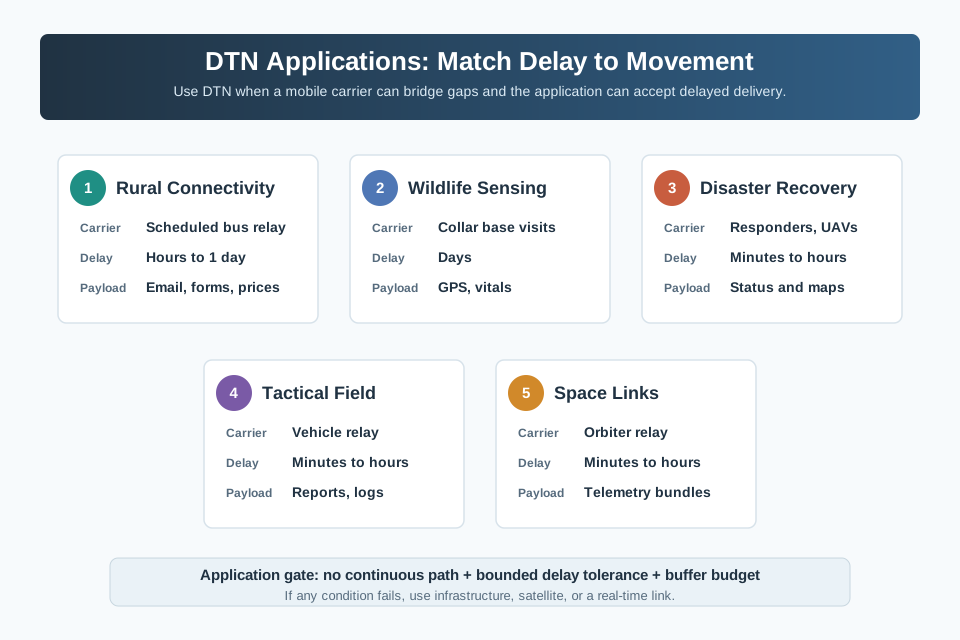
Carrier path
Name the bus, collar, responder, UAV, spacecraft relay, or other mobile system that physically bridges disconnected islands.
Delay budget
State the acceptable delivery window in minutes, hours, or days before choosing a routing pattern.
Payload value
Confirm that delayed delivery is still useful for the farmer query, wildlife record, survey file, or science observation.
17.11 Deployment Record
This section: Deployment Record — A deployable DTN use case needs more than a story about intermittent links.
A deployable DTN use case needs more than a story about intermittent links. Record the movement schedule, storage plan, priority policy, and fallback path so the team can retest the design when conditions change.
Start with a contact budget. For each expected carrier encounter, record the earliest and latest arrival time, expected contact duration, conservative link rate, setup overhead, and the backlog that must move during that window. If a route provides 300 seconds at 80 kbps, the theoretical payload budget is about 3 MB before protocol overhead, retransmissions, and link margin. The deployable budget should be lower than the arithmetic maximum.
Then make the application policy visible. Each bundle class should have a lifetime, priority, maximum local storage share, and behavior when the contact window is shorter than planned. A clinic might send appointment reminders and inventory updates by bus-carried DTN, but reserve cellular, satellite, or radio voice for emergency alerts. A wildlife study might prioritize low-rate collar summaries before large image files so the smallest useful data moves first.
The review artifact should also name the owner of the buffer. A sensor node, handheld gateway, vehicle computer, or base station may be responsible for holding bundles for hours or days. That device needs power budget, storage health monitoring, clock quality for expiry decisions, and a way to report dropped or expired payloads. Without that record, a field failure looks like "the network lost data" even when the real cause was a full flash partition or expired queue.
Contact model
Document expected carrier visits, contact duration, link rate, and worst-case gap between upload opportunities.
Buffer plan
Size local storage for own data, relay data, protocol overhead, retries, and the longest credible isolation period.
Priority rule
Define which messages transfer first, which expire, and which can be dropped when the contact window is shorter than expected.
Fallback boundary
Separate non-urgent DTN traffic from emergency, safety, medical, or control traffic that needs a direct channel.
17.12 Under the Hood: Why Good Fits Still Fail
This section: Under the Hood: Why Good Fits Still Fail — Most DTN application failures are not caused by the store-carry-forward idea itself.
Most DTN application failures are not caused by the store-carry-forward idea itself. They come from weak assumptions about movement, value decay, storage pressure, security, and operational ownership.
Bundle Protocol version 7, standardized in RFC 9171, makes those assumptions concrete by carrying endpoint identifiers, creation time, lifetime, destination, source, and forwarding metadata in a stored bundle. The lifetime field matters because a late bundle can be worse than no bundle: it can update a dashboard with obsolete state or trigger a workflow after the useful window has passed. Application logic should therefore treat expiry as a normal outcome, not an exceptional crash.
Forwarding policy is another failure surface. Scheduled contacts, such as spacecraft ground passes, can use a known contact plan. Opportunistic contacts, such as field vehicles or animal-borne relays, need measured encounter probabilities and conservative replication rules. Epidemic forwarding can improve delivery probability, but it also multiplies buffer pressure and energy use. A production design should state when to replicate, when to keep one copy, and when to delete a stale or low-priority bundle.
Security also changes shape because bundles rest on intermediate carriers. Payload confidentiality and integrity should be designed with Bundle Protocol Security, RFC 9172, or an equivalent end-to-end protection model, not left to the assumption that every relay is trusted. Operators also need audit evidence: which node accepted the bundle, which contact forwarded it, when it expired, and whether any payload was dropped under pressure.
- Movement drift: a bus route, animal migration, patrol pattern, or satellite window can change after deployment.
- Value decay: a payload that was useful after one hour may be useless after one day.
- Storage pressure: relay buffers fill first when every node carries other nodes' backlog.
- Security exposure: bundles spend time at intermediate carriers, so payload protection and custody records matter.
This section:
Checkpoint: Deployment Record
You now know:
- A usable DTN record names the carrier path, delay budget, payload value, buffer plan, priority rule, and fallback boundary.
- Bundle lifetime and expiry are application decisions, not cleanup details, because stale data can be worse than missing data.
- Security must cover stored bundles at intermediate carriers with end-to-end protection and audit evidence.
This section:
17.13 Summary
This section: Summary — DTN routing is useful when a path can exist over time even though it does not exist end to end at one instant.
DTN routing is useful when a path can exist over time even though it does not exist end to end at one instant. The application supplies the delivery deadline and value of late data; the environment supplies scheduled or opportunistic contacts; the routing policy decides how many copies to create and which carrier should hold them; and buffer, energy, expiry, and security policies determine whether that plan survives field conditions.
- Space DTN uses predicted relay and ground-station contacts, persistent storage, and contact-plan routing across long propagation delays and planned outages.
- Rural and remote DTN uses buses, ferries, patrols, or service vehicles to carry non-urgent records between kiosks and connected hubs.
- Wildlife tracking uses animal encounters and sink visits to return low-rate science data while tightly budgeting replicas, flash, and battery.
- Disaster response uses responders, vehicles, and UAVs to move reports through damaged infrastructure, while urgent command and safety traffic stays on a separate path.
- Underwater sensing stores observations across weak acoustic links and drains them during AUV visits, surfacing events, or other brief high-capacity contacts.
- Vehicular opportunistic networking exploits repeated routes and roadside encounters for telemetry and content that can wait, not for collision avoidance or coordinated control.
The routing family is a resource ladder rather than a delay lookup. Epidemic routing maximizes encounter use by replicating widely and therefore consumes the most buffer and airtime. Spray-and-wait bounds the number of copies. Predictive and social routing use encounter history or stable mobility relationships to choose carriers. Contact-plan routing is the natural fit when future links are scheduled. None guarantees delivery: the selected policy must be tested against measured contact traces, finite storage, message lifetime, and the consequences of loss or lateness.
17.14 Further Reading
This section: Further Reading
- RFC 4838: Delay-Tolerant Networking Architecture explains the architectural problem, store-and-forward overlay, custody, and endpoint model. It is foundational background, not the current Bundle Protocol wire specification.
- RFC 9171: Bundle Protocol Version 7 is the current IETF standards-track Bundle Protocol specification; read it for bundle fields, lifetime, fragmentation, and processing rules rather than as a routing-algorithm guide.
- RFC 9172: Bundle Protocol Security defines integrity and confidentiality services for bundles. It does not replace device hardening, key management, or convergence-layer security.
- NASA’s DTN overview connects store-and-forward behavior to space operations, scheduled outages, rate mismatch, and operational adoption.
- Juang et al., Energy-Efficient Computing for Wildlife Tracking: Design Tradeoffs and Early Experiences with ZebraNet is a primary deployment paper on peer-to-peer collars, data homing, energy, and storage tradeoffs.
- Pentland et al., DakNet: Rethinking Connectivity in Developing Nations describes asynchronous rural connectivity using mobile access points; its historical deployment context should not be read as a present-day cost or coverage claim.
- Soares et al., GeoSpray: A Geographic Routing Protocol for Vehicular Delay-Tolerant Networks shows how bounded replication and geographic evidence can be combined for vehicular carriers. It is one evaluated routing design, not a universal VDTN default.
- Kebkal et al., Experimental Results of Delay-Tolerant Networking in Underwater Acoustic Channel reports an underwater DTN implementation over acoustic modems; its test conditions should be checked before transferring results to another sea state, modem, or mission.
17.15 What’s Next
This section: What’s Next
- To learn DTN fundamentals and store-carry-forward, read DTN Store-Carry-Forward.
- To study epidemic routing algorithms, read DTN Epidemic Routing.
- To explore social routing for DTN, read DTN Social Routing.
- To compare with ad hoc routing protocols, read Ad-Hoc Multi-Hop Routing.
- To revisit ad hoc production readiness, read Ad-Hoc Production Readiness.
17.16 Key Takeaway
This section: Key Takeaway — DTN applications should be designed around delayed delivery, local storage, custody decisions, and priority.
DTN applications should be designed around delayed delivery, local storage, custody decisions, and priority. If the mission can tolerate delay, intermittent connectivity becomes a design condition instead of a failure.
Find help
3 reviewed answers.
Where should I start in a module?
Open the module page from the sidebar to see its chapters in order. Use the module map to return to a topic you need.
Modules and pathsReviewed
What can I try when a project does not work?
Check the symptom, then work through the diagnostic steps. Keep the error message and the smallest example that reproduces it.
When you are stuckReviewed
How do interactive examples work?
Use the interactive guide to check how examples and simulations work before changing your project.
Interactive examples guideReviewed