7 DSDV Cost and Scalability
7.1 Start Simple
Start with devices that have to pass useful data before any fixed network is guaranteed. In DSDV Cost and Scalability, the first question is not the protocol name; it is which neighbors, routes, failure signals, and degraded behaviors you would trust in the field.
7.2 Start With the Cost of Being Ready
DSDV’s strength is fast forwarding from a ready route table. Its cost is the work required to keep those routes ready while nodes move, links change, and destinations multiply.
Start by counting what readiness consumes: update airtime, table memory, energy, and convergence time. Evaluation is the act of deciding whether those costs are acceptable for the field pattern you actually have.
7.3 Fast DSDV, Constant Upkeep
Destination-Sequenced Distance Vector (DSDV) is proactive routing. Each node keeps routes ready before an application packet arrives. That can be valuable when devices are awake, topology changes are modest, and messages need to move without waiting for a route-discovery exchange.
The cost is continuous maintenance. Nodes advertise route knowledge, receive neighbor updates, compare sequence numbers, and keep table entries for destinations that may not be used soon. In an IoT ad-hoc network, that maintenance consumes airtime, memory, processing, and battery budget even when application traffic is quiet.
A useful evaluation starts by separating the application benefit from the routing upkeep. If the application is a mobile robot team, a warehouse cart mesh, or a field gateway cluster where peers exchange state frequently, immediate next-hop lookup can remove a visible delay from each transaction. If the application is a sleepy environmental monitor that reports to one gateway every few minutes, most route entries are maintained for flows that rarely happen.
DSDV also has more than one kind of upkeep: scheduled table refreshes, smaller incremental changes, and triggered updates after a route becomes invalid. Each one has to fit the same radio duty-cycle and energy envelope as the sensing workload.
The first-pass decision is therefore not “proactive or reactive” in the abstract. It is whether ready routes will be used often enough, and stale routes removed quickly enough, to justify keeping the routing table alive across every relay. A defensible DSDV fit statement names the traffic pattern, node wake behavior, expected movement or link instability, and the alternative that would be tried if control traffic dominates payload traffic.
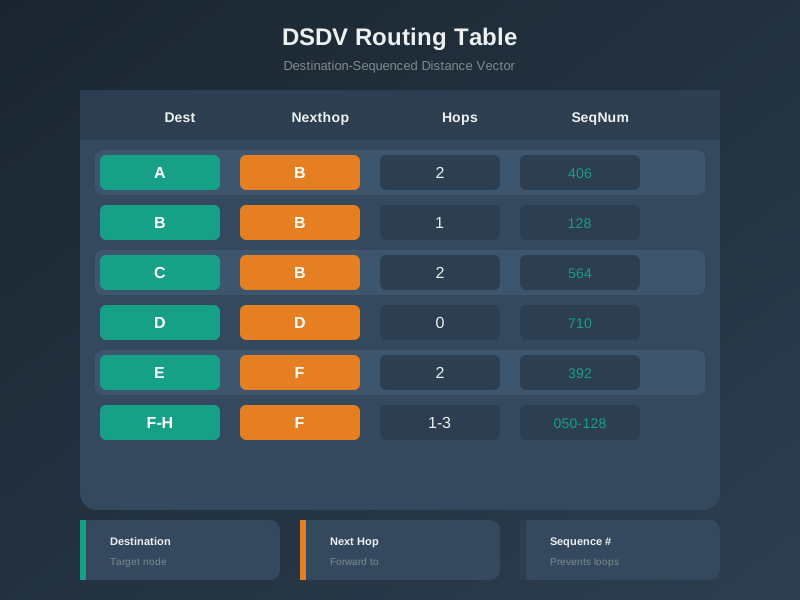
DSDV keeps a table view ready so forwarding can start immediately, but that table has to be maintained across the network.
7.3.1 Good Fit
DSDV is strongest in always-on or frequently awake ad-hoc networks with modest topology churn, frequent peer communication, and applications that benefit from route availability before each message.
7.3.2 Weak Fit
DSDV is usually a weak first choice for duty-cycled sensors, sparse hub-and-spoke telemetry, energy-constrained relays, or networks where route entries are maintained for destinations that are rarely contacted.
7.3.3 Review Trigger
Ask for measured control airtime, update frequency, route-table memory, relay battery impact, and convergence behavior before approving DSDV for field use.
Use DSDV when the value of ready routes is higher than the cost of keeping the whole routing picture fresh. If only a few sleeping sensors talk to one gateway, a proactive table for every destination is usually the wrong shape.
7.4 Practitioner: Build a DSDV Cost Review
A DSDV review should not stop at “routes are ready.” It should prove that the deployed network can afford the upkeep. The review links routing behavior to the real radio, firmware, duty cycle, node memory, relay placement, and traffic pattern.
Make the review comparative. Run the same traffic model against the DSDV candidate and at least one simpler alternative, such as a gateway-oriented tree, a reactive ad-hoc protocol, or a static route set for fixed installations.
Then record the point where DSDV stops being better: update airtime above the payload budget, relay batteries missing their lifetime target, table entries exceeding tested memory headroom, or convergence slower than the application can tolerate.
7.4.1 Evidence Ledger
| Evidence | What to measure | Why it matters | Failure signal |
|---|---|---|---|
| Control airtime | How much radio time route updates and invalidations consume. | Control frames compete with application frames on the same link. | Routing traffic stays high while useful payload traffic is low. |
| Battery and wake cost | How often nodes wake to send, receive, parse, and act on route state. | Listening can cost as much as sending in small wireless devices. | Relay nodes age faster than leaf nodes or miss sleep targets. |
| Table pressure | Route-entry count, memory footprint, and update processing time. | Constrained devices can fail before the protocol fails on paper. | Firmware trims state, drops updates, or resets under load. |
| Convergence behavior | Route repair after a link break, gateway outage, or node movement. | Sequence numbers only help if stale routes are removed quickly enough. | Packets follow old next hops after topology changes. |
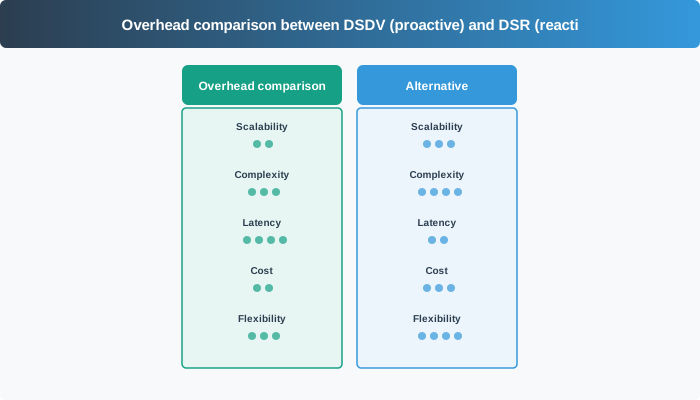
A practical DSDV review treats table size and update churn as deployment costs, not just protocol details.
7.4.2 Review Flow
- Describe the traffic: record who talks to whom, how often, whether traffic is peer-to-peer or gateway-centered, and whether route setup delay matters.
- Measure upkeep: estimate or test control frames, route-table memory, wake time, and processing load with the actual update settings.
- Stress topology changes: break links, move relays, restart gateways, and watch stale-route removal plus convergence behavior.
- Compare alternatives: compare DSDV with reactive, hybrid, tree, or gateway-oriented designs using the same traffic and power assumptions.
7.5 Scaling Fails Through Coupled Costs
DSDV scalability is not a single number. Several costs grow together. More destinations increase table state. More nodes can create more advertisements to hear and process. More topology churn produces more invalidations and triggered updates. More sleeping endpoints make route freshness harder to maintain without spending energy on listening windows.
Sequence numbers are the safety mechanism that keeps stale routes from winning. They let a node prefer fresher information over a shorter but older path. That rule prevents many loop-prone decisions, but it also means the system needs update propagation and route invalidation to work reliably when links change.
The hard scaling edge appears when those mechanisms pull in opposite directions. Longer update intervals save airtime and battery, but they leave more time for a broken next hop to remain attractive. Shorter intervals repair the table faster, but they can crowd out payload traffic on low-rate radios. Triggered updates help after important changes, yet a noisy link can turn them into repeated repair traffic. Incremental updates reduce the size of each advertisement, but nodes still need enough state to decide which entries changed and enough receive time to hear neighbors’ changes.
That coupling is why a DSDV evaluation should include a churn test, not just a steady-state table dump. Remove a relay, lower one link’s packet-delivery ratio, restart a gateway, and watch how sequence numbers, unreachable metrics, and next-hop choices propagate. The pass condition is not instant convergence. The pass condition is that stale forwarding stops before the application violates its latency, loss, safety, or energy budget, and that the control plane returns to a stable update rate after the disturbance.
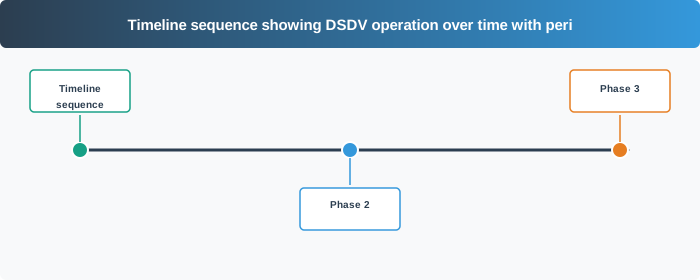
DSDV behavior depends on the timing relationship between route updates, topology changes, and application traffic.
7.5.1 Under-the-Hood Risk Boundaries
| Boundary | Risk to inspect | What a reviewer needs |
|---|---|---|
| Freshness boundary | Sequence numbers must advance and propagate fast enough that old paths do not survive after a real topology change. | Route-table traces before and after a failure, including rejected stale advertisements. |
| State boundary | Every maintained destination consumes memory and processing even when the application never sends to that destination. | Route-entry counts, memory headroom, and update-processing measurements on the actual node class. |
| Energy boundary | A low-power node pays for control traffic by waking, listening, parsing, and sometimes retransmitting updates. | Wake-window measurements and relay battery estimates under representative control traffic. |
| Churn boundary | Mobility, link noise, relay failure, and gateway restart can turn periodic upkeep into repeated repair traffic. | Disturbance tests that measure convergence timing and post-event control stability. |
Do not approve DSDV from table correctness alone. The hard question is whether the control plane stays affordable while still removing stale routes quickly enough for the application.
7.6 Summary
DSDV is useful when route availability matters and the devices can afford proactive maintenance. It becomes risky when sleepy nodes, sparse traffic, large route tables, or frequent topology churn make control traffic more expensive than the delay it avoids.
7.7 Key Takeaway
Evaluate DSDV as a control-plane budget decision: ready routes are valuable only when airtime, battery, memory, and convergence evidence prove the network can afford them.
7.8 See Also
- DSDV Proactive Routing: review the proactive-routing mechanics that create the cost trade-off.
- How DSDV Updates Routes: follow update timing, table changes, and convergence behavior in more detail.
- DSR Reactive Routing: compare DSDV with an on-demand route-discovery approach.
- ZRP Hybrid Zone Routing: contrast proactive table maintenance with zone-limited hybrid discovery.